-
-
MCP ForgeAI,Your API Reimagined for the Agentic Era.
Inspiration
We wanted to eliminate the repetitive work developers face when turning existing APIs into AI-agent-ready integrations. MCP adoption should not require manually designing tools, schemas, authentication, and server code for every API.
What it does
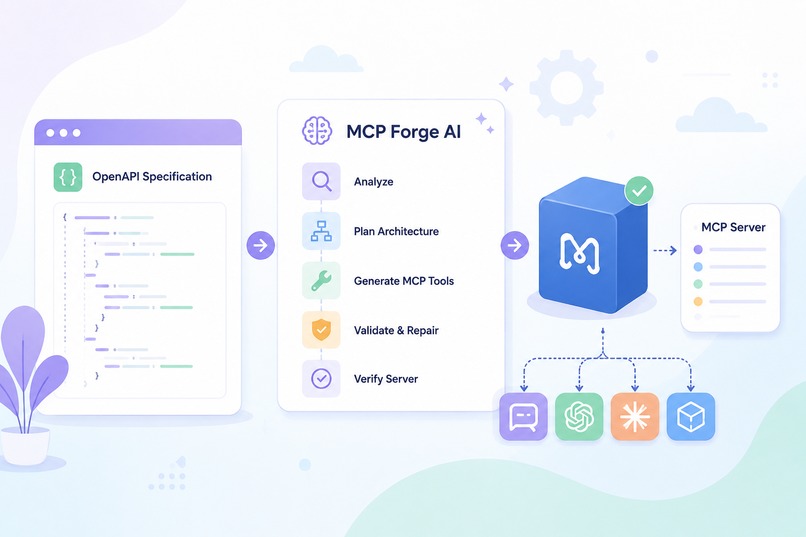
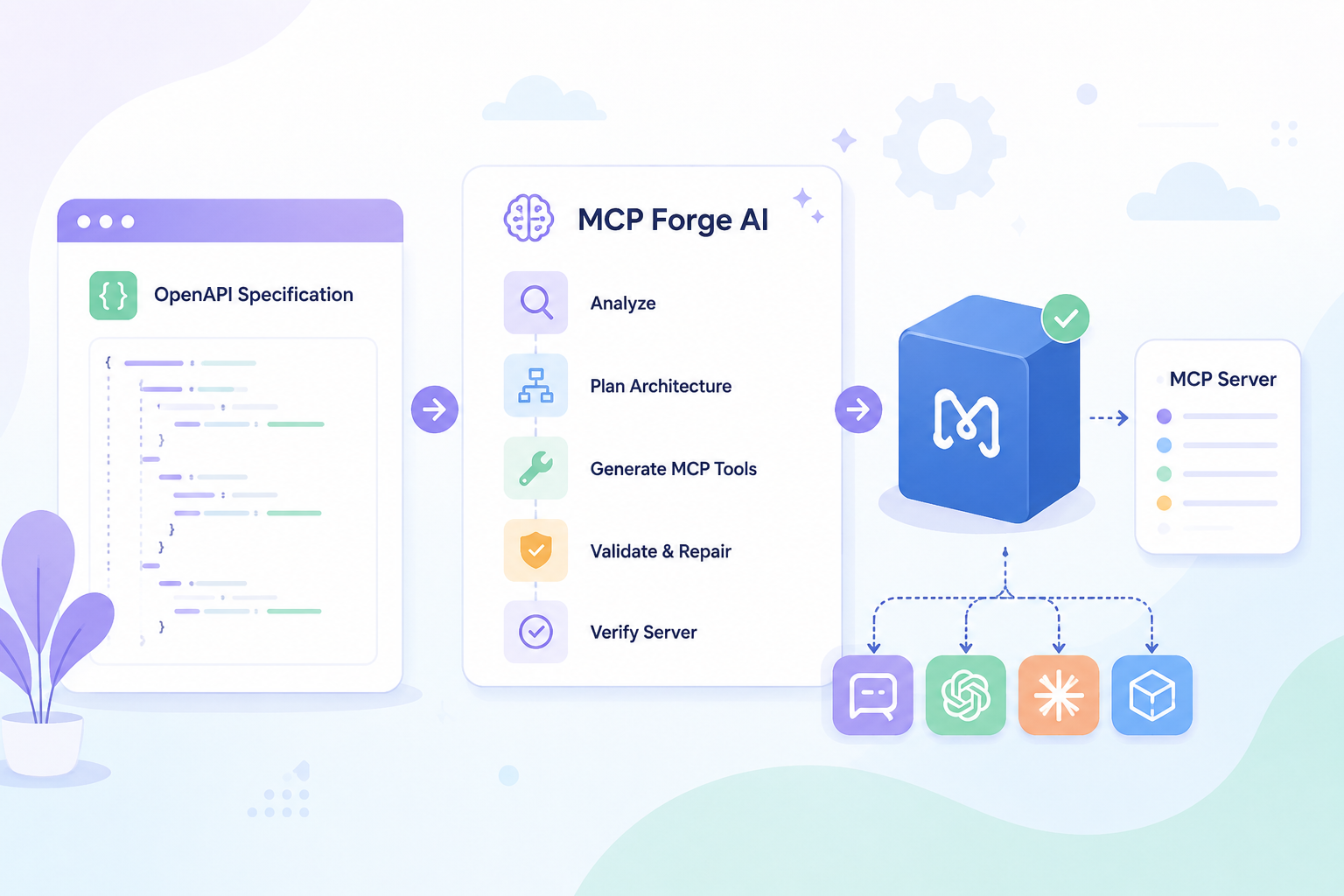
MCP Forge AI converts an OpenAPI specification into a production-ready MCP server automatically. Developers can upload, import, or paste an API specification, after which the system analyzes the API, creates an MCP architecture plan, generates MCP tools, validates the implementation, repairs issues, and verifies the final server.
How we built it
We built a step-by-step developer workflow around an AI-powered MCP generation pipeline. The platform parses OpenAPI endpoints, authentication schemes, resource groups, and data models, then maps them into MCP tools and server components.
The workflow follows:
$$ \text{API Spec} \rightarrow \text{Analysis} \rightarrow \text{Architecture Plan} \rightarrow \text{MCP Generation} \rightarrow \text{Validation} \rightarrow \text{AI Repair} \rightarrow \text{Verification} $$
The frontend provides a SaaS developer workspace for uploading specifications, reviewing the generated architecture, confirming the plan, and monitoring the generation workflow.
Challenges we ran into
The biggest challenge was reliably converting different API structures and authentication schemes into consistent MCP tools while keeping the generated integration production-ready. We also had to design a workflow that gives developers visibility and control instead of treating AI generation as a black box.
Accomplishments that we're proud of
We created an end-to-end workflow that takes developers from API specification → analysis → architecture planning → MCP generation → validation → repair → verification.
The platform automatically identifies API endpoints and transforms them into structured MCP tools, reducing the manual effort required to make APIs agent-ready.
What we learned
We learned that building reliable AI developer tools requires more than generating code. Schema understanding, deterministic architecture decisions, validation, error handling, authentication, and developer control are equally important.
We also learned how to design an AI workflow that makes complex MCP generation understandable and controllable for developers.
What's next for MCP Forge AI - From API to Agent-Ready MCP Automatically.
Next, we plan to expand MCP Forge AI with more API formats, stronger authentication handling, deeper validation and self-repair, reusable MCP templates, deployment options, version management, and integrations with agent platforms such as Freshworks Agent Studio.
Built With
- api
- dotenv
- editor
- events
- execa
- fastify
- get-port
- groq
- js-yaml
- monaco
- next.js
- node.js
- parser
- pino
- pnpm
- react
- server-sent
- shadcn/ui
- swagger
- tailwind
- turborepo
- typescript
- vercel
- zod


Log in or sign up for Devpost to join the conversation.