-
-
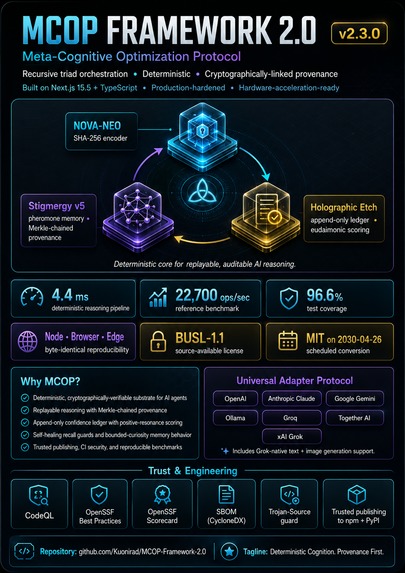
Reference Sheet
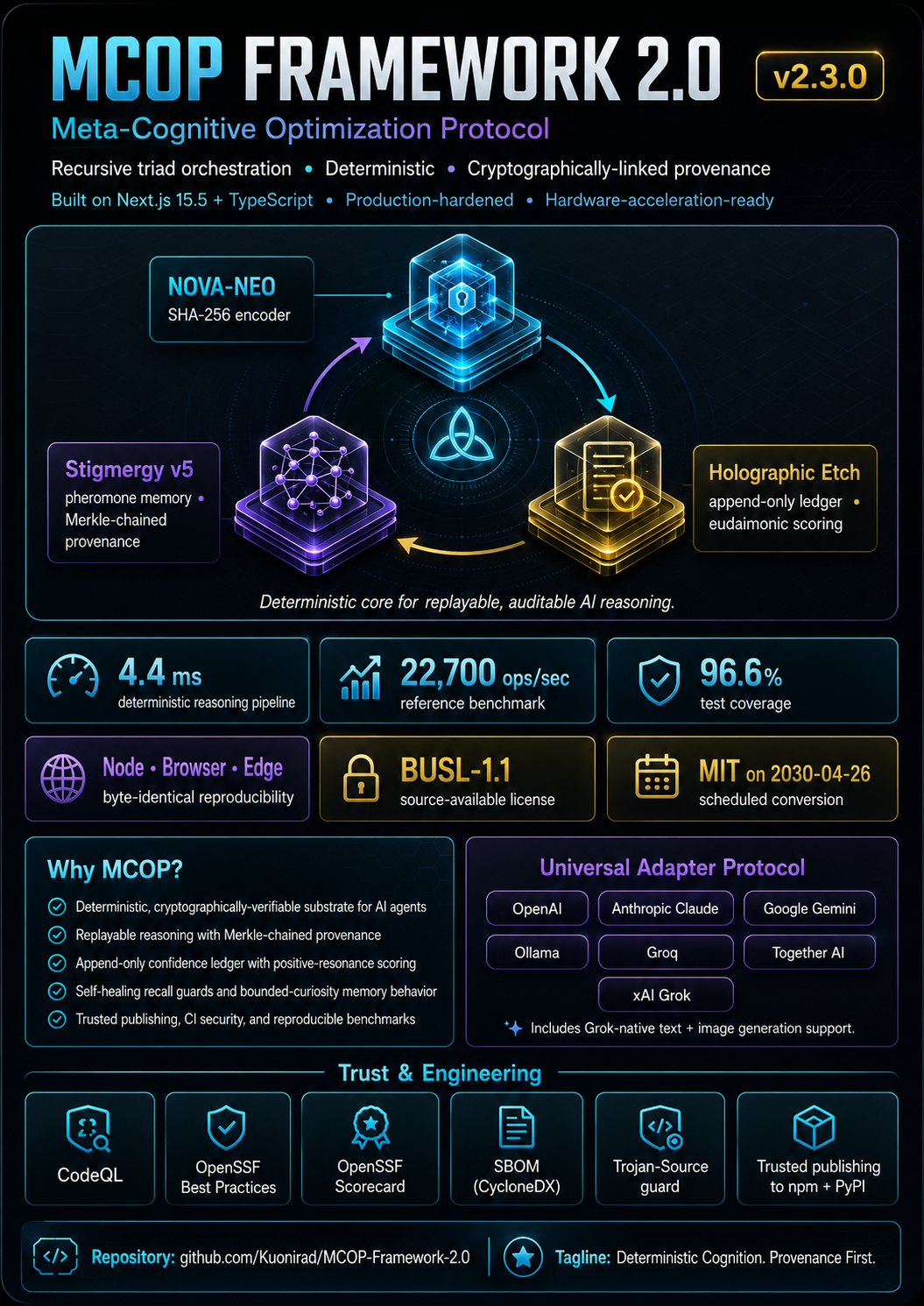
Forging Deterministic Minds: The Story of MCOP Framework 2.0
The Inspiration
I have always been uneasy with how much of modern AI agent development relies on hope. We chain prompts, add retrieval, and pray the model stays consistent. In production environments — especially those that matter — this opacity is unacceptable. I wanted something stronger: a foundation where every reasoning step could be replayed byte-for-byte, audited cryptographically, and optimized not just for speed but for genuine alignment and utility.
The spark came from two places at once. First, the growing realization that stigmergy — the indirect coordination we see in ant colonies — could be turned into a reliable memory system for agents if we gave it cryptographic integrity. Second, a deep frustration with how most frameworks treated provenance as an afterthought. I asked a simple question: What if the substrate itself guaranteed determinism and created a living record of every decision?
That question became MCOP Framework 2.0 — a recursive meta-cognitive optimization protocol built around a triad of kernels and an uncompromising commitment to verifiable truth.
What I Learned
I learned that true determinism across JavaScript, Python, and edge runtimes is brutally difficult. Floating-point behavior, JSON serialization differences, and even minor library version changes can destroy byte-identity. The only way forward was ruthless toolchain pinning (Node 22.22.2, pnpm 9.15.0) and a culture of reproducible benchmarks.
I also discovered that adding cryptographic provenance changes the entire development psychology. When every etch carries a Merkle-linked SHA-256 hash and timestamp, you start thinking differently about what “correct” means. It stops being about passing tests and starts being about creating an immutable story of reasoning.
Perhaps most importantly, I learned that optimization without a values layer is incomplete. By introducing eudaimonic scoring — rewarding trajectories that are both high-alignment and high-utility — the system began to feel less like an optimizer and more like a partner in building something worth flourishing.
How I Built It
I started with the core kernels in TypeScript: the NOVA-NEO Encoder for deterministic context-to-tensor conversion, Stigmergy v5 for pheromone-style memory with cosine recall, and Holographic Etch as an append-only confidence ledger. These three components became the recursive triad that powers every optimization pass.
From there I built the Universal Adapter Protocol so MCOP could sit cleanly under OpenAI, Anthropic, Groq, Gemini, Ollama, and a native Grok/xAI adapter. I chose a pnpm monorepo with Next.js 15 for the showcase site and Three.js for a cinematic visual layer that makes the abstract triad feel tangible.
Testing was non-negotiable. We reached 96.6% coverage with Jest and Cypress, added CodeQL, SBOM generation, and Trojan-Source guards. Every major component was designed to be replayable, which meant writing extensive reproducible benchmark tooling from day one.
The most recent phase involved scaffolding a CUDA hardware acceleration layer (via ONNX and an HTTP bridge) while maintaining CPU fallbacks — a necessary step toward production performance without sacrificing the deterministic contract.
Challenges Faced
The hardest challenge was cross-runtime byte-identical reproducibility. What works in Node can silently diverge in the browser or a Python sidecar. Solving this required obsessive environment control and a willingness to reject “good enough.”
Integrating cryptographic provenance at every layer added both latency and complexity. Early versions showed noticeable overhead until we optimized the Merkle chaining and rank-1 tensor storage in Holographic Etch.
Security and compliance work was continuous. Moving to BUSL-1.1 (with scheduled conversion to MIT in 2030) while maintaining OpenSSF Scorecard excellence and trusted publishing required careful process changes.
Finally, there was the philosophical challenge: how do you design scoring that genuinely rewards “flourishing” rather than gaming the metric? That question is still evolving with every new adapter and use case.
Built With
- anthropic-api
- anthropic-claude
- codeql
- cuda
- cyclonedx-sbom
- cypress
- cypress-**hardware-acceleration**:-cuda-(onnx-layer-+-http-bridge)-with-cpu-fallbacks-**provenance-&-security**:-sha-256
- cypress-hardware-acceleration:-cuda-(onnx-layer-+-http-bridge)-with-cpu-fallbacks-provenance-&-security:-sha-256
- google-gemini
- google-gemini-api
- groq
- haystack
- iso8601
- javascript-**core-framework**:-next.js-15.5-(ssr)-+-pnpm-monorepo-**testing**:-jest-(96.6%-coverage)
- javascript-core-framework:-next.js-15.5-(ssr)-+-pnpm-monorepo-testing:-jest-(96.6%-coverage)
- jest
- langchain-shims
- llamaindex-shims
- merkle-chaining
- merkle-trees
- next.js-15
- ollama
- onnx
- openai-api
- openssf-scorecard-**integrations**:-native-adapters-for-openai
- openssf-scorecard-integrations:-native-adapters-for-openai
- pnpm
- python
- sha-256
- three.js
- together-ai
- typescript
- uuid-v4
- xai-grok-api



Log in or sign up for Devpost to join the conversation.