Inspiration
Every minute, four children under five die in sub-Saharan Africa from pneumonia, diarrhea, malaria, or severe malnutrition. Not because treatment doesn't exist, but because no one recognized the danger sign in time. The WHO built IMCI precisely for this: a validated, step-by-step protocol for triaging sick children. It works. But it lives in clinical training manuals, not on the phone of the 19-year-old sister caring for her baby brother at 11 PM or the young mother whose nearest clinic is an hour away. We are students from Cameroon. We have watched this gap cost lives. MBOA Health exists to close it, one caregiver at a time.
What it does
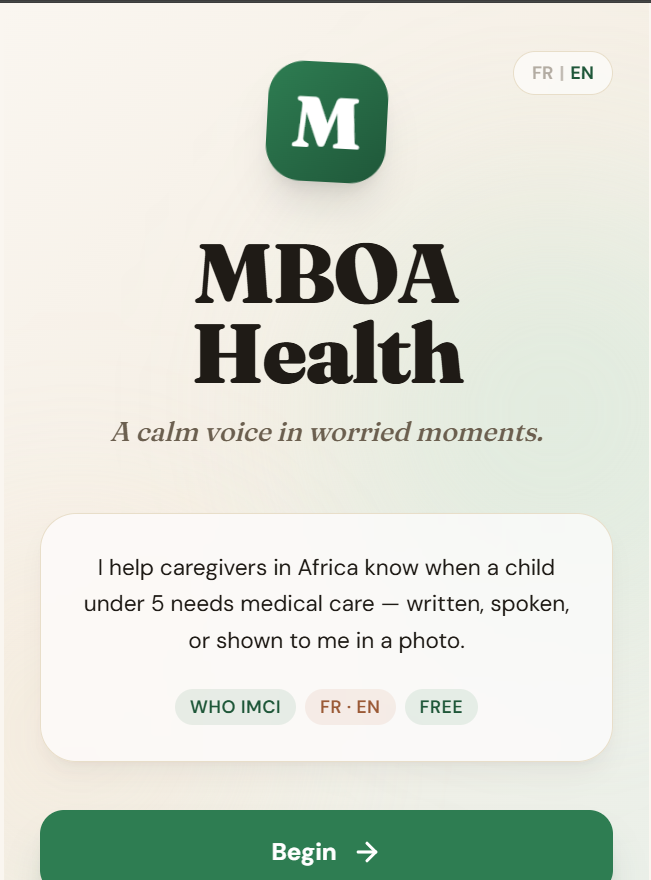
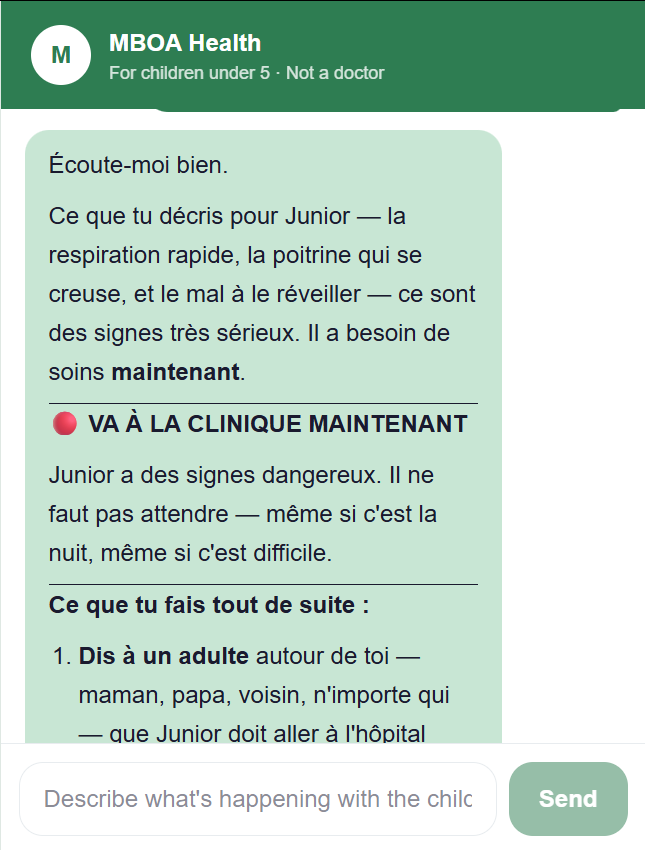
MBOA Health is a bilingual AI companion (English and French) built for caregivers of children under 5, powered by Claude Sonnet 4.6 and grounded entirely in the WHO IMCI clinical framework. A caregiver types, speaks, or photographs what they're seeing: a rash, pale palms, and labored breathing. Claude (not a generic chatbot but a system prompt-constrained IMCI interpreter) asks one careful question at a time and arrives at a clear triage decision: 🟢 Care at home, with specific watch-for guidance 🟡 See a health worker today, within hours, not tomorrow 🔴 Go to a clinic now, with a direct-call button to Rwanda's national health line (114) For urgent cases, MBOA Health makes a second Claude call that re-summarizes the entire conversation into a structured, WhatsApp-ready clinical handoff. No names, no personal data, just the clinical picture a community health worker needs. One tap to copy. One tap to send. Every assessment displays a "Based on WHO IMCI" source link. Caregivers and clinicians can verify exactly what Claude is grounded in.
How we built it
Stack: Next.js 16 (App Router), TypeScript, and Tailwind CSS, deployed on Vercel. The AI layer: Claude Sonnet 4.6. Our system prompt encodes the WHO IMCI decision logic directly. Claude doesn't generate medical opinions. It translates a validated protocol into the caregiver's language, tone, and level of health literacy. The constraint is the feature. Multimodal input: Web Speech API handles voice in both French and English, with text-to-speech for responses. Anthropic's vision API lets Claude actually analyze uploaded photos (a rash, a child's breathing pattern, pale palms) and incorporate what it sees into the triage. The CHW handoff: A separate Claude call converts the full conversation into a structured WhatsApp message: no names, just clinical detail. This is not a chat export. It is a purpose-built clinical artifact. Privacy architecture: No accounts. No database. No analytics. Conversations live only in browser memory and are gone when the tab closes. We never ask for the child's name. In an emergency, that question wastes seconds we don't have and creates data we shouldn't keep.
Challenges we ran into
Conservative triage vs. false-alarm fatigue. Every "when uncertain, escalate" decision in our system prompt was a deliberate tradeoff. We chose to always lean urgently. A false alarm is recoverable. A missed danger sign is not. Camfranglais. Caregivers in Francophone Africa don't write clean academic French. They write in fragments, in Camfranglais, the fluid mix of French, English, and Cameroonian pidgin that's the actual daily language of millions. Standard language detection fails here. Claude didn't. It understood every variation we threw at it, fragmented, code-switched, and worried bursts, without us having to force-detect a language first. Holding scope. Mid-hackathon, we almost widened to general health questions. We pushed back hard. IMCI only works for under-5s. Specificity is credibility. We held the line. A subtle security bug. The Web Speech API requires a secure context. Accessing the dev server over a local network IP instead of localhost silently broke microphone access for hours. Catching it required understanding browser security policies at a level most teams don't go near.
Accomplishments that we're proud of
Honest scope, publicly. We tested rigorously in English and French. We did not claim Kinyarwanda support because browser speech APIs don't yet reliably handle it. Most hackathon teams overclaim. We chose to underpromise and overdeliver, and we say so explicitly in the app. Agentic output. MBOA Health doesn't just chat. It produces a real artifact that enters the real world. The WhatsApp handoff moves clinical information from a worried caregiver to a trained health worker in one tap. That's Claude acting, not just responding. Privacy by architecture, not policy. We don't have a privacy policy because we have nothing to be private about. No names. No accounts. No storage. The data we don't collect cannot be breached, subpoenaed, or misused. Visible grounding. Every triage result links directly to the WHO IMCI source. This is not a black box telling a scared parent what to do. It's a transparent interpreter of a protocol clinicians already trust.
What we learned
Claude is unusually good at meeting users where they actually are. Not where documentation assumes they are. Caregivers don't write in clean French. They write in fragments, in mixed languages, in panicked bursts at midnight. Claude understood all of it. That's not a small thing. That's the entire product working as intended for the people it was built for. We also learned that constraint is a design tool. Limiting Claude strictly to IMCI, refusing to let it answer general health questions, made it more trustworthy, not less useful.
What's next for Mboa-Health
Immediate: Kinyarwanda voice support as browser speech APIs improve for low-resource African languages. V2: Postnatal care for the 0 to 28 day window, the highest-mortality period of a child's life, deliberately scoped out of v1 to ship something rigorous rather than something wide. Infrastructure: Offline-first SMS fallback via Africa's Talking for caregivers in low-connectivity areas, because the caregiver who needs MBOA Health most is often the one with the worst signal. Real-world integration: Formal partnership with Rwanda's Ministry of Health to route CHW handoffs to verified, mapped community health workers, turning a WhatsApp message into a dispatched response.
Built With
- claudeapi
- css
- node.js
- typescript
- vercel

Log in or sign up for Devpost to join the conversation.