-

Poster
Title
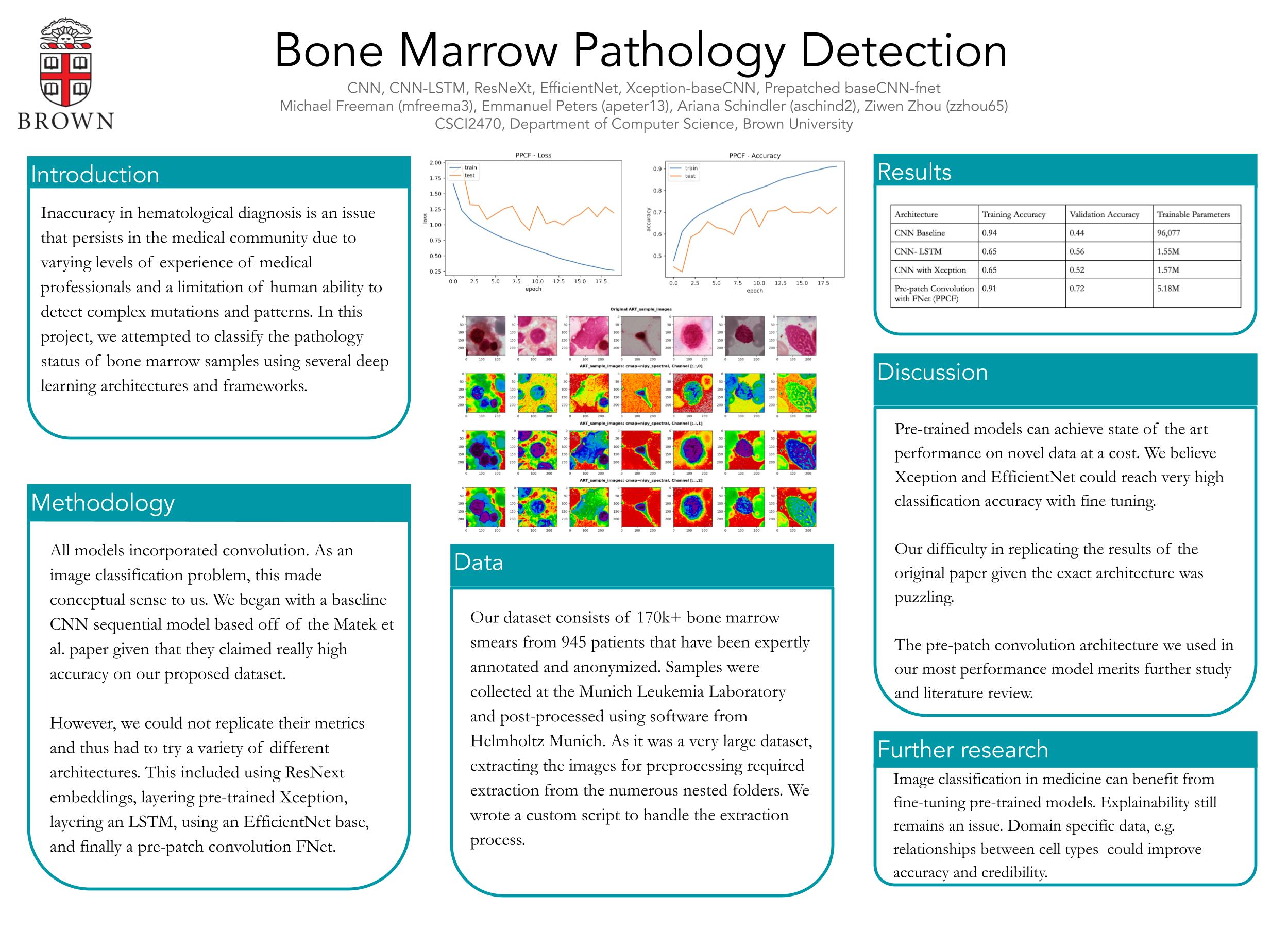
Bone Marrow Pathology Detection
Who
Ariana Schindler (aschind2), Michael Freeman (mfreema3), Emmanuel Peters (apeter13), Ziwen Zhou (zzhou65)
Introduction
We are attempting to classify the pathology status of bone marrow slides. We have over 170k samples available to us, that come from healthy patients as well as those with various pathologies. All of us in the group have a rooting interest in science & medicine, and the member of the group who proposed the idea recognized that current bone marrow analysis is often done manually and subject to human errors. It's also known to be quite a difficult and subtle task, so we propose that a deep learning approach can either prove superior to human results or illuminate the path toward other automated approaches. As defined, this is a classification problem, but unsupervised learning approaches could be integrated (perhaps some type of feature detection and grouping to see if any interesting patterns arise).
Related Work
We did not notice any meaningful work done with the dataset we found (it's quite a new dataset, which is exciting). We did draw some inspiration from work done upon a similar dataset (although it was a more restricted set that was classifying solely leukemia status). It can be found here: https://www.kaggle.com/datasets/sebastianriechert/bone-marrow-slides-for-leukemia-prediction. There are no public implementations of the specific task we are trying to accomplish, and not for this dataset. However, there is an interesting technique implemented here: https://github.com/cvdfoundation/google-landmark for a landmark classification task that we think would be very interesting.
While doing preliminary research, we came across this article from Nature: https://www.nature.com/articles/s41598-020-58467-9. In this article, they are discussing training CNNs and RNNs on biopsied samples of the stomach and colon in order to better classify epithelial tumors. In this study, they worked to classify by tumor type as well as stage. They were able to achieve area under curves (AUCs) up to >0.97 for certain tumor types, which is very impressive. The article shows high generalization ability, and demonstrates the potential to use such a model in a diagnostic workflow system for pathologists.
Reading this article informed us that AUCs of that number were possible and might be incorporated into a reach goal. It should be noted that this study worked exclusively with diseased samples of a completely different cell type.
Midway through the project, we realized that there is a new project that is using this dataset. They reached high precision recall metrics with a large CNN. As a 1470/2470 group, we were not allowed to replicate the paper as our project (even though we did do it for verification purposes), and instead chose to test a variety of different architectures and frameworks. [
Public Implementations ("Living List"):
Data
We are using the following dataset: https://www.kaggle.com/datasets/andrewmvd/bone-marrow-cell-classification. As taken from the corpus description, this dataset consists of 170k+ anonymized bone marrow smears from 945 patients that have been expertly annotated. Samples were collected at the Munich Leukemia Laboratory and post-processed using software from Helmholtz Munich. As it's 170k samples, we expect to do significant preprocessing on it (especially because they only arise for 945 patients, we need to ensure we're not introducing bias from sample selection).
Methodology
This is the least fleshed out section, as we are are 1470 Capstone/2470 students trying to implement our own project. We think that starting with CNNs and RNNs first is appropriate. They were the models use in the Nature project of study, and are the classic techniques we've studied in class for classification tasks. We are currently working on preprocessing first, but will refine our methodology summary as we attempt to create CNNs and RNNs and gauge their success. We can have Multilayer perceptrons, KNNs, and SVMs in our back pocket if our initial approaches do not prove promising.
Metrics
As our general task is a classification one, accuracy is our primary metric. We intend to partition 10-15,000 of our samples in the dataset to treat as a testing set and another 10-15,000 samples as a validation set. AUC is a possible metric we can use, but a more familiar form of accuracy metric is also plausible.
In terms of base, target, and stretch goals, we've largely been considering accuracy/AUC cutoffs. For base, it would be nice to see accuracy >0.7; for our target, we would like to see accuracy >0.85; and for our stretch we would ideally like to see accuracy >0.95. Somewhere within our target and stretch goals, we would also like to incorporate feature detection and unsupervised learning as a secondary portion of our project.
Ethics
Who are the major “stakeholders” in this problem, and what are the consequences of mistakes made by your algorithm? The major stakeholders of our bone marrow pathology project would be pathologists responsible for classifying bone marrow patients as well as their patients. Mistakes made by the algorithm would primarily be felt by the patients, who could proceed with an inaccurate diagnosis. We are much more concerned about Type II errors (false-negatives), which could delay lifesaving treatment. Type I errors (false-positives) are not ideal, but less deleterious.
Why is Deep Learning a good approach to this problem? Bone marrow smear pathology detection is a very difficult task that when performed by humans relies on various heuristics. It can be error-prone, so we expect a deep learning approach to be able to learn the existing heuristics as well as see more high-level patterns that will enable more accurate classification. With the ability of deep learning to detect complex patterns in pathology samples comes the ethical responsibility of considering explainability. The use of deep learning for pathology detection arose out of a need to examine differences in cells at a more granular level than is achievable with the human eye and magnification. Because of this, it may be difficult to explain to patients and doctors alike exactly where the network detected an irregularity in a diagnosis, what the irregularity was, and the severity of cell mutation. To increase confidence in the network’s ability to accurately diagnose, the network should be trained on sufficiently large data.
Division of Labor
We want everyone in our group to be involved in some capacity in each part of the project. However, we have assigned preliminary leaders for each section of our projected breakdown.
Preprocessing: Emmanuel
EDA: Ariana
CNN Training: Michael
RNN Training: Ziwen
Google Landmark: Emmanuel
Final Division of Labor
Preprocessing and Data Augmentation: All
Ariana:
EDA
Final formatting for the reflection
Presentation & Report
All: Baseline CNN
Model Architectures -
Ziwen:
baseCNN + RNN
baseCNN + LSTM
Emmanuel:
baseCNN + Xception
EfficientNet
baseCNN + concatenated with MRCNN masks
ResNet embeddings to baseCNN
Michael:
Pre-patched Convolutional Network with FNET
Custom CNNs
Reflection 11/30
Final Writeup/Reflection:
Github Repo:
Video:
https://drive.google.com/file/d/15BF-REv9ds3_0ZzT53buFhvjmtOFtjb3/view?usp=sharing
Built With
- keras
- python

Log in or sign up for Devpost to join the conversation.