-
-
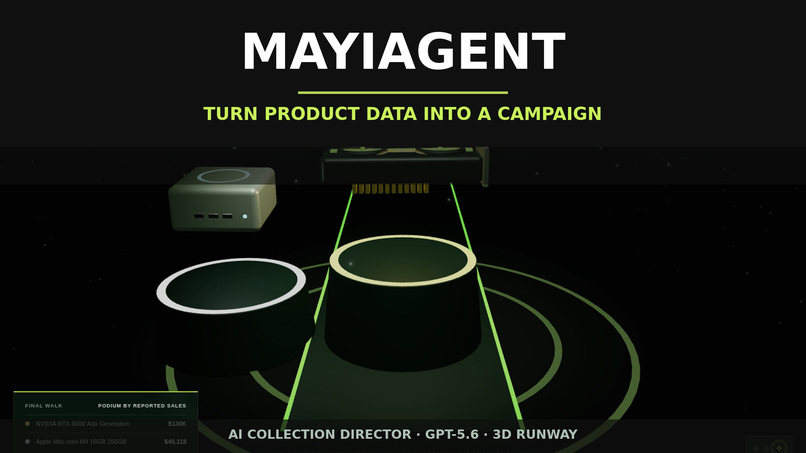
mayiagent - turn data into campaign
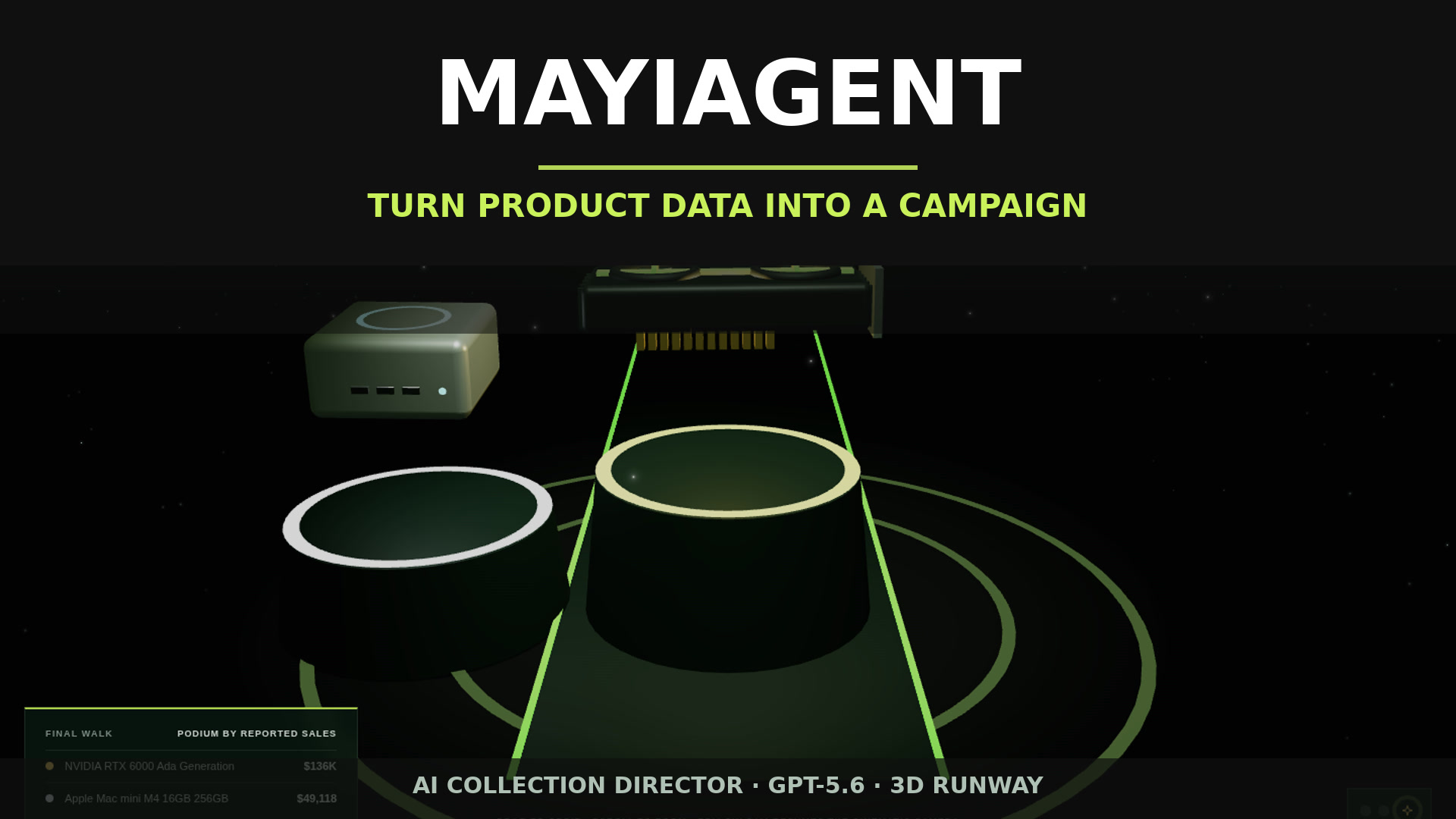
Project name
MayIAgent
Tagline
Turn product-performance data into an AI-directed 3D campaign.
Category
Work & Productivity
MayIAgent is a productivity tool for ecommerce and marketing teams. It turns a spreadsheet of product results into an understandable campaign direction, concrete experiments, and a shareable action plan.
Short project description
MayIAgent is an AI collection director for ecommerce and marketing teams. A user uploads aggregate product-performance data, and GPT-5.6 turns the evidence into product roles, campaign angles, and concrete next actions. The result is presented as an interactive 3D runway, with evidence cards, a collection finale, country-specific seller discovery, local SQLite history, and an exportable Markdown action plan. The application uses the authenticated Codex CLI, so the local demo does not require an OpenAI Platform API key.
Full project description
Product-performance spreadsheets contain views, clicks, orders, and sales, but they rarely tell a marketing team what campaign to run next. MayIAgent turns that data into a campaign people can see, understand, and act on.
The user uploads a CSV or opens the included synthetic demo collection. MayIAgent validates the file in the browser, removes known customer and payment fields, deduplicates rows, and creates a privacy-filtered product summary. The raw CSV is never written to the database.
For new evidence, MayIAgent sends the normalized product summary and deterministic performance signals to GPT-5.6 through an authenticated local Codex CLI session. GPT-5.6 returns schema-constrained structured output containing a collection title, a campaign thesis, a role for every product, evidence-backed insights, campaign angles, next actions, and a finale. Roles include star, traffic magnet, hidden gem, breakout, rescue mission, and steady performer.
The direction becomes an interactive Three.js runway instead of another static dashboard. Users can select every product, inspect the reported evidence behind its role, navigate with keyboard shortcuts, jump to an organized all-product finale, and export the complete strategy as a Markdown action plan.
MayIAgent can also open a flat interactive world map for a selected product. A separate user-triggered Codex web search finds up to five exact local seller pages for a requested country. Results show their source, observed availability, price when exposed, confidence, and shipping notes without claiming that any seller is the best or cheapest.
Normalized collections, successful GPT directions, accepted product links, and country-search results are cached in local SQLite. Reopening the same collection or repeating a recent product-country search is immediate. SQLite is initialized automatically; no separate database installation or configuration file is required.
If Codex is unavailable, unauthenticated, times out, or returns invalid output, MayIAgent remains usable with a clearly labeled deterministic fallback computed from the same reported metrics. The runway, evidence cards, finale, and action-plan export still work.
How Codex accelerated the workflow
Codex was the primary development environment for MayIAgent. It helped turn an early website-audit experiment into a more original, focused product for marketing teams. Codex accelerated:
- product framing and the decision to build an AI collection director;
- the browser-safe CSV importer, privacy filtering, validation, deduplication, and aggregation;
- the structured direction contract and JSON Schemas;
- deterministic analysis and graceful failure behavior;
- local SQLite history, evidence fingerprinting, and cache reuse;
- the React and Three.js runway, product models, finale, map, and keyboard controls;
- safe public product-page media extraction and seller-link normalization;
- the downloadable action-plan generator;
- automated tests, type checking, linting, production builds, and visual smoke testing;
- iterative debugging from real screenshots and product-owner feedback.
Codex made it possible to explore, implement, test, and repeatedly reshape the complete idea within the hackathon timeline instead of treating AI as a final code-completion step.
How GPT-5.6 is used in the product
MayIAgent explicitly runs gpt-5.6-sol through codex exec using the user's authenticated Codex CLI session. No OpenAI Platform API key is required.
GPT-5.6 receives only the normalized product summary, deterministic signals, and per-period metrics. It creates the collection narrative, product roles, evidence-backed insights, campaign angles, next actions, and finale. Its output must pass the committed JSON Schema before it reaches the interface. Product IDs are preserved, copy length is bounded, and any missing or invalid product direction is replaced with deterministic analysis.
A second, user-triggered GPT-5.6/Codex web-search workflow handles country-specific seller discovery. It is constrained to exact public HTTPS product pages and cannot purchase, submit forms, select a best seller, or convert uncertain search-result pages into purchase links.
Key product and technical decisions
- Evidence stays visible. Creative campaign roles are always paired with the reported metrics that support them.
- The product does not predict sales, claim causation, or present uploaded figures as independently verified.
- Raw CSV data stays in the browser. Only privacy-filtered summaries are stored locally.
- Structured GPT output is validated before rendering.
- A deterministic fallback keeps the experience functional when Codex cannot run.
- Identical evidence reuses a saved GPT direction instead of spending time generating it again.
- Product-country searches are cached for seven days but retain timestamps and freshness warnings.
- Linked product images are treated as supporting media, with safe procedural models as the fallback.
- Seller discovery is the single purchase path, and MayIAgent never calls a seller the best or cheapest.
- The 3D experience communicates hierarchy and campaign roles while the evidence card preserves practical detail.

Log in or sign up for Devpost to join the conversation.