-
-
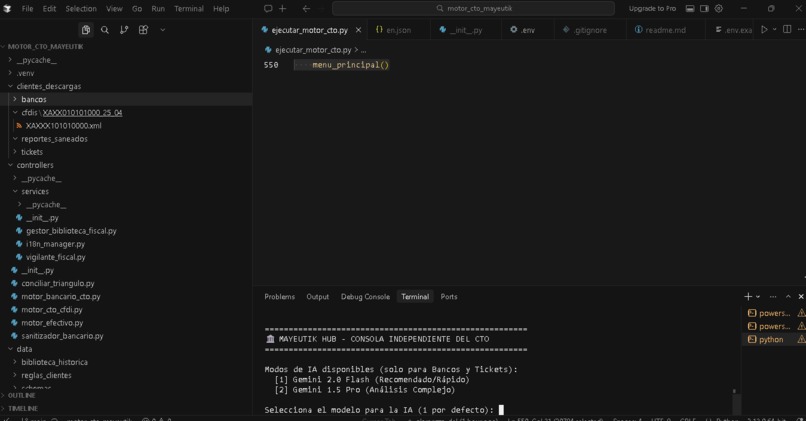
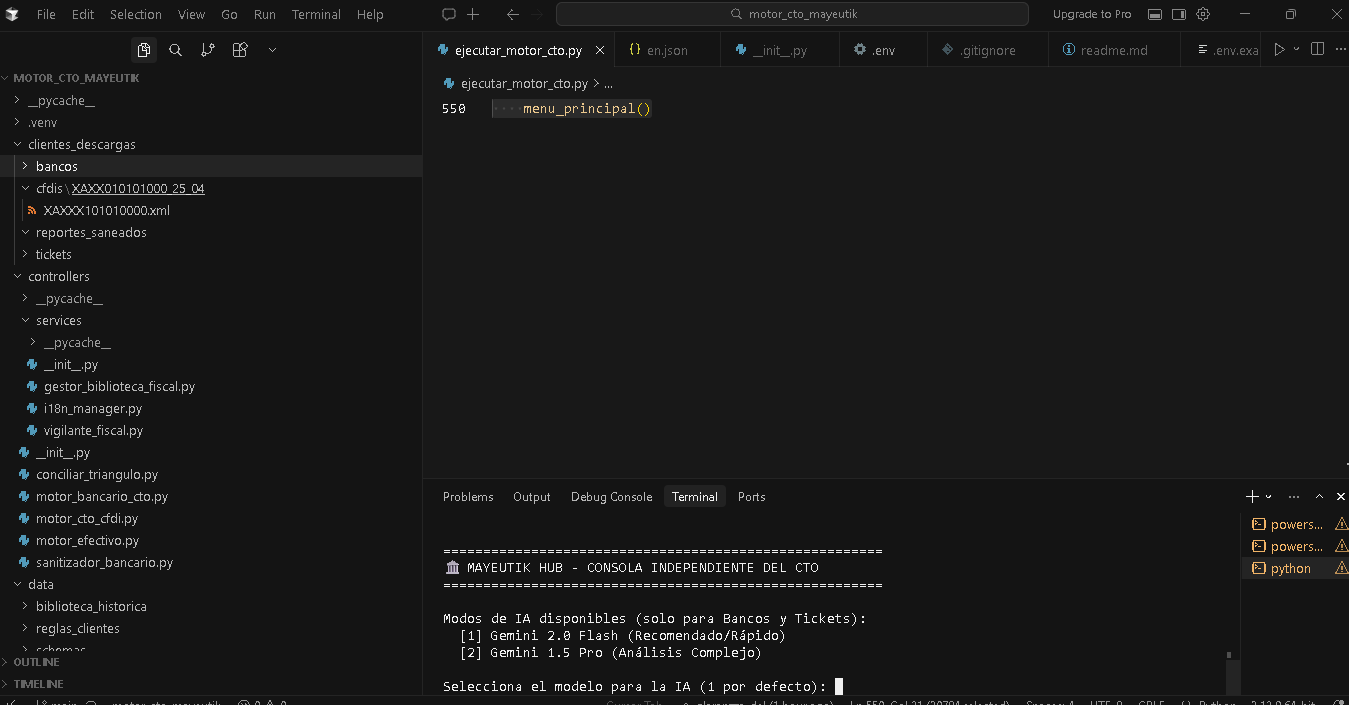
El arranque de la consola maestra ejecutar_motor_cto.py y la selección de los modelos Gemini 2.0 Flash / Gemini 1.5 Pro[cite: 1, 4]
-
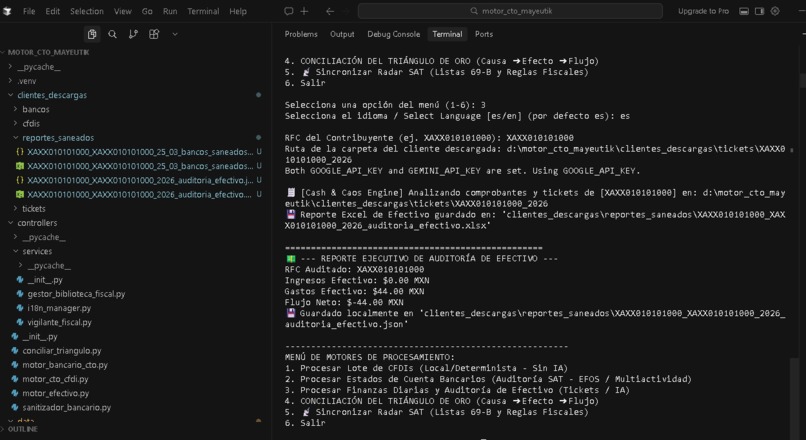
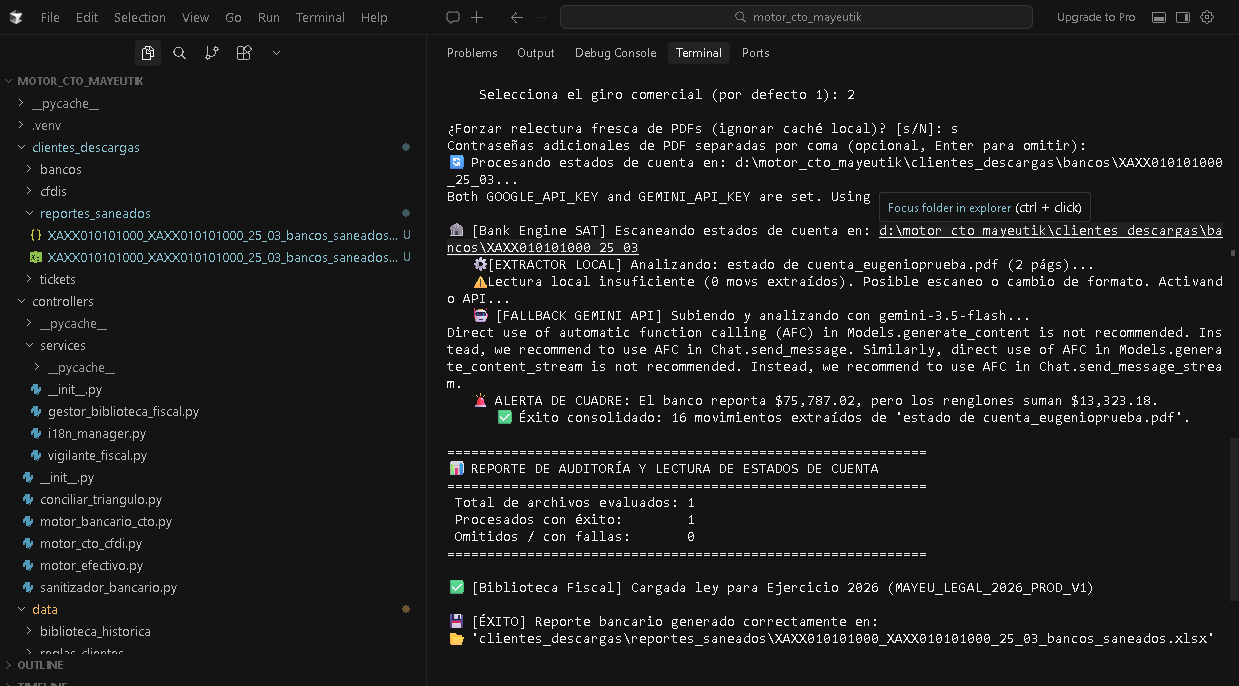
la lectura local determinista detecta insuficiencia en el PDF y activa la API de Gemini, evaluando la alerta de cuadre
-
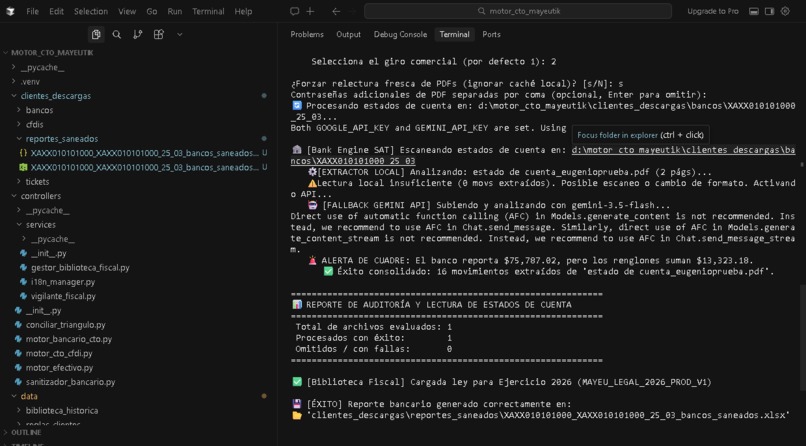
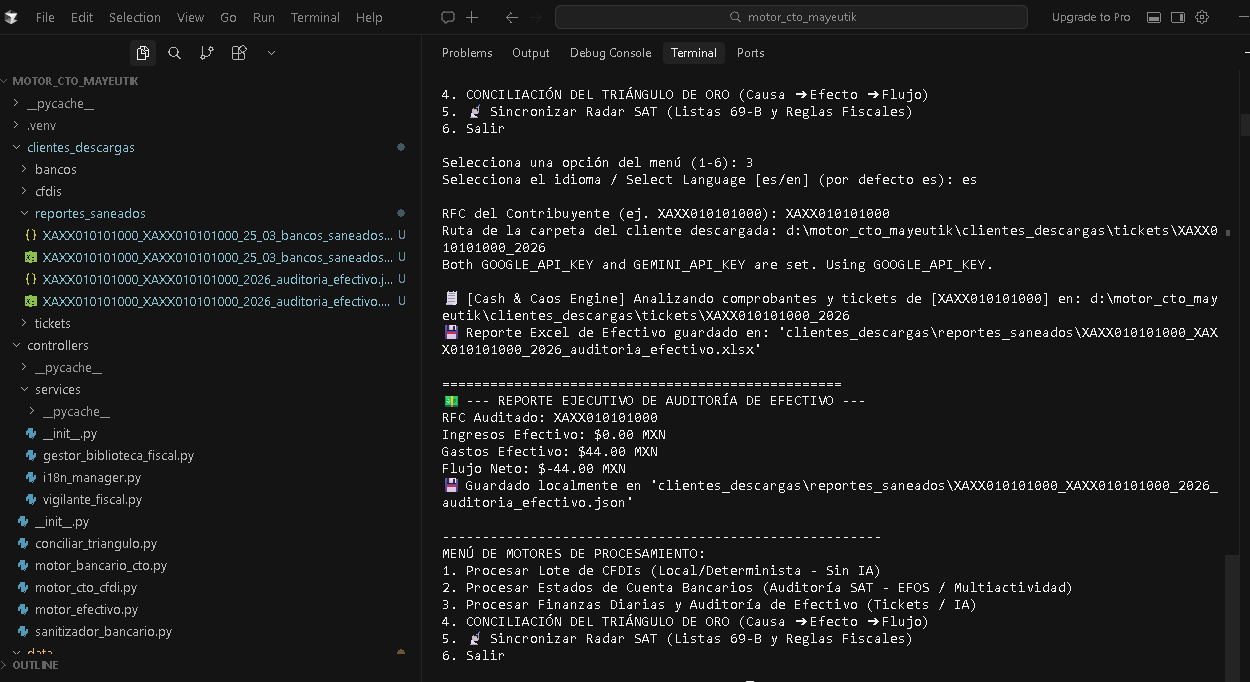
El procesamiento forense de efectivo y comprobantes diarios (Opción 3), exportando el Excel y el archivo .json saneado
-
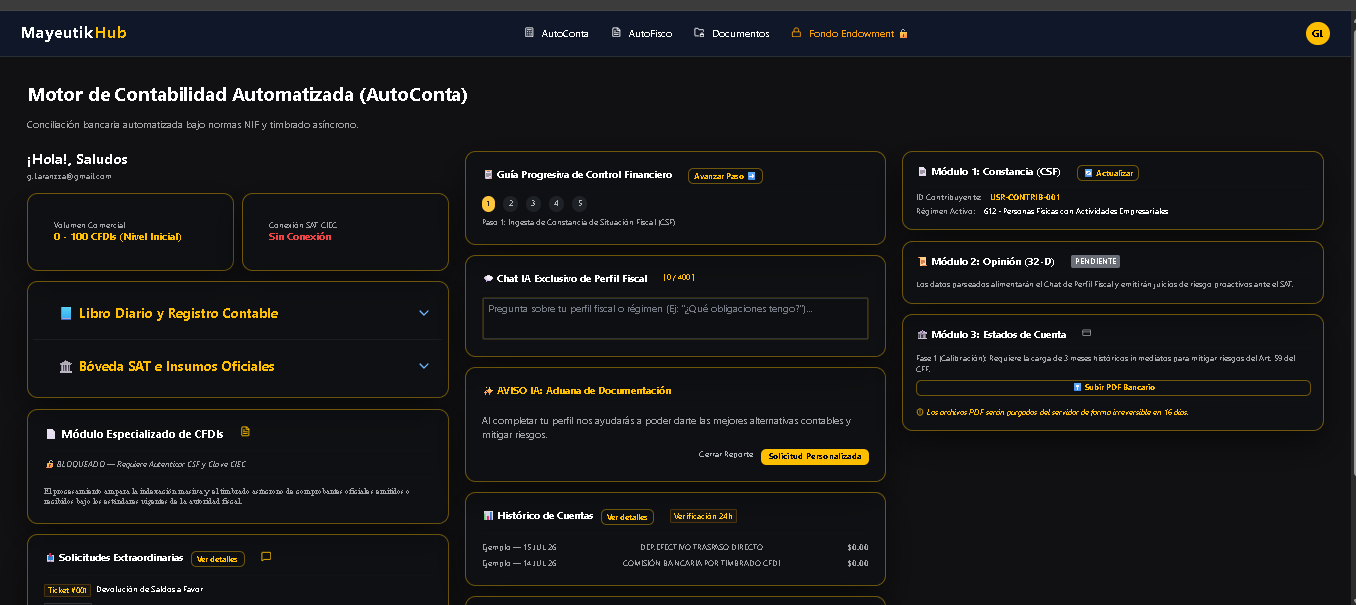
The future of Mayeutik Hub is the web access platform (Reflex UI) that connects taxpayers with the autonomous forensic engine.
-
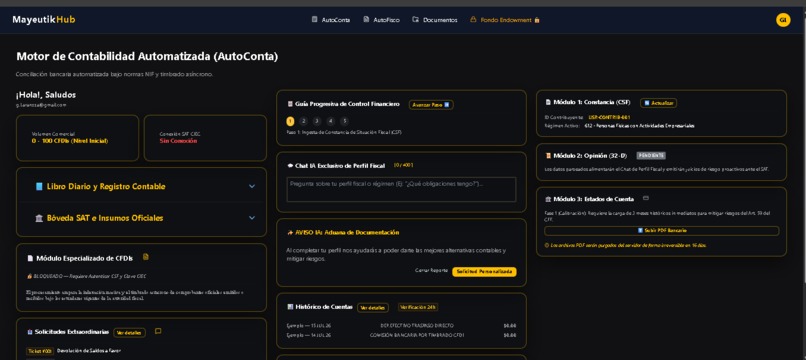
Upcoming Mayeutik Hub Full-Stack Web Portal (Reflex UI Staging) featuring Zero-Trust authentication architecture.
Mayeutik Hub: AI-Powered Forensic Tax Intelligence & Autonomous Compliance
💡 Inspiration: The Maieutics of Data
The spark for Mayeutik Hub was born from a shared frustration: the traditional accounting ecosystem operates as a reactive historical ledger rather than a preventive shield. Conventional firms and mainstream software often react to fiscal contingencies only when penalties have already escalated and resolution is costly.
As an accountant and business administrator, I identified a systemic flaw: while mainstream ERPs (such as CONTPAQi or Aspel) do possess bank reconciliation modules, they demand perfectly structured .txt or .csv layouts and grueling manual data entry. They collapse when faced with the chaotic reality of unstructured data—scanned bank PDFs, uncatalogued layouts, or handwritten cash receipts. Because of this high manual friction, proactive forensic cross-referencing is rarely executed.
This creates dangerous blind spots under Articles 59 (presumption of omitted taxable income) and 69-B (EFOS phantom companies blacklist) of the Mexican Federal Fiscal Code (CFF), exposing SMEs and freelancers to frozen bank accounts and severe fines. Furthermore, taxpayers often operate in the dark, paralyzed by "tax terror" and misunderstanding their own cash flows. Mayeutik Hub is an automated solution designed to transform this manual vulnerability and anxiety into absolute financial sovereignty through Socratic visual clarity. We apply maieutics by bringing our users' true financial reality to light.
⚙️ What the Application Does
Mayeutik Hub is an AI-native platform for Strategic Fiscal Operations and Forensic Tax Auditing. Its core innovation is the tripartite reconciliation of the "Golden Triangle of Fiscal Materiality":
- Issued and Received CFDIs (XMLs 3.3/4.0): Deterministic extraction of invoice metadata with granular tax breakdowns (VAT, IEPS, and statutory withholdings).
- Bank Statements (PDFs): Multimodal cash flow parsing, issuing risk alerts for unbilled deposits (CFF Art. 59) and verifying inter-account equity transfers under Mexican Supreme Court Precedent (SCJN Jurisprudence 2a./J. 56/2021).
- Daily Finances (Cash / Petty Cash): Visual extraction of disorganized or handwritten receipts, enforcing statutory cash deductibility thresholds ($\le \$2,000.00\text{ MXN}$) under Article 27 Fraction III of the Mexican Income Tax Law (LISR).
In our current deployment, the operational engine runs through our CTO console (ejecutar_motor_cto.py). Designed in Cursor and powered by deterministic algorithms, this engine slashes manual accounting review cycles from 1–3 weeks down to a structured 24-to-48-hour expert verification window (1 to 2 business days), scaling dynamically with client batch volume.
🛠️ How We Built It: Smart Hybrid Architecture
We engineered a high-throughput processing pipeline in Python, maintaining an audited $\$0.00\text{ USD}$ baseline in cloud infrastructure:
- 3-Tier Hybrid Engine ($0 Base Cost): We combine zero-token-cost local deterministic parsing (PyMuPDF and Pandas) with the multimodal computer vision of Google Gemini 2.0 Flash / Gemini 2.5 Pro via the official
google-genaiSDK as an intelligent fallback for scanned or complex layouts. - Mathematical Anchor Verification & MD5 Hashing: The engine enforces global balance integrity to detect omitted pages: $$ \Delta_{\text{Audit}} = \left| \text{Initial Balance} + \sum \text{Credits} - \sum \text{Debits} - \text{Final Balance} \right| $$ and synthesizes deterministic hashes $H(t) = \text{MD5}(\text{Date} \,|\, \text{Amount} \,|\, \text{Narrative})$ to deduplicate transactions across overlapping monthly statements at zero cloud compute cost.
- Reflex Web Interface: A full-stack Python prototype modeling the guided experience for our upcoming client modules (AutoConta and AutoFisco).
- Zero-Trust Security & 16-Day Auto-Purge: Encrypted workpapers are delivered securely via Google Drive links, after which temporary server payloads are irreversibly purged on a 16-day clock in strict compliance with Mexican privacy law (LFPDPPP) and CFF Article 30.
🚨 Challenges We Faced
- Bank Statement Heterogeneity: Banks frequently alter their statement layouts. Coupling local coordinate parsing with Gemini multimodal vision fallbacks allowed us to ingest uncatalogued and scanned formats with 100% data extraction accuracy.
- Classifying Unidentified Inflows vs. SAT Inquiries: Aligning with aggressive tax audits, we engineered interactive classification workflows enabling taxpayers to document family loans and equity contributions, successfully disproving presumed business revenue under CFF Art. 59.
- Zero-Trust UX & Delivery Protocol: Coordinating encrypted deliverable releases and educating users on the 16-day automated purge protocol cleanly transferred the statutory 5-year document custody obligation (CFF Art. 30) to the client without friction.
🏆 Achievements We Are Proud Of
- Order-of-Magnitude Turnaround Compression: Compressing multi-week accounting bottlenecks into an expert-verified audit window within 24 to 48 hours.
- Accelerated Technical Mastery: Transitioning from an accounting and finance foundation to mastering Python backend architecture, Reflex, Cursor, and Google Cloud SDKs to build an un-obsoletable system.
- Validated Commercial Traction: Generating $273.00 USD ($4,900.00 MXN) across 5 paid client transactions from 4 active users during the official hackathon window, proving strong market willingness to pay. (This builds upon an earlier manual validation phase that generated ~$328.00 USD / $5,900.00 MXN, proving the core business demand before automating the bottleneck).
- Decoupled Legal Engine (
GestorBibliotecaFiscal): Tax laws and deduction rules are decoupled into versioned annual JSON repositories (2021–2026), enforcing constitutional non-retroactivity (Art. 14 CPEUM) during historical audits without source code alterations.
📚 What We Learned
- Hybrid Architecture is Superior: Combining deterministic local code ($0 marginal cost) with Gemini's multimodal vision creates a resilient SaaS model with 75%–80% net operating margins.
- Data Minimization Eliminates Liabilities: Destroying payload files after 16 days is infinitely safer for regulatory privacy than maintaining exposed relational databases on servers.
- AI Augments Professional Judgment: AI does not replace accountants; it removes mechanical data entry, elevating the professional into a high-value forensic auditor.
- Visual Socratic UX Builds Trust: Translating complex tax laws into visual cues (like a "Fiscal Traffic Light") empowers users to understand their financial reality and prevents churn.
🚀 What’s Next for Mayeutik Hub
- Building the "AI Tax Knowledge Base": Every human decision made today during the CTO audit phase feeds a growing algorithmic memory (
GestorReglasClienteCTO). As the founder, my role will shift from auditing individual receipts to auditing this underlying rule database, ensuring the AI learns the specific deduction criteria and behavioral patterns of each tax regime. - Autonomous Agentic Reconcilers: Once this knowledge base matures, our decoupled architecture will enable autonomous Gemini multi-agent systems to evolve from discrepancy "detectors" into active, hyper-personalized "reconcilers," running continuous background SAT monitoring.
- Shared-Success & Full Web Integration: To sustain growth without rigid payrolls, we will implement an Equity/Revenue-Share structure for key tech partners while finalizing our Reflex web UI for self-service client onboarding.
- Community Endowment Fund: Channeling operational surplus into a community reserve fund, monitored via a real-time public transparency dashboard under a collaborative win-win model.

Log in or sign up for Devpost to join the conversation.