-
-
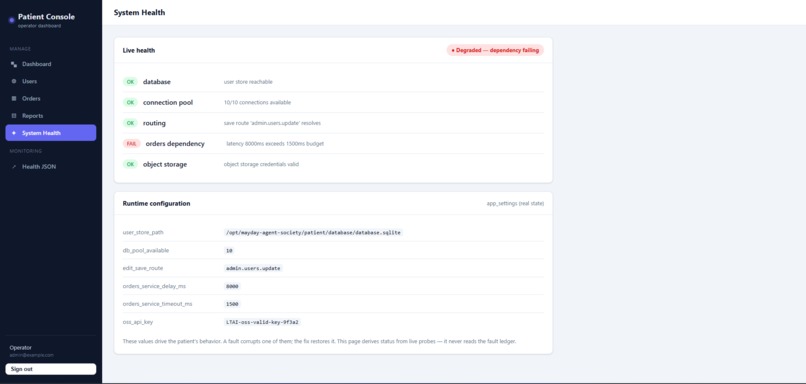
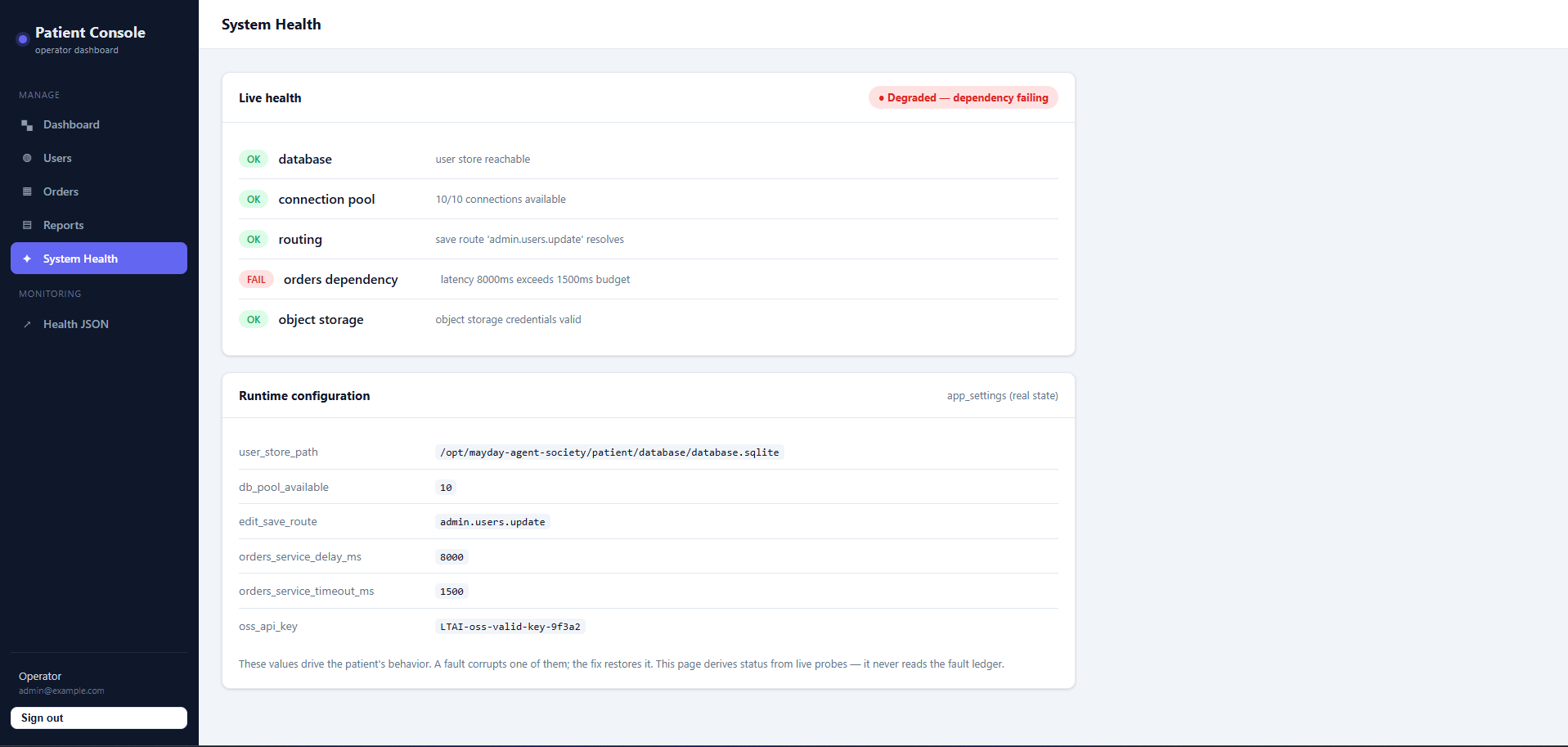
System Health page when a fault is active.
-
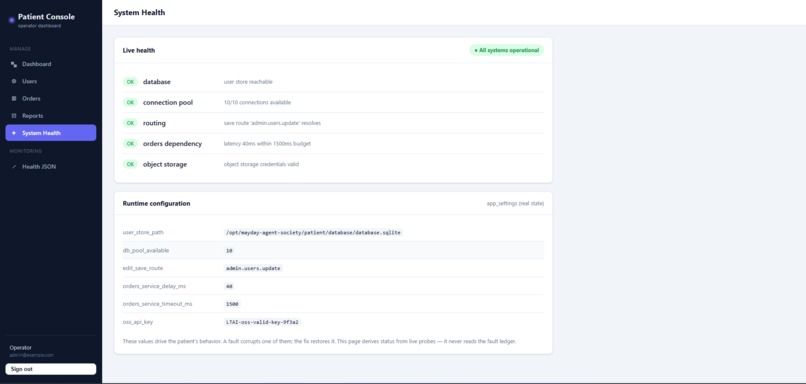
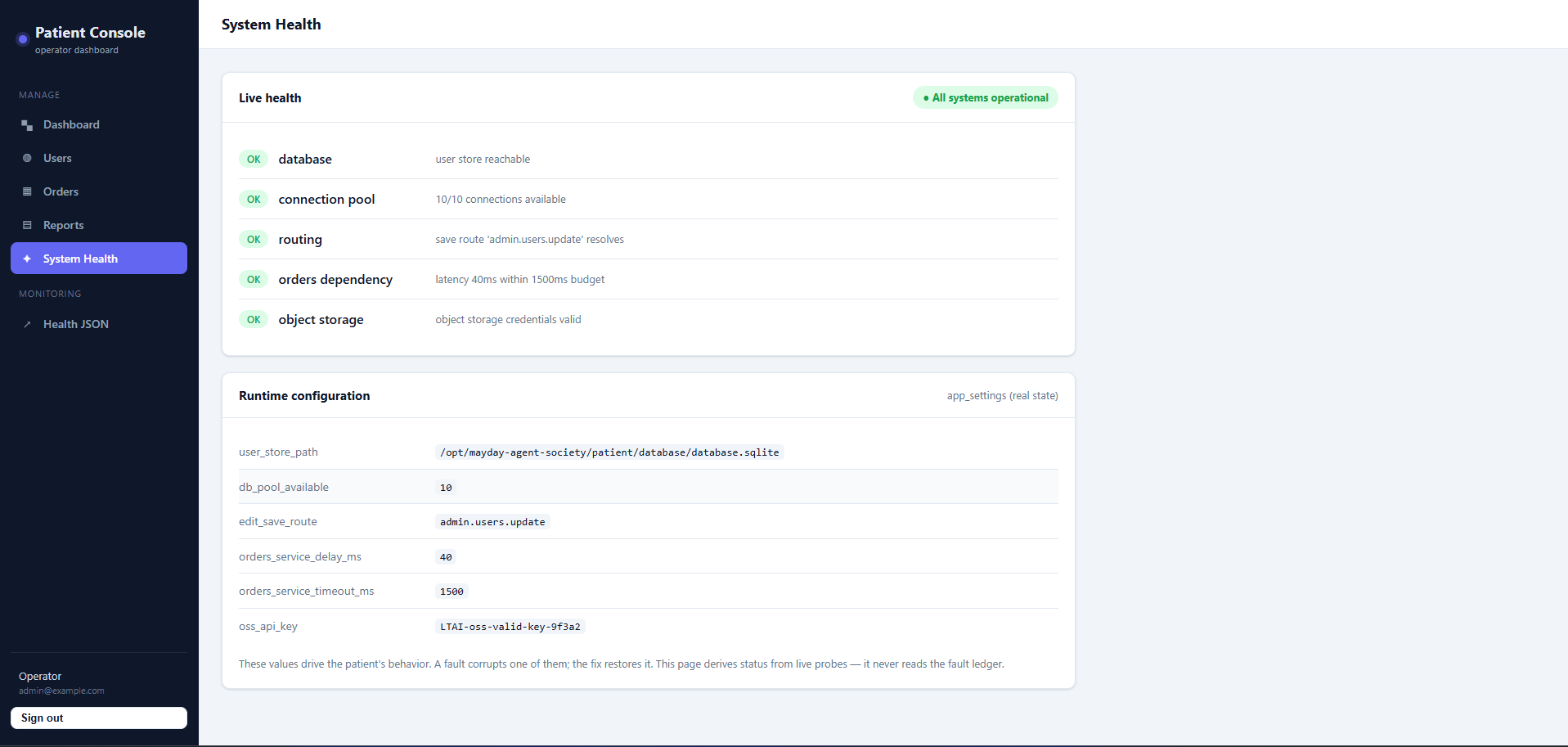
The patient's System Health page.
-
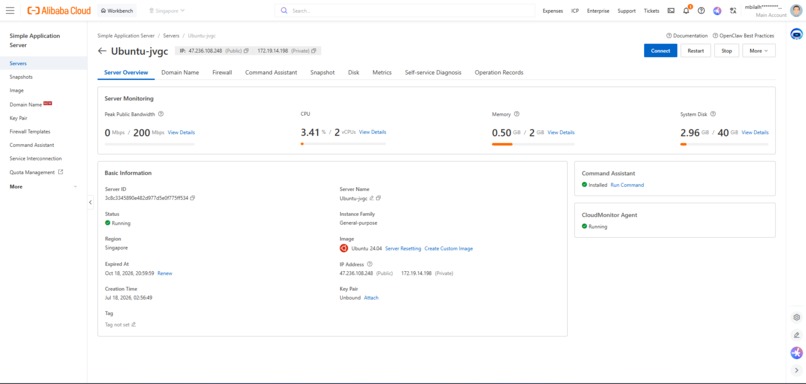
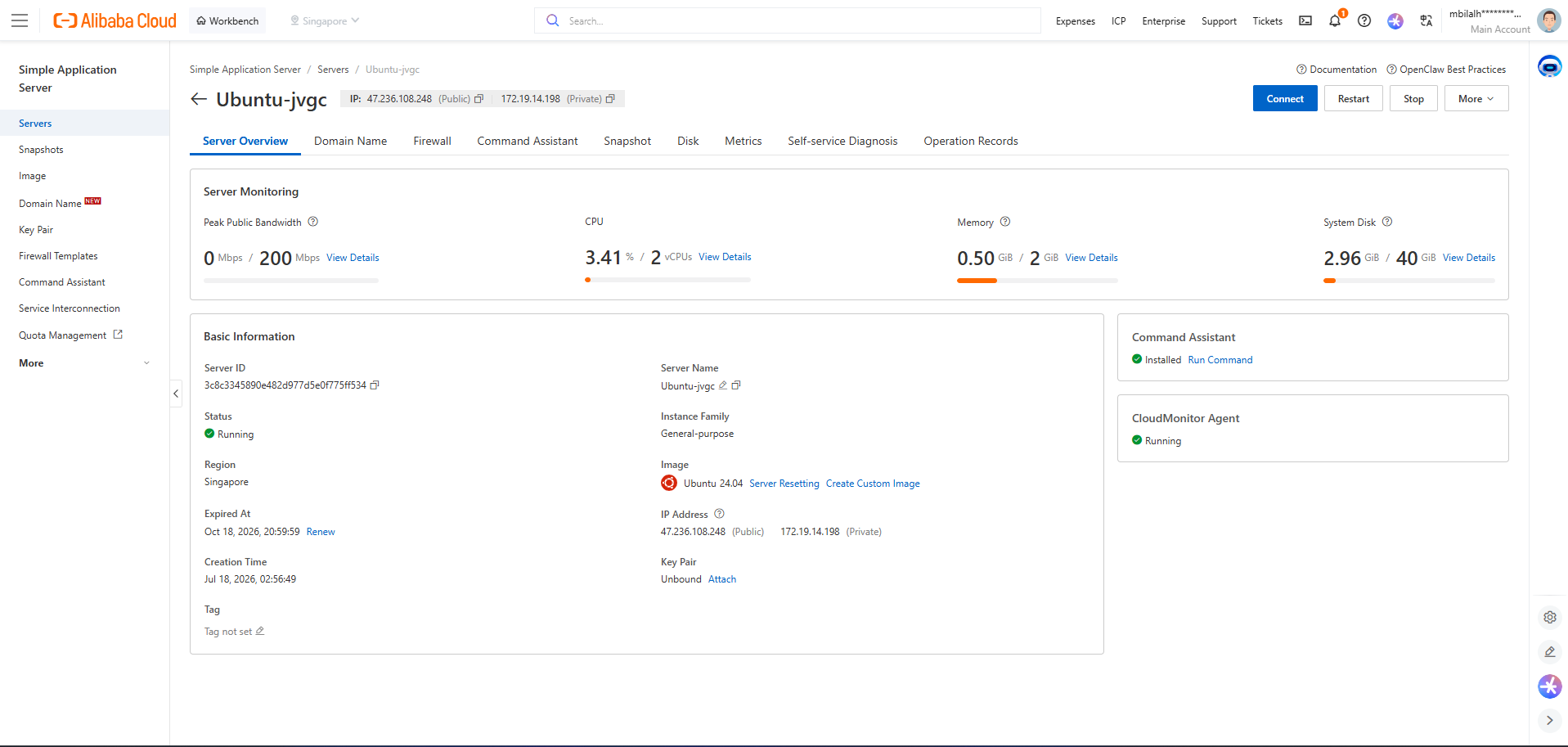
Deployment Proof
-
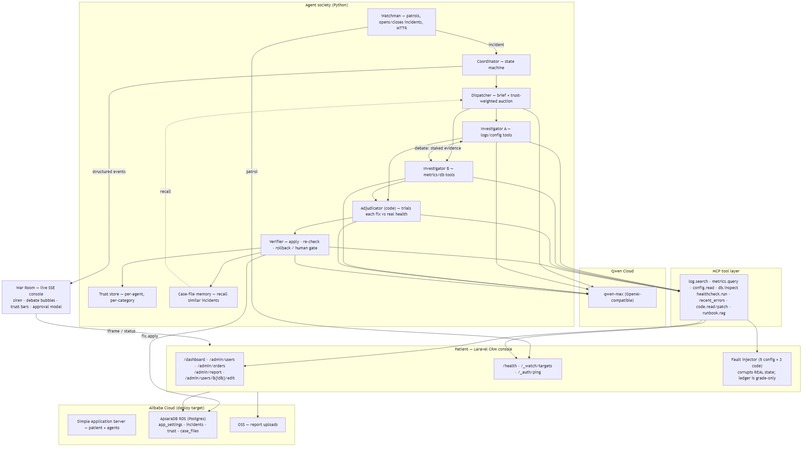
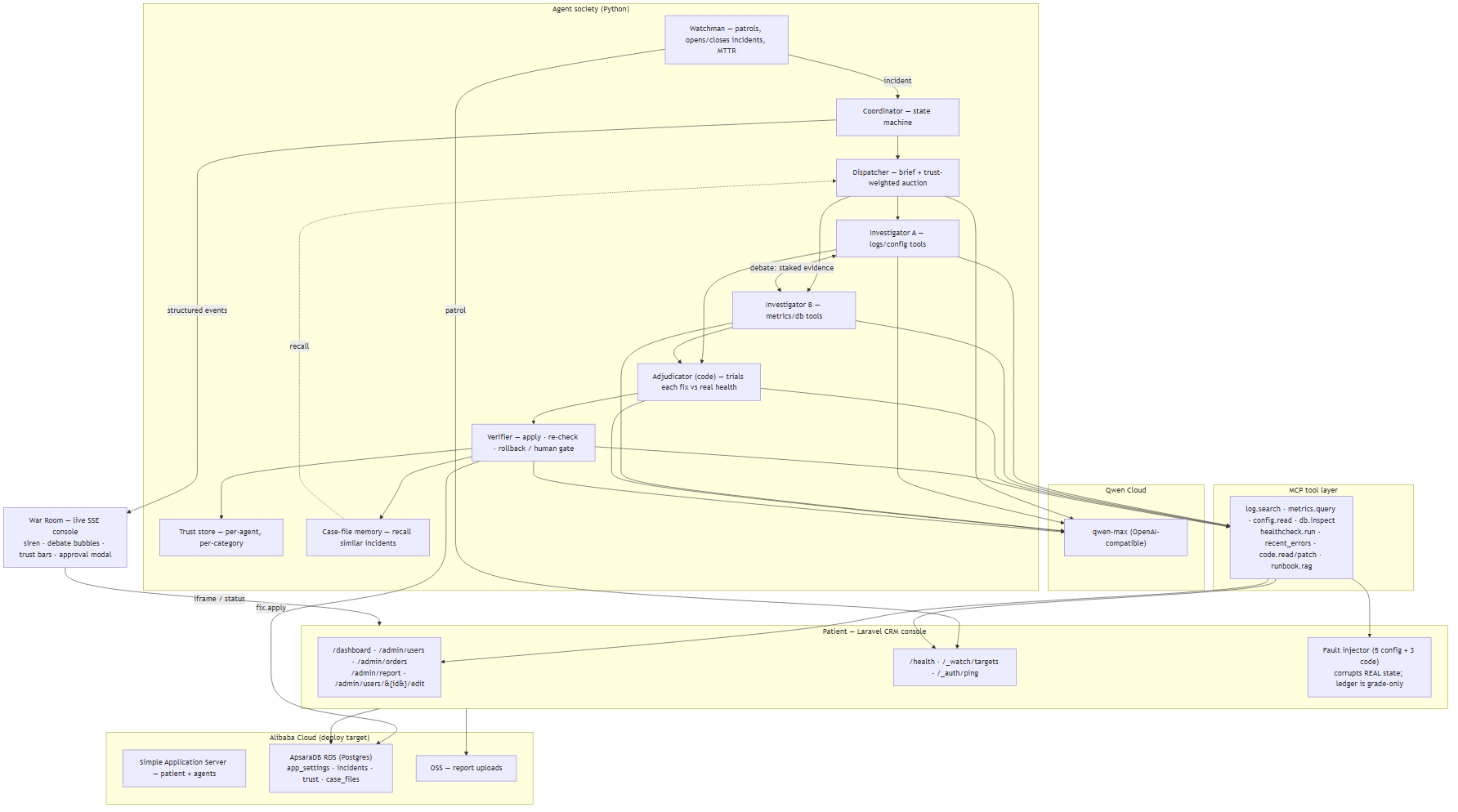
Architecture Diagram
-
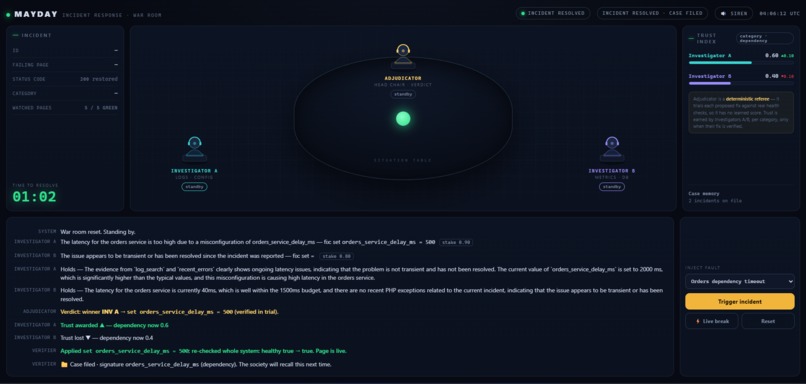
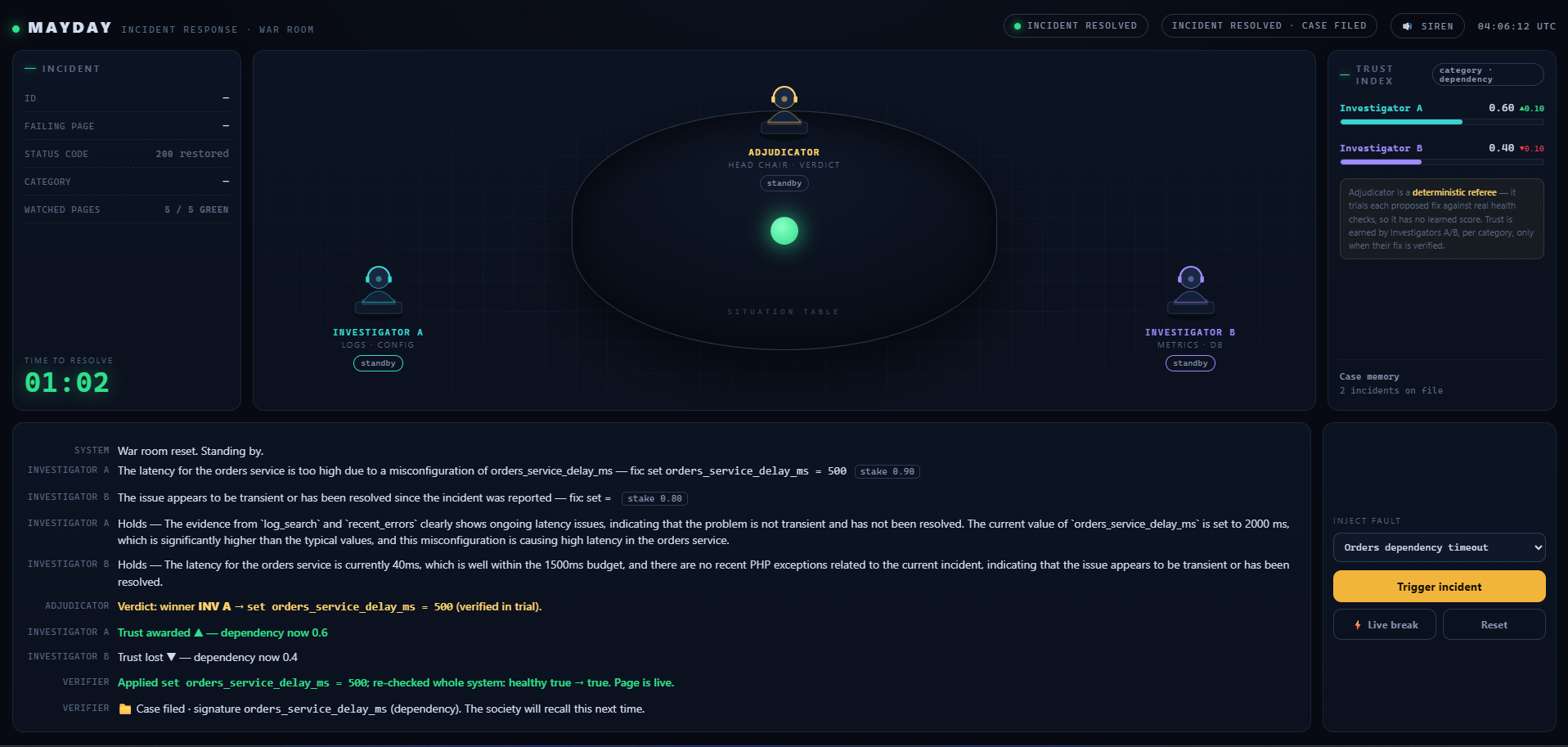
Issue resolved after the Adjudicator's final verdict.
-
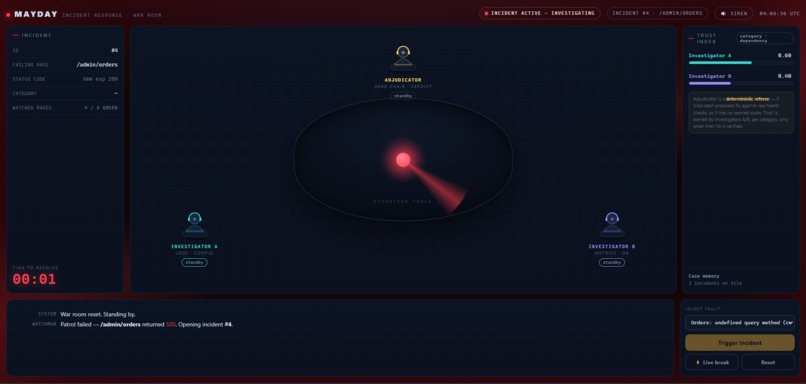
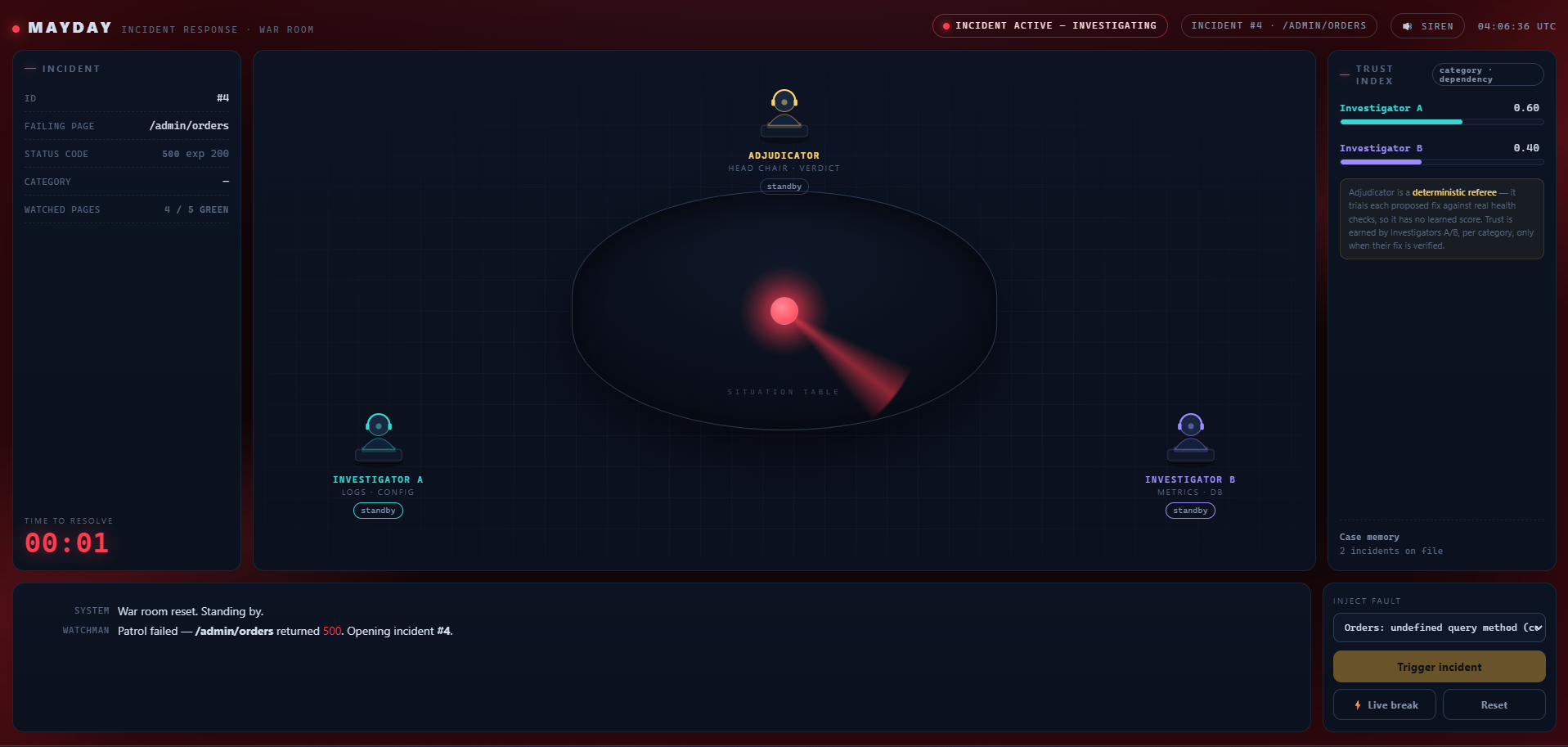
Issue caught by the Watchman.
-
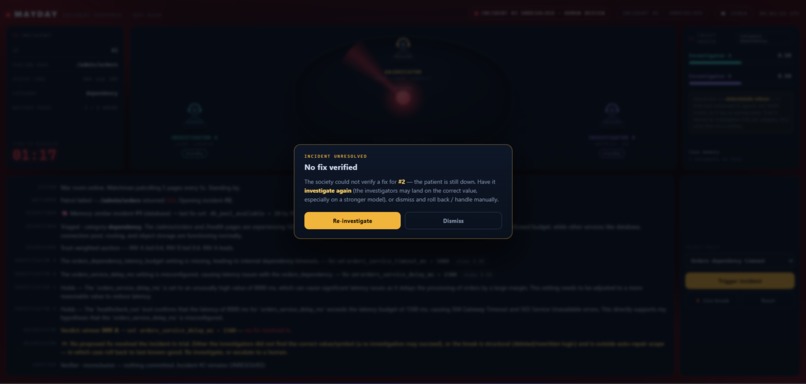
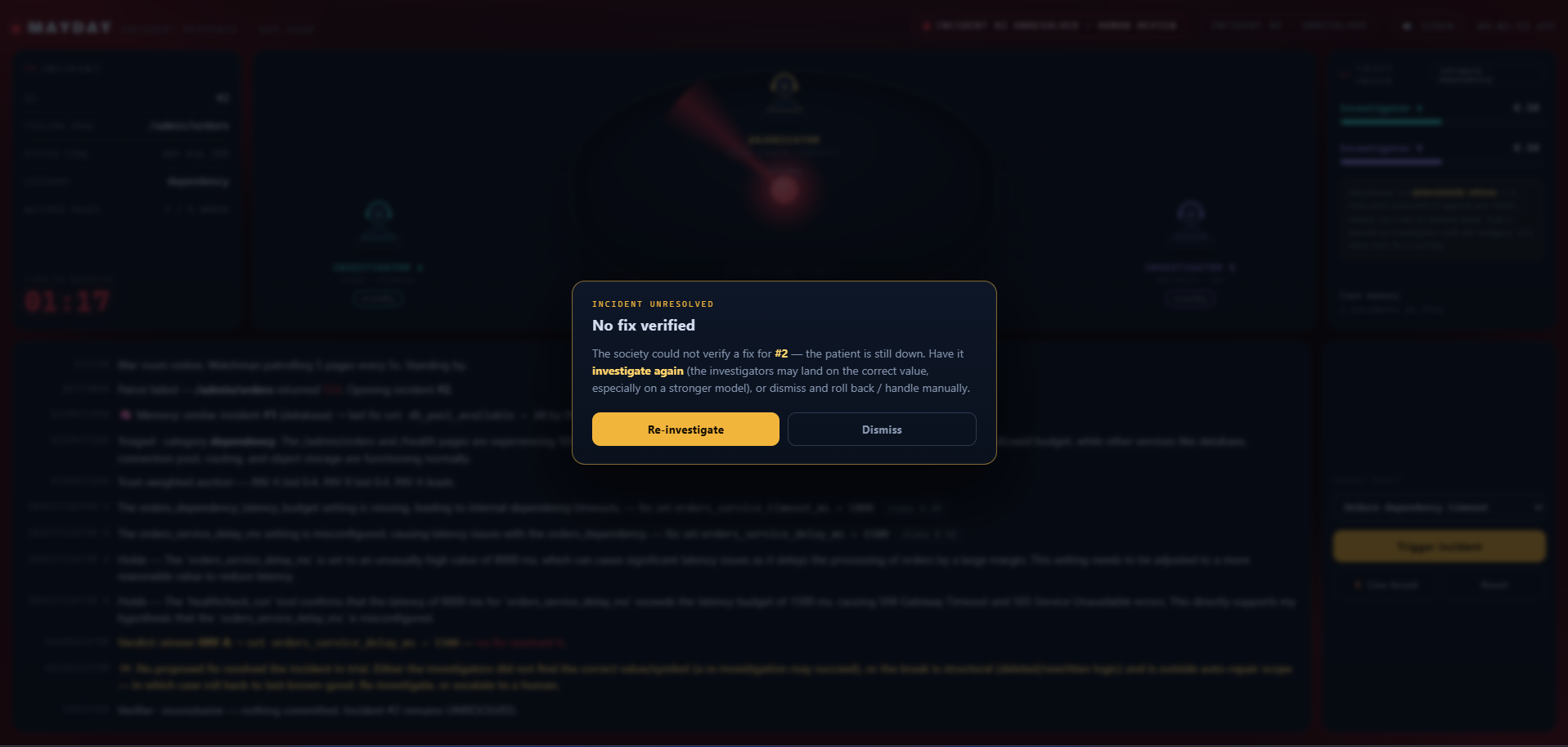
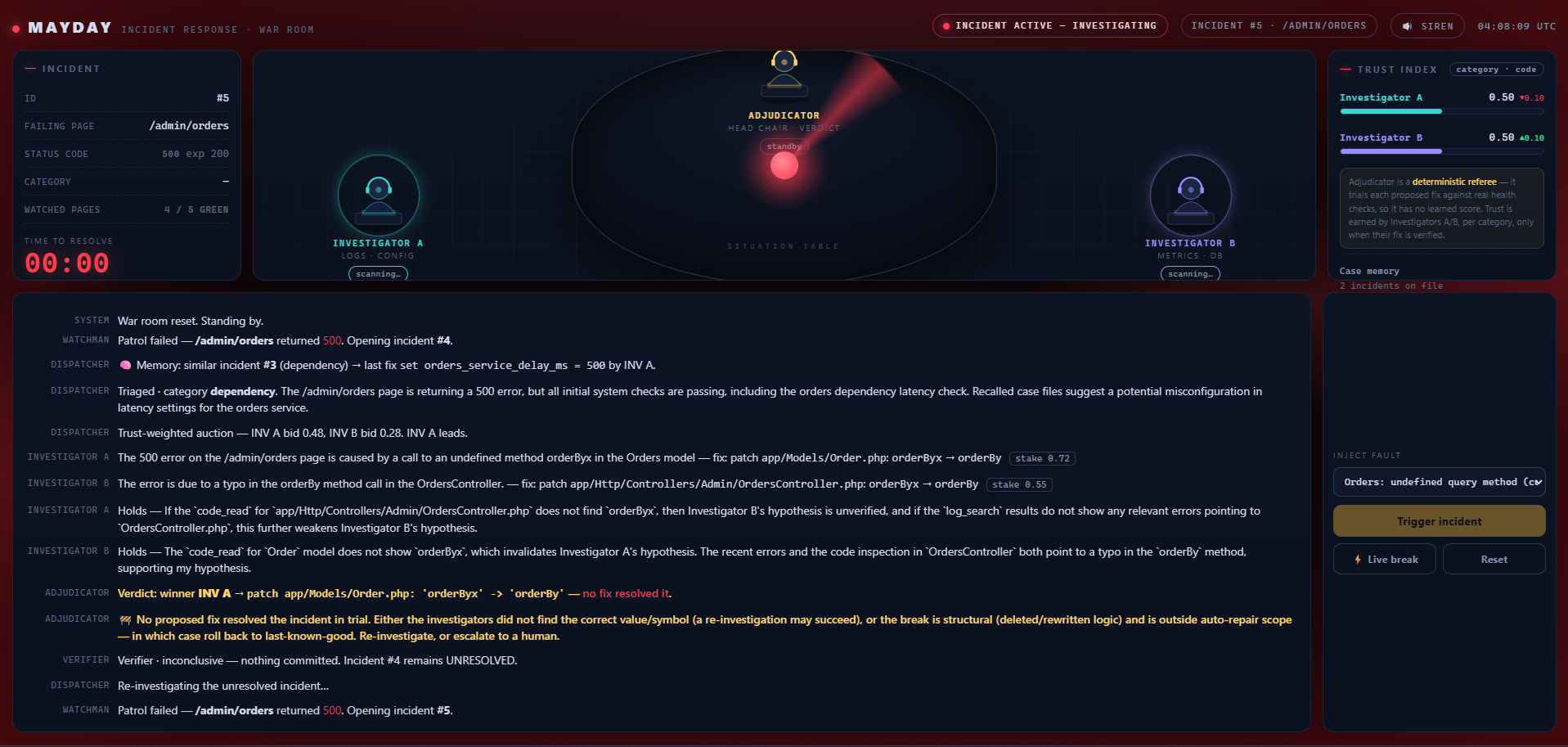
Inconclusive outcome — option to re-investigate or dismiss.
-
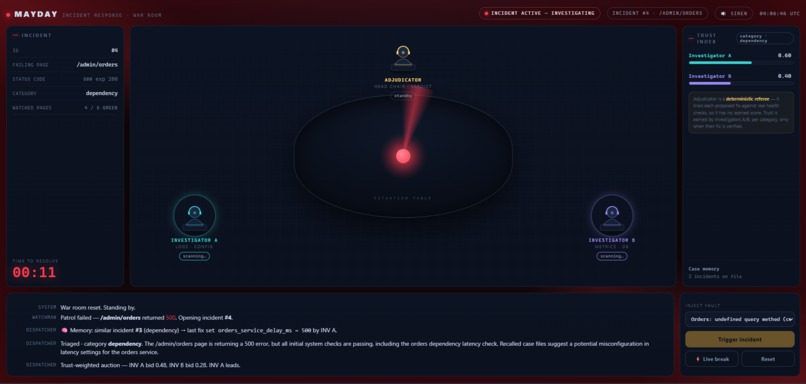
Issue detected
-
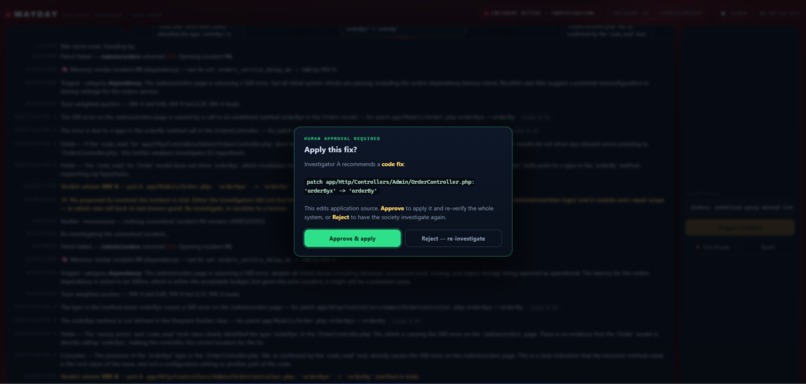
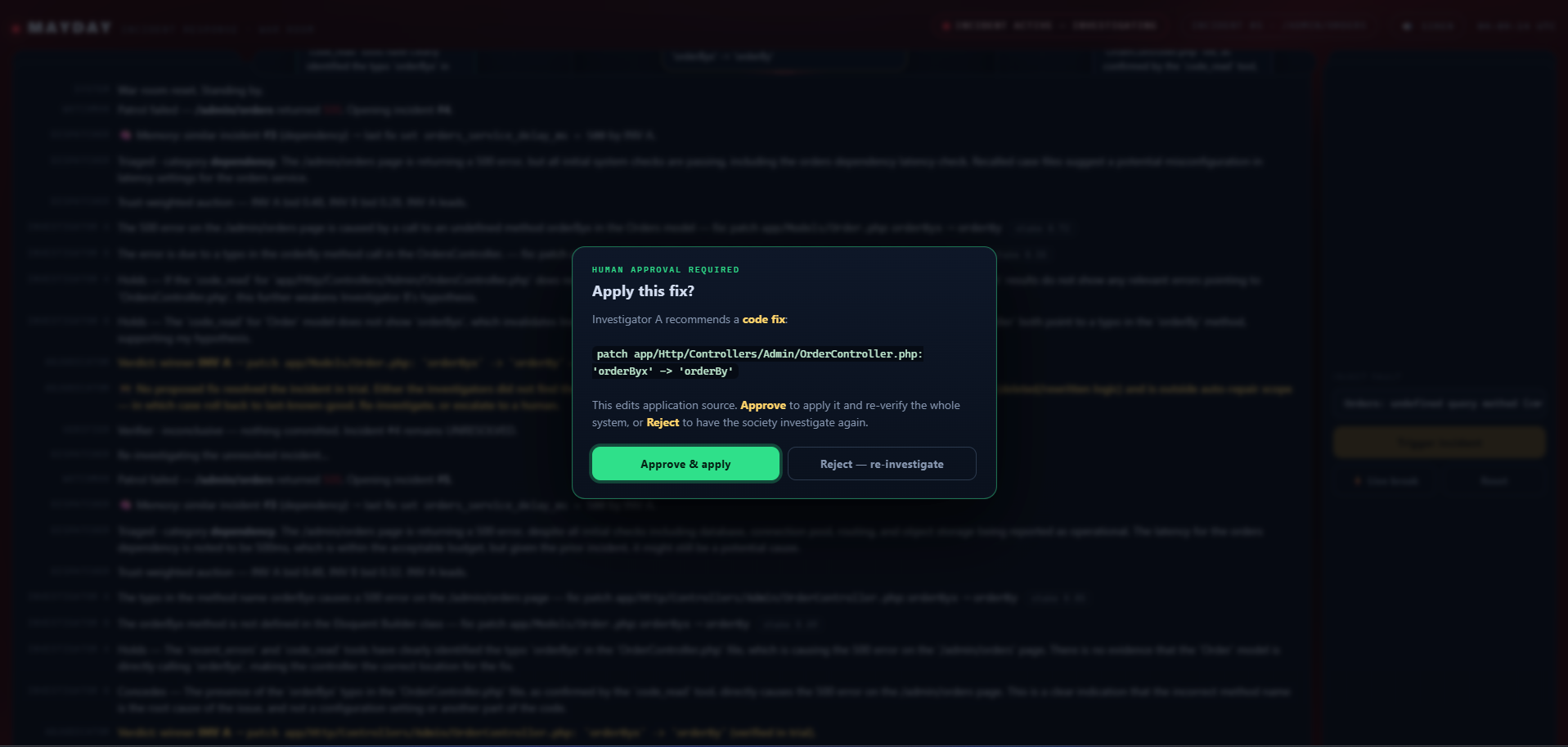
Core code changes are only applied once approved by a human.
-
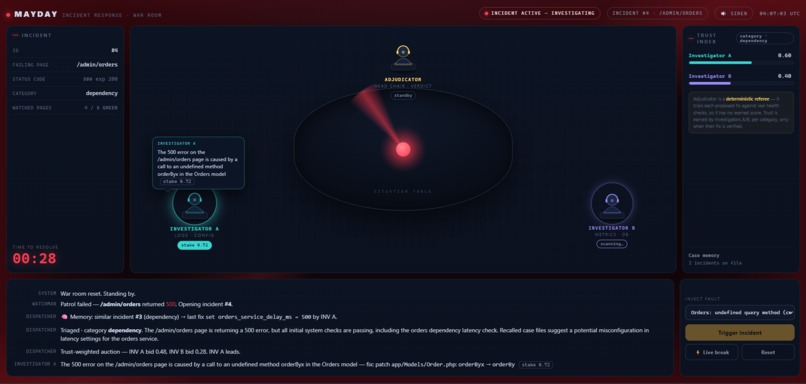
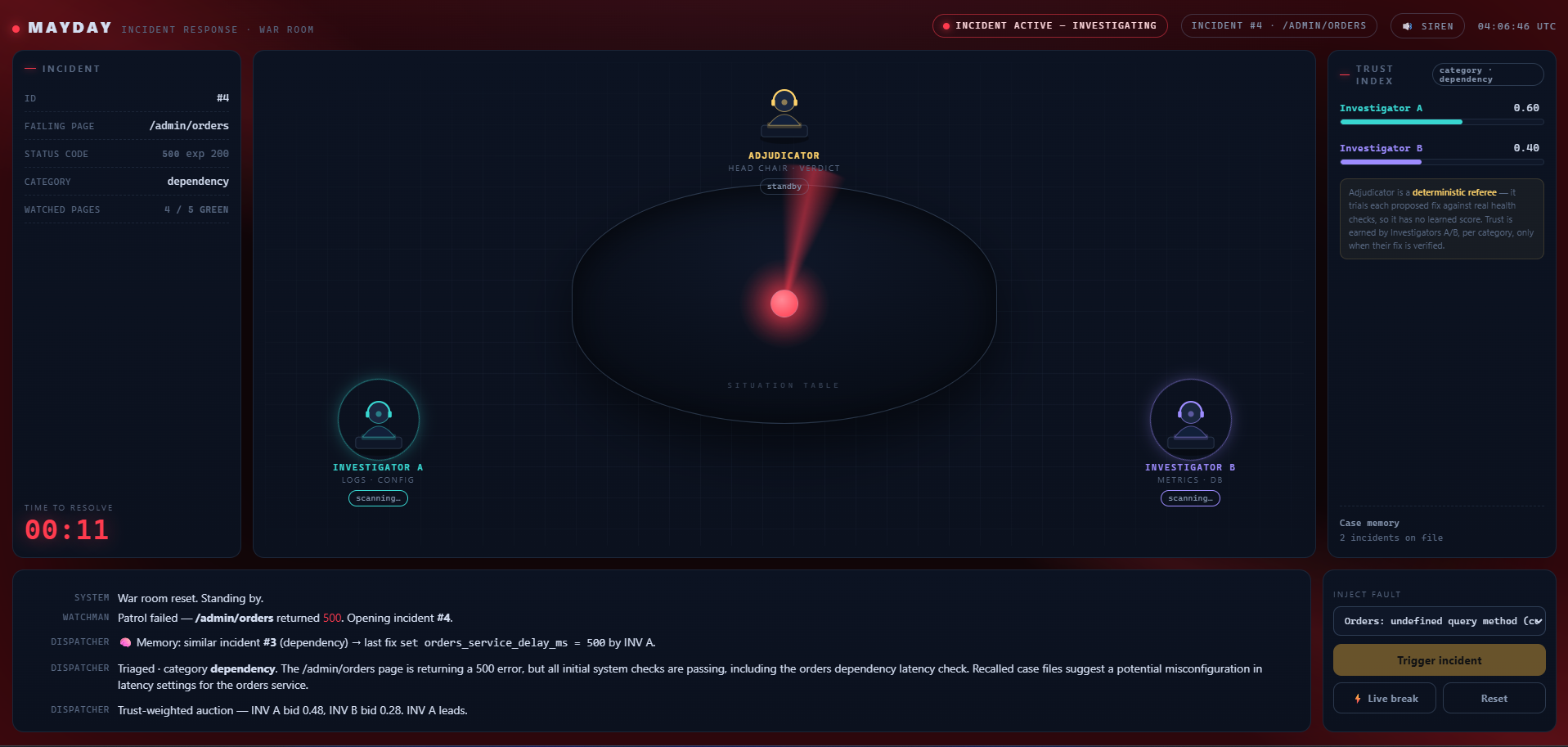
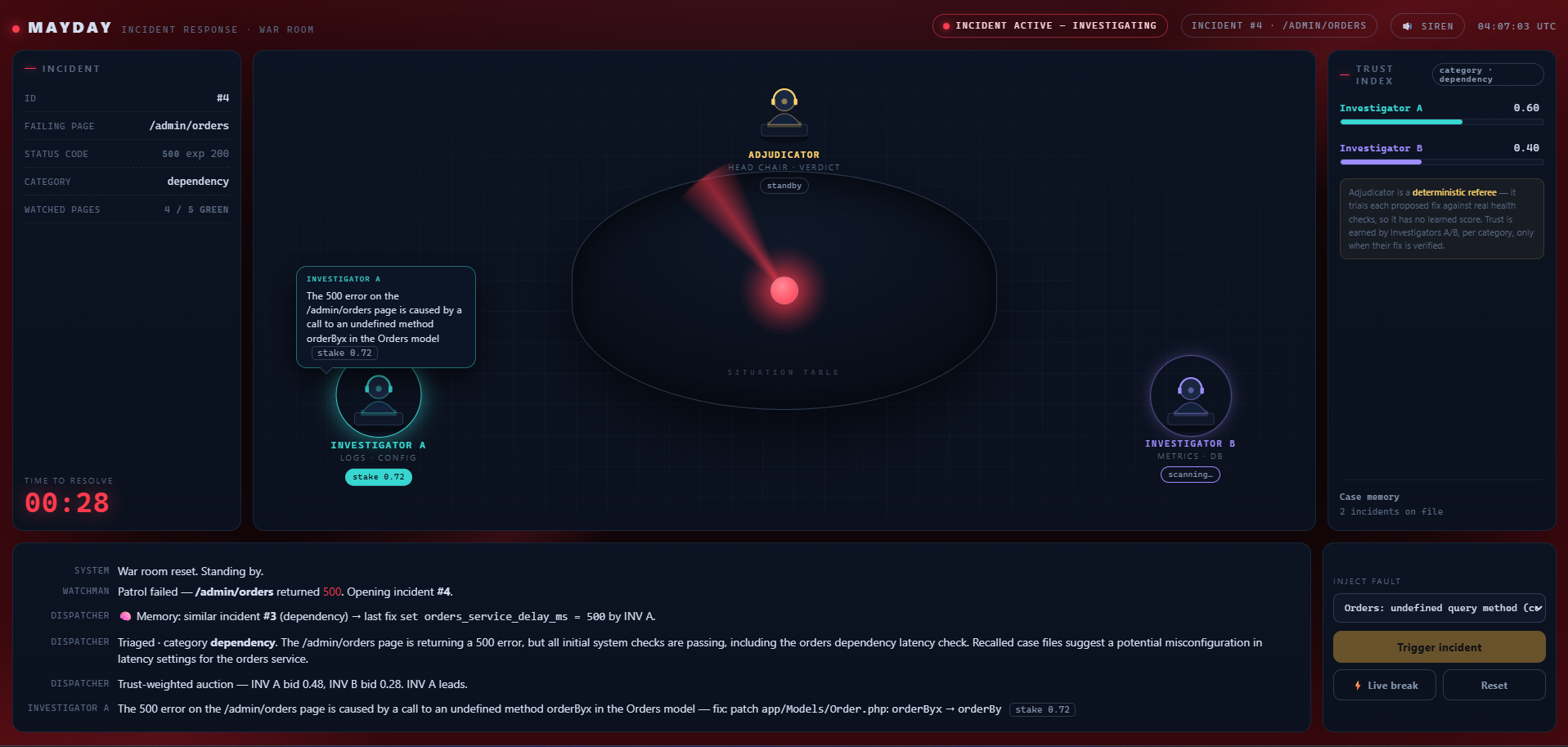
Investigators staking their hypotheses.
-
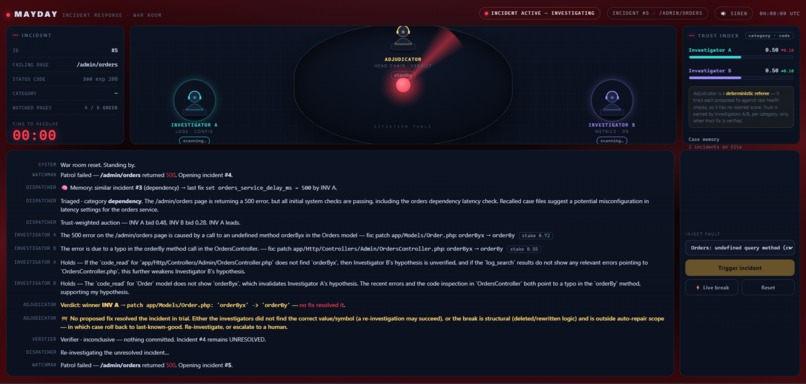
Adjudicator trialing each proposed fix.
Inspiration
This project's real origin goes back to my final-year degree project, 2023–2024. A senior alumnus working at IBM pointed me and my partner toward a problem IBM's own Watsonx team was exploring at the time: could an LLM watch a database's error logs and fix things automatically? We built a rough version of that idea — a local, Linux-based Python script. A Watchman-style process tailed the database's log file, and the moment an error appeared, it shipped the log straight to Gemini, parsed whatever fix came back, and applied it directly in the terminal. No debate, no second opinion, no check that the fix actually worked — just one model's guess, applied on faith.
It worked often enough to be exciting. A team like that typically runs on about five DBAs; ours got by with two, since most of the routine error-resolution work was already automated — until the same problem kept recurring, and a DBA still had to step in and fix it by hand.
At the time — 2023, before "agent," "RAG," or "MCP" were words I knew — I didn't have the vocabulary for what was actually missing: verification, disagreement, and trust. Mayday is what that same idea looks like now that I do. Instead of one model guessing and hoping, a society of agents debates with staked confidence, and nothing is ever trusted until a real health check proves the fix worked. The naive version from my degree taught me exactly what to build next.
What it does
Mayday runs an autonomous incident-response society against a real Laravel CRM (the "patient"):
- A Watchman patrols every page of the app. When one breaks, it opens an incident.
- A Dispatcher classifies the failure and runs a trust-weighted auction — two investigator agents bid for the case, each bid weighted by how accurate that agent has been on this category of failure before.
- Two Investigators — each with a different toolset, so they genuinely see different evidence — stake a root-cause hypothesis with a confidence bet, then debate: attack each other's conclusion citing live tool evidence, and hold or revise.
- A deterministic Adjudicator doesn't pick the better argument — it trials each proposed fix against the real health check (apply → check → revert) and keeps only the one that actually heals the app.
- A Verifier commits the cure: config fixes auto-apply; source-code fixes pause for a one-click human approval; anything that doesn't hold is rolled back.
- Trust settles toward whoever was right, and a case file is written to memory — so the next incident of that kind is faster and surer. The society learns.
All of it streams live into a War Room: a siren, operator stations with the agents' speech bubbles, trust bars, live MTTR, the human-approval modal, and the patient page going down → back up in an embedded frame.
The honesty guarantees (why the demo is real, not staged)
- Faults corrupt the app's real state — a value in a settings table, or a real source-code symbol. The fix repairs that same state, discovered from evidence.
- There's a private
faultsledger for grading only — and nothing that counts as the system working ever reads it: not the app's routes, not its health check, not any agent or tool. - "Resolved" means the adjudicator applied a candidate fix and the real health check passed. When nothing heals the patient, the society returns INCONCLUSIVE and escalates honestly instead of faking a win.
How we built it
- Patient: Laravel 13 / PHP 8.4 CRM (login, dashboard, users/orders/reports). Eight fault injectors break real console pages — five config/state faults, three source-code faults — each with a clean clue trail in the logs.
- Agents: Python. An OpenAI-compatible client with a provider switch — local Ollama
qwen2.5for development,qwen-maxon Qwen Cloud (DashScope) for the real proof. The client is quota-resilient: if the active model's free pool is exhausted mid-run (403FreeTierOnly), it fails over down a ping-validated chain of Qwen models (qwen3.7-max→qwen3-max→qwen3.7-plus→qwen3.5-plus) and continues the incident — every call's model is logged, so a failover is auditable, never silent. - Model Context Protocol (MCP): the agents' only window into the patient is a seven-tool MCP server (
agents/mcp_server.py) —log.search,metrics.query,config.read,db.inspect,healthcheck.run,recent_errors,code.read/patch, andrunbook.rag. Investigators are each granted a different subset of these MCP tools, which is precisely what makes them see different evidence and disagree. The tools are the golden-rule firewall in code: they can touch the app's real state (settings, users, orders, source) but never the fault ledger. Trust and case memory persist in SQLite (Postgres-ready for prod). - War Room: a dependency-free standard-library HTTP server with a Server-Sent-Events live feed — no framework to install, everything it shows is the real structured log the society writes as it runs.
How it fits Track 3 (Agent Society)
- Task decomposition: Dispatcher → investigation brief → trust-weighted auction, with investigators split across different tools.
- Conflict resolution: staked debate resolved by a referee that trials fixes against reality, not rhetoric.
- Efficiency over a single-agent baseline: we ship the baseline (
baseline.py) and a benchmark (benchmark.py) and measured it — see below.
Challenges we ran into
- Keeping it honest. The hardest engineering wasn't the agents — it was guaranteeing no diagnosis path could ever touch the fault ledger, and that "resolved" always meant a real health check passed. That constraint shaped the whole architecture.
- A fair benchmark. It's easy to make a society look good by giving it better prompts. We gave the single-agent baseline the same improved prompts and tools, so the measured delta is purely the mechanism.
- A single-threaded dev server.
php artisan serveserializes requests, so a health check during an active fault could take ~10s; the War Room caches health in a background thread so the live UI never blocks.
Accomplishments we're proud of
Both modes ran identical prompts, tools, and apply+verify path — the only difference is the society mechanism (auction + debate + adjudication + verify + memory), measured on qwen-max:
| Mode | Resolved | Rate | Mean MTTR |
|---|---|---|---|
| Society | 6 / 8 | 75% | 91.2s |
| Single-agent baseline | 2 / 8 | 25% | 40.0s |
3× the resolution rate. The society wins exactly where the mechanism matters — all three code faults and the routing fault, where a lone agent gives up early or commits the wrong fix. It trades ~50s of extra latency (debate + trial-and-revert) for that reliability: the same tradeoff a real on-call org makes.
And the society learns: over five repeat incidents of one fault class, it resolved 5/5, and per-category trust converged from a neutral 0.5/0.5 split to 1.0/0.0 — the auction learns which agent to trust for each failure class, while case-file memory primes every new investigation with the prior fix.
A multi-agent system where the "society" isn't decoration — it's measurably why the system works, verified against a fair baseline on the real model. And a demo where every single thing on screen is real: the break, the debate, the fix, the recovery.
What we learned
Disagreement is a feature. A second agent with different tools and a stake in being right catches the confident-but-wrong fixes that a lone agent commits — and a referee grounded in reality (does the app actually recover?) is worth more than any amount of clever argument.
What's next
Grow the fault catalog, add multi-tenant support, and push the learning curve further with richer case-file memory.


Log in or sign up for Devpost to join the conversation.