-
-

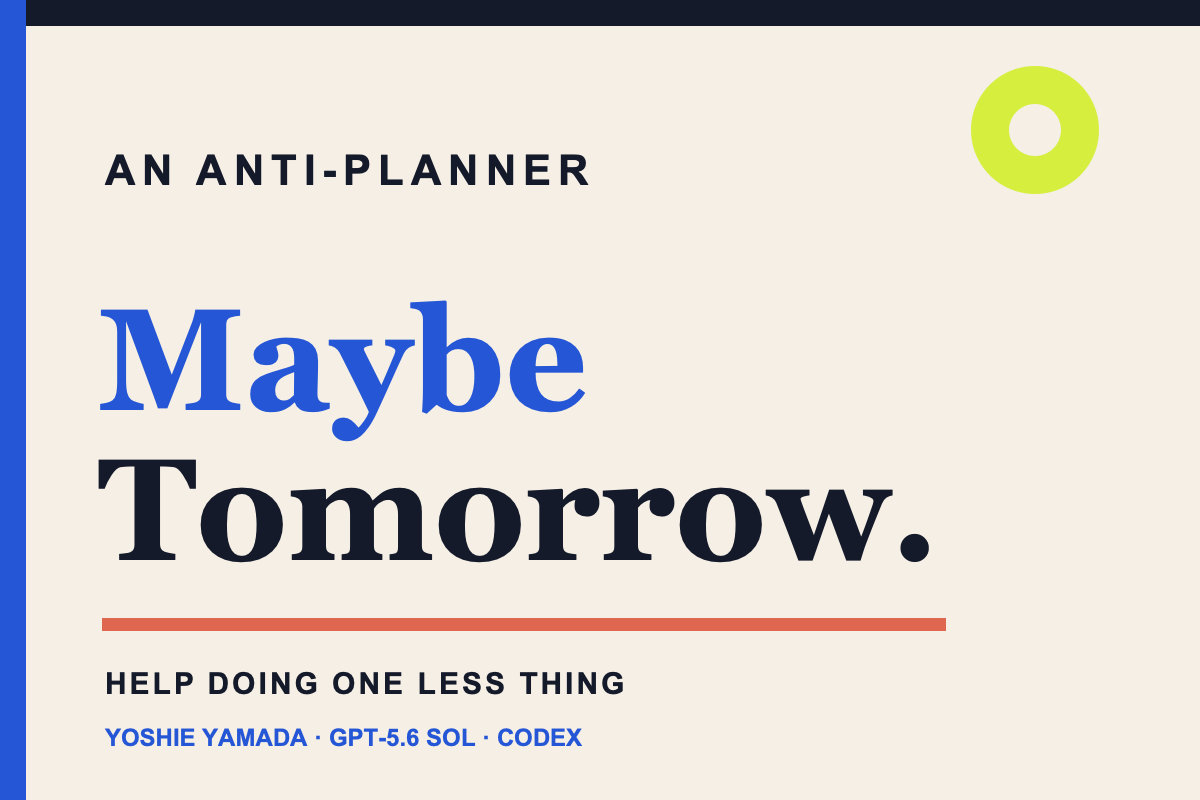
Maybe Tomorrow. — an anti-planner for people who need help doing one less thing.
-
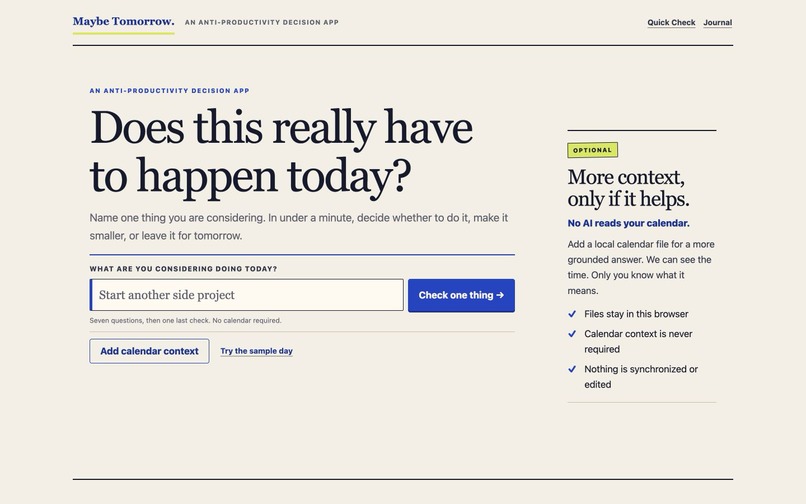
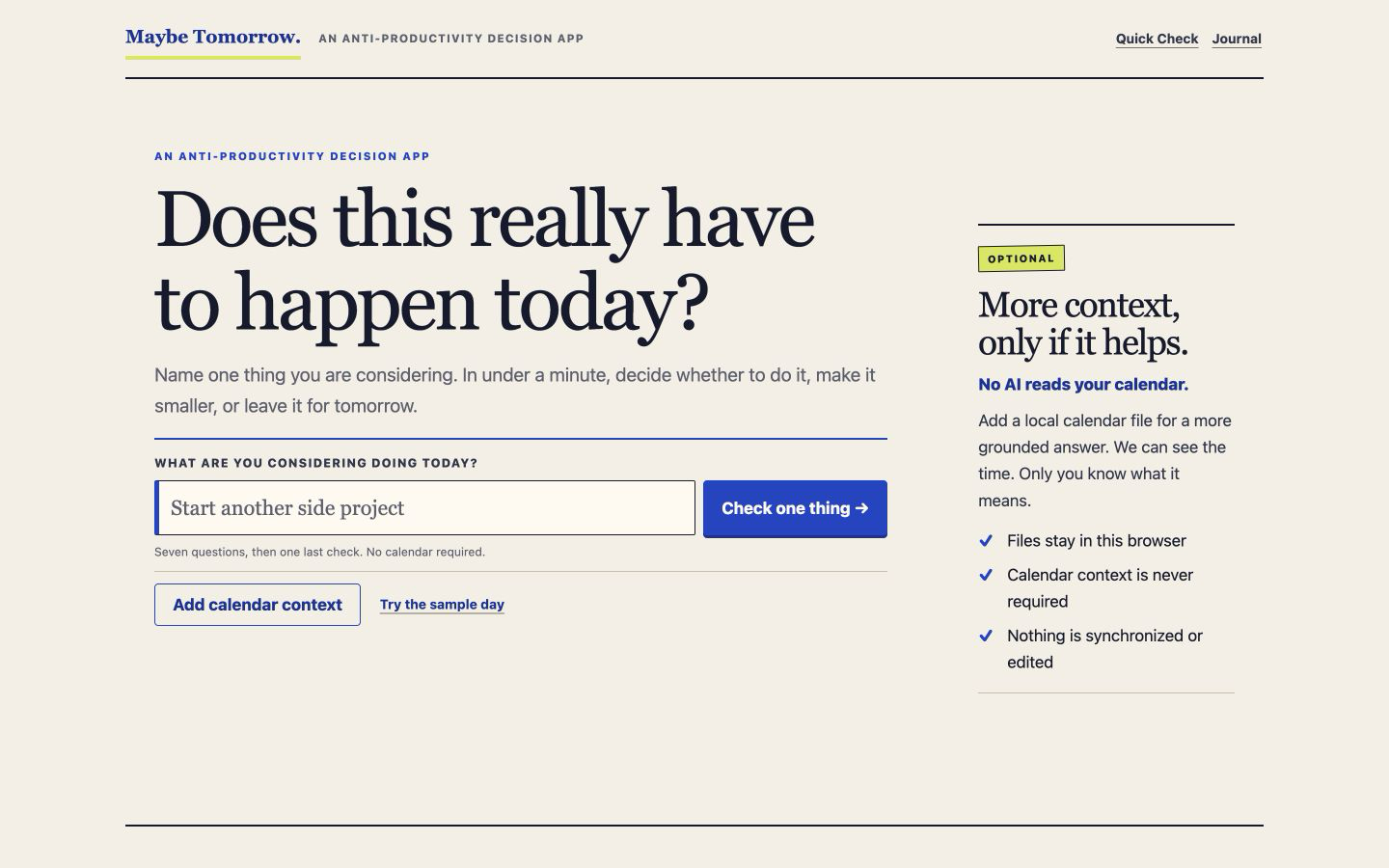
Start with one activity. The core Quick Check works without a calendar.
-
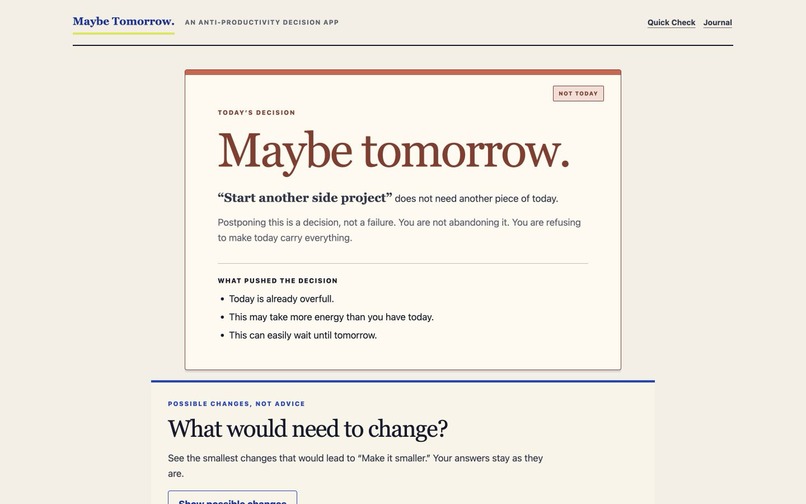
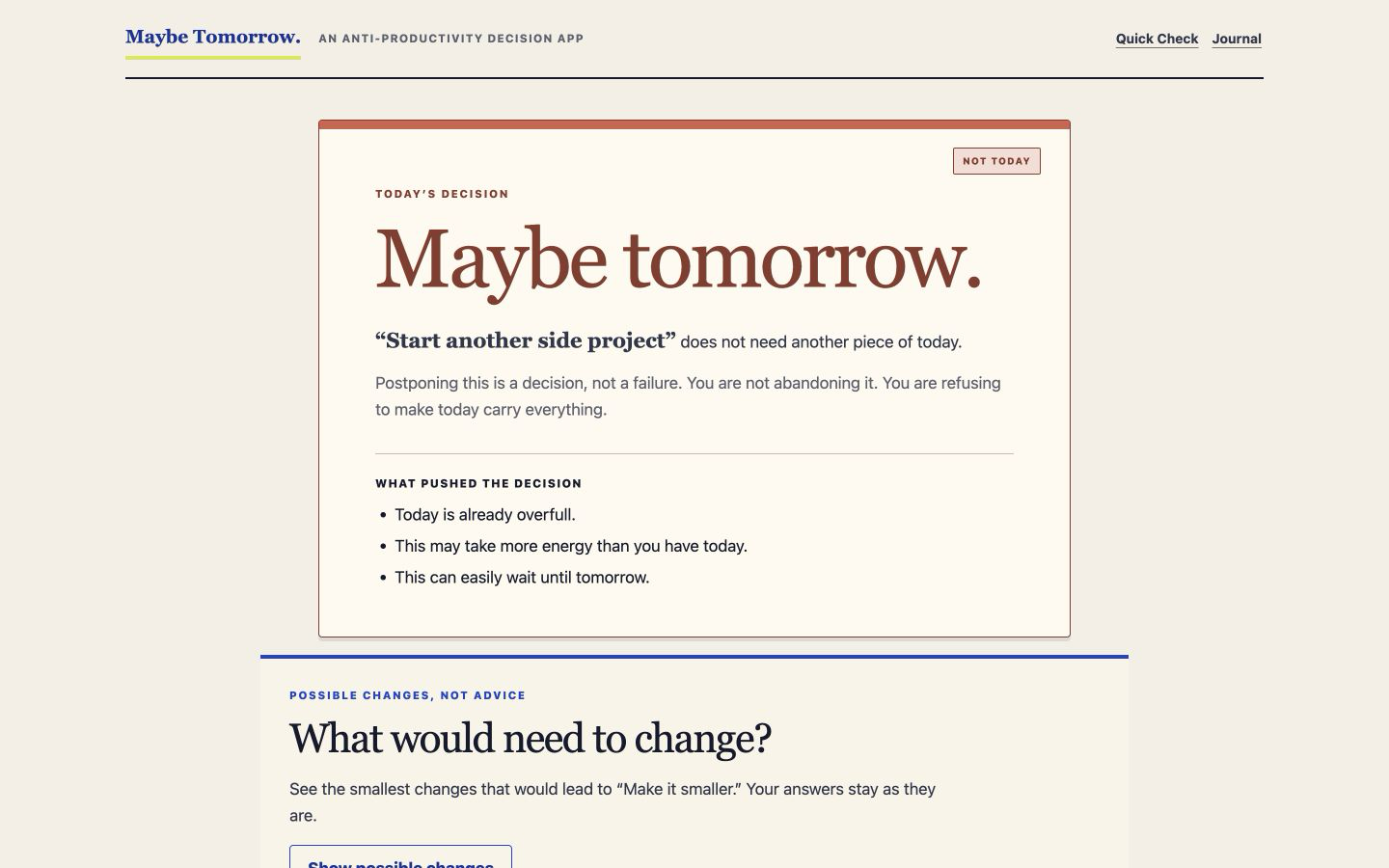
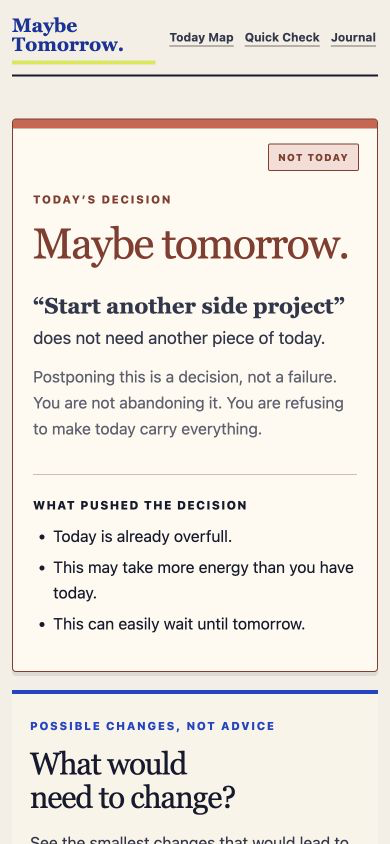
One of exactly three verdicts, with the leading factors explained clearly.
-
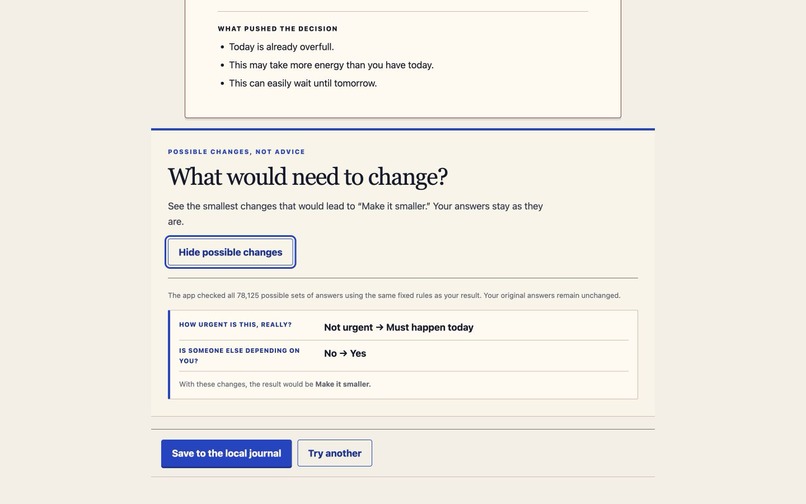
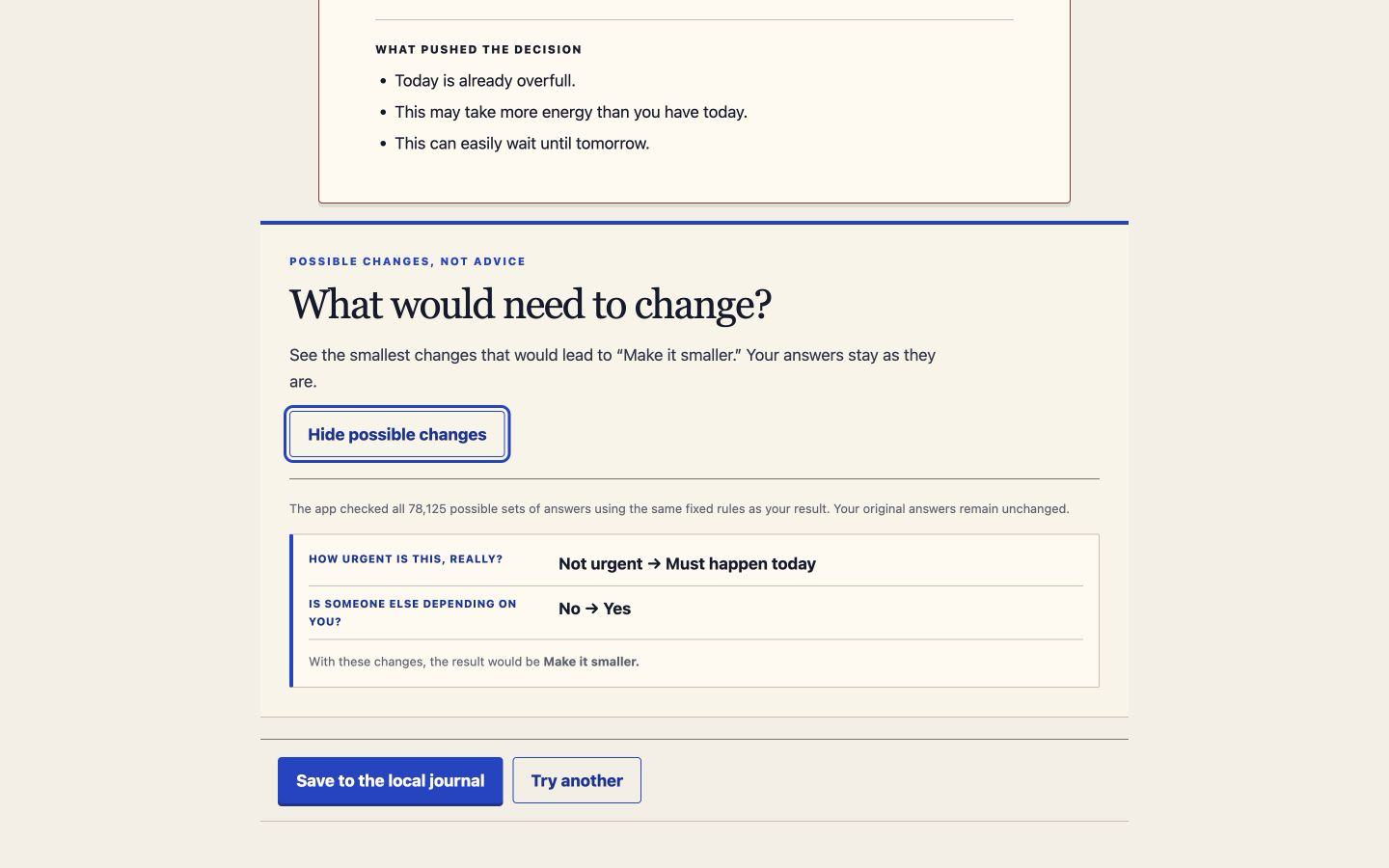
Cost of Yes checks all 78,125 answer combinations to find the nearest facts that would change the verdict.
-
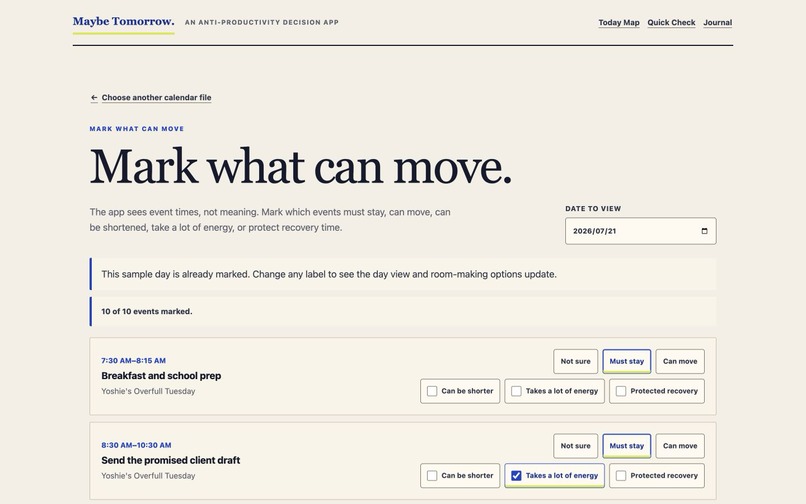
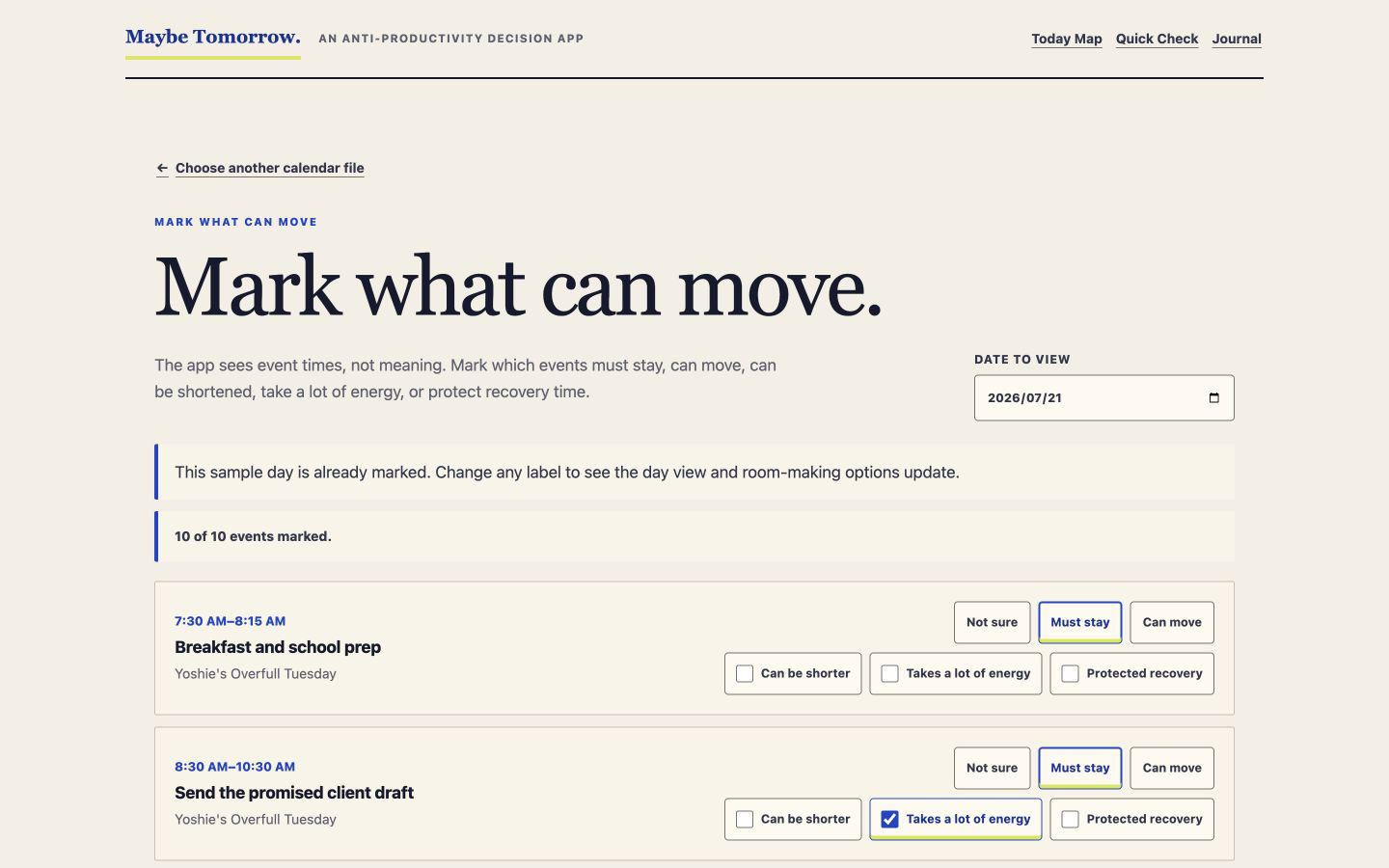
Users—not the app—classify events in the fictional sample day. No title inference or runtime AI.
-
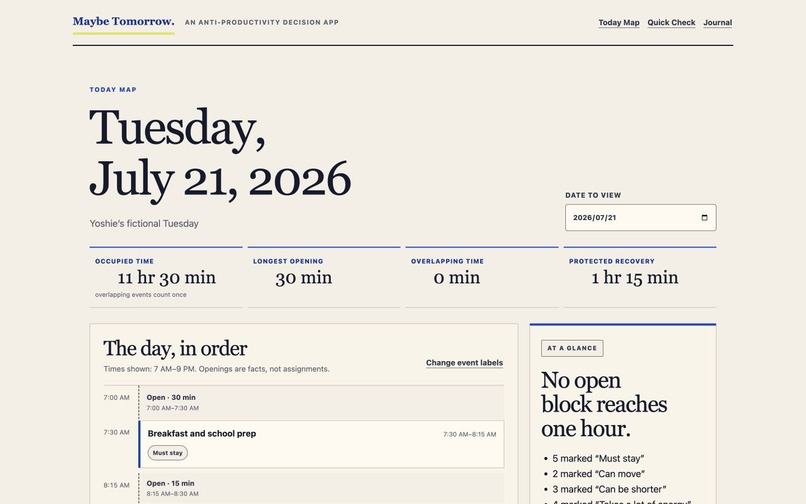
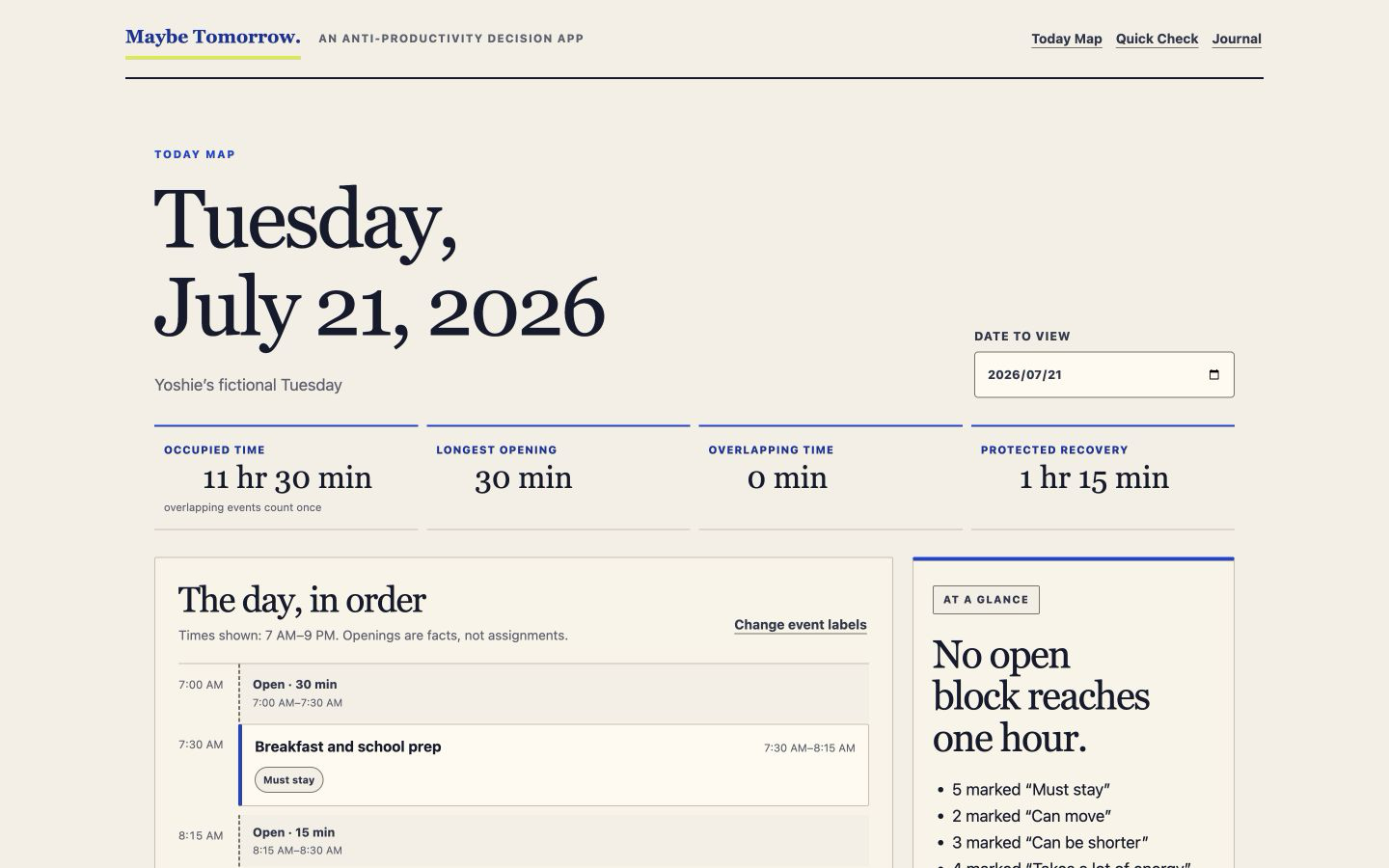
Today Map shows occupied time, openings, overlaps, and protected recovery without grading the day.
-
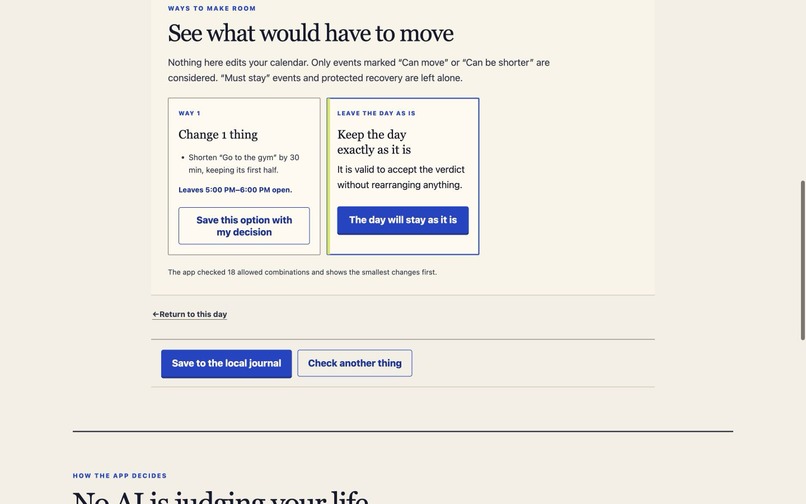
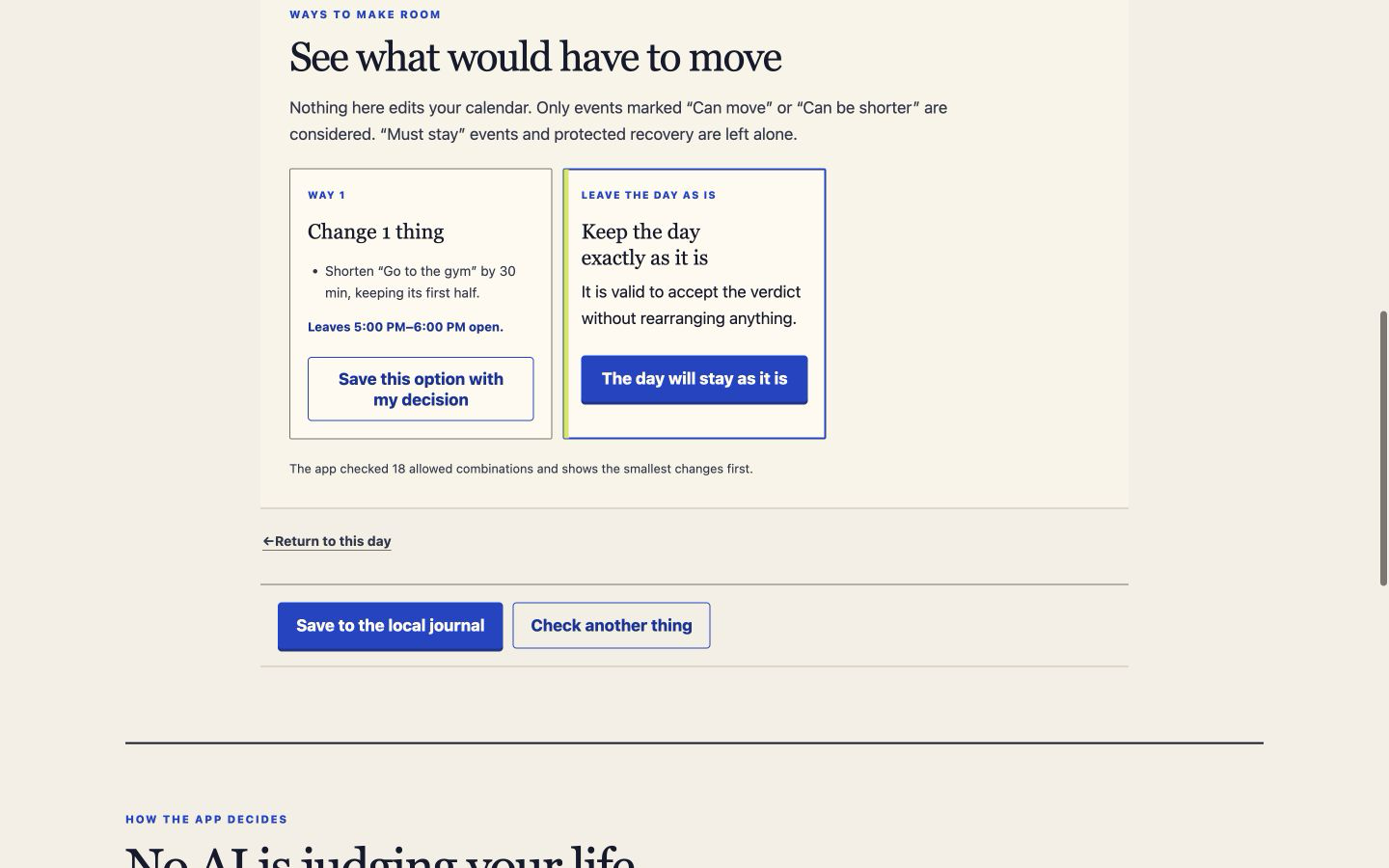
The room-making engine previews the smallest authorized changes that create time, without editing the calendar.
-
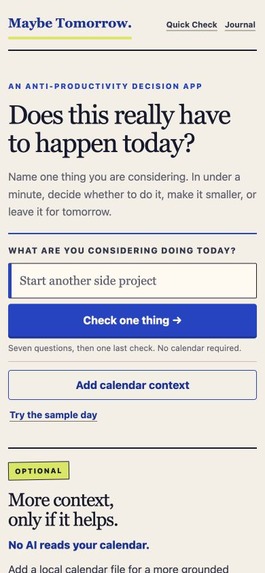
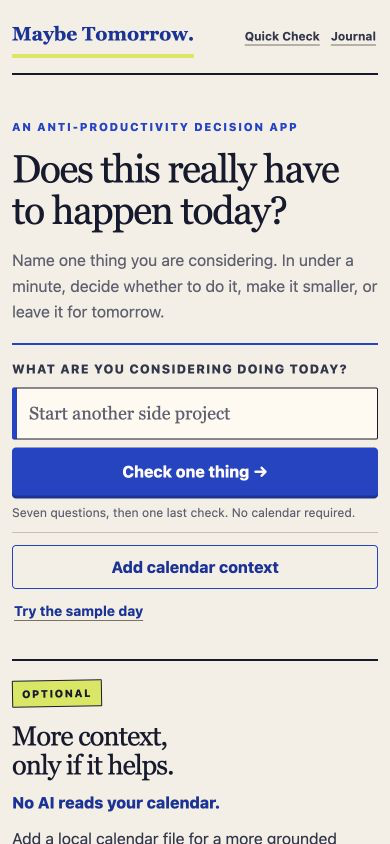
The complete Quick Check is mobile-first and comfortable on a narrow screen.
-
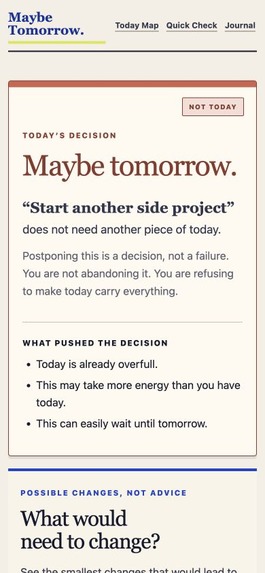
The same private, deterministic, and explainable verdict experience on mobile.
Inspiration
I am Yoshie Yamada, a novelist, freelance writer, parent, and independent creator. My problem has rarely been a lack of motivation. Work, fiction, family, exercise, learning, and new projects can all be genuinely important and enjoyable at the same time.
In 2025, the year I opened my sole proprietorship, I was taken to the emergency department after trying to carry too much at once. I kept adding meaningful work and creative projects. Exactly six months later, I was taken to the emergency department again.
I did not need another tool or friend saying, “You can do it.” I needed something willing to ask:
Does that really have to happen today?
Maybe Tomorrow. treats postponement as an intentional decision rather than a failure. It makes no medical claim.
What it does
Check one thing
A user names one proposed activity and answers seven five-point questions plus one question about whether the idea can be made smaller. A transparent, deterministic engine returns one of three verdicts and explains the leading factors. The core interaction is designed to take under a minute and requires no calendar.
The optional What would need to change? view checks all 78,125 combinations of the seven scored answers. It identifies the nearest facts that would have produced an adjacent verdict without changing the user's answers or generating persuasive advice.
Add optional calendar context
A user can import an .ics file or a Google Calendar export ZIP. The file is
parsed entirely in the current browser tab and is never uploaded. A bundled
fictional sample day lets judges test the complete flow without personal data.
The application never infers meaning from event titles. The user explicitly marks events as Must stay, Can move, Can be shorter, Takes a lot of energy, or Protected recovery. The Today Map reports occupied time, overlapping time, protected recovery, and the longest continuous opening without grading the day.
For a proposed activity, See what would have to move searches documented bounds of changes the human has authorized. Fixed commitments and recovery are protected. The app returns at most three smallest previews within that search and never edits the source calendar.
Completed decisions can be stored in a browser-local Decision Journal. Original files and complete calendar snapshots are never stored there.
How I built it
I am not a software engineer, and I did not manually write or edit the application code.
I developed the product with my long-term AI partner, Templex Tsukino, in ChatGPT using GPT-5.6 Sol. Our conversation began with my lived problem and the anti-productivity premise. Templex converted it into signed repository artifacts: product specifications, deterministic scoring rules, English UX copy, visual direction, privacy boundaries, implementation briefs, demo scenarios, and review criteria.
Codex implemented the React and TypeScript application, wrote and ran the tests, documented engineering decisions, configured deployment, and reported the work through the repository.
The repository became a governance layer between a human creator and two AI roles:
- I defined the lived problem, made product and trust decisions, tested the experience, and held final approval.
- Templex used GPT-5.6 Sol to turn those judgments into explicit rules and review gates.
- Codex translated approved documents into code, tests, issues, commits, pull requests, deployment, and evidence.
- I used the working product and reported where it was wrong.
- Templex reviewed the feedback; Codex refined the implementation; I approved release.
I directed part of the build away from my computer. At an internet cafe and a gym, I used a smartphone connected to Codex to continue giving instructions. I returned home to use the application, evaluate its language and interaction, and provide final review.
The public repository preserves this process through signed documents, timestamped commits, GitHub Issues #3 and #5, Pull Request #4, and the Codex worklog. This was not one-prompt generation. It was a documented human–AI–AI software-development loop.
How GPT-5.6 was used
GPT-5.6 Sol was used through Templex Tsukino to:
- identify the anti-productivity thesis from a personal pattern;
- define the exactly-three-verdict deterministic model and guardrails;
- write interface copy and explanation language;
- design the local-first privacy and trust boundaries;
- define the editorial visual identity;
- review Codex's larger Anti-Planner proposal in Issue #3;
- review the completed product after human testing and restore Quick Check as the primary experience in Issue #5; and
- create review gates that Codex could implement and verify.
The live app does not call GPT-5.6. The model's contribution is visible in the product architecture, decisions, signed documents, and review history.
How Codex was used
Codex was used to:
- implement the original Quick Check and the full local-first Anti-Planner;
- preserve one scoring engine across direct and calendar-aware paths;
- implement bounded ICS and ZIP parsing, recurrence and exception handling, and safe timezone behavior;
- create Today Map, the bounded room-making engine, the exhaustive Cost of Yes search, and the versioned Decision Journal;
- write deterministic unit and regression tests;
- test mobile and desktop browser behavior;
- respond to Yoshie and Templex review through issues and a pull request;
- refine the visual hierarchy, US English, and interaction copy; and
- document and deploy the finished application.
Codex accelerated the project by turning a repository-scale specification into a tested application in one focused cycle, then applying qualitative human review without weakening the deterministic engine or privacy boundary.
Challenges
Designing a brake without becoming judgmental
A tool that tells people to postpone things can become paternalistic or medically suggestive. The verdicts depend only on explicit answers, explain their factors, preserve genuine obligations, and allow the user to reject any calendar preview.
Adding calendar depth without violating trust
Live integration would have required OAuth, remote APIs, token handling, and a different privacy model. We chose honest local snapshot import. The app can see time structure, but it does not claim to know what an event means.
Making deterministic behavior useful
The product avoids runtime AI advice, but it is not a static questionnaire. Cost of Yes checks the complete finite answer space. The room-making engine ranks valid combinations of explicit human-authorized changes while protecting fixed events and recovery.
Keeping the product's center after expansion
The first expanded version made calendar context look like the main product. My browser review caught that. We restored a direct one-activity check as the first action and made calendar context visibly optional.
Collaborating without the human touching code
The challenge was making my product judgment precise enough to govern code I was not writing. Signed specifications, issues, review gates, worklogs, and reproducible demo paths made the collaboration inspectable and correctable.
Accomplishments
- A complete consumer product based on an inversion of productivity software.
- A core interaction designed for under a minute without calendar data.
- Browser-local ICS and calendar-export ZIP parsing with recurrence, exceptions, all-day events, embedded timezone support, limits, and safe text handling.
- Explicit human event classification with no title inference.
- A factual Today Map that does not grade the user's day.
- A deterministic room-making engine that protects fixed and recovery events.
- Exhaustive search of all 78,125 scored Quick Check states.
- A validated browser-local Decision Journal that excludes original calendar data.
- 71 tests passing across 10 files, plus strict TypeScript and production build checks.
- A distinctive after-hours-stationery / independent-magazine visual identity.
- A public repository documenting both the result and the human–AI–AI process.
- A non-engineer creator directed part of the build remotely, tested it as the first user, and shipped without manually editing application code.
What I learned
AI-assisted software creation is not only about generating code faster. It can separate roles more clearly. My lived experience and taste were not replaceable. GPT-5.6 was strongest when turning those judgments into explicit product logic and review criteria. Codex was strongest when translating a large approved scope into code, tests, evidence, and deployment. The repository made disagreements and corrections concrete.
Refusing runtime AI can also be a positive technical thesis. Users should be able to understand why this product asks them to stop. AI was used intensely to create it, while the shipped software declines to interpret private life on the user's behalf.
What comes next
The next work is not automatic feature growth. It is observing whether people understand the permission the product is trying to grant. Possible research includes broader usability testing, simpler explanations for rare import warnings, moving bounded parsing work into a browser worker, and Decision Journal export without accounts. Any read-only account integration would be a separate trust model, not a hidden upgrade to this release.
Built With
- chatgpt
- codex
- css
- fflate
- github
- github-actions
- gpt-5.6-sol
- ical.js
- localstorage
- react
- typescript
- vite
- vitest

Log in or sign up for Devpost to join the conversation.