Maya Care
A privacy-first, mobile baby care tracker built by a real family for the exhausting, beautiful, and highly disorganized first months of parenthood.

Repository: github.com/PaulHRios/Maya
Live Demo: Open Maya Care
Inspiration
Maya Care began as a personal project after the birth of my daughter, Maya.
During her first weeks, my partner and I constantly needed to remember when she had last eaten, slept, had a diaper change, received medication, or completed another part of her daily routine.
Like many new parents, we were exhausted. Important information was scattered across messages, notes, timers, and memory. Even a simple question such as:
When was her last bottle?
could become surprisingly difficult to answer at three in the morning.
I wanted to create one shared place where both caregivers could quickly record daily care without adding more mental load.
Maya Care was not originally designed as a competition project. It was built to solve a real problem inside my own family.
What it does
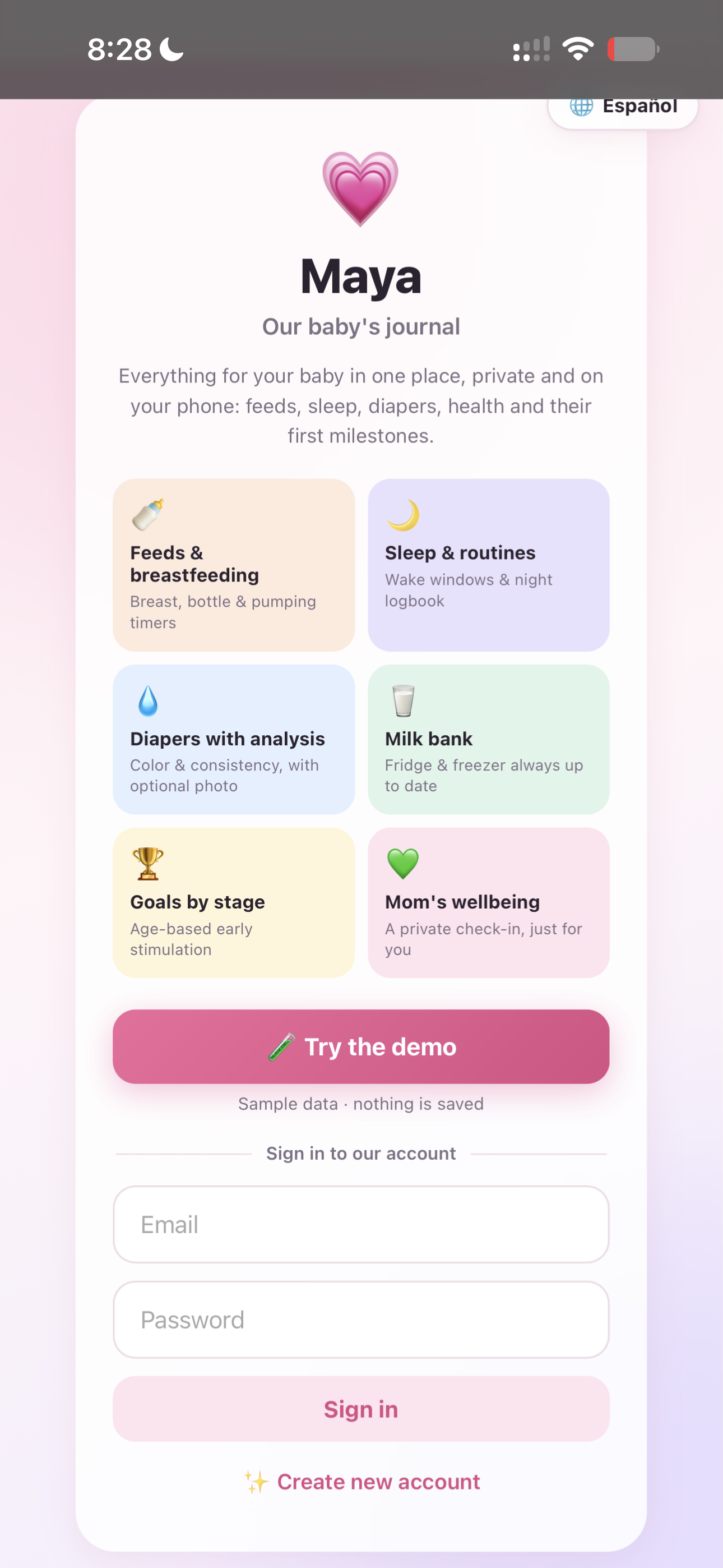
Maya Care is a privacy-first Progressive Web App designed for parents and caregivers.
It provides a mobile-first dashboard for recording, reviewing, and sharing a baby's daily care information.
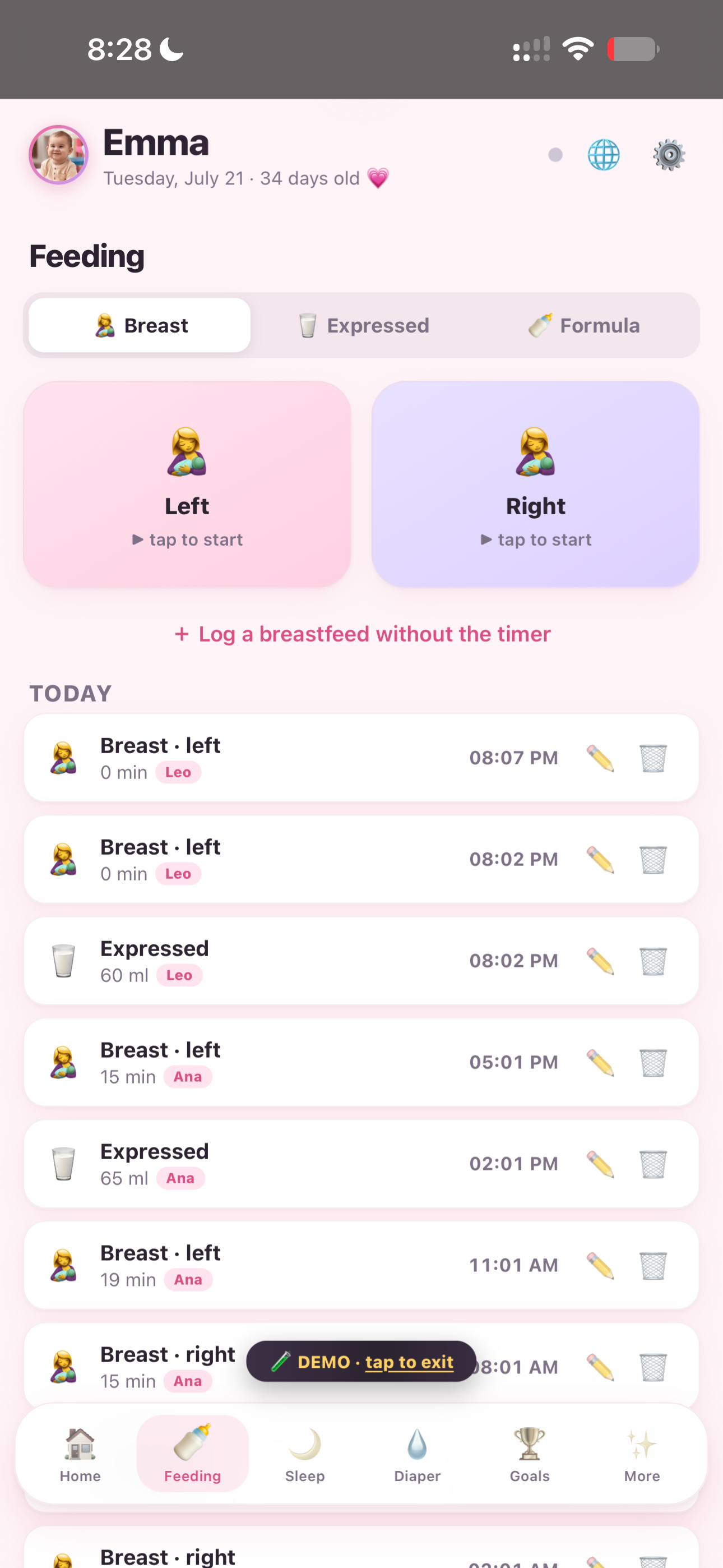
Feeding
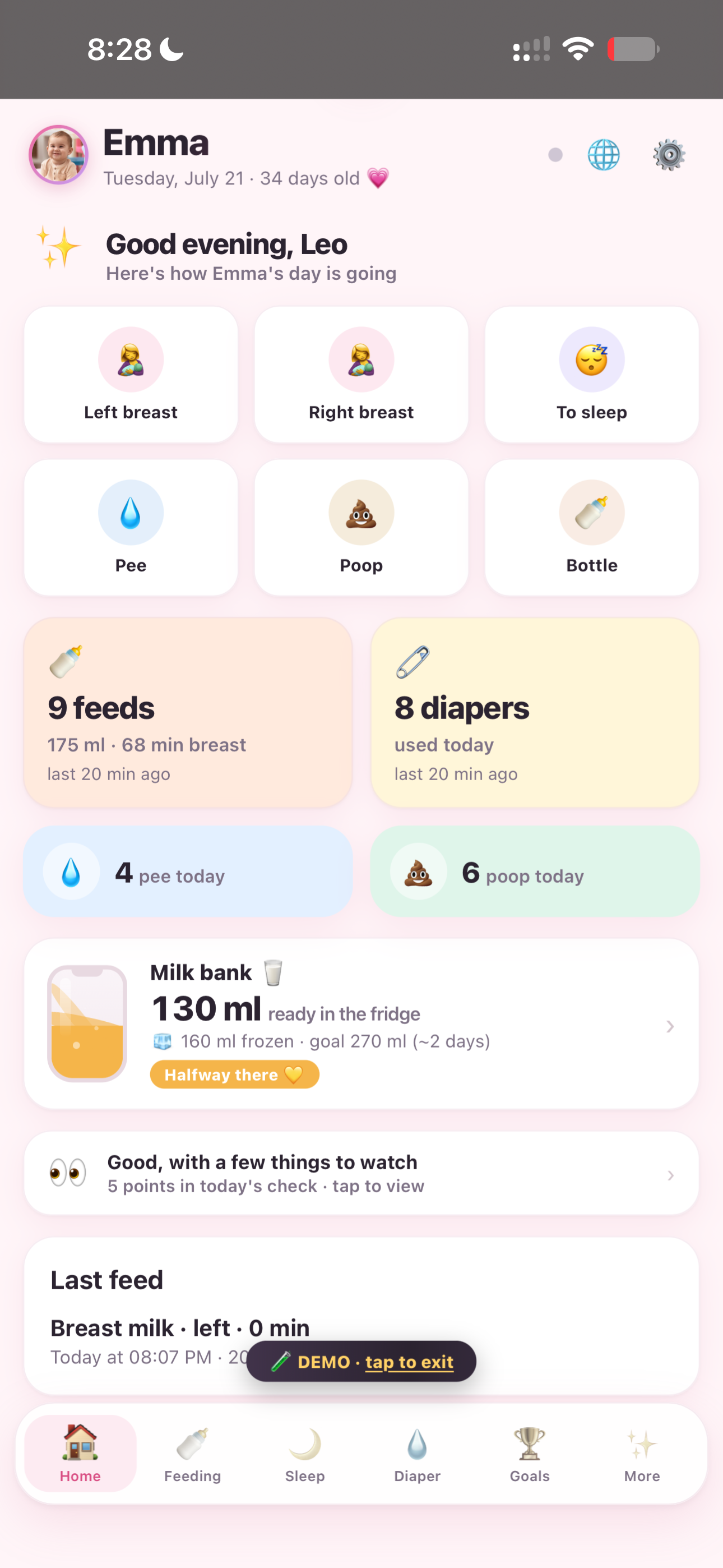
- Breastfeeding timers for the left and right sides
- Pause and resume support
- Expressed breast milk records
- Formula feeding records
- Bottle amounts in milliliters
- Caregiver authorship for each record
- Feeding history and daily totals
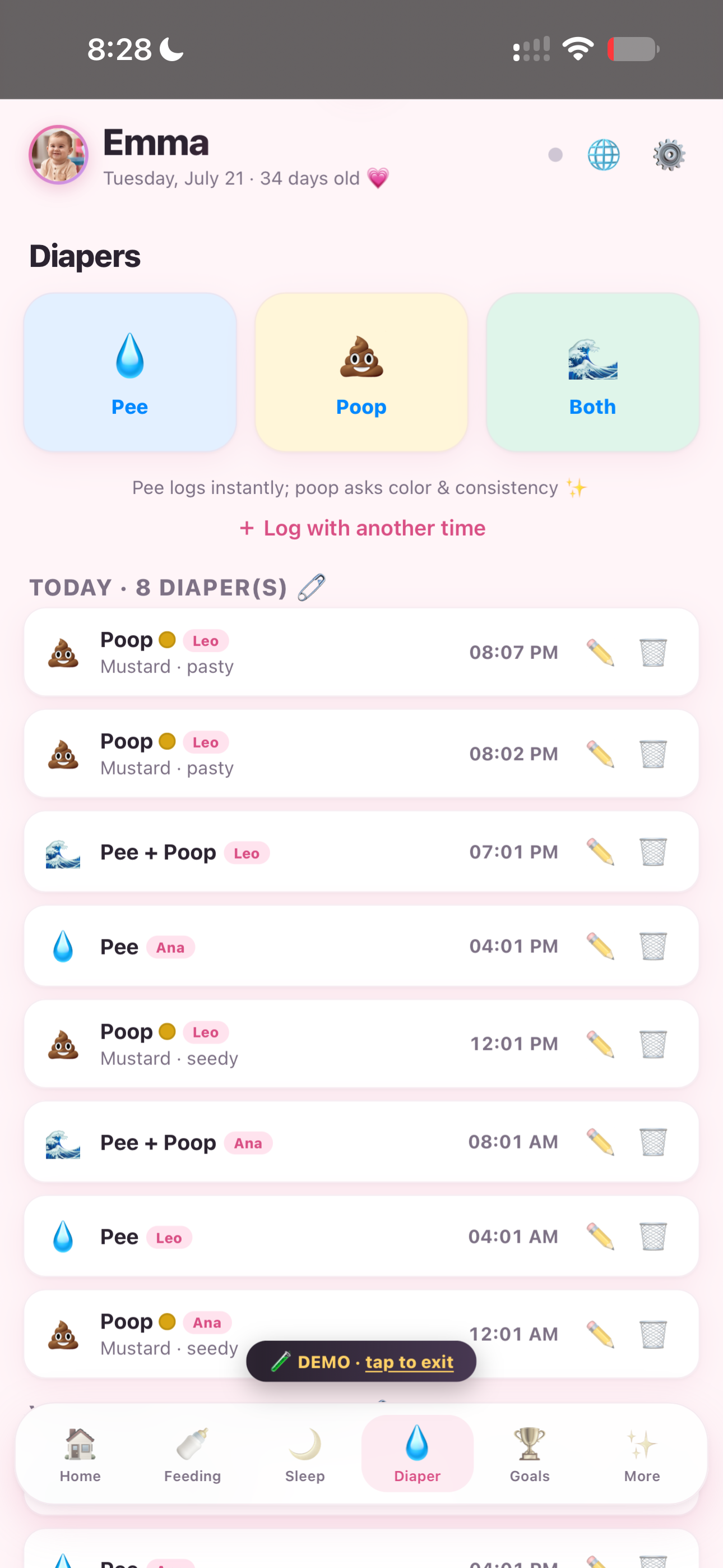
Diapers
- One-tap wet and dirty diaper logging
- Physical diaper inventory counter
- Daily diaper history
- On-device photo analysis that can suggest stool color and consistency
- Educational pediatric guidance without medical diagnosis
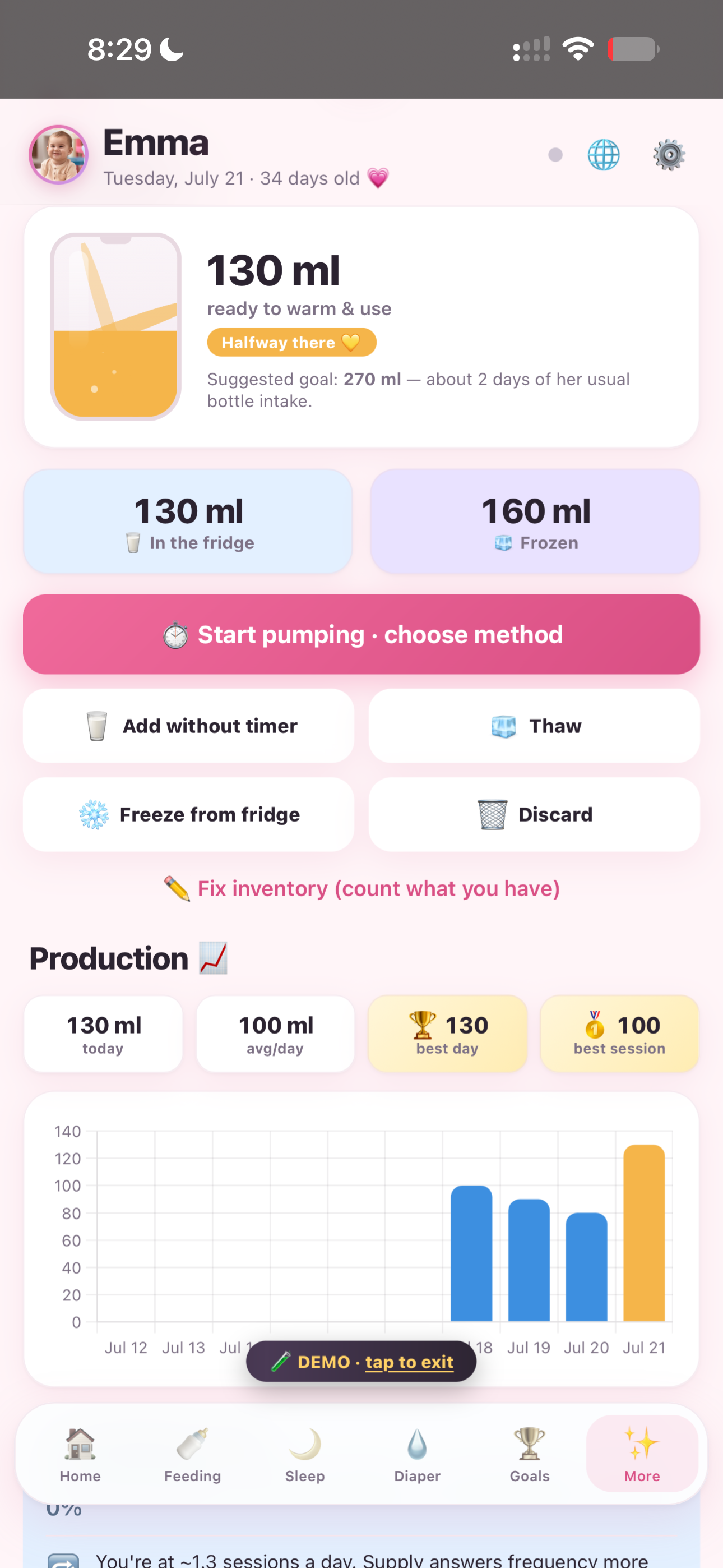
Breast milk inventory
- Refrigerator and freezer milk storage
- Visual inventory gauge
- Automatic deduction when stored milk is used
- Automatic inventory updates after pumping
- Inventory targets calculated from the baby's recorded intake
Pumping
- Guided pumping sessions
- Multiple pumping methods and routines
- Phase alerts and timers
- Production history
- Pumping charts
- Personal production records
- Adaptive coaching based on previous sessions
Sleep
- Sleep session tracking
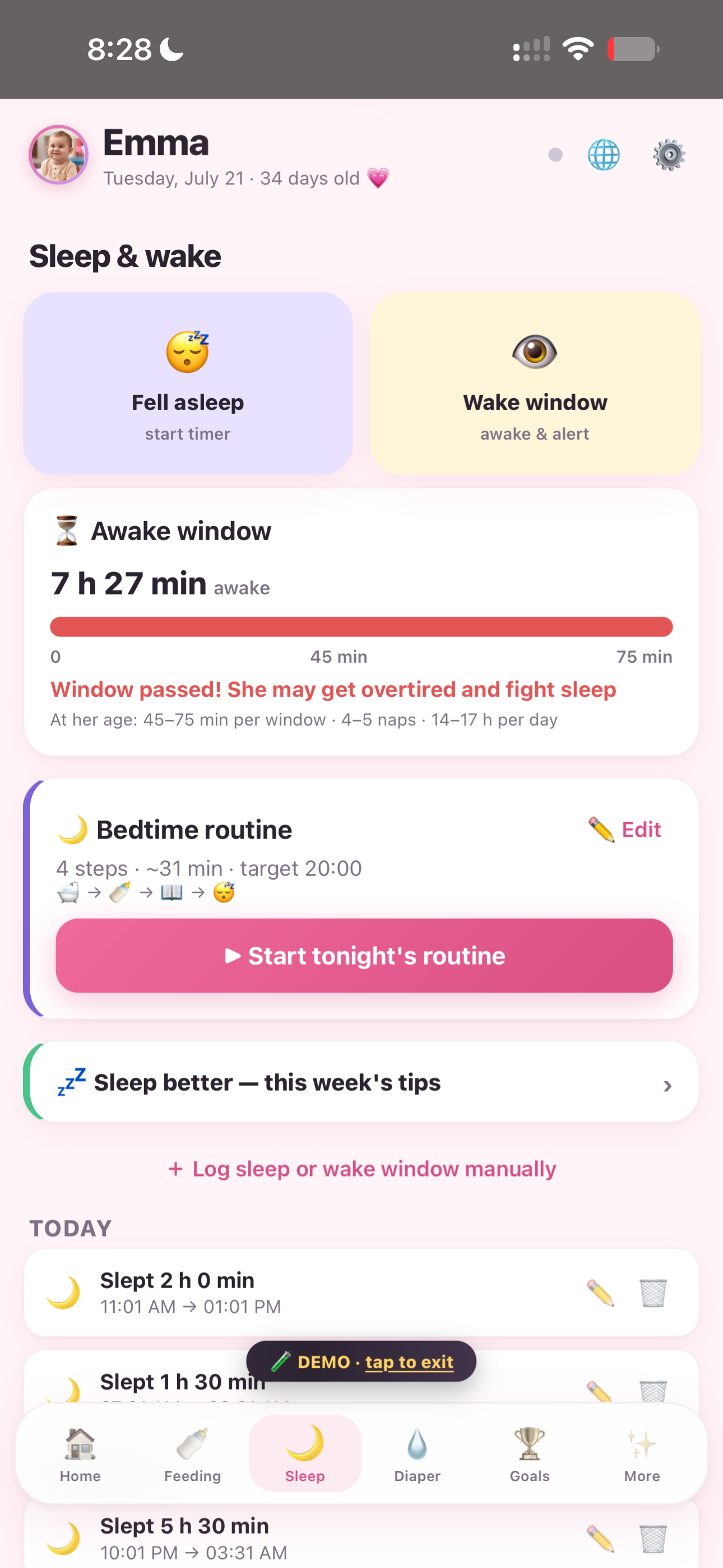
- Wake-window tracking based on age
- Visual wake-window status
- Night-vigil logbook
- Caregiver hand-offs
- Custom bedtime routines
- Guided bedtime routine mode
- Sleep history and data-based observations
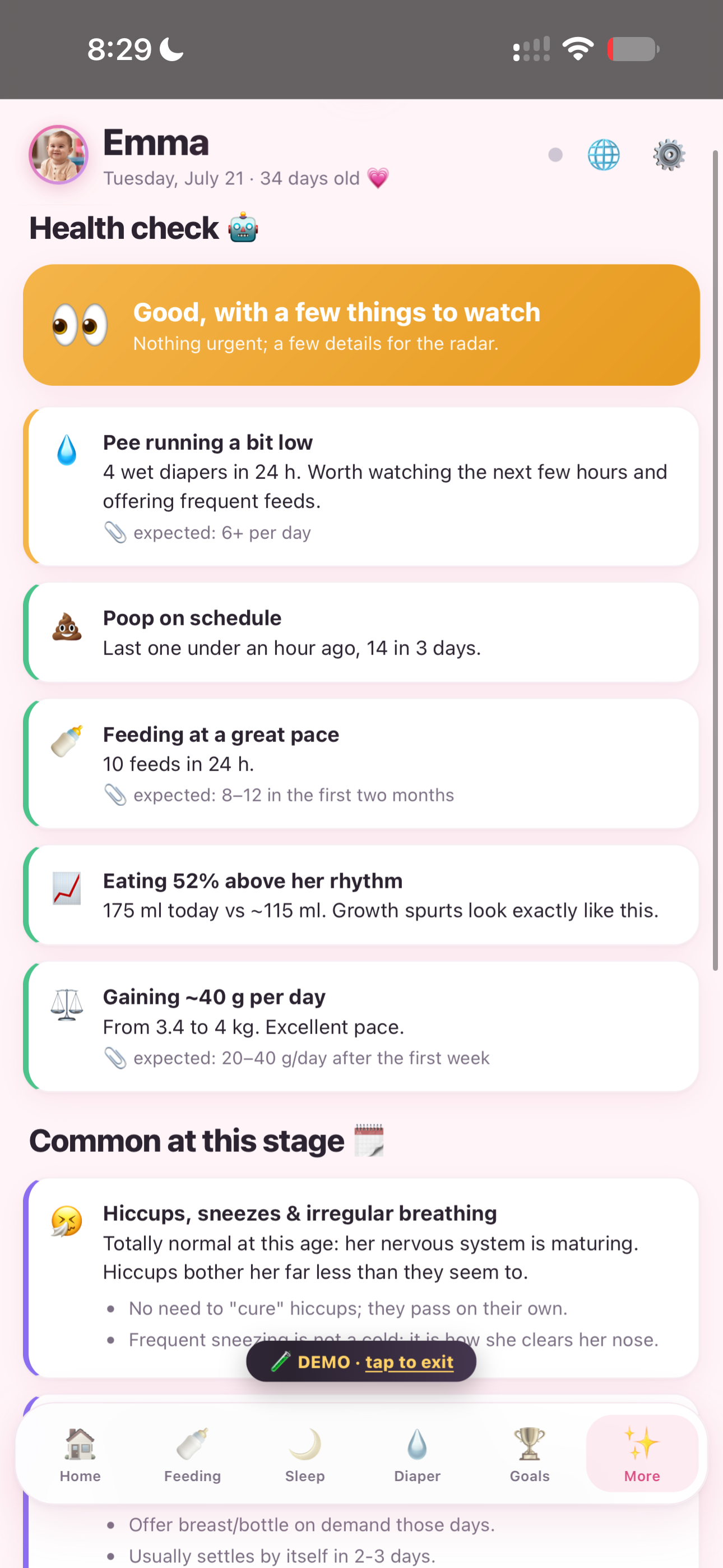
Health and development
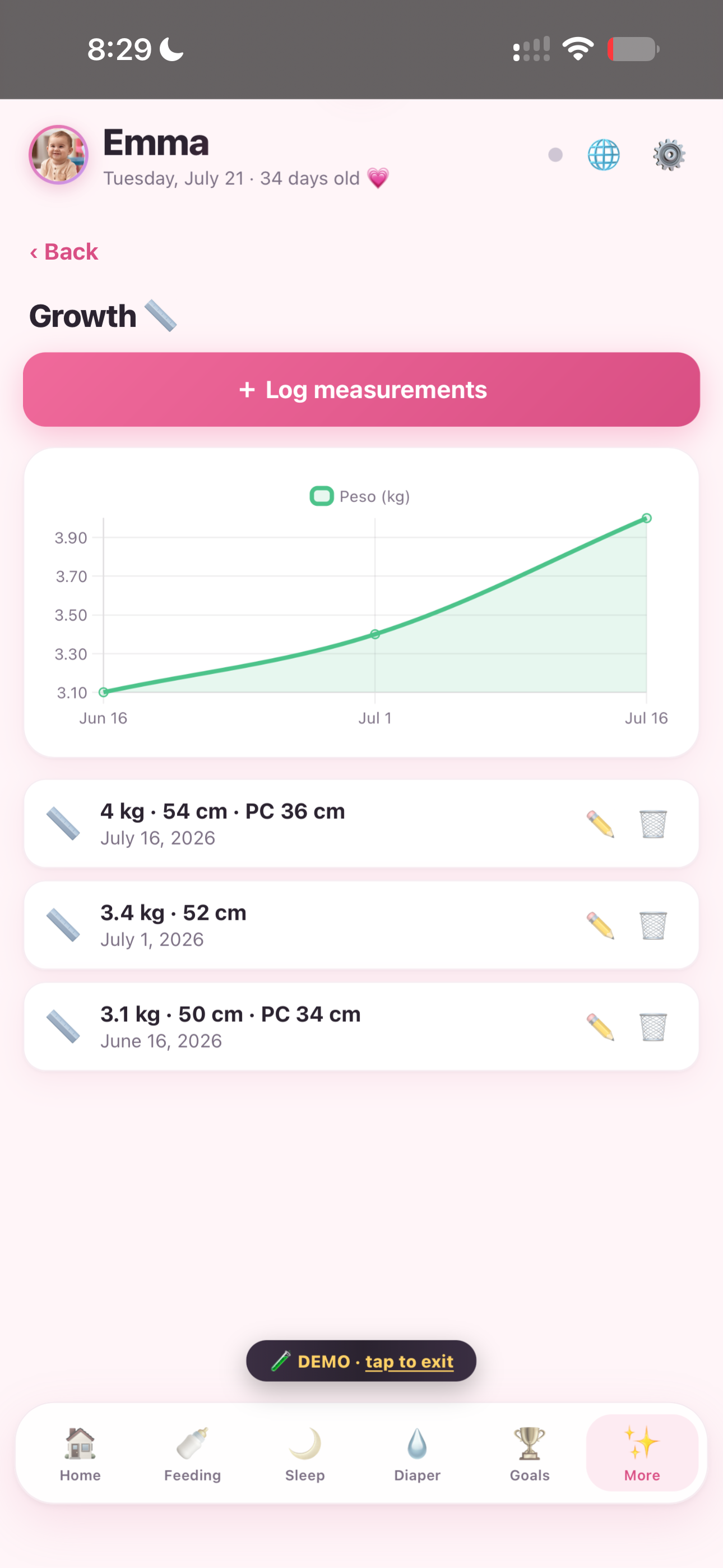
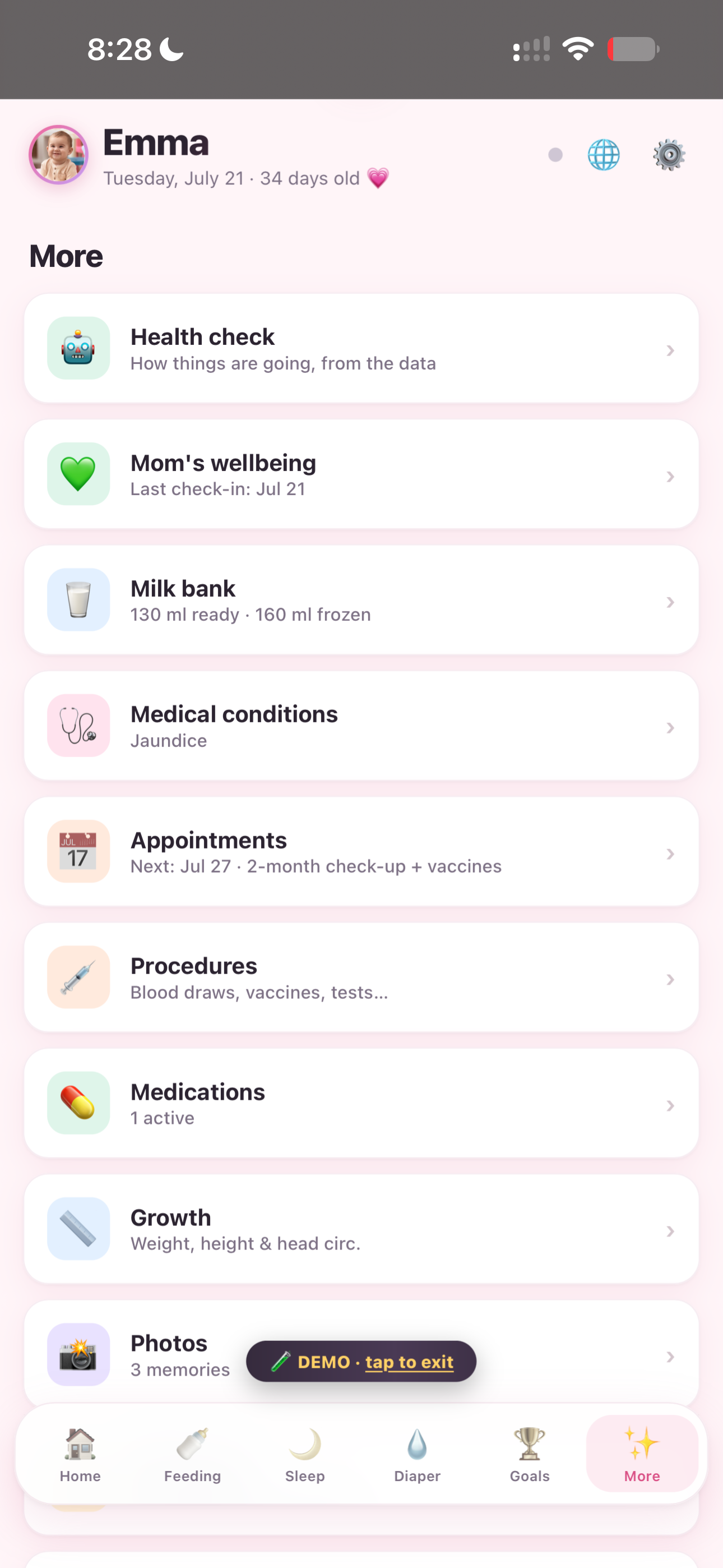
- Weight and growth tracking
- Feeding-frequency analysis
- Hydration-related tracking
- Weight trajectory observations
- Condition history
- Comparison against the baby's own previous baseline
- Stage-based guidance for events such as colic, teething, and sleep regressions
Daily activities
- Age-appropriate stimulation activities
- Activity timers
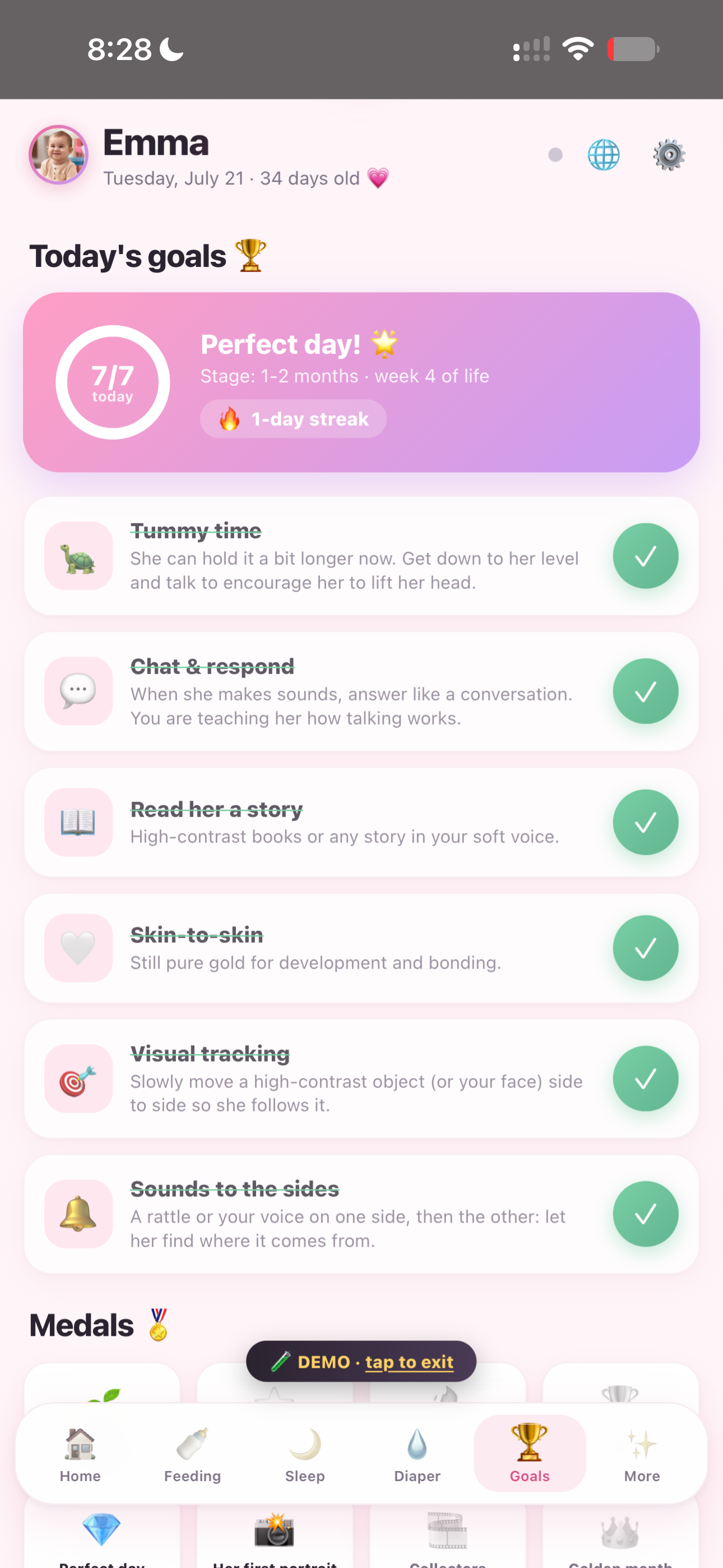
- Daily challenges
- Progress streaks
- Medals and completion records
- Additional activities related to active conditions
Caregiver wellbeing
Maya Care also includes a private maternal-wellbeing section based on the Edinburgh Postnatal Depression Scale.
The screening results remain private on the mother's device and include access to real support resources.
The EPDS is used only as a screening tool. It is not a diagnosis.
Medical organization
- Medication records
- Daily medication checklists
- Medical conditions and resolution status
- Appointment tracking
- Native calendar files using
.ics - Appointment reminders
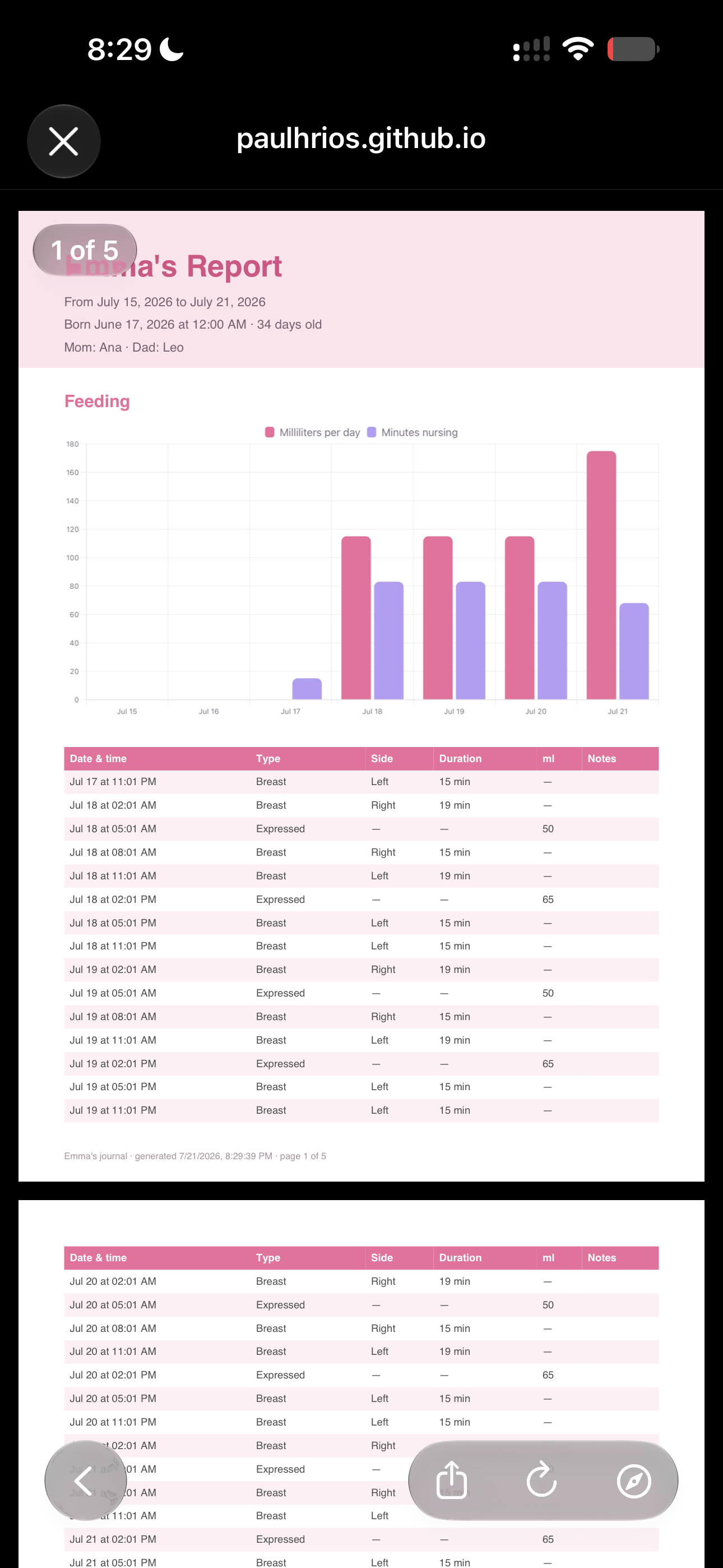
- Pediatrician-ready PDF reports
- Feeding, diaper, sleep, weight, and bilirubin charts
Additional features
- Support for up to five children
- Four visual themes
- Dark mode
- Weekly photo reminders
- Offline-first functionality
- Installation as a mobile PWA
- Shared synchronization between caregivers
- English and Spanish support
- Synthetic public demonstration mode
Privacy-first synchronization
Maya Care runs as a static application on GitHub Pages.
It does not require:
- A traditional backend
- A public user database
- Advertising trackers
- Analytics services
- A third-party baby-data platform
For private family use, caregiver devices synchronize through the family's own private GitHub repository.
The GitHub access token is encrypted using AES-GCM and can only be decrypted using the family's credentials.
The encryption key is derived with:
- PBKDF2
- SHA-256
- 310,000 iterations
- Credential-specific encryption
Plaintext credentials and access tokens are never intentionally committed to the public repository.
Public demonstration
The public demo uses a fictional baby named Emma.
It generates four days of realistic synthetic records directly inside the browser using localStorage.
The demonstration:
- Does not contain Maya's real medical information
- Does not use real family photographs
- Does not include private credentials
- Does not connect to the family's private data repository
- Does not upload demonstration information to a server
- Cannot access the production family's records
This separation allowed me to demonstrate the complete product without exposing private information belonging to my daughter or my family.
How I built it
Maya Care was built as a lightweight Progressive Web App using:
- HTML
- CSS
- Vanilla JavaScript
- Progressive Web App technologies
- Service workers
- GitHub Pages
- GitHub Contents API
- Chart.js
- jsPDF
- Local browser storage
- Web Crypto API
- AES-GCM encryption
- PBKDF2-SHA256 key derivation
- Synthetic demonstration data
- Offline caching
- Responsive mobile-first design
The project does not require a build step.
Libraries such as Chart.js and jsPDF are stored locally so important functionality remains available offline.
Data synchronization
Records are stored in append-friendly collections and merged using:
- Unique record IDs
updatedAttimestamps- Tombstones for deleted records
- Conflict-aware merging
- Device synchronization through the GitHub Contents API
This allows both caregivers to contribute records without relying on a conventional application server.
Offline support
The service worker uses a network-first strategy for the application shell with a complete offline fallback.
Caregivers can continue accessing important parts of the application even when the internet connection is weak or temporarily unavailable.
That matters in places where mobile reception is unreliable, which apparently still exists despite humanity putting computers in watches.
How I used OpenAI
For OpenAI Build Week, I used OpenAI Codex with GPT-5.6 to review and extend the existing project.
Codex helped me:
- Audit the existing codebase
- Identify privacy and security risks
- Separate private family data from the public demonstration
- Prototype an encrypted local account vault
- Design the contract for a structured insights engine
- Define confidence levels for generated observations
- Compare activity against the baby's own baseline
- Create synthetic demonstration scenarios
- Develop security and privacy tests
- Improve validation and maintainability
- Prepare the project for safe public deployment
The GPT-5.6-assisted work was integrated and expanded into the final application through:
- The local analysis engine
- The public demo mode
- Per-credential encrypted secrets
- Privacy-focused validation
- Structured insights
- Security testing
The deployed health-analysis system runs locally on the caregiver's device.
Maya Care does not send private baby information to an AI model for medical diagnosis.
Challenges
Protecting real family information
The original application was built for actual family use.
It contained real routines, records, photographs, medication information, credentials, and personal data.
Publishing the project required a complete separation between:
- Production family data
- Public demonstration data
- Authentication credentials
- API access tokens
- Medical records
- Uploaded photographs
- Local caregiver information
Creating a realistic demo without exposing real family information became one of the most important parts of the project.
Synchronizing without a conventional backend
I wanted the application to remain lightweight and avoid maintaining a traditional server and account database.
Using a private GitHub repository as a data store created several technical challenges:
- Concurrent edits from different devices
- Duplicate records
- Deleted-record synchronization
- Offline changes
- Merge conflicts
- Authentication
- Secure token storage
I addressed these problems with timestamped records, unique IDs, tombstones, conflict-aware merging, and encrypted access credentials.
Designing health-related features responsibly
Baby care is a sensitive context.
The application needed to help caregivers recognize patterns without pretending to replace a doctor.
To maintain that boundary:
- Analysis is based only on recorded caregiver data
- Observations are compared against the baby's own baseline
- Medical diagnoses are avoided
- Confidence levels are included where appropriate
- Guidance remains educational
- Caregivers are encouraged to consult a pediatrician for medical concerns
- EPDS results are treated as screening information, not a diagnosis
Building for exhausted users
A baby tracker can contain dozens of features and still fail if recording a bottle requires too many steps.
The interface had to remain usable:
- With one hand
- While holding a baby
- During the night
- Under stress
- With limited attention
- With an unreliable internet connection
This required careful attention to navigation, timers, button placement, visual hierarchy, responsive design, and offline behavior.
Accomplishments that I am proud of
- Building a real product used by my own family
- Creating a complete mobile-first PWA without a frontend framework
- Supporting private synchronization without a conventional backend
- Encrypting repository credentials locally
- Building a realistic synthetic public demonstration
- Supporting feeding, diapers, sleep, pumping, medication, growth, and appointments
- Creating pediatrician-ready PDF reports
- Supporting up to five children
- Adding offline functionality
- Building bilingual English and Spanish support
- Creating local insights based on each baby's own baseline
- Maintaining a clear boundary between care tracking and medical diagnosis
- Turning a personal family tool into a project that other caregivers can study and adapt
What I learned
This project taught me that useful products often begin with small, repetitive problems.
Parents do not necessarily need more information. They need less friction.
A caregiver should not have to search through messages, remember several timers, or open multiple applications just to understand what happened during the last few hours.
I also learned that privacy cannot be treated as a feature added at the end.
When an application handles information about a child, privacy affects:
- The architecture
- Authentication
- Data storage
- Demonstration environments
- Testing
- User experience
- AI integration
- Public deployment
OpenAI Codex was most valuable when it helped me examine the system more critically, identify risks, structure complex changes, and test assumptions.
The lesson was not simply that AI can generate code.
The more important lesson was that AI can help a developer reason about a product's architecture, safety, privacy, and edge cases, provided the developer remains responsible for the final decisions.
What's next for Maya Care
Future development will focus on:
- Voice-based quick logging
- Natural-language care-event entry
- Easier multi-caregiver account setup
- More robust offline conflict resolution
- Custom pediatrician report templates
- Improved accessibility
- Additional languages
- Secure backup and account recovery
- Optional reminder notifications
- Better long-term trend visualization
- Simplified encrypted repository configuration
- Native iOS and Android versions
- Optional integrations with health and baby-care devices
The long-term goal is to make Maya Care a practical, private, and reliable companion that reduces the organizational burden of caring for a baby without replacing caregiver judgment or professional medical care.
Safety disclaimer
Maya Care provides organizational tools and general educational guidance. It is not a medical device, does not provide medical diagnoses, and does not replace a pediatrician or other qualified healthcare professional.
Links
- GitHub: https://github.com/PaulHRios/Maya
- Interactive Demo: https://paulhrios.github.io/Maya/index.html?demo=1
- Demo Landing Page: https://paulhrios.github.io/Maya/demo.html


Log in or sign up for Devpost to join the conversation.