Inspiration
Useful local information should reach people along the paths of their everyday lives—not only when they remember to search for it.
Municipalities manage road construction and traffic restrictions. Communities organize events. Local businesses and public facilities publish announcements. Yet putting this information on a website does not necessarily bring it to the people who need it.
Our joint pilot project with Nishiwaki City in Hyogo Prefecture, Japan, makes this challenge concrete.
The pilot focuses on real-time road construction and traffic restriction information originating within municipal operations. Some of this information is known only to the administration until it is actively published. It cannot simply be reconstructed by searching existing websites or collecting community reports. Our goal is to bring municipality-held information approved for public release into a shared regional information platform and distribute it beyond a single municipal website.
During our pilot discussions, we also agreed to include the registration of disaster-related information and evacuation shelter information. In Japan, disaster preparedness makes timely, accessible local information especially important.
Language creates another barrier. A neighborhood event or a local administrative notice may be useful to international residents and visitors, but remain difficult to discover or understand in Japanese.
These challenges led us to a simple question:
Could an affordable Fire TV device—including one already sitting unused—turn an existing screen into a useful, multilingual access point for local information?
What it does
Mawarimichi Signage turns compatible Amazon Fire TV devices and existing displays into configurable community information screens.
It connects to Mawarimichi, our regional information platform, so that each venue can combine selected administrative information and open data, approved community contributions, and its own announcements.
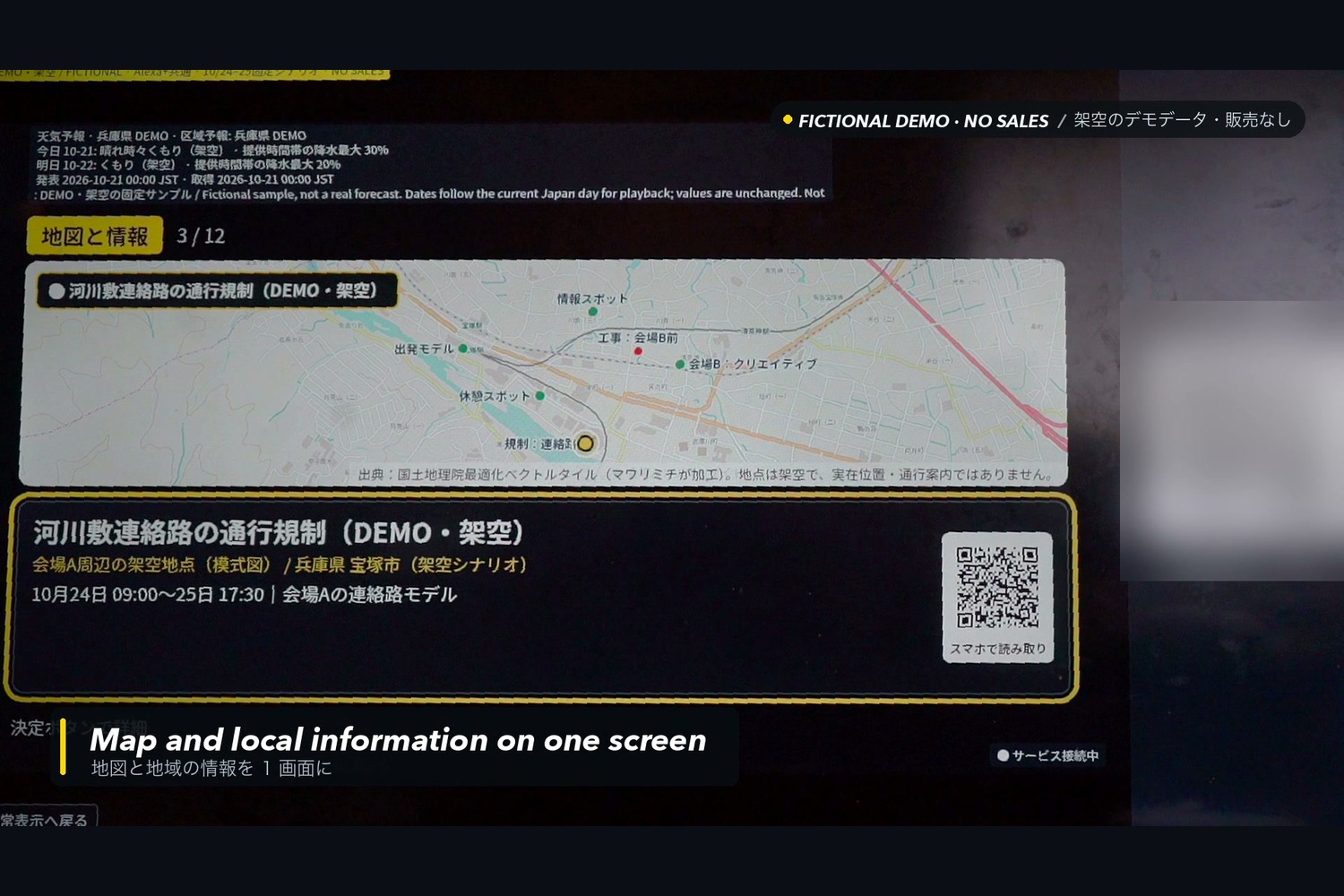
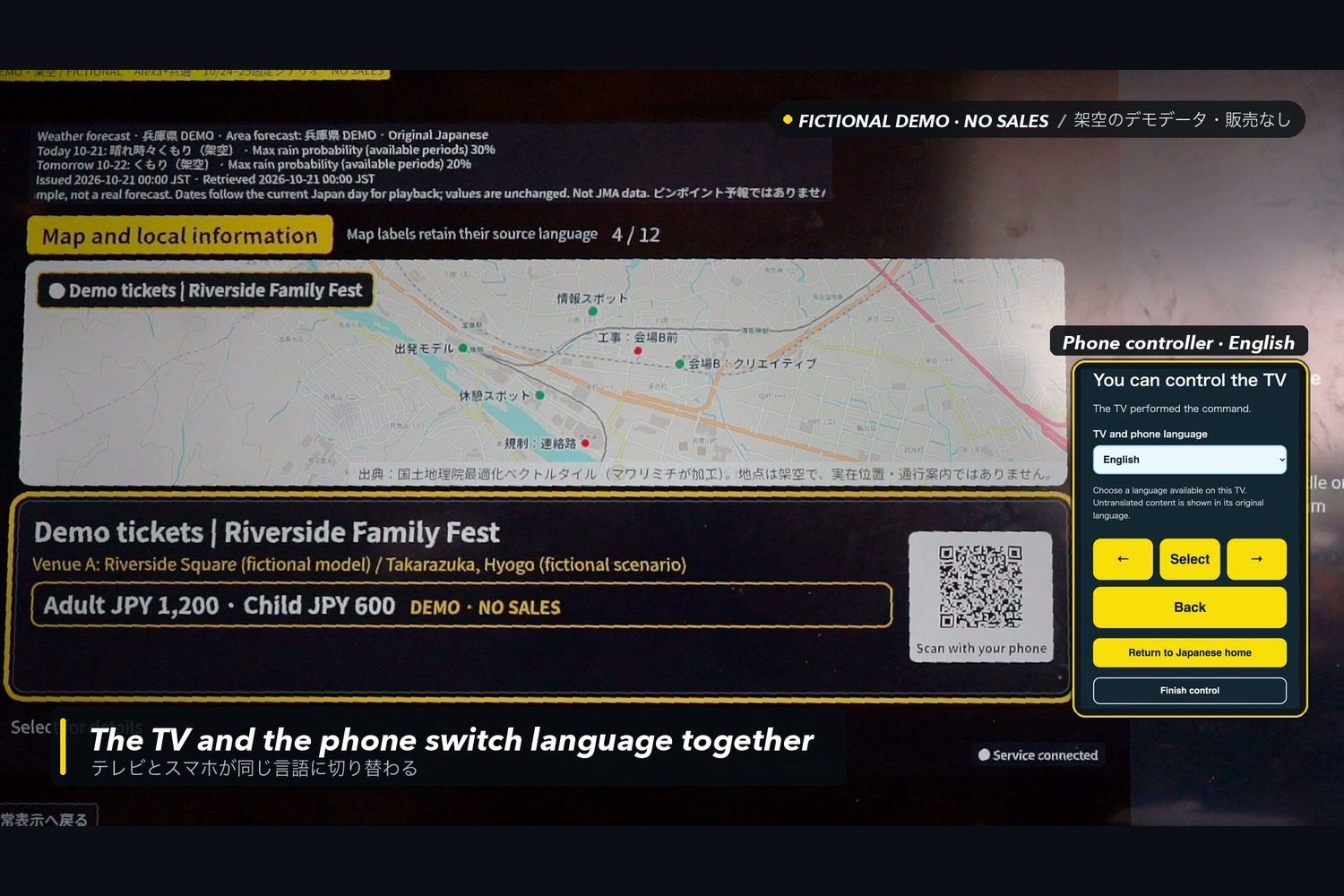
The signage application displays posts, images, videos, and maps, with remote-control interaction and QR codes connecting viewers to further information on their phones.
A community center can combine municipal notices with neighborhood activities.
A neighborhood shopping district can bring together announcements from individual shops, local events, and relevant municipal information on shared displays, helping visitors discover more shops and activities throughout the area.
A hotel lobby can show nearby events, relevant road restrictions, and hotel announcements.
This flexibility matters: each operator chooses what is relevant to its location and audience rather than receiving the same fixed information feed everywhere.
Connecting official and community information
The wider Mawarimichi platform allows people and organizations to contribute regional information, including events and ticket offerings. The account responsible for each publication destination controls approval of what appears there.
This allows community information to appear alongside administrative information while preserving their different sources and publication responsibilities. A resident's event announcement does not become an official government statement simply because the two share a screen.
For the Nishiwaki pilot, the scope includes municipal road construction and traffic restriction information, together with the agreed registration of disaster-related information and evacuation shelter information.
The aim is to connect information originating within municipal operations with the places where residents and visitors actually spend time.
Reaching people across language barriers
Mawarimichi includes AI-powered translation, helping international residents and visitors access local events and municipal information that would otherwise be difficult to understand.
The goal is not only to translate major tourist information. It is also to make small community events, neighborhood activities, and everyday administrative updates accessible beyond Japanese-speaking audiences.
Combining translation with multiple delivery channels addresses two different barriers: where people encounter information and which language they can understand.
One information platform, multiple ways to reach people
Fire TV signage is one delivery channel within Mawarimichi's broader approach, which also includes websites, maps, and AI-based information access.
Mawarimichi's own analytics distinguish access through web, AI, and signage channels, helping publishers understand how people reach their information. Complementary services, including surveys, support additional uses such as gathering feedback.
The aim is to avoid creating another isolated information system for every screen or venue. Mawarimichi serves as the shared information hub, while each delivery channel makes that information accessible in a different setting.
How we built it
Mawarimichi is an existing regional information platform. This submission focuses on the Fire OS signage application and its integration with that platform, rather than presenting the entire platform as something newly created for this hackathon.
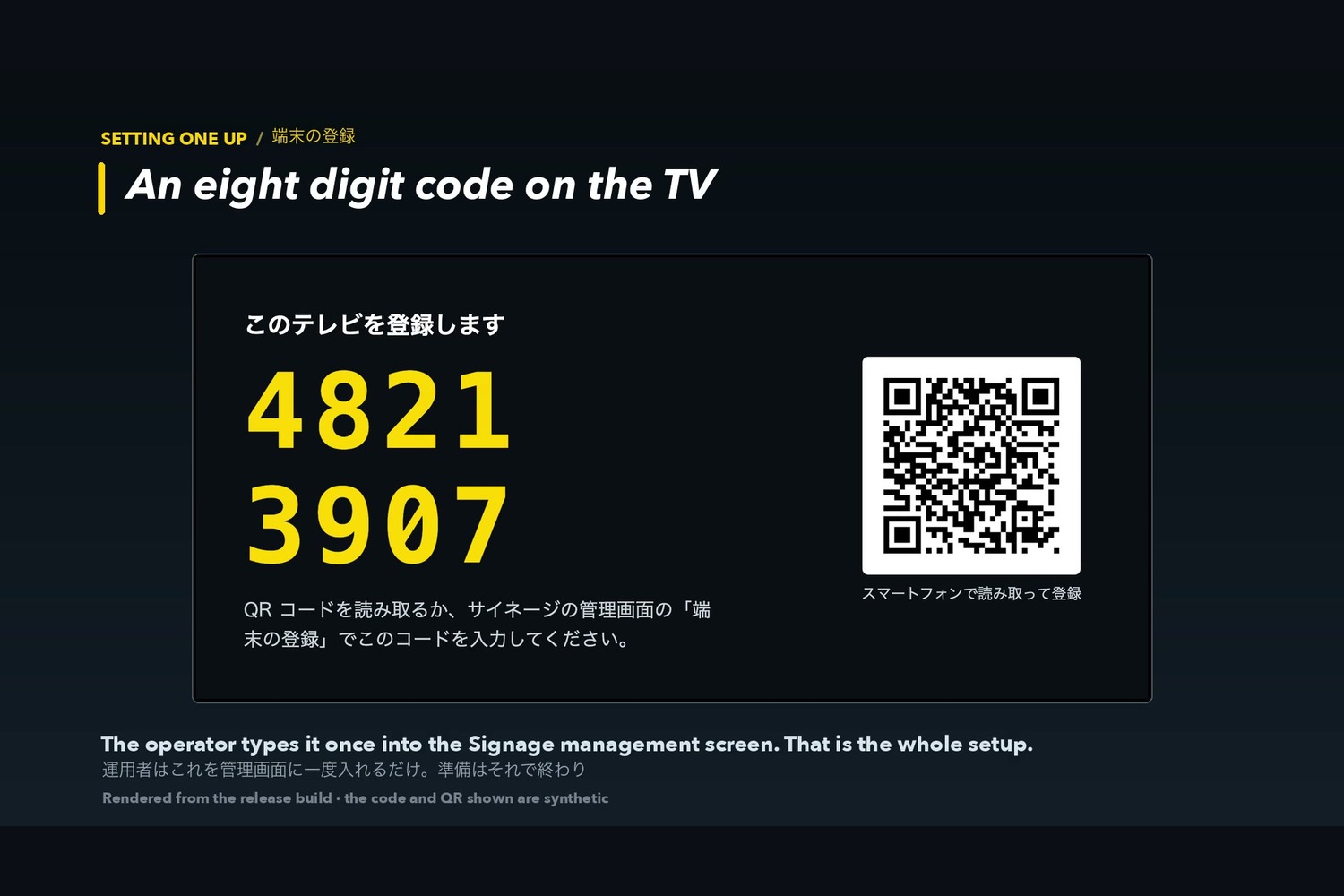
We use Mawarimichi as the shared content and management backend. Each signage device is registered and linked to a Space—a managed collection of content and settings within the platform.
This allows the display application to use existing content-management and publication workflows instead of requiring operators to maintain a separate signage-only content management system.
The signage work includes mixed-content playback, maps, QR codes, remote-control navigation, device registration, Space assignment, offline handling, restart recovery, and analytics integration. These capabilities support a display intended to operate without someone continuously interacting with it.
The Fire OS version is complete. We purchased a Fire TV Stick and have repeatedly tested the application on the physical device connected to our own display.
Our development and testing therefore include real Fire TV hardware, not only emulator-based validation.
The source code for this submission is provided in our private GitHub repository, and the designated reviewers have been invited:
https://github.com/katsuakikureyama/mawarimichi-signage-firetv-app-2026
Challenges we ran into
Building signage, not just a webpage on a television
A screen that looks correct during a demonstration is only part of the problem.
A signage application must also be practical to operate: someone needs to register the device, select the right content, navigate with a remote control, and keep the display useful during everyday operation.
Connectivity interruptions, restarts, and unattended playback make device behavior an important part of the product—not an afterthought.
Combining information without losing publication control
Municipal notices, community events, and a venue's own announcements can all be useful on the same screen, but they have different publishers and responsibilities.
The challenge is to make them work together without creating an uncontrolled feed or implying that every community contribution has been endorsed by the municipality.
Mawarimichi's publication-approval approach allows each destination to control its content while drawing from a shared information platform.
Keeping timely information meaningful
Disaster-related and road restriction information introduce requirements beyond ordinary promotional signage.
Keeping a screen running is not the same as keeping its information current. Cached content must not be confused with a live update. A designated evacuation shelter's location also does not automatically mean that the shelter is currently open.
These distinctions are part of the publication and operational workflows to be evaluated in the municipal pilot. Multilingual access must support clarity without obscuring the original source or the timing of an update.
Accomplishments that we're proud of
We have completed a working Fire OS signage application, tested it repeatedly on a physical Fire TV Stick, and connected it to a real municipal use case.
Through Hyogo Prefecture's Hyogo TECH initiative, Tulipa Design is working with Nishiwaki City on a joint pilot. This gives the project a concrete setting in which to evaluate how information held within municipal operations can reach residents through maps and everyday screens.
We are proud of bringing several needs together: reusing affordable consumer devices and existing displays, combining administrative and community information under publication controls, and using AI translation to extend access beyond Japanese-speaking audiences.
We are also building for more than one type of venue. Public facilities, shopping districts, hotels, and individual businesses can use the same platform while selecting information suited to their own audiences.
The result is more than a standalone display application. It is another way for a shared regional information platform to reach people in the physical spaces around them.
The same infrastructure can support everyday community life while providing an additional channel for municipality-approved information when circumstances change.
What we learned
Publishing information and actually reaching people are different problems.
A useful notice can still go unnoticed when someone does not know which website to visit. A local event can remain inaccessible when its description is available only in an unfamiliar language.
Shared screens, QR codes, translation, and conversational interfaces serve different needs. Their value increases when they connect to the same underlying information rather than requiring each channel to be maintained separately.
We also learned to think about the display operator as well as the viewer. A community center, a shopping district, and a hotel may draw from the same regional information, but need different combinations of content and different publication choices.
Real-device testing keeps attention on practical operation, not just how the interface looks during development.
Finally, we learned that trusted local information depends on both technology and responsibility. The system needs useful delivery channels, but it also needs clear decisions about who publishes, who approves, and how information is updated.
What's next for Mawarimichi Signage
Our immediate next step is to deploy and evaluate the completed Fire OS application through the Nishiwaki City pilot.
The focus is now on field operation: how municipal staff register and publish information, how venues select and display it, and how updates reach the people who need them.
The pilot will address real-time municipal road construction and traffic restriction information. It will also include the agreed registration of disaster-related information and evacuation shelter information, with appropriate attention to sources, update procedures, and the distinction between designated locations and confirmed operational status.
We will use the field trial to refine installation and management workflows, multilingual presentation, long-running playback, and operation under changing connectivity conditions.
Extending access through AI and in-vehicle navigation
Beyond signage, Mawarimichi aims to bring the same regional information into more of the places and situations where people need it: websites, AI-powered search, conversations, and in-vehicle navigation.
Alongside our ChatGPT integration, our separate Alexa+ and MCP project extends this approach to natural-language access, with the goal of making useful local information available to more people.
We also aim to provide municipal road construction and traffic restriction information to Japan's VICS ecosystem, so that relevant updates can reach drivers through compatible car navigation systems, including voice guidance.
This is a planned information-delivery channel, not a claim that VICS integration is already operating. It extends the same principle beyond screens in buildings: useful information should reach people while they are moving through the community.
Expanding together with Hyogo Prefecture
Following the Nishiwaki City pilot, we aim to work together with Hyogo Prefecture to expand this approach to other municipalities.
Our ambition is not to stop at a single-city demonstration. We want to develop an approach that other municipalities can adopt, with community centers, shopping districts, hotels, and local businesses serving as information access points suited to their own audiences.
Mawarimichi is the hub connecting these channels. Fire TV makes it possible to add physical information access points using affordable, familiar devices rather than requiring dedicated signage hardware at every location.
Our goal is to make useful, trusted local information flow naturally into everyday life—across languages, through the web and AI, onto shared screens, and into vehicles.


Log in or sign up for Devpost to join the conversation.