-
-
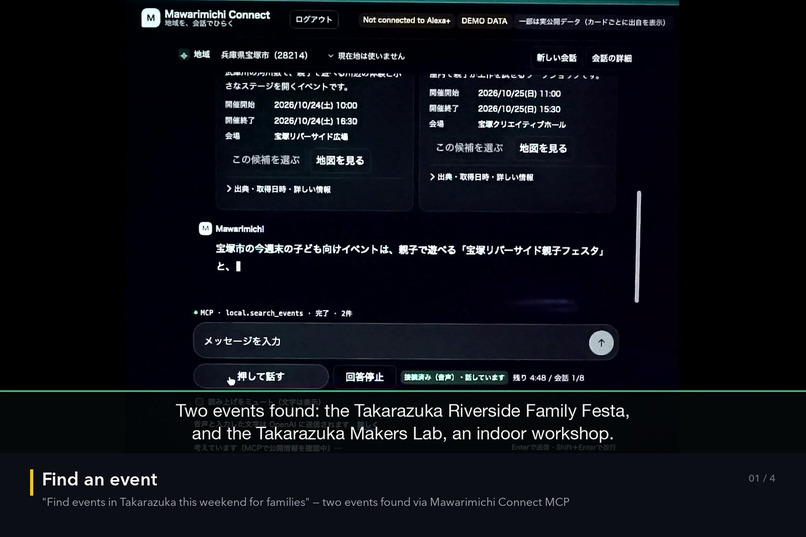
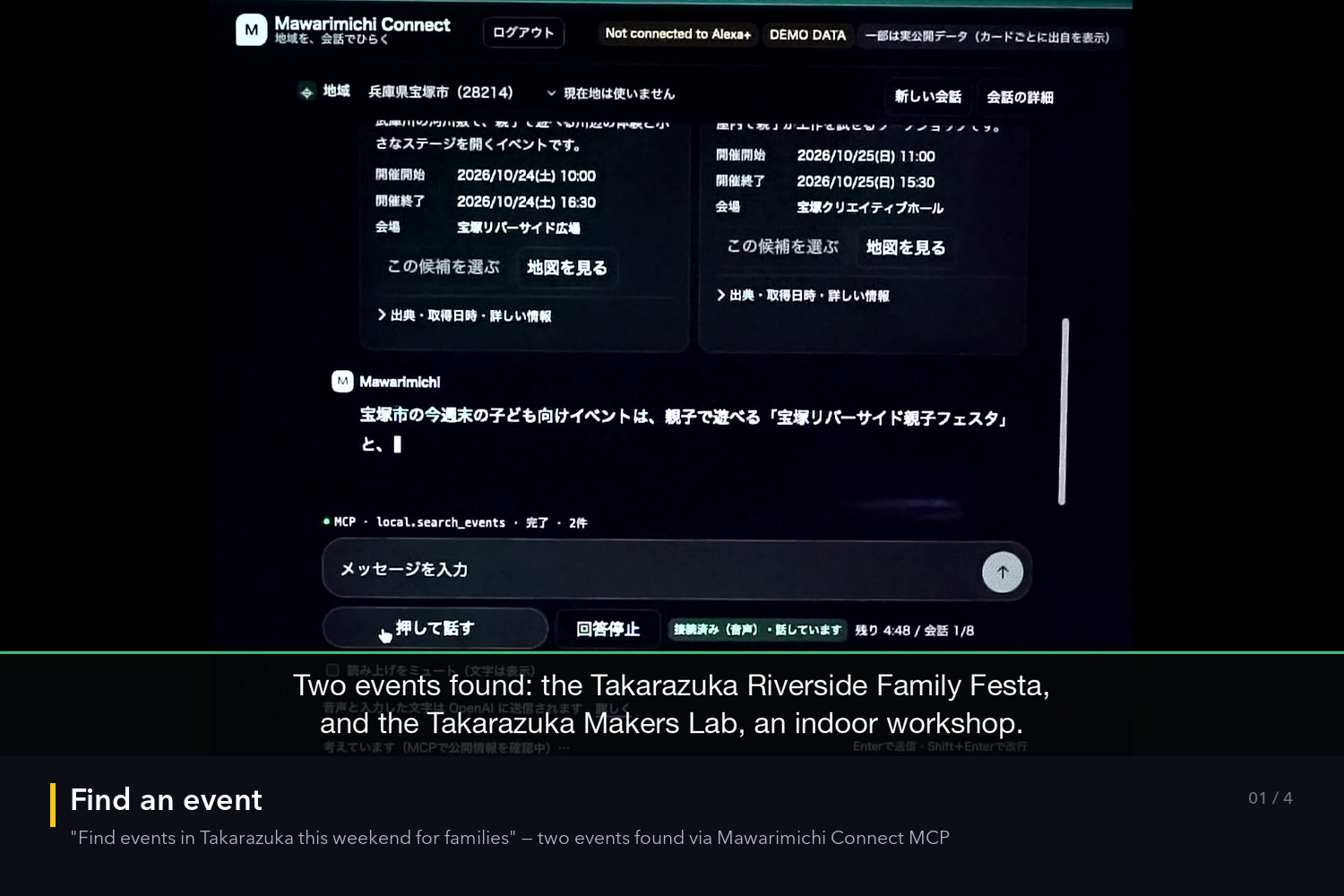
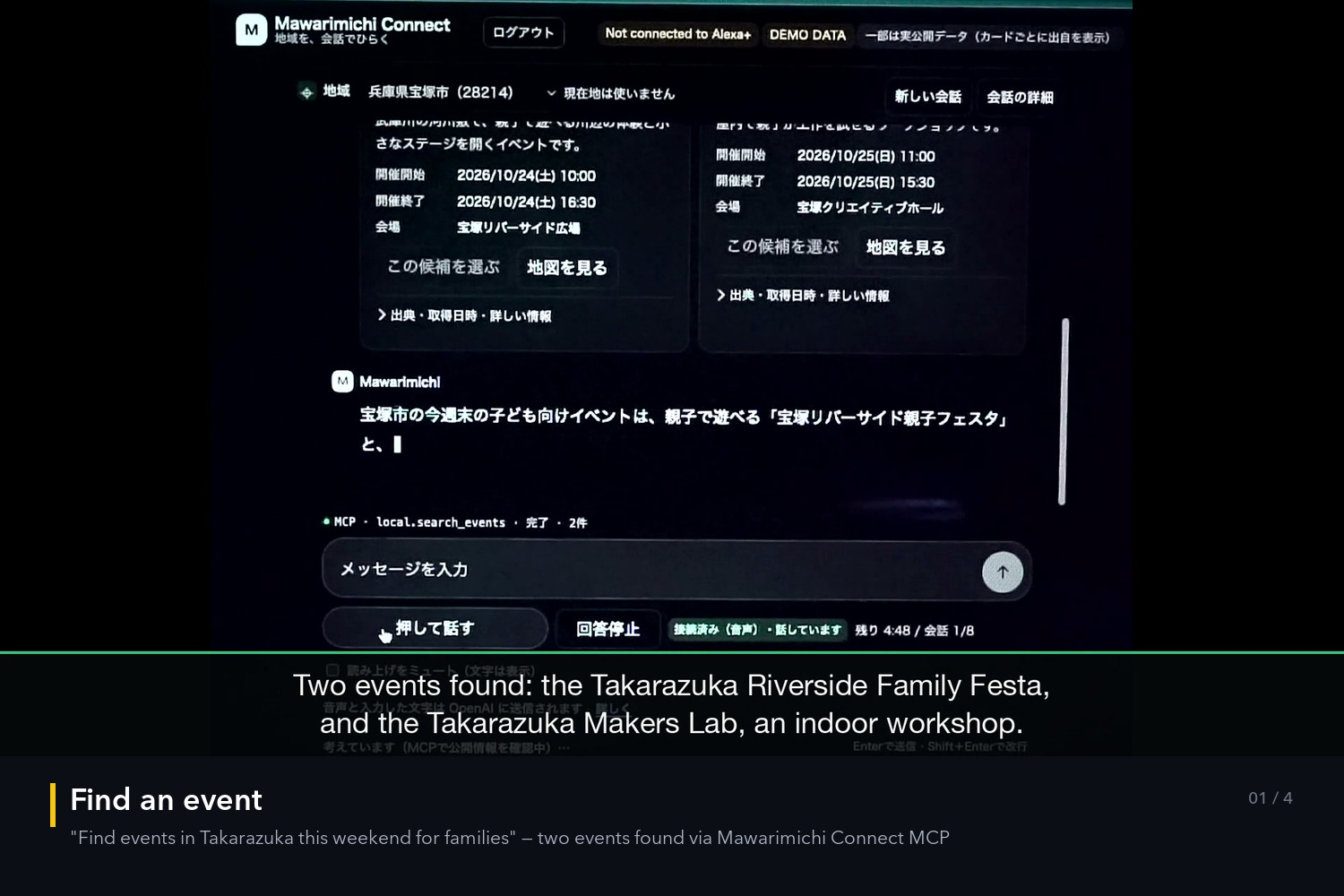
Find event
-
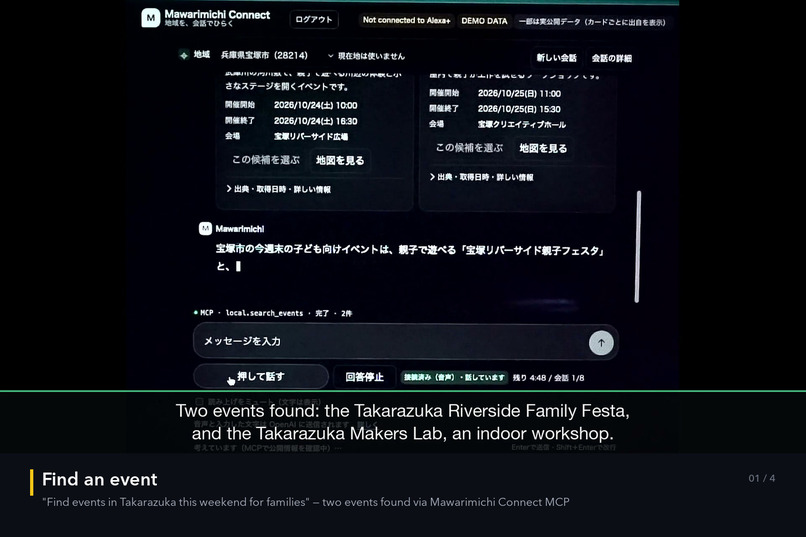
Weathear and road restrictions for the event day
-
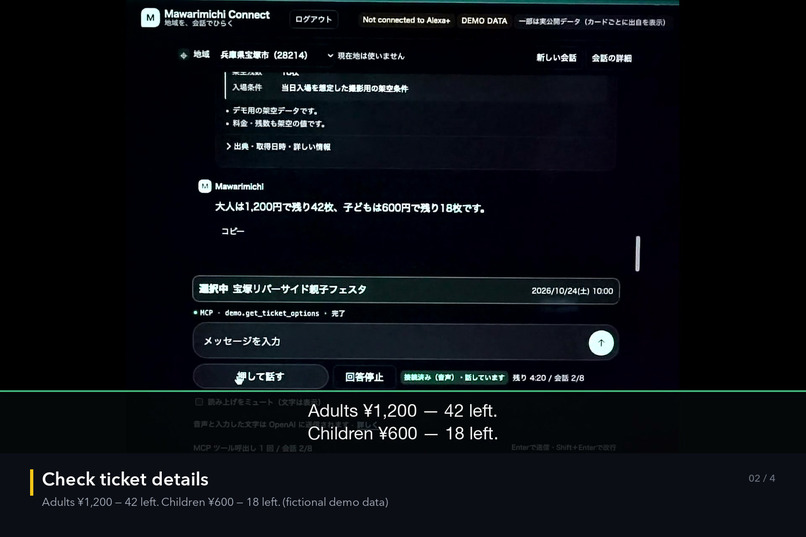
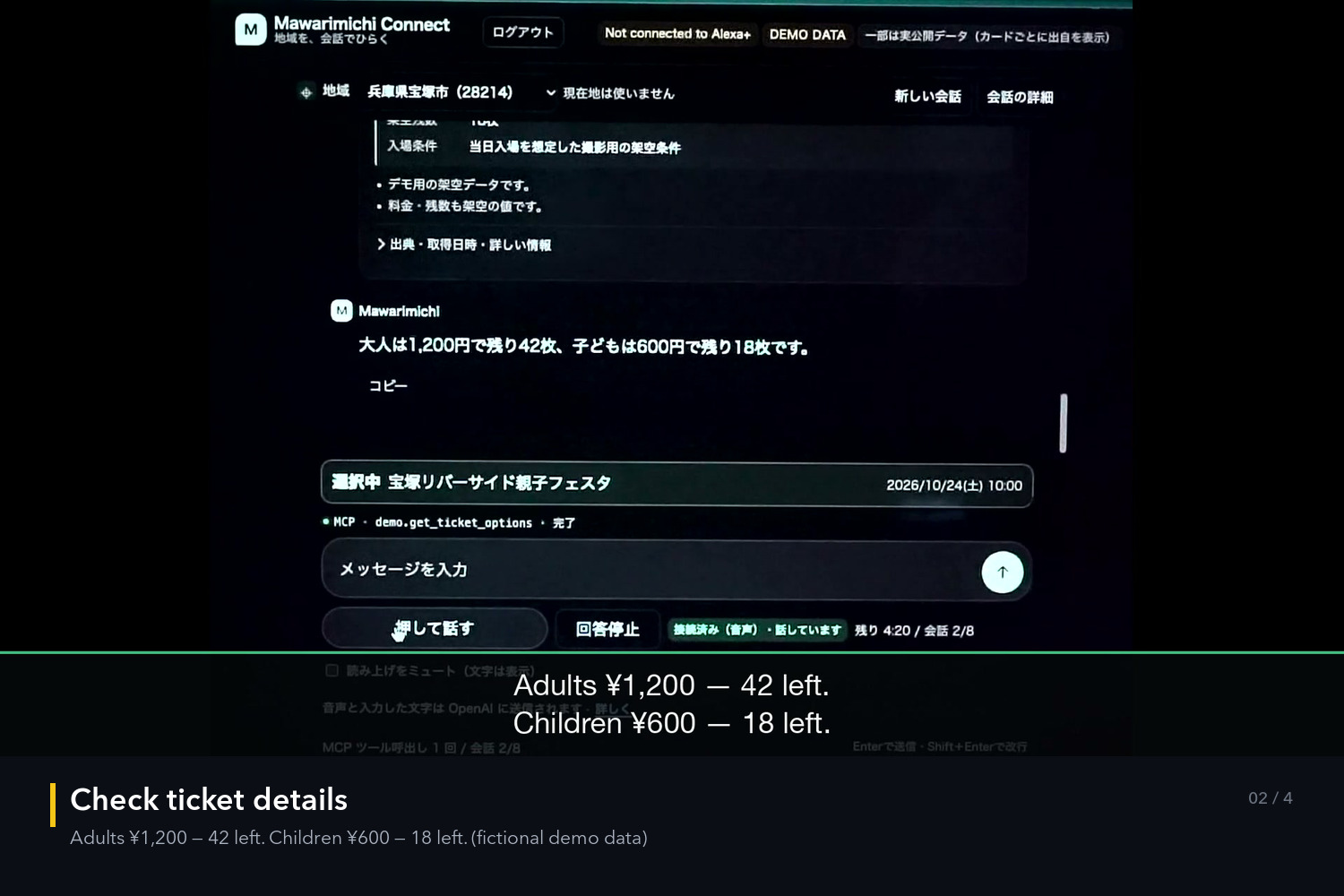
Check ticket detail
-
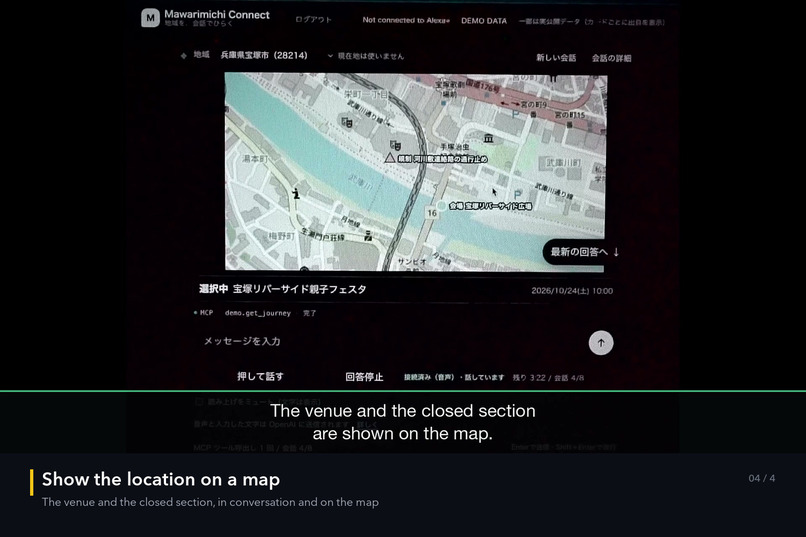
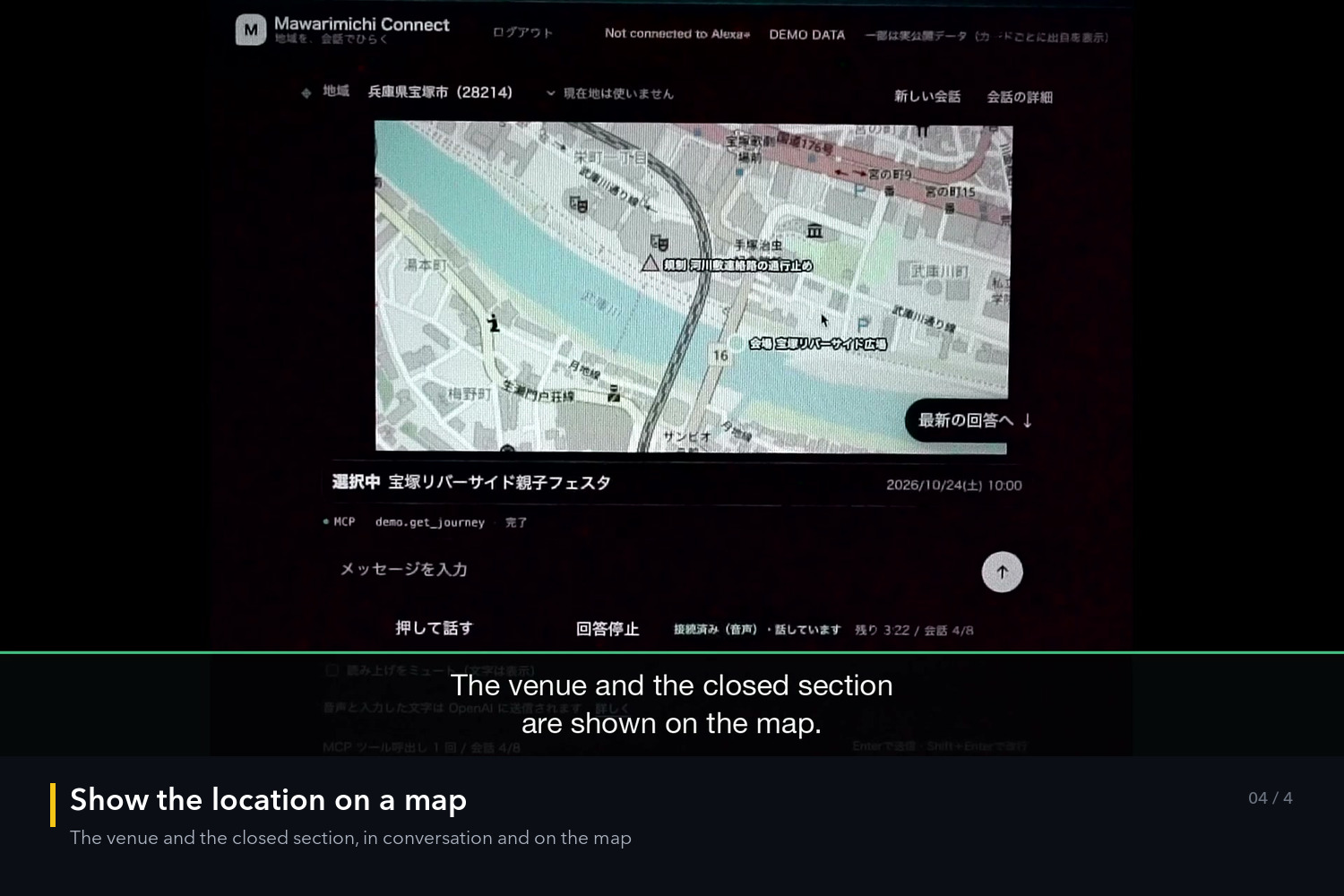
Show the location on a map
Inspiration
Useful local information should reach people through the ways they already live, move, and communicate—not only when they know which website to search.
A community organizes an event. A shopping district announces an activity. A municipality updates a road restriction. Each piece of information can be valuable, but it may remain scattered across different websites and administrative workflows.
Our joint pilot with Nishiwaki City in Hyogo Prefecture, Japan, brings this challenge into focus.
The pilot addresses real-time road construction and traffic restriction information originating within municipal operations. Some of these updates are known only to the administration until they are actively published. Searching existing websites cannot recover information that has not yet been made available.
Our aim is to help information approved for public release move from municipal workflows into a shared regional information platform—and from there to the people who need it.
During the pilot discussions, we also agreed to include the registration of disaster-related information and evacuation shelter information. These are important extensions of the same problem: people need accessible, trustworthy local information, especially when their usual plans are disrupted.
Language is another barrier. Neighborhood events and everyday administrative notices can remain difficult for international residents and visitors to discover or understand.
What if people could simply ask about their community, continue the conversation, and find the relevant information without navigating multiple unfamiliar services?
That is the motivation behind Mawarimichi Connect for Alexa+.
What it does
Mawarimichi Connect for Alexa+ connects a conversational experience to regional information through Mawarimichi's Open MCP interface.
The project combines MCP-based information access with a browser-based demonstration of an Alexa+-style experience.
Users can ask natural-language questions, continue with follow-up requests, and explore results through conversational answers and information cards.
A typical use case begins with a simple question:
"What local events are happening this weekend?"
The conversation can then move toward the details needed to make a decision: the venue, relevant facilities, or published road restrictions around the area.
The goal is not to stop at a single search result. It is to help people connect information that belongs together in everyday life.
Connecting municipal and community information
Mawarimichi is the underlying regional information platform. It brings together information from municipalities, residents, businesses, and community organizations.
People and organizations can contribute events, ticket information, and other local announcements. The account responsible for a publication destination controls what is approved to appear there.
Open MCP provides an interface to information permitted for public access. It does not turn an organization's private records into public data.
This allows community information and administrative information to become accessible through the same conversational channel while retaining their different sources and publication responsibilities.
For the Nishiwaki pilot, the municipal information scope includes road construction and traffic restrictions, together with the agreed registration of disaster-related information and evacuation shelter information.
Making local information accessible across languages
Mawarimichi includes AI-powered translation to help local information reach international residents and visitors.
This is not limited to major tourist attractions. Small neighborhood events, shopping district activities, and everyday municipal notices also deserve to be discoverable across language barriers.
The combination of multilingual information and conversational access helps address two problems at once: understanding the information and knowing where to look for it.
The service remains focused on information about communities in Japan. English and other languages make that information more accessible; they do not require each community to operate a separate overseas-facing service.
Supporting different community settings
A resident could ask about activities at a community center.
A visitor could discover events and shops in a neighborhood shopping district.
A hotel guest could explore nearby activities and relevant municipal information without knowing the names of local departments or websites.
These are different situations, but they can draw on the same regional information platform.
How we built it
Mawarimichi existed before this hackathon. This submission focuses on its external MCP-based information access and the conversational experience developed for the Alexa+ track, rather than presenting the entire underlying platform as newly created.
The implementation uses Go components to connect the demo and MCP workflows with Mawarimichi's information services.
The basic flow is:
User request → conversational application → MCP tool call → retrieved regional information → answer and result cards.
The browser demo is organized around the conversation rather than around a developer console. It includes follow-up interaction, horizontally arranged result cards, visible MCP progress, and expandable technical details.
This lets the user focus on finding useful information while still making the underlying tool activity inspectable.
The submitted web demonstration presents a simulated Alexa+ experience. It is a demonstration of our own conversational application, not a reproduction of Amazon's native Alexa+ interface.
Our development workflow includes local MCP integration tests and controlled test data. These help us check the connection between tool execution and the conversation interface without depending entirely on changing production records.
We also separate public information access from the cost of operating an AI conversation demo. The product introduction can be shared publicly, while the hosted conversational demo remains password-protected.
The MCP interface belongs to Mawarimichi Connect. It is not designed as a separate information database maintained only for Alexa+. The same public-information foundation can support other compatible AI clients and additional delivery channels.
Challenges we ran into
Moving from a technical integration to a useful conversation
Exposing tools is only part of the work. A person looking for a local event should not need to understand MCP, inspect raw responses, or reconstruct the answer from technical logs.
We worked on the conversation interface, including follow-up interaction, result cards, Japanese text input, and clear feedback when communication fails.
The challenge was to make the information understandable without hiding the relationship between the answer and the retrieved results.
Preserving the meaning of public information
A community announcement, a municipal road restriction, and an evacuation shelter record do not have the same authority or operational meaning.
Combining them in one conversation must not erase those distinctions.
For example, the location of a designated evacuation shelter does not establish that it is currently open. Likewise, the absence of a retrieved road restriction is not proof that every road is safe or unrestricted.
These distinctions are important considerations for the municipal publication and information-delivery workflows.
Keeping testing reproducible and operating costs controlled
Conversational applications involve several moving parts: the interface, the conversation layer, MCP tools, and the underlying information sources.
Controlled test data and separate integration checks help us identify which part of the workflow is responsible for a result.
At the same time, publicly sharing a product page should not create unlimited paid AI requests. We therefore keep the public introduction separate from the authenticated execution of the hosted conversation demo.
Accomplishments that we're proud of
We have connected a conversational interface and real MCP integration to a concrete regional information use case.
The project goes beyond presenting raw tool responses. The conversation, result cards, progress display, and expandable details make the information flow understandable to both users and reviewers.
We are also proud that the work is connected to a real municipal collaboration.
Tulipa Design is working with Nishiwaki City through Hyogo Prefecture's Hyogo TECH initiative. That collaboration gives us a practical setting for evaluating how information held within municipal operations can become easier for residents and visitors to access.
Another important achievement is keeping the information foundation shared. We do not want every assistant, website, or display to require its own independently maintained copy of local information.
This Alexa+ submission focuses on conversational access. Our separate Fire TV submission focuses on bringing information to shared screens. Both support the same broader goal: helping regional information reach people in the circumstances where they need it.
What we learned
Making information available is not the same as making it easy to use.
A useful event listing can remain undiscovered. An accurate municipal notice can be difficult to find. A clear Japanese description can still exclude someone who cannot read it.
Conversational access, structured result cards, and translation address different parts of that problem.
We also learned that a useful AI experience requires more than a fluent answer. The information must come from an appropriate source, the interface must make the result understandable, and the system must preserve important distinctions about publication and current status.
Testing the interface, MCP connection, and data flow separately also helps us understand what a successful demonstration actually proves.
Our central lesson is that AI can make local information easier to access, but it does not replace the people and organizations responsible for publishing and maintaining that information.
What's next for Mawarimichi Connect for Alexa+
Validating the approach through the Nishiwaki City pilot
Our next priority is to evaluate the information workflows through the Nishiwaki City pilot.
This includes how municipal staff register and update road construction and traffic restriction information, how information approved for publication becomes accessible, and how residents and visitors find it through different channels.
The pilot also includes the agreed registration of disaster-related information and evacuation shelter information, with attention to sources, update procedures, and the distinction between designated locations and confirmed operational status.
We will use the findings to refine conversational access, multilingual presentation, and the information needed to support useful follow-up questions.
Reaching people through more everyday channels
Alexa+ is part of a wider approach that also includes ChatGPT integration, websites, maps, and Fire TV signage.
We want people to access the same regional information through the interface that suits their situation, rather than requiring them to learn a new service for every task.
We also aim to provide municipal road construction and traffic restriction information to Japan's VICS ecosystem, so that relevant updates can reach drivers through compatible car navigation systems, including voice guidance.
VICS is a planned information-delivery channel. It extends the same principle beyond websites and conversations: useful local information should also reach people while they are moving through the community.
Expanding together with Hyogo Prefecture
Following the Nishiwaki City pilot, we aim to work together with Hyogo Prefecture to expand this approach to other municipalities.
The goal is not to end with a single-city demonstration. It is to develop an approach that other municipalities can adopt, while supporting community centers, shopping districts, hotels, and local businesses in ways suited to their audiences.
Mawarimichi is the shared information hub. Our goal is to make useful, trusted local information flow naturally into everyday life—across languages, through conversation, onto shared screens, and into vehicles.
Built With
- alexa+
- context
- go
- model
- protocol

Log in or sign up for Devpost to join the conversation.