-
-
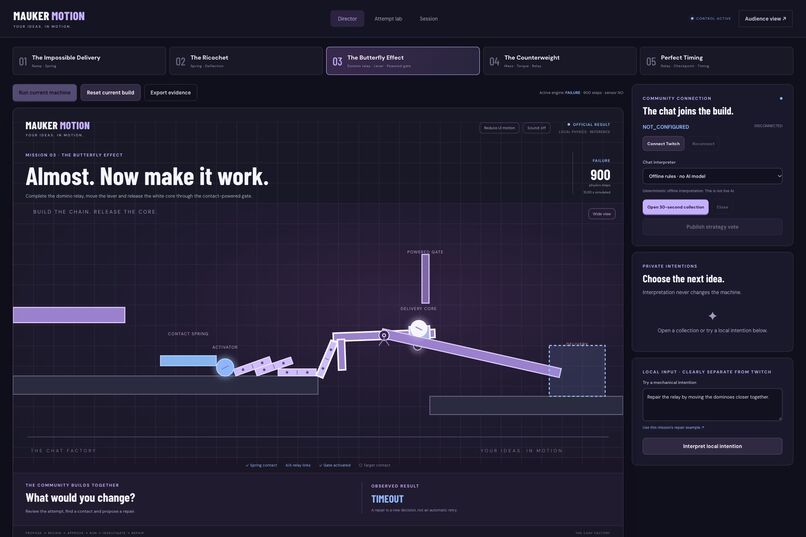
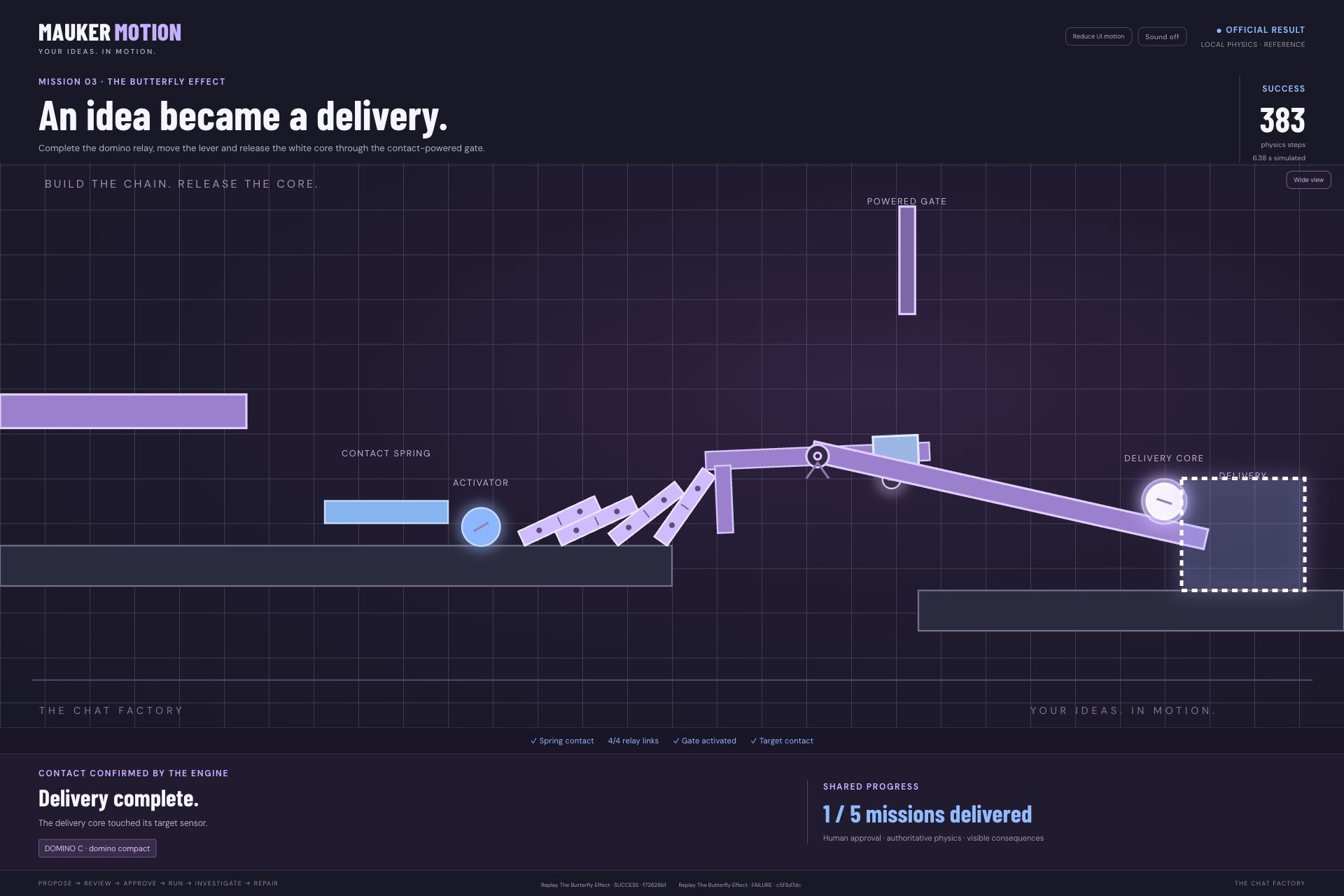
Delivery confirmed by physics: The repaired domino relay reaches SUCCESS with target contact at 383 steps.
-
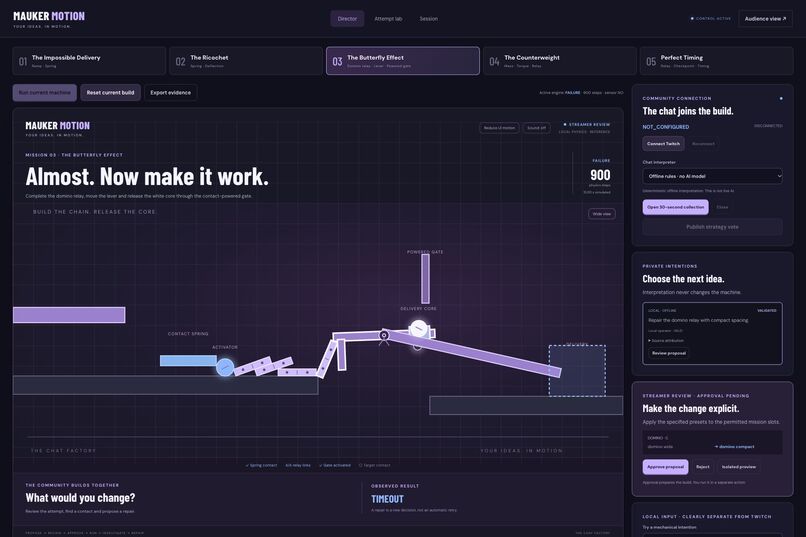
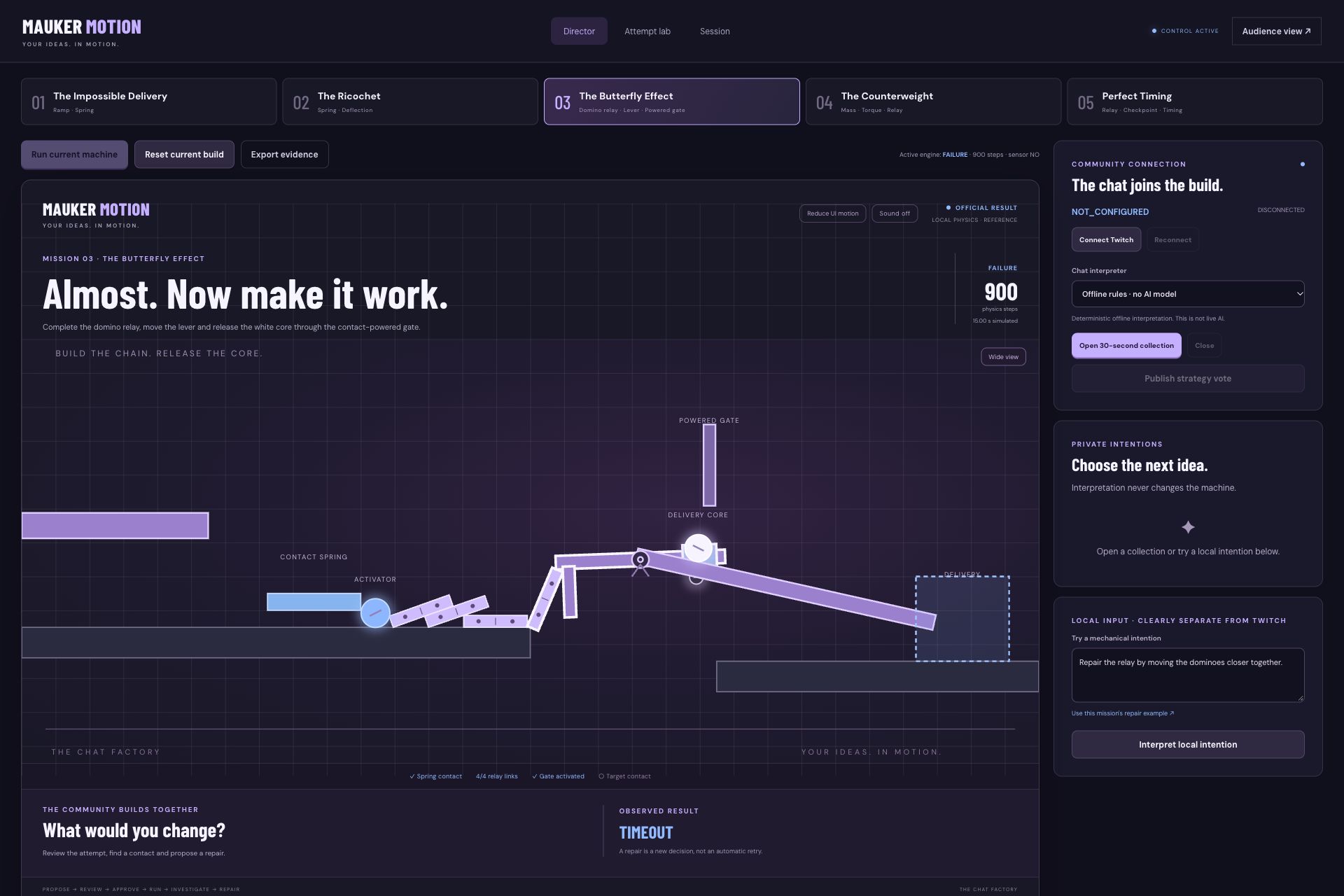
The original relay times out at 900 steps, creating a repair challenge. The director shows all five missions.
-
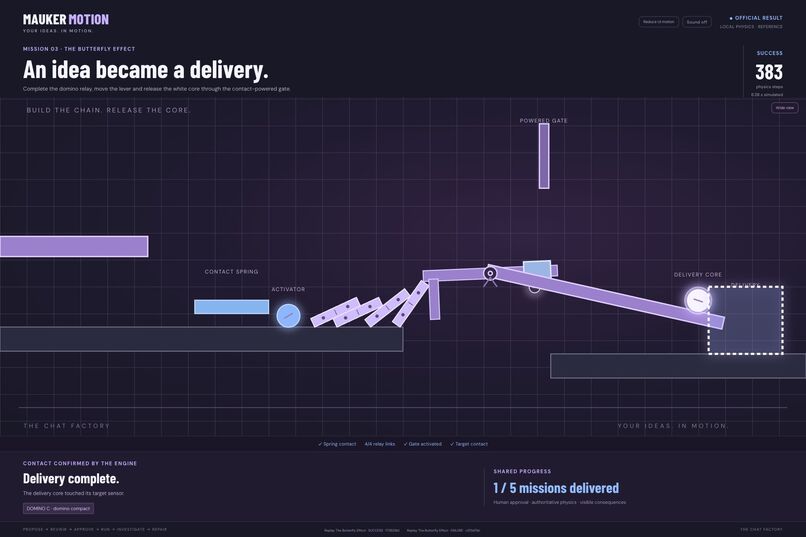
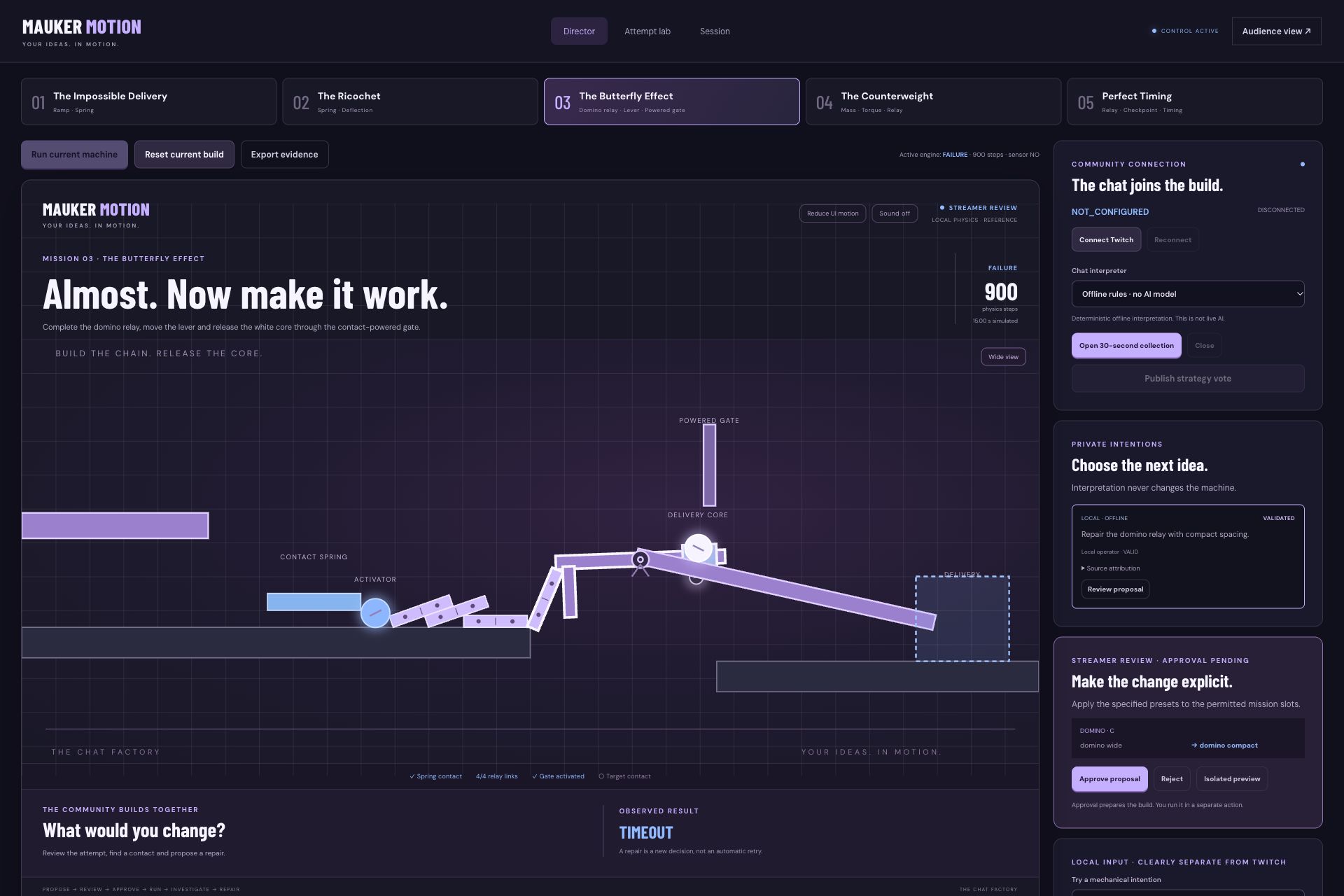
DOMINO C: wide to compact, awaiting approval. The active machine remains FAILURE. Interpretation changes nothing. Offline rules example.
-
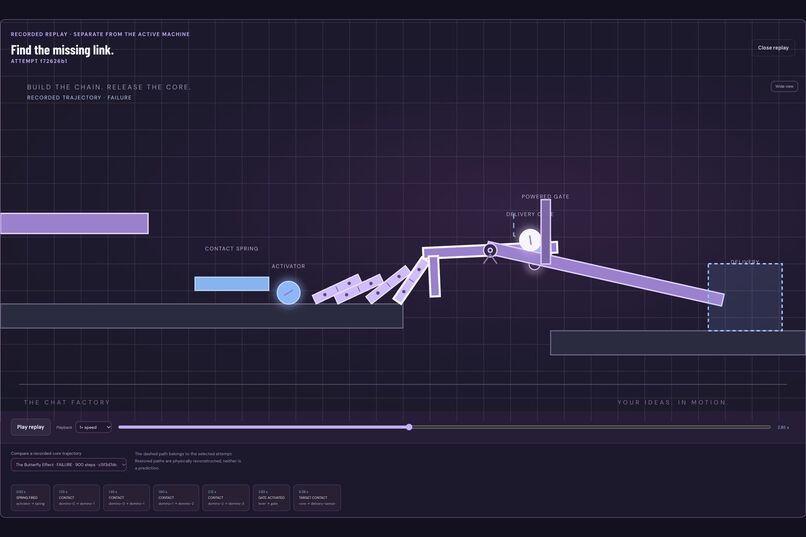
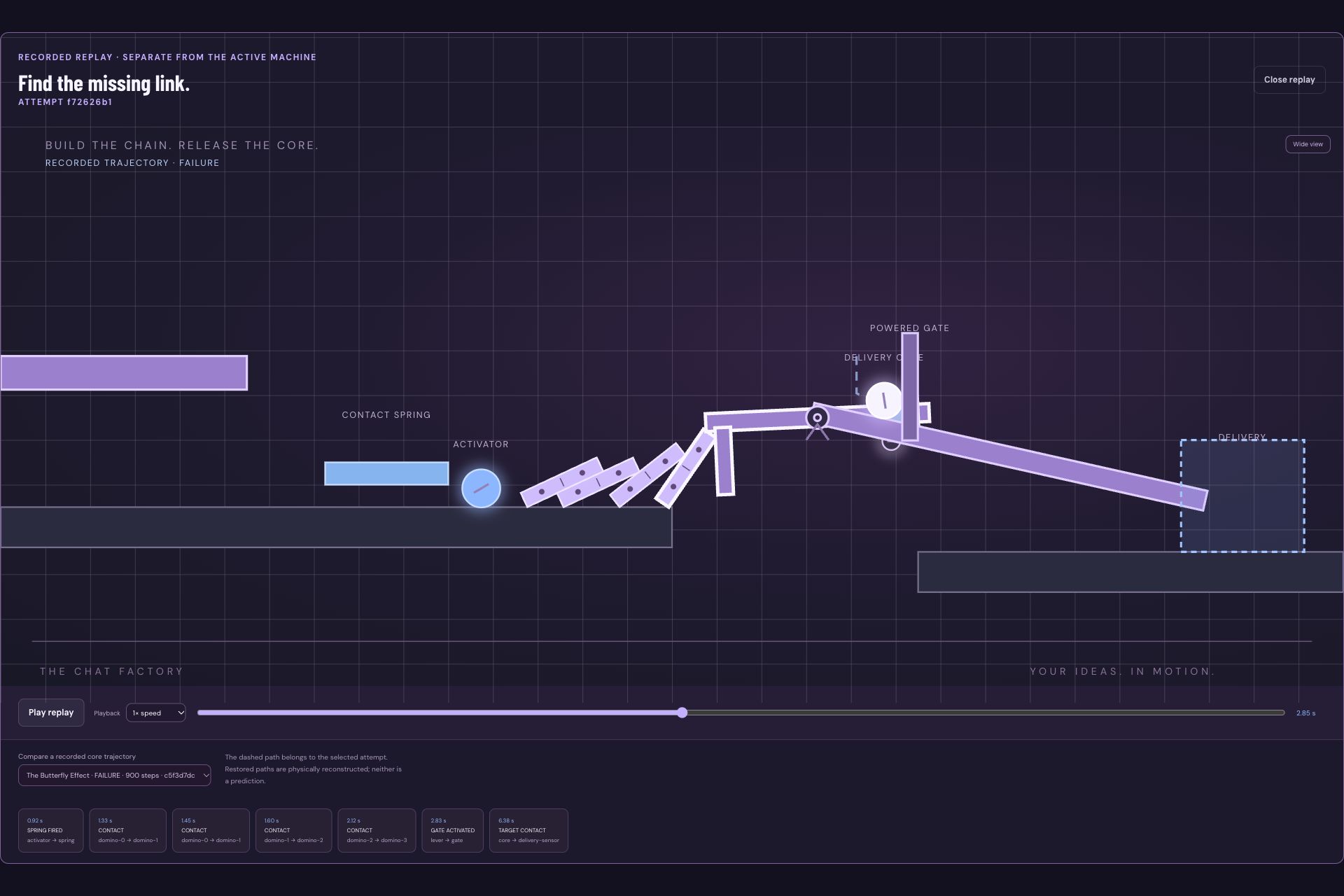
Replay the recorded gate activation and compare the failed trajectory. Replay stays separate from the active machine. Local offline gameplay
Inspiration
What if a viewer’s idea could become a visible change in the machine on screen?
MAUKER MOTION began with that question. I wanted to create a shared physics puzzle where viewers could contribute ideas, the streamer could make meaningful decisions, and everyone could watch the consequences unfold.
The concept became simple: the chat imagines, the streamer decides, and physics responds.
What it does
MAUKER MOTION is a collaborative physics game for Twitch. Viewers send natural-language suggestions through chat using !motion. OpenAI interprets supported intentions and proposes structured mechanical changes. The streamer reviews the exact before-and-after configuration and chooses whether to approve it.
Approval prepares the machine. A separate run tests the change through physics simulation. Success requires the delivery ball to reach its target sensor.
Five missions explore ramps, springs, domino relays, levers, counterweights, and contact-triggered gates. The experience includes:
- A private director interface for the streamer.
- A read-only audience arena compatible with an OBS Browser Source.
- Recorded replays and trajectory comparisons.
- Advisory community votes and duplicate-idea grouping.
- Local progress recovery and explicit control transfer between browser tabs.
Every proposal passes strict schema validation and authoritative game rules before it can reach human review.
How I built it with Codex
I used OpenAI Codex throughout development as a coding collaborator. I defined the experience, scope, and acceptance criteria, tested the authentic Twitch workflows, and required evidence before accepting each development stage.
Codex helped implement and refine the physics contracts, Twitch OAuth and EventSub integration, provider-neutral interpretation pipeline, validation rules, interface, session recovery, automated tests, and documentation. We also used failing tests and observed behavior to diagnose issues and improve the implementation.
Development progressed from a reproducible physics reference to a complete community repair loop. Each stage preserved the previous tests and separated simulated infrastructure checks from authentic provider validation.
How it works
The interface uses React and TypeScript. A Node.js backend owns the game session and runs Matter.js physics. Twitch messages arrive through an EventSub WebSocket connection.
The OpenAI adapter uses the Responses API with strict JSON Schema output. A deterministic offline interpreter supports development and credential-free gameplay testing, with explicit labeling.
The backend validates the mission, allowed presets, game phase, source message, and current revision. Human approval and official execution remain separate actions. Credentials stay on the server, while the audience receives a restricted public view.
Challenges
The main challenge was coordinating chat, AI responses, browser controls, and physics without losing a clear source of authority.
Duplicate messages, late responses, connection interruptions, and stale browser tabs all needed predictable handling. We introduced revision checks, source attribution, bounded collection windows, explicit controller ownership, and recoverable local checkpoints.
Another challenge was making the active result clearly distinguishable from an isolated preview or replay. That distinction shaped both the interface and the approval workflow.
Accomplishments
An authentic Twitch message successfully passed through OpenAI interpretation, strict validation, streamer review, explicit approval, and a separate physics run that reached the target sensor.
The flagship domino repair rehearsal completed in 117.812 seconds. The corrected machine succeeded after 383 simulation steps, with sensor contact confirmed by the engine.
The regression suite passed 213 application tests and six repository protection checks. Two optional live API tests remain excluded from the default automated run; authentic provider validation was performed separately. GitHub Actions also passed the repository checks, tests, and build.
The OBS audience view was manually verified, including hiding, showing, and refreshing its browser source while preserving the active game result.
What I learned
AI interpretation, game validation, human approval, and physical execution need clear, separate contracts.
The project also demonstrated how much interface clarity matters: viewers and streamers need to understand which idea is being reviewed, who controls the machine, and which result belongs to the official attempt.
What's next
The current release is a local, single-streamer preview. The next priorities are playtesting with streamer communities, expanding the mission catalog, improving onboarding and accessibility, and developing tools for authoring additional validated puzzles.
The goal is to make each round a shared experiment: a viewer contributes an idea, the streamer makes a decision, and the whole community sees what happens.
Built With
- ajv
- codex
- github
- matter.js
- node.js
- obs
- openai
- react
- twitch
- typescript
- vite
- vitest

