Math that listens before it teaches
Correctness tells us what happened. Reasoning helps us decide what to do next.
The same wrong answer can come from different ideas. A learner who thinks “eight is bigger than six” and a learner who thinks “eight pieces means more” may choose the same incorrect fraction, but they need different follow-ups. Most math products see only the answer. Matma runs a short Discovery Pass, keeps several bounded and revisable hunches, and asks one discriminating probe before deciding whether and how to teach.
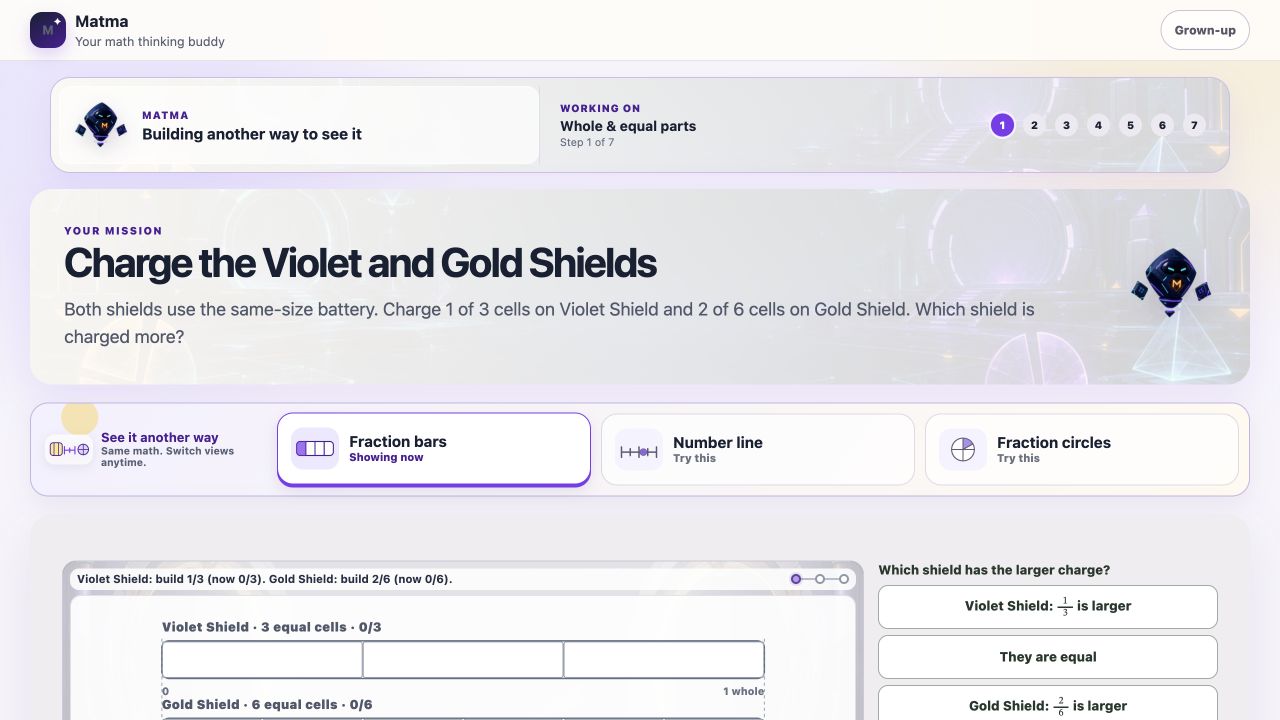
When support is useful, the learner gets one compact mission and a validated interactive representation. Their saved interests can change the story, objects, narration, color, and companion—but never the operands, grading, evidence, or progression.
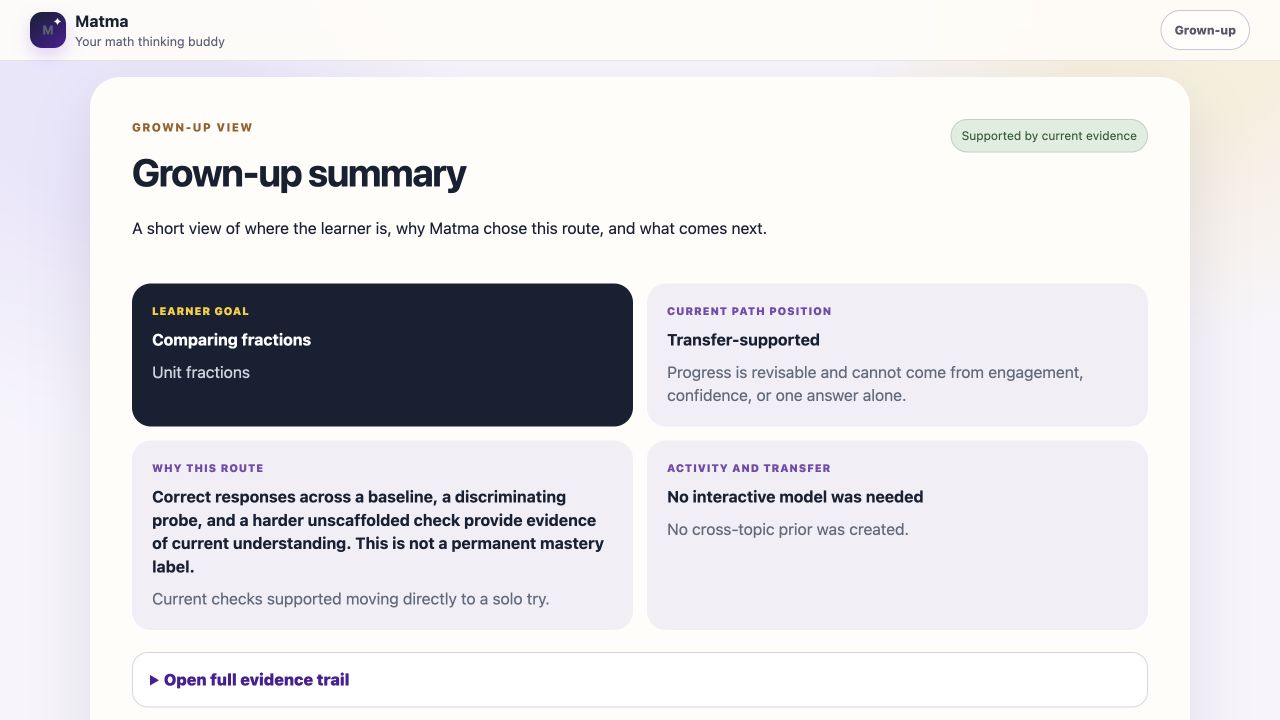
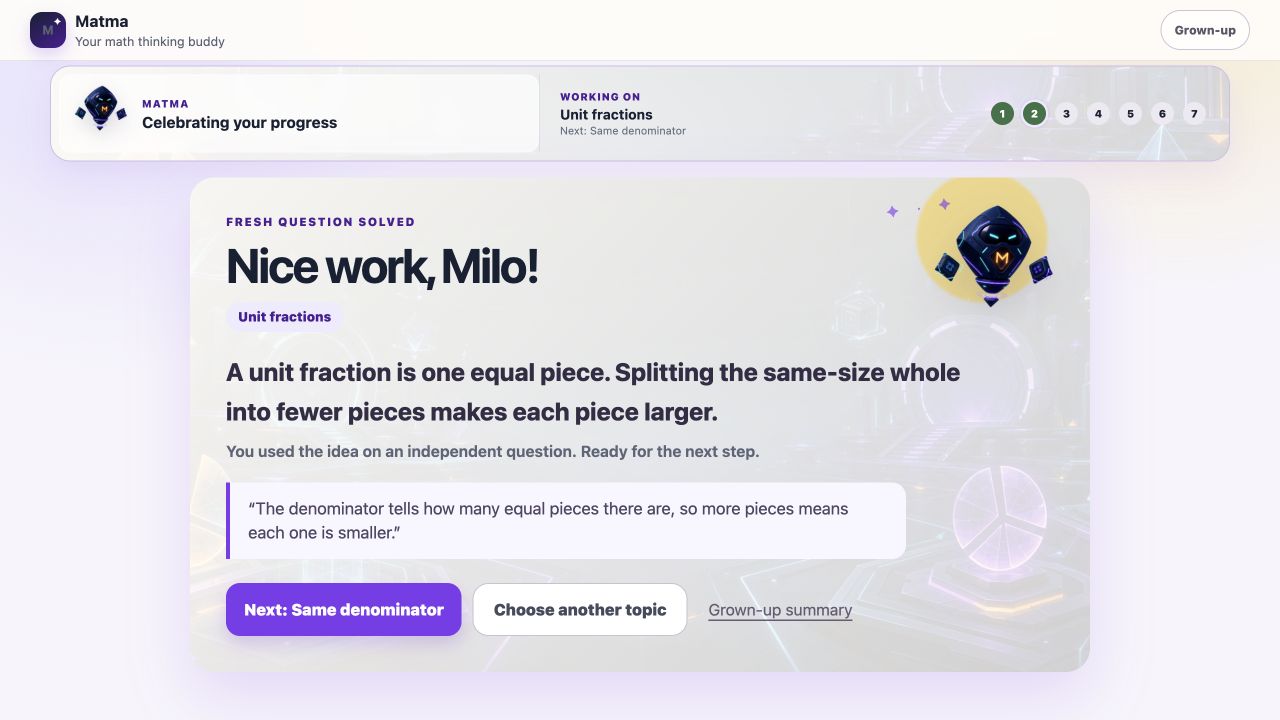
After the activity, Matma asks for a fresh story-free solo solution. That can support the current context, but it is not yet independent transfer. A later session instantiates a separate neutral task before any representation becomes reusable memory. The child sees a concise celebration and the actual next Focus Session; a quiet Grown-up summary explains the route, evidence, graph position, and memory effect without assigning a permanent learner label.
What we built
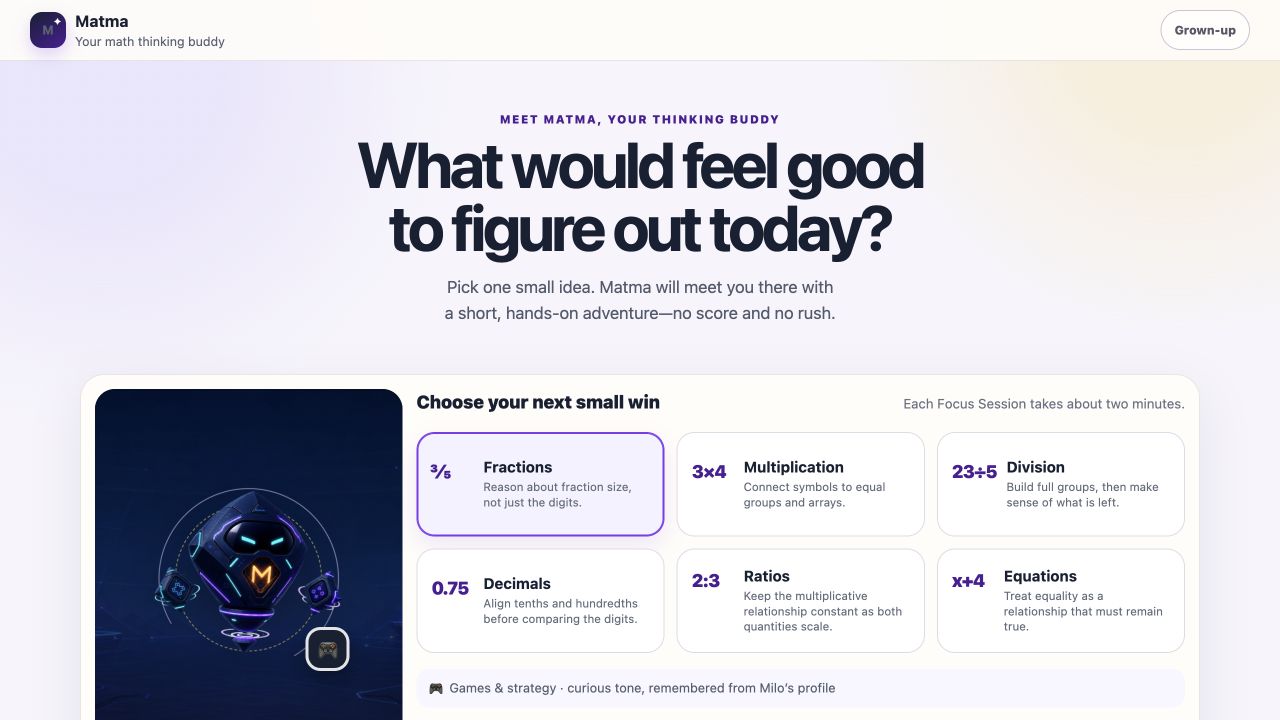
The six-case Education release contains complete evidence-guided journeys for:
- multiplication models;
- fraction comparison;
- decimal comparison and place value;
- ratio and proportional reasoning; and
- linear equations and balance.
- division and remainders
Across the product, Matma ships 10,755 seeded deterministic questions across 33 task families, six versioned concept packs, six validated skill graphs, 33 competency nodes, 198 approved strategy/representation routes, exact code-native interactions, six substantial interest worlds, and original responsive illustrations.
Fractions are the flagship proof. The first session establishes context support through scaffolded interaction plus a fresh solo check—or through multiple independent discovery answers plus that solo check. The next Fractions session supplies the independently generated neutral transfer needed before representation memory. A helpful fraction representation may then become a weak starting prior for ratios, but Matma recalibrates it against current ratio evidence before reuse.
Why GPT-5.6 and Codex
GPT-5.6 contributed at two layers.
At build time, Codex was the product and engineering collaborator. It helped turn several early ideas into the reasoning-first thesis and v4 product contract; translated research-informed learning principles into enforceable software boundaries; designed the evidence model, skill graphs, validators, and adversarial fixtures; authored and refactored the six-topic vertical slice; generated the original world illustrations; inspected the running UI at desktop and mobile sizes; and repeatedly used test, accessibility, browser, and deployment evidence to critique its own work.
Codex also improved its own build loop. The primary agent retained architecture, editing, and release authority while bounded Sol specialists performed independent adversarial reviews. Owner feedback and those reviews produced concrete changes: a graph-based learning loop instead of a fixed activity sequence; three mathematically distinct fraction models instead of cosmetic swaps; a strict child/adult information boundary; a teen-friendlier illustrated and animated visual system; and regression repairs for both no-intervention progression and evidence-accurate celebrations.
At runtime, GPT-5.6 is a bounded pedagogical planner. It can interpret the learner’s confirmed words, rank only supplied hypotheses, select an approved probe/strategy/representation ID, identify missing evidence, and compile child-safe presentation. It cannot alter operands, grade mathematics, invent IDs, diagnose a condition, assign a learning style, or convert engagement into mastery. The server validates structured output and cross-checks every ID before deterministic state code can use it.
The public judge build intentionally runs the same credential-free deterministic fallback so it is safe, repeatable, and requires no login. The repository also contains the live saved-auth GPT-5.6 development provider and server-side Responses API boundary. Current unmocked reasoning and adaptive-selection smokes pass through codex-exec:gpt-5.6-sol.
How it scales
New topics are contract-driven, not copied pages. A topic supplies a versioned concept pack, skill graph, deterministic task families, immutable primitive configuration, substantial world adapters, planner candidates, and evaluation fixtures. Shared validators guarantee graph integrity, exact grading, valid IDs, instruction suitability, evidence semantics, neutral transfer, memory rules, child/adult separation, accessibility, and fallback behavior.
That architecture let Division reuse the equal-groups interaction grammar while adding its own sharing, grouping, quotient, and remainder semantics—without weakening or redefining the original five-case target.
Validation and responsible scope
The release gate passes 305 unit and contract tests across 47 files, five diagnostic evaluations, all six packs and 10,755 generated questions, all six graphs and 198 routes, both production targets, runtime-surface validation, and 37 clean Chromium journeys including axe coverage. Fresh remote-browser smokes verify the hosted flagship Fraction journey and persisted Equation progression.
Synthetic fixtures and software tests validate bounded behavior, not educational efficacy. Matma is not a clinical tool, fixed learning-style classifier, full curriculum, or broad K–12 claim.
Built With
- codex
- express.js
- gpt-5.6
- openai-responses-api
- openai-sites
- playwright
- react
- typescript
- vite
- vitest
- zod

