-

1
-
2
-
3
-
4
-
5
-
6
-
7

মাঠের ডাক্তার (Mather Daktar)
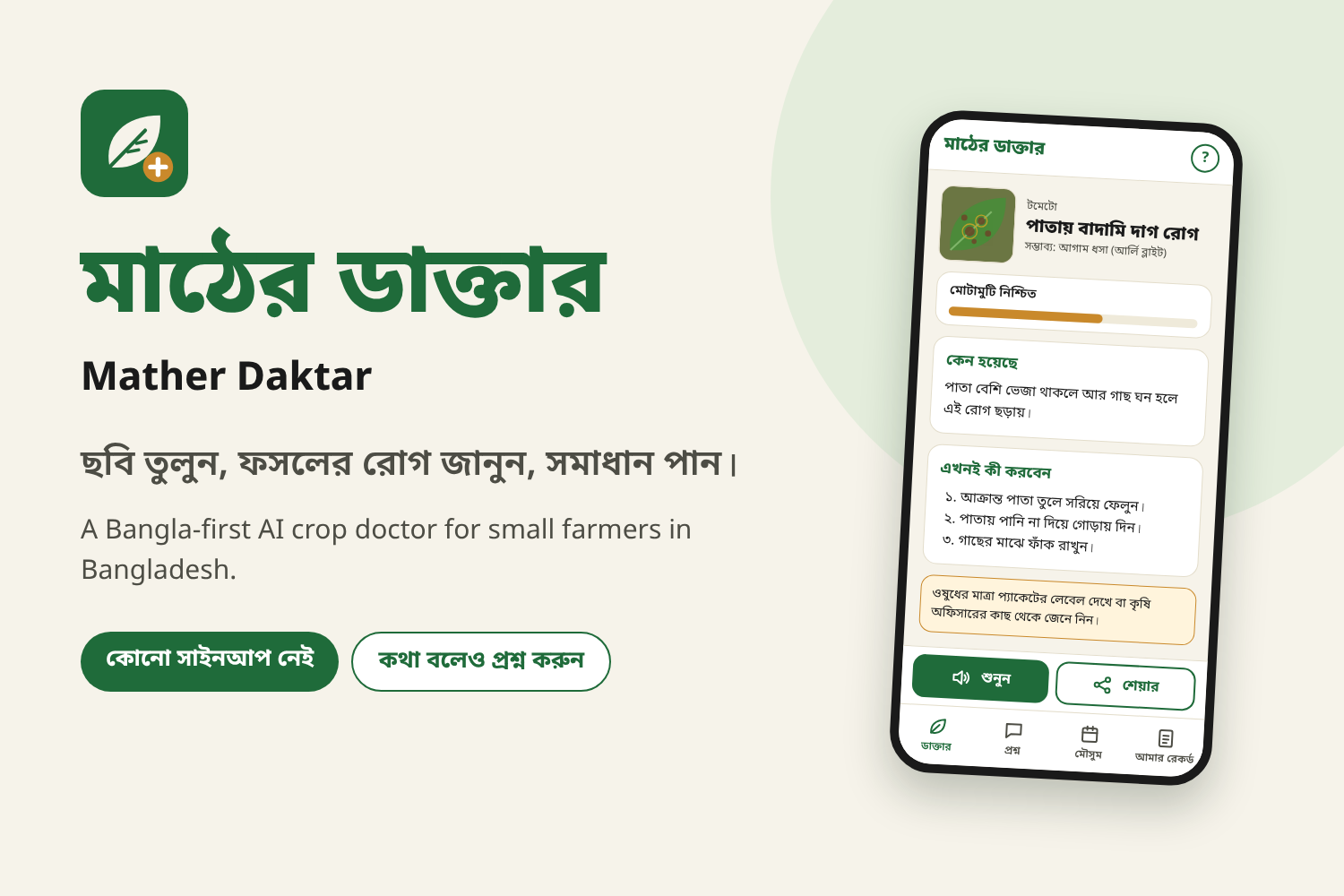
Take a photo of a sick plant. Get a clear Bangla answer in seconds.
Inspiration
[Replace this with your real story. Example: "Last season, my uncle noticed the leaves of his tomato plants curling. The agriculture officer was far away, so he asked the local shop. He spent 500 taka on a pesticide that didn't help, and the plants still died."]
That kind of moment happens across Bangladesh every season. Agriculture supports a large share of our people, yet a small farmer who sees a spotted leaf often has nobody to ask. Extension officers are few and hard to reach. The nearest advice is usually a shopkeeper, and the result can be the wrong pesticide, the wrong amount, wasted money, damaged soil, and a health risk to the farmer.
When I looked at existing tools, I found two gaps:
- Most are in English, or are built for crops and conditions elsewhere.
- Most assume the user can read well and navigate a complicated app.
I wanted to build something a farmer, or a farmer's child, could use on a basic Android phone in under a minute, entirely in Bangla.
What it does
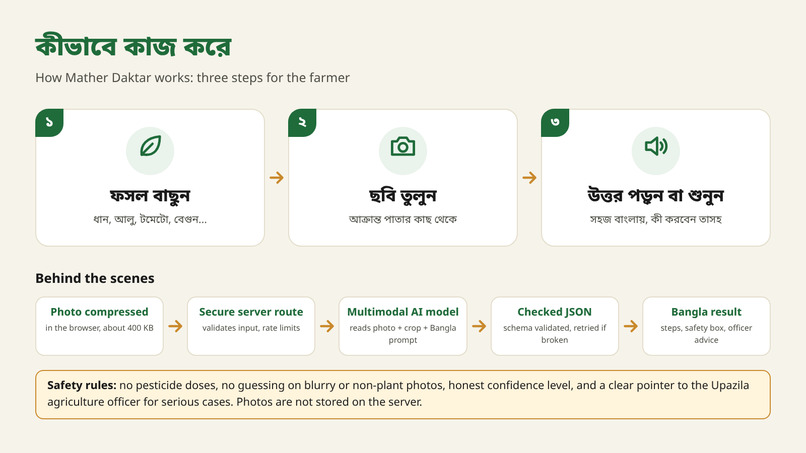
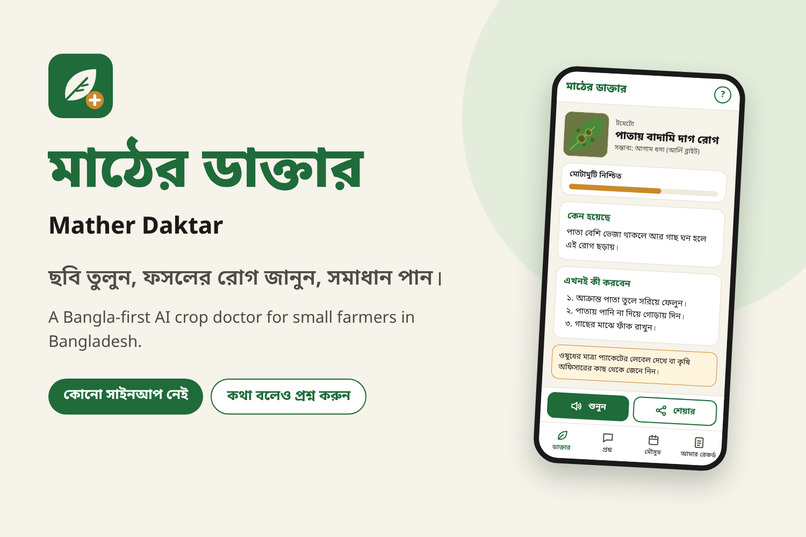
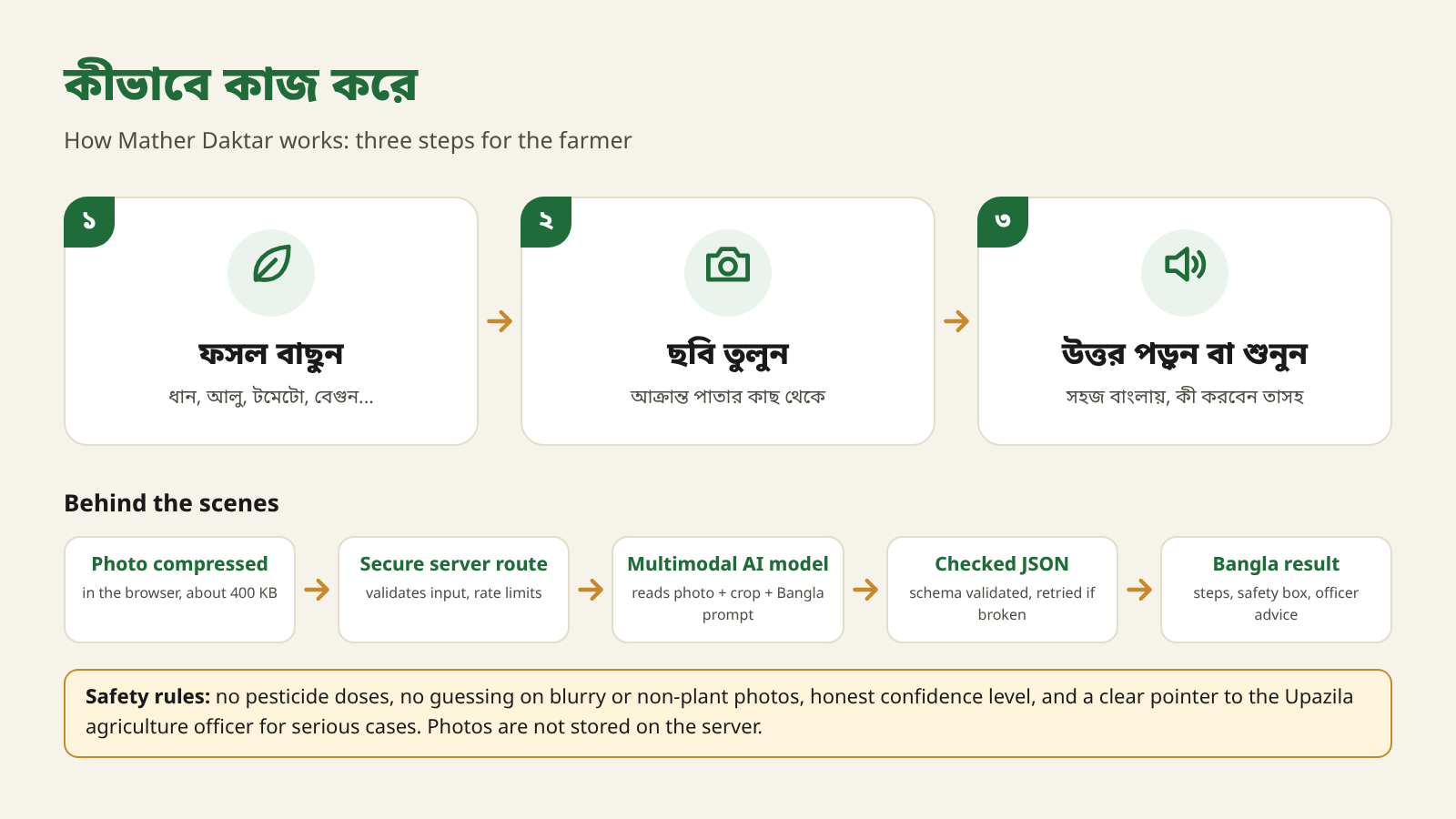
Mather Daktar is a Bangla-first AI crop doctor. The flow is deliberately simple:
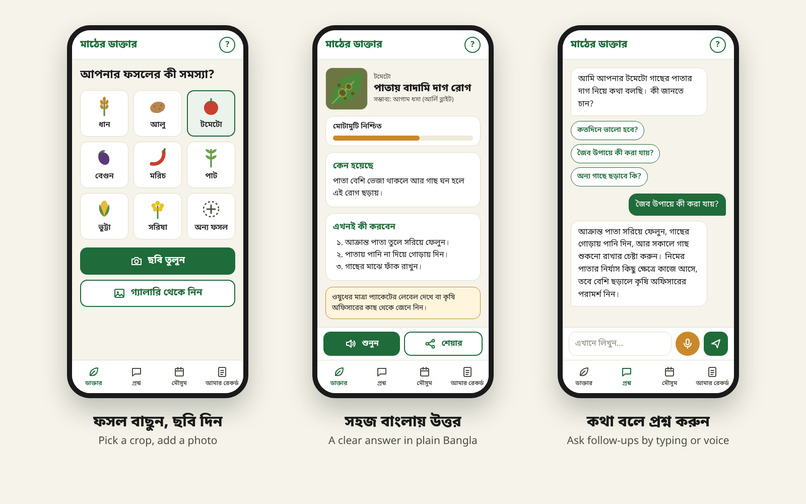
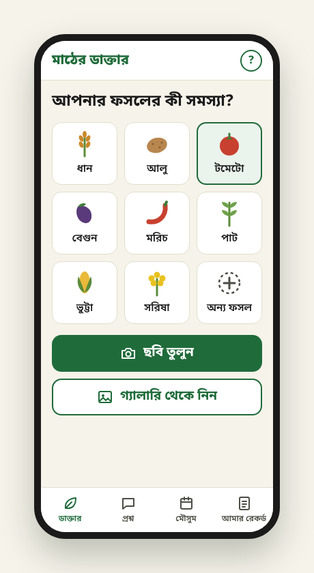
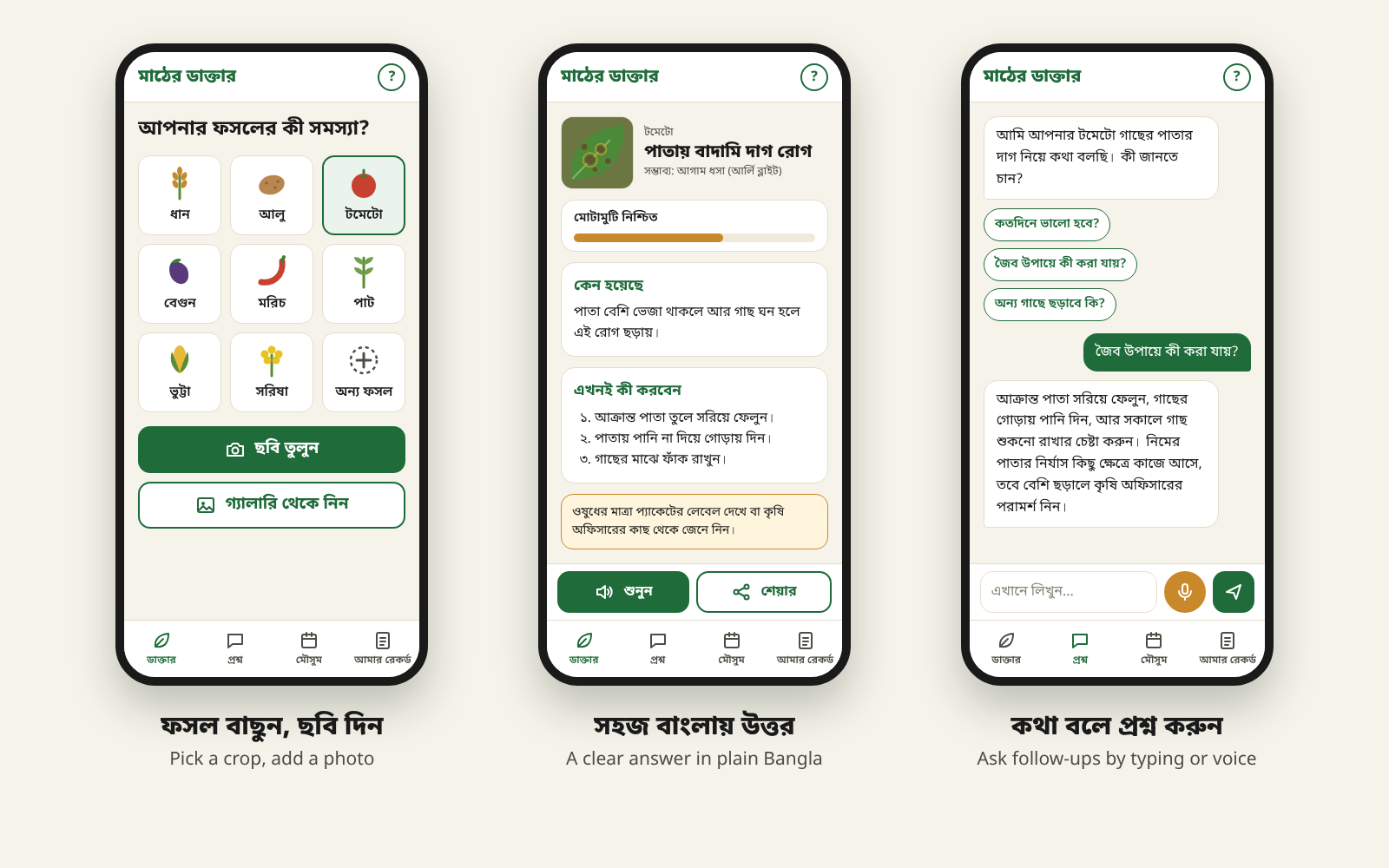
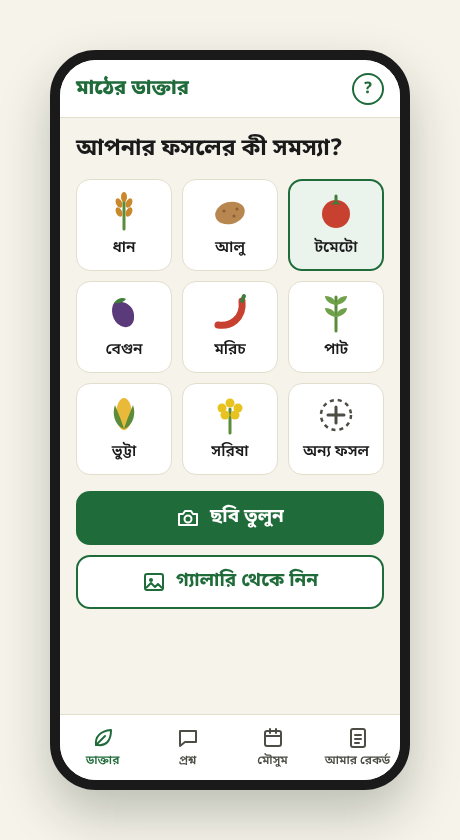
- Choose the crop from large, labeled buttons (rice, potato, tomato, brinjal, chili, jute, maize, and more).
- Take a photo of the affected leaf or plant.
- Read or listen to the answer in plain, spoken Bangla.
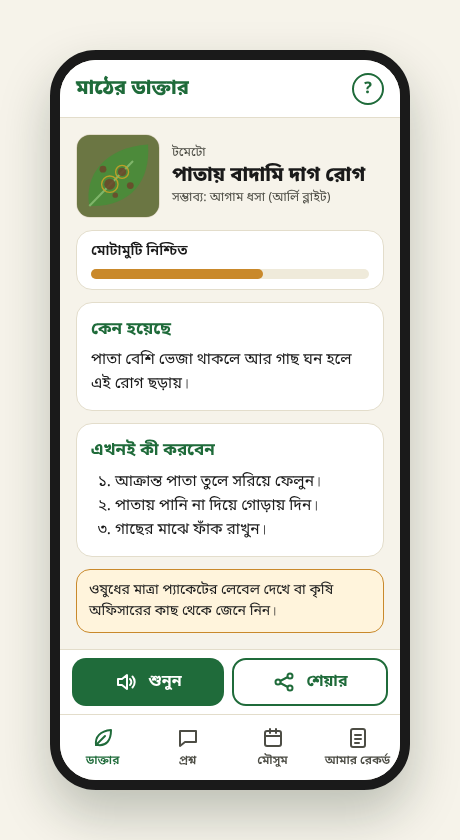
Each result includes:
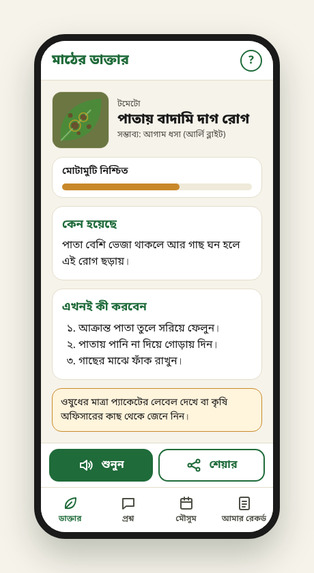
- The likely problem: disease, pest, nutrient shortage, or water stress, with an honest confidence level (shown as a colored bar, not a confusing percentage)
- Why it happened: in one or two simple sentences
- What to do now: low-cost and organic options first, then the type of treatment if needed
- What not to do: common mistakes such as overspraying
- A safety box: protective gear and waiting-period reminders whenever a chemical is mentioned
- Officer escalation: if the case is serious or the photo is unclear, the app tells the farmer to contact the Upazila agriculture officer
Around that core, the app has four tabs, each with one clear job:
| Tab | Purpose |
|---|---|
| ডাক্তার (Doctor) | Pick a crop, take a photo, get a diagnosis |
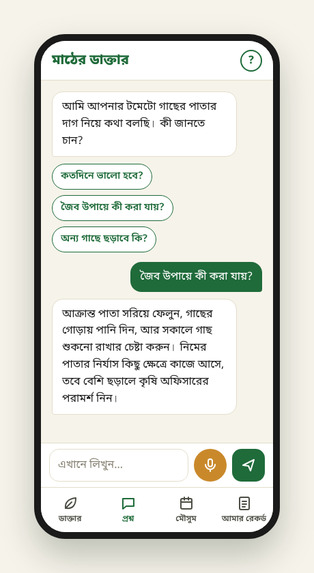
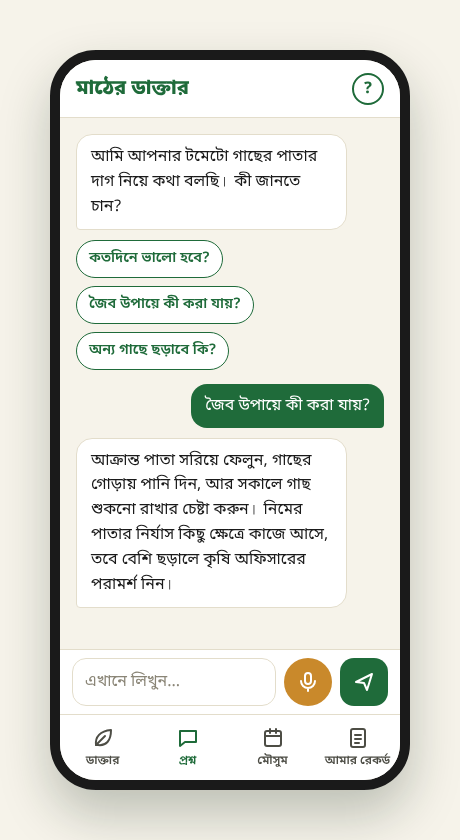
| প্রশ্ন (Ask) | Ask follow-up questions by typing or by voice |
| মৌসুম (Season) | See this month's risks and tasks for the chosen crop |
| আমার রেকর্ড (My records) | Reopen or delete past diagnoses |
Users can also listen to any answer read aloud and share a clean advice card with a neighbor or family member through WhatsApp or Messenger. There is no signup, no login, and no ads.
Who it's for
It is a B2C product for individual people: small farmers, their children who help them, agriculture students, and home and rooftop gardeners. Each of them uses it on their own phone.
How I built it
Frontend
- Next.js (App Router) with TypeScript and Tailwind CSS, deployed on Vercel
- A mobile-first design for 360px screens, with 18px+ Bangla text (Noto Sans Bengali), 56px touch targets, and an icon plus a label on every control
- A warm, calm palette (field green, soil amber, and off-white) chosen for contrast and readability outdoors
- Installable as a PWA, with the app shell and saved history available offline
AI layer
- A multimodal AI model ([Claude / Gemini], [model name]) analyzes the crop photo together with the selected crop and an optional note
- All AI calls run server-side, behind one provider-abstraction file, so the API key never reaches the browser and the model can be swapped by changing one file
- The model is required to return structured JSON, which I validate with Zod. If the output is malformed, the server retries once with a repair instruction, and otherwise shows a friendly error instead of broken text
- A carefully written Bangla system prompt tells the model to speak in simple spoken Bangla, use Bangladeshi crops, seasons, and practices, and prefer low-cost and organic options first
Safety by design
- The app never gives pesticide doses or invents brand names. It names only the type of treatment and sends the farmer to the product label or the agriculture officer
- If the photo is blurry, too dark, or not a plant, the app refuses to guess and asks for a better photo
- Confidence is reported honestly, with alternative possible causes listed when the model is unsure
- Text inside an image or a user note is treated as data, never as instructions
Engineering details
- Photos are compressed in the browser (max 1024px, about 400 KB) so diagnosis works on slow mobile data
- Input validation and per-IP rate limiting on every API route
- Voice input and read-aloud use the browser's built-in speech features and are shown only on devices that support Bangla, so users never see a broken button
- Seasonal tips are cached per crop and month, so repeat visits load instantly and cost nothing
- Photos are not stored on the server. History stays on the user's own device
Challenges I ran into
- Making the AI honest instead of impressive. A model will happily name a disease from a bad photo. I had to design the prompt, the schema, and the "retake photo" state so the app admits uncertainty rather than confidently guessing. For a farmer, a wrong confident answer is worse than no answer.
- Keeping the language simple. Standard AI Bangla can sound formal or textbook-like. Getting short, spoken-style sentences without technical jargon took repeated prompt testing with realistic cases. [Add a specific example of a bad output you fixed.]
- Preventing dangerous advice. Pesticide doses are where harm happens. I decided to block dose recommendations entirely and always attach safety warnings, even though it makes the app a little less "impressive" in a demo.
- Designing for non-literate users. Every screen needed one main action, large icons with labels, and as little text as possible. I removed features and screens that didn't directly help the farmer, and made sure no feature appears in more than one place.
- Real-world constraints. Slow networks, low-end phones, camera permission denials, and devices without a Bangla voice all needed their own handled states, in Bangla, with one clear next step.
- Time. [Mention the short timeline of the buildathon and how you prioritized.]
- [Add one or two real problems you hit while building, such as deployment, image upload size, or voice support, and how you solved them.]
Accomplishments I'm proud of
- A complete, working, publicly hosted product with real AI behind every screen, not a mockup
- A design that a first-time smartphone user can understand without instructions
- A safety-first approach that puts the farmer's wellbeing ahead of impressive-looking output
- Fully Bangla UI, errors, and AI responses, with no English text left for the user to decode
- Full documentation, including a short Bangla user guide written for people with limited reading ability
What I learned
- Good AI products are defined as much by what they refuse to do as by what they do
- For low-literacy users, fewer elements beat more features. Removing things improved the experience more than adding them
- Structured output and validation turn an unpredictable model into something reliable enough to build a product on
- Real accessibility means testing on small screens, slow networks, and imperfect devices, not just on a developer laptop
- [Add your own learning: a technical skill, a design lesson, or something you realized about the problem.]
Limitations (being honest)
- A single photo cannot always separate similar-looking problems, so the app reports confidence and suggests alternatives
- It supports a defined list of common Bangladeshi crops. Other crops use a general mode with lower accuracy
- It is an advisory tool and does not replace an agriculture officer or a lab test
- Bangla voice features depend on what the user's phone supports
What's next
- Test with real farmers and agriculture extension workers, and improve the prompts from their feedback
- Add a verified knowledge base built from Department of Agricultural Extension (DAE) and BARRI/BARC guidance for stronger accuracy
- Add local weather-aware warnings (heavy rain, heat, flood risk)
- Offer a simple price-check feature so farmers can see fair market prices
- Explore an SMS or call-based version for farmers without smartphones
- Partner with agriculture student groups and local NGOs to reach farmers directly
Built with
Next.js · TypeScript · Tailwind CSS · Zod · [Claude API / Gemini API] · Web Speech API · Vercel · PWA
Try it
- Live app: https://mather-daktar.vercel.app/
Built solo for the Ostad Presents YUNet AIgnite Buildathon 2026.
Built With
- agentic-ai
- anthropic
- claude-api
- computer-vision
- css3
- html5
- javascript
- lucide-react
- multimodal-ai
- nextjs
- node.js
- noto-sans-bengali
- prompt-engineering
- pwa
- react
- structured-output
- tailwindcss
- typescript
- vercel
- web-speech-api
- zod
