-
-

The name
-
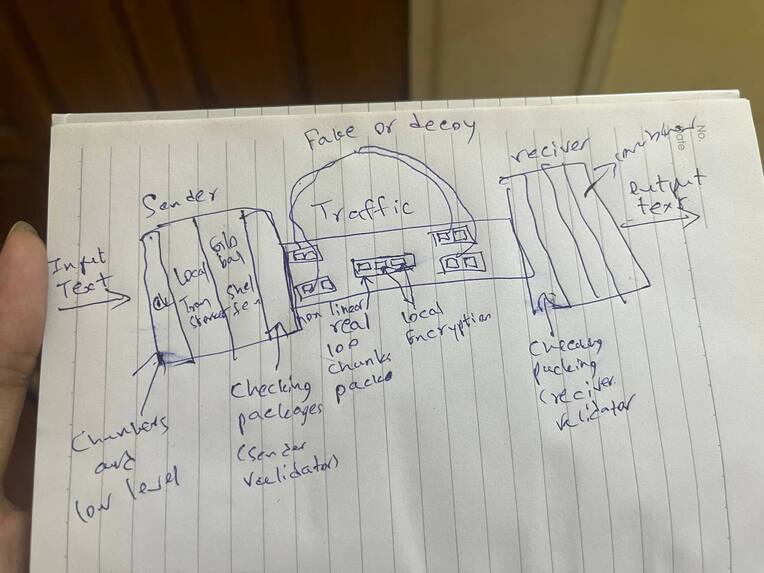
The whole Architecture with my handwriting
-
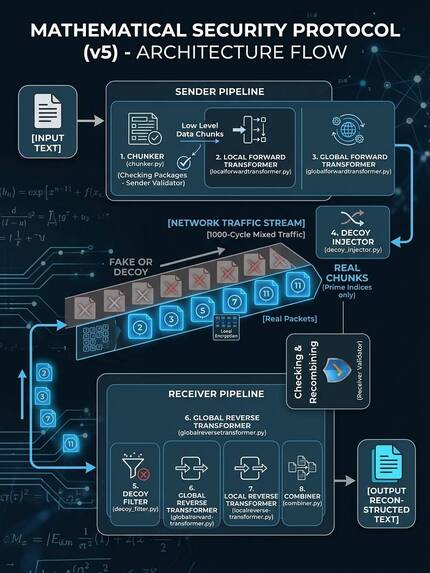
The whole Architecture with beautiful graphics

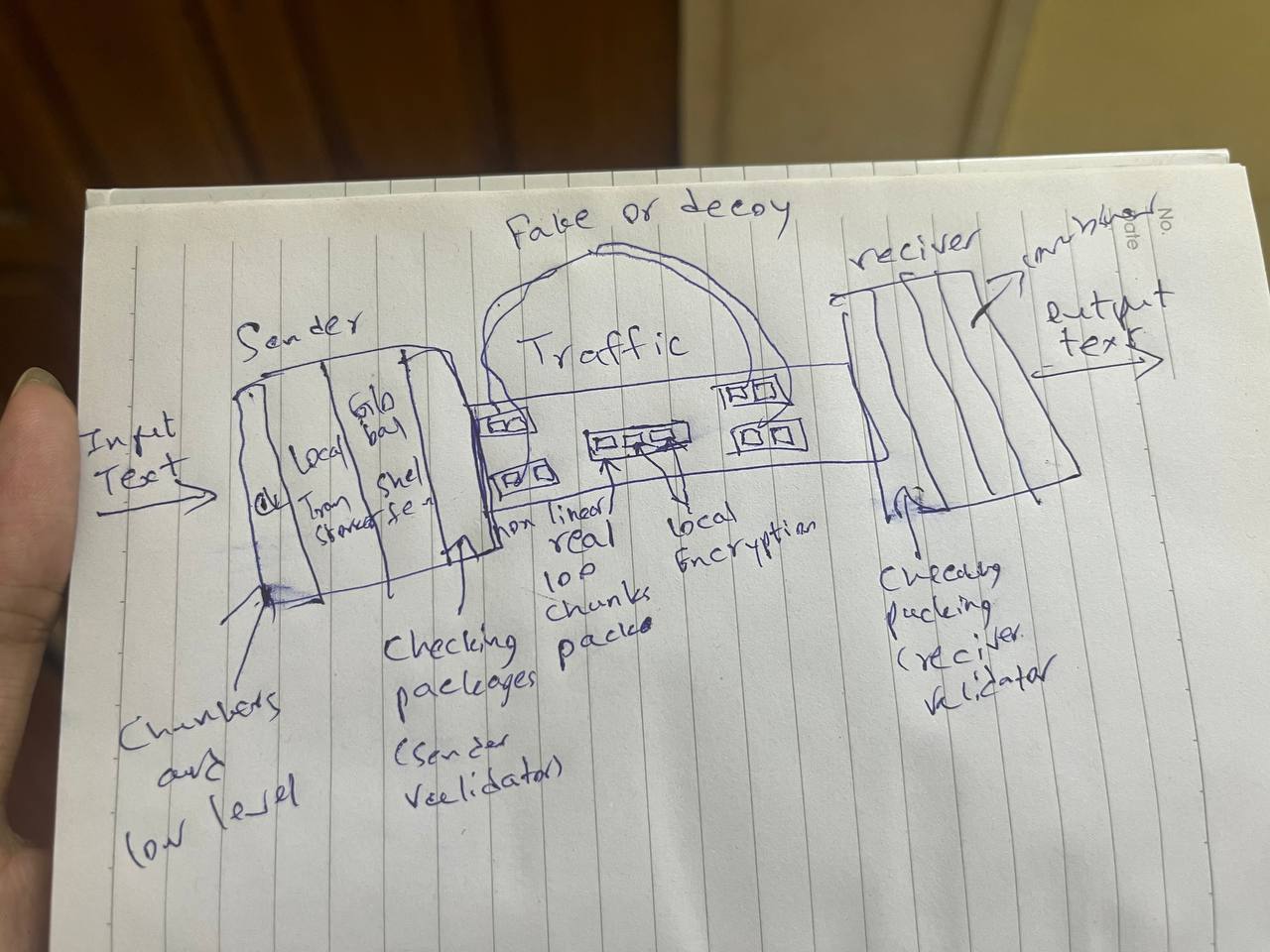
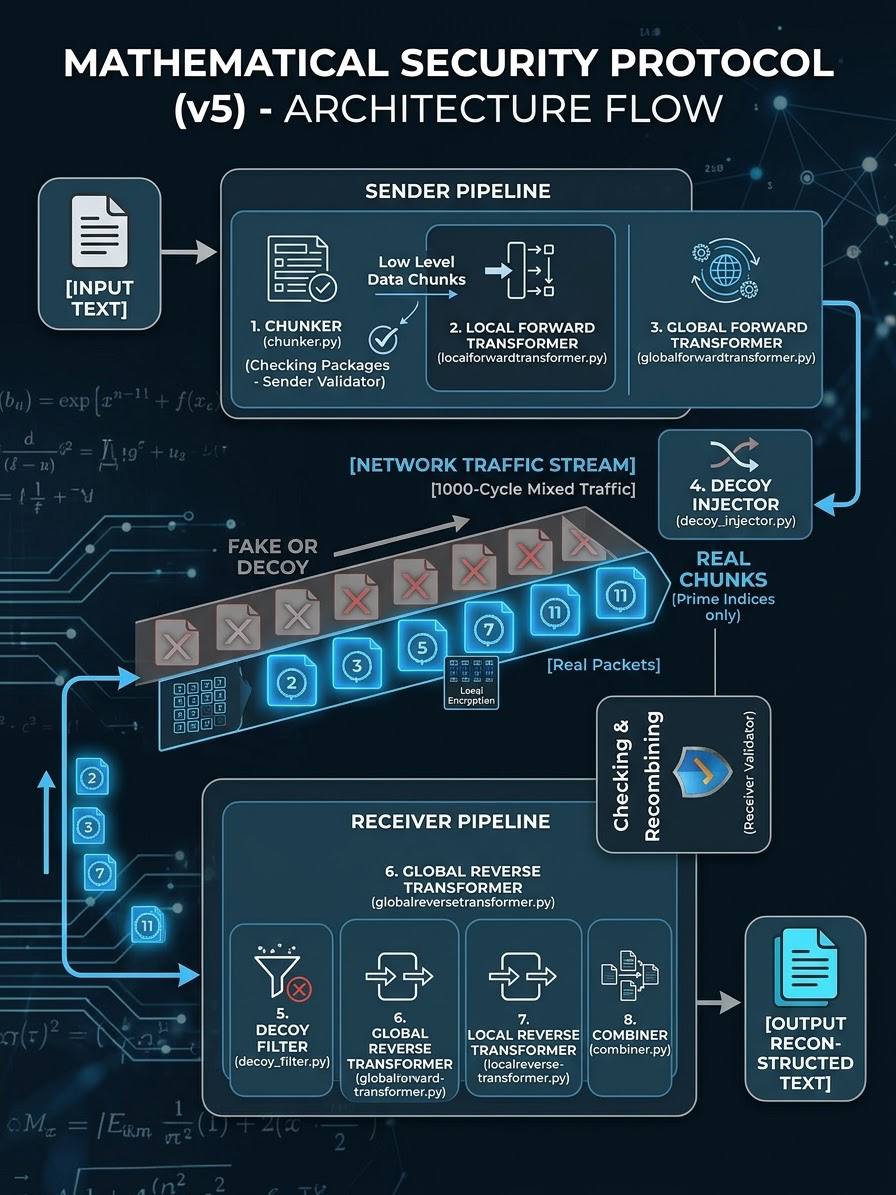
Inspiration
This project did not begin with a single technical challenge. It arose from the converging perspectives of a Polymath, bridging diverse domains—from spatial mechanics in Engineering and the abstract logic of Physics and Computer Science, to narrative structures in Cinema, the intricate layers of Painting, strategic patterns in Business, and existential architectures found within Buddhist Scripture and the Bible. Security is perceived here as a holistic system rather than just a cryptographic primitive, where truly robust solutions are born where disciplines intersect.
What it does
The Mathematical Security Protocol (v5) is a multi-layered, quantum-resistant security architecture designed to prevent tampering, injection, and drop attacks.
- Layer 1: Local Confusion: Applies coordinate confusion to individual data chunks.
- Layer 2: Global Prime Diffusion: Dynamically shuffles chunks using prime-weight distributions.
- Layer 3: Decoy Injection: Obfuscates transmissions within a 1000-cycle limit by injecting dummy packets, inspired by real-world security strategies like a presidential motorcade where the "President" (real data) is concealed among identical decoy vehicles at prime indices.
- Dual-Side Validation: Ensures absolute integrity and packet counts on both sender and receiver ends.
How we built it
The protocol was engineered by breaking security into independent, modular layers and integrating them systematically:
- Chunker: Splits raw plaintext into low-level byte chunks.
- Local & Global Forward Transformers: Handles mathematical confusion and prime-indexed diffusion.
- Decoy Injector: Creates the 1000-cycle mixed stream.
- Sender/Receiver Validators: Enforces structural pre-checks and drop/tamper detection before final recombination.
Challenges we ran into
One of the core logic hurdles was in the GlobalForwardTransformer, where deterministic sorting initially caused ineffective chunk shuffling. This was successfully resolved by implementing a robust, seeded random permutation model to ensure true prime-weight diffusion. Managing a strict 1,000-cycle limit alongside dual-side validation also required meticulous state checking.
Accomplishments that we're proud of
- Successfully developed a custom, non-traditional cryptographic architecture that is naturally quantum-resistant by bypassing standard public-key factorization vulnerabilities.
- Integrated multi-disciplinary system thinking into a flawless 10-step encryption-decryption pipeline.
- Produced comprehensive documentation, a technical whitepaper, and a polished 3-minute video demonstration.
What we learned
This hackathon reinforced the truth that the most complex technological problems often have elegant solutions rooted in cross-disciplinary patterns and system design. Breaking a security protocol down to its elemental mechanics allows for far superior structural integrity than relying solely on static key lengths.
What's next for Mathematical Security Protocol (v5)
We plan to scale the protocol into a production-ready network packet filter, expand the prime-weight distribution models for high-throughput data streams, and explore further implementations of multi-layered decoy routing in decentralized communication networks.
