Inspiration
Many students experience mathematics as a sequence of worksheets, formulas, and individual tests. We wanted to turn it into something students would voluntarily practice because succeeding in mathematics directly helps their team win.
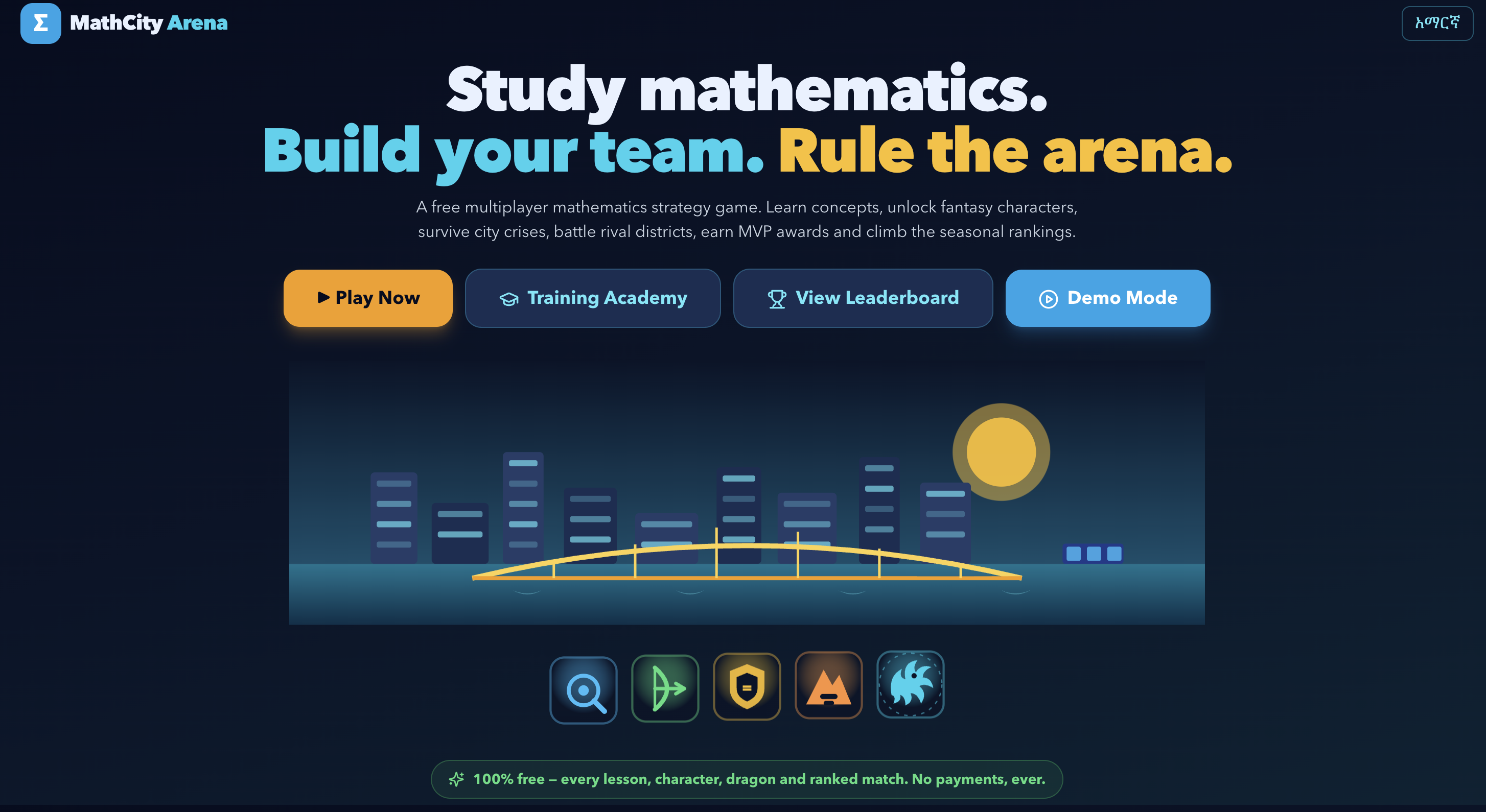
MathCity Arena was inspired by classroom competitions and multiplayer strategy games. Instead of only answering questions for marks, students use mathematics to build a district, prepare for disasters, unlock fantasy units, defend their team, challenge rival teams, and climb a seasonal leaderboard.
What it does
MathCity Arena is a classroom-based mathematics strategy game for middle-school students.
A teacher creates a match lobby, and students join either as solo players or in teams of up to four. Every team begins with equal resources and competes during a fresh match.
Students solve mathematics questions to:
Earn resources and deployment energy Construct and improve their district Unlock units such as Archers, Giants, Guardians, Engineers, Healers, and Necromancers Prepare for classroom-wide disasters Attack and defend during mathematics battles Unlock the Dragon through advanced challenges
Different units require different mathematical skills. For example, Archers use ratios and percentages, Giants use geometry and measurement, and Engineers use coordinates and scale.
A global City Crisis affects every team with the same base event and potential damage. Teams reduce that damage through correct answers, planning decisions, and defensive upgrades.
At the end of each match, every team receives a final placement such as #1, #2, or #3. The game also calculates each student's contribution percentage, chooses a Team MVP for each team, and selects one Match MVP across the classroom.
Long-term statistics include wins, win ratio, average placement, MVP awards, season points, and leaderboard rank. Temporary buildings, units, and damage reset when a new match begins.
How we built it
We built MathCity Arena as a responsive browser-based prototype.
The current hackathon version focuses on a complete and understandable classroom match experience, including:
Player and team setup Classroom lobby presentation Mathematics-powered gameplay City Crisis events Unit deployment Team placements Contribution percentages MVP selection Match history Seasonal leaderboard presentation Locally saved progress
The prototype uses local browser storage to preserve progress. Local party interactions can be demonstrated across browser tabs, while simulated opponents are clearly identified. A production version would use a secure real-time classroom server for cross-device synchronization, teacher controls, and school-wide seasons.
Challenges we ran into
The largest challenge was balancing education and competition.
A game based only on speed could discourage students who need more time. A game based only on battle damage could ignore students who contribute through defense, planning, construction, or teamwork.
We designed scoring so that mathematical accuracy remains the most important factor, while also recognizing:
Question difficulty Defensive actions Resource management Crisis preparation Team assists Creative decisions
Another challenge was defining a multiplayer concept honestly within a limited hackathon build. Rather than claiming a global production backend, we created an interactive local prototype with transparent simulated opponents and locally saved progression.
Accomplishments that we're proud of
We are proud of creating a concept that combines classroom learning with the excitement of a competitive strategy match.
Key accomplishments include:
Supporting solo players and teams of up to four Connecting mathematics topics to distinct unit abilities Designing equal classroom-wide City Crisis events Tracking individual contribution within team performance Selecting Team MVP and Match MVP Creating repeatable matches with persistent seasonal statistics Supporting advanced optional challenges that motivate students to study ahead
What we learned
We learned that educational games become more engaging when knowledge changes what the player can actually do.
Mathematics is not presented as a separate quiz layer. It controls resources, defenses, units, disaster survival, and final placement.
We also learned that team contribution must be measured carefully. The strongest contributor is not always the student who causes the most battle damage. A student who solves difficult questions, protects the district, supports teammates, or prepares for a disaster can be equally important.
What's next for MathCity Arena
Future development would include:
Real-time multiplayer through a classroom server Teacher-created question banks Grade- and curriculum-specific content English and Amharic language support School and inter-school tournaments Collaborative class-versus-system matches Stronger accessibility controls Secure student accounts and teacher dashboards Analytics showing which mathematics topics need more practice Mobile and tablet optimization
Built With
- apis
- browser
- css
- css3
- design
- educational
- game
- html5
- javascript
- localstorage
- react
- responsive
- tailwind
- technology
- typescript
- vite

Log in or sign up for Devpost to join the conversation.