-
-
MathCase: an open case workbench for questioning, checking, and building on mathematical proofs.
-
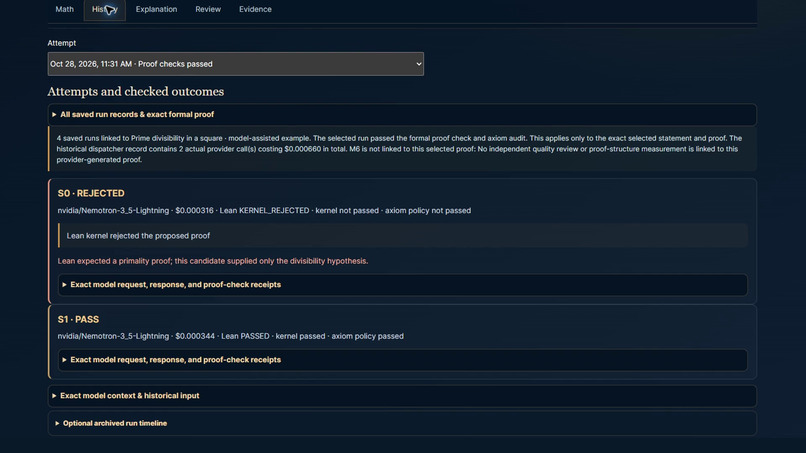
A saved Nemotron proof attempt fails Lean; checker feedback leads to a bounded passing retry.
-
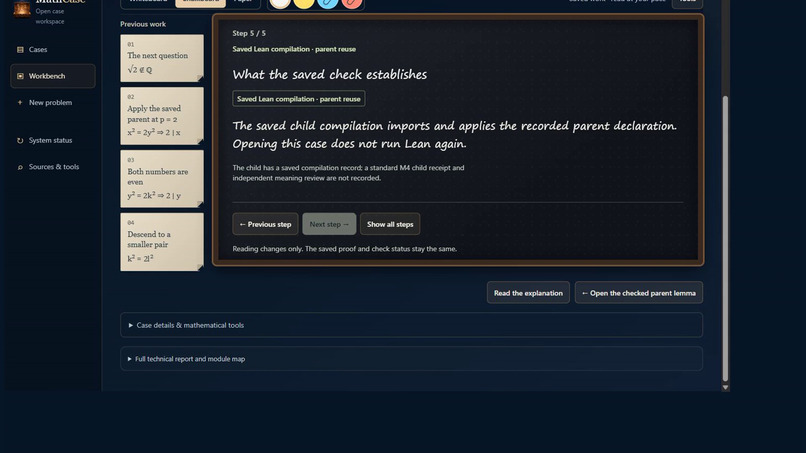
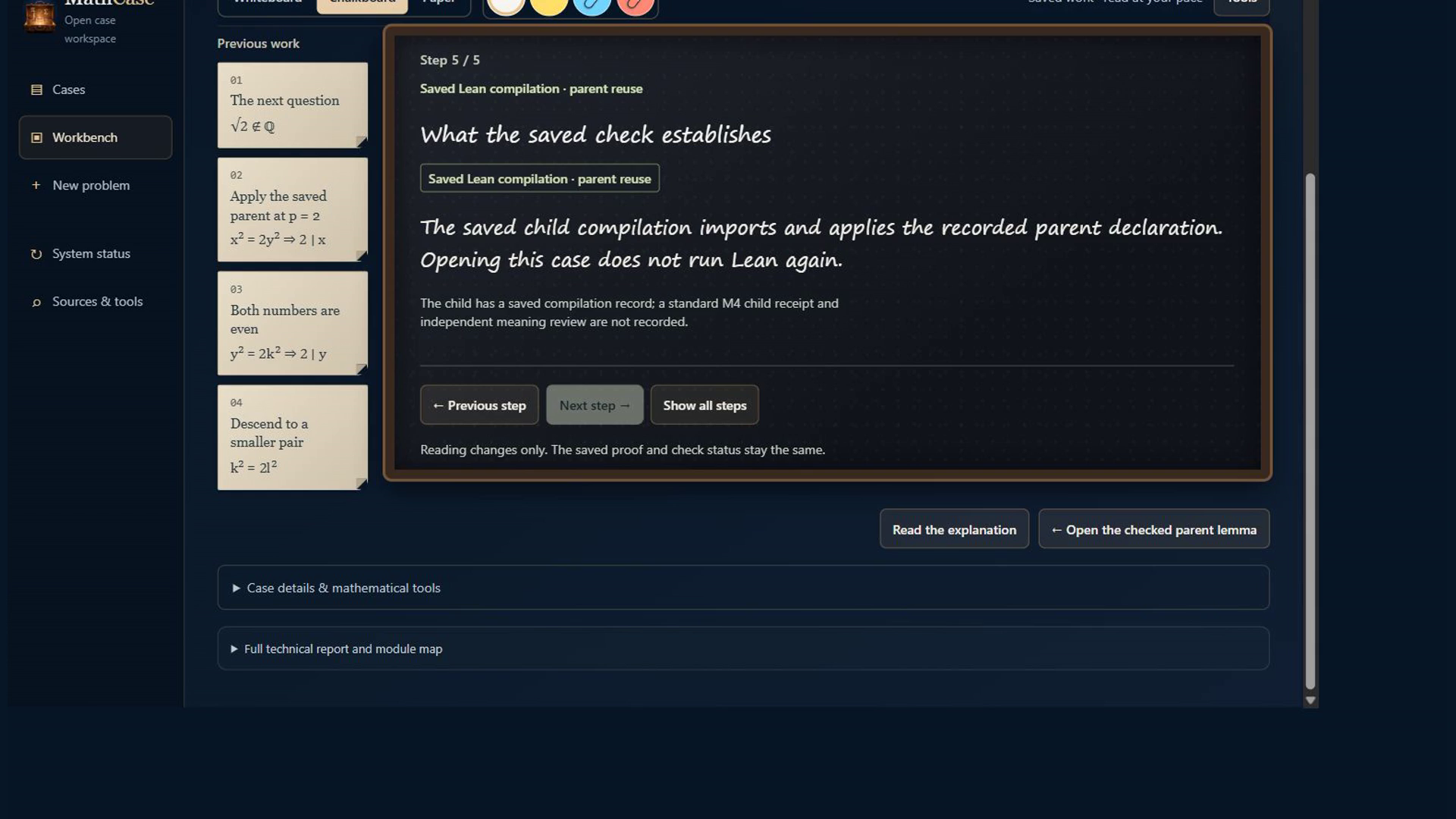
The √2 child imports and applies the exact checked parent lemma at p = 2.
-
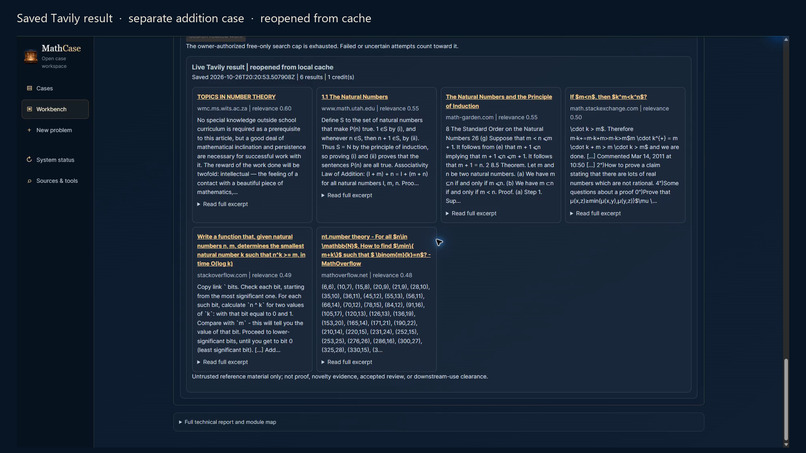
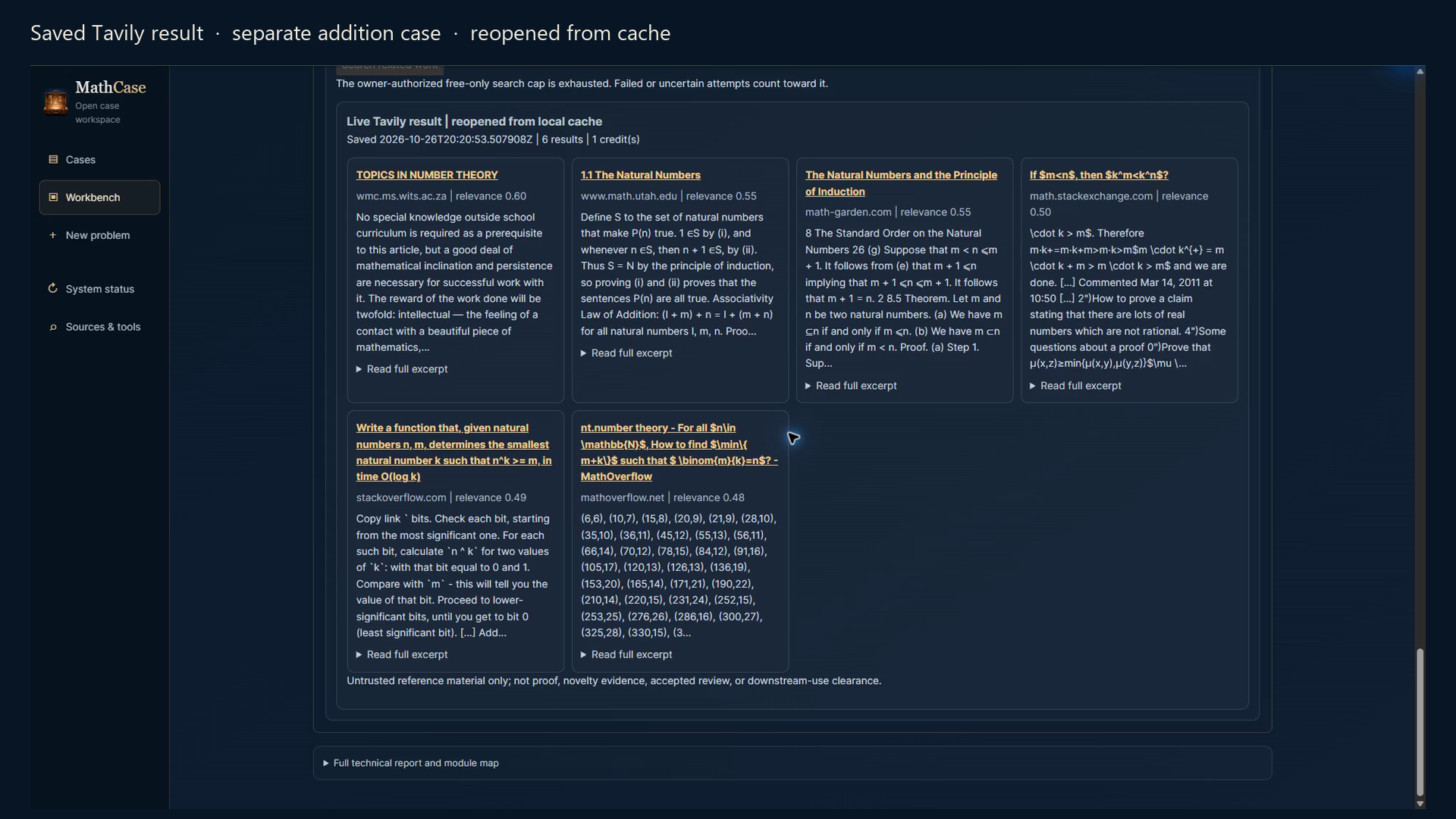
A separate app-origin Tavily search saved six source results, reopened from local cache.
-
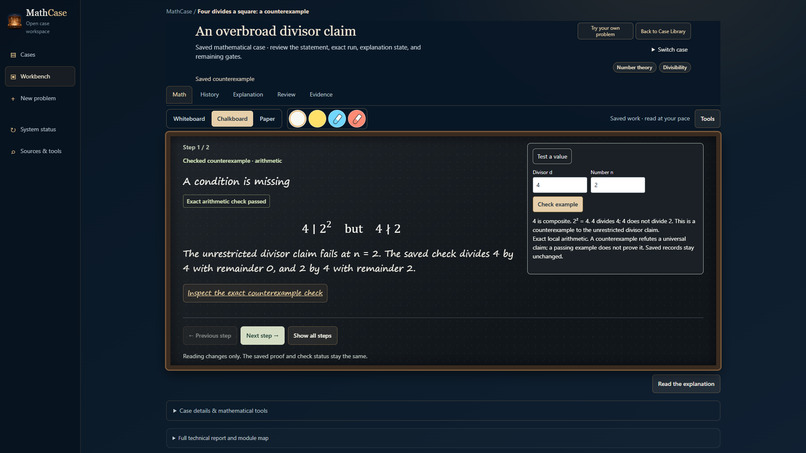
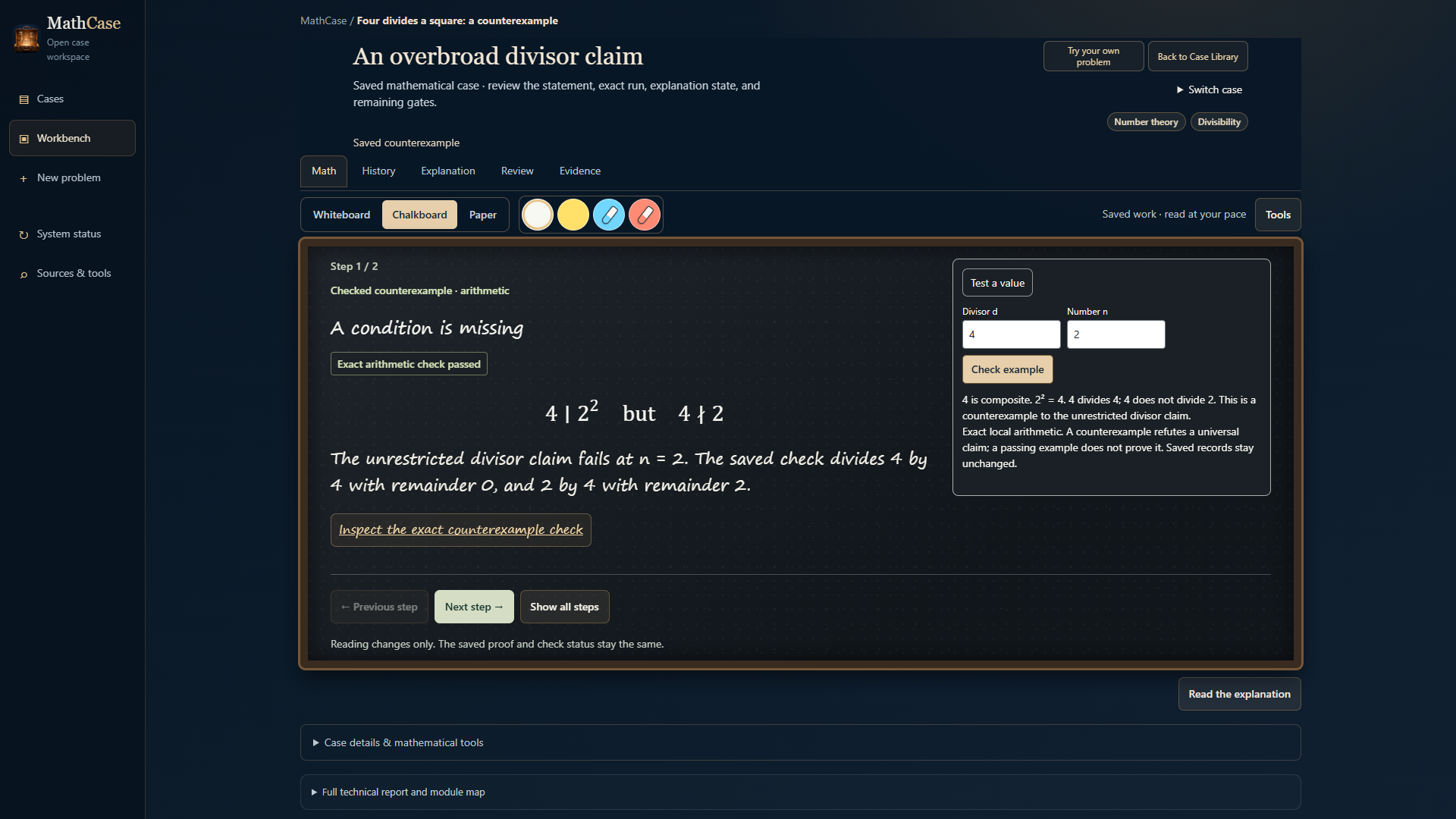
Test a value in the corrected Case Desk: n = 2 disproves the unrestricted divisor claim.
Open the no-key demo · Watch the 2:57 film · Source and local setup
Know what you can build the next proof on
For a student learning proofs, a convincing AI answer leaves a practical question: which step can I actually trust and reuse? MathCase puts the claim, the failed attempt, the checked correction, and the next proof in one inspectable workbench.
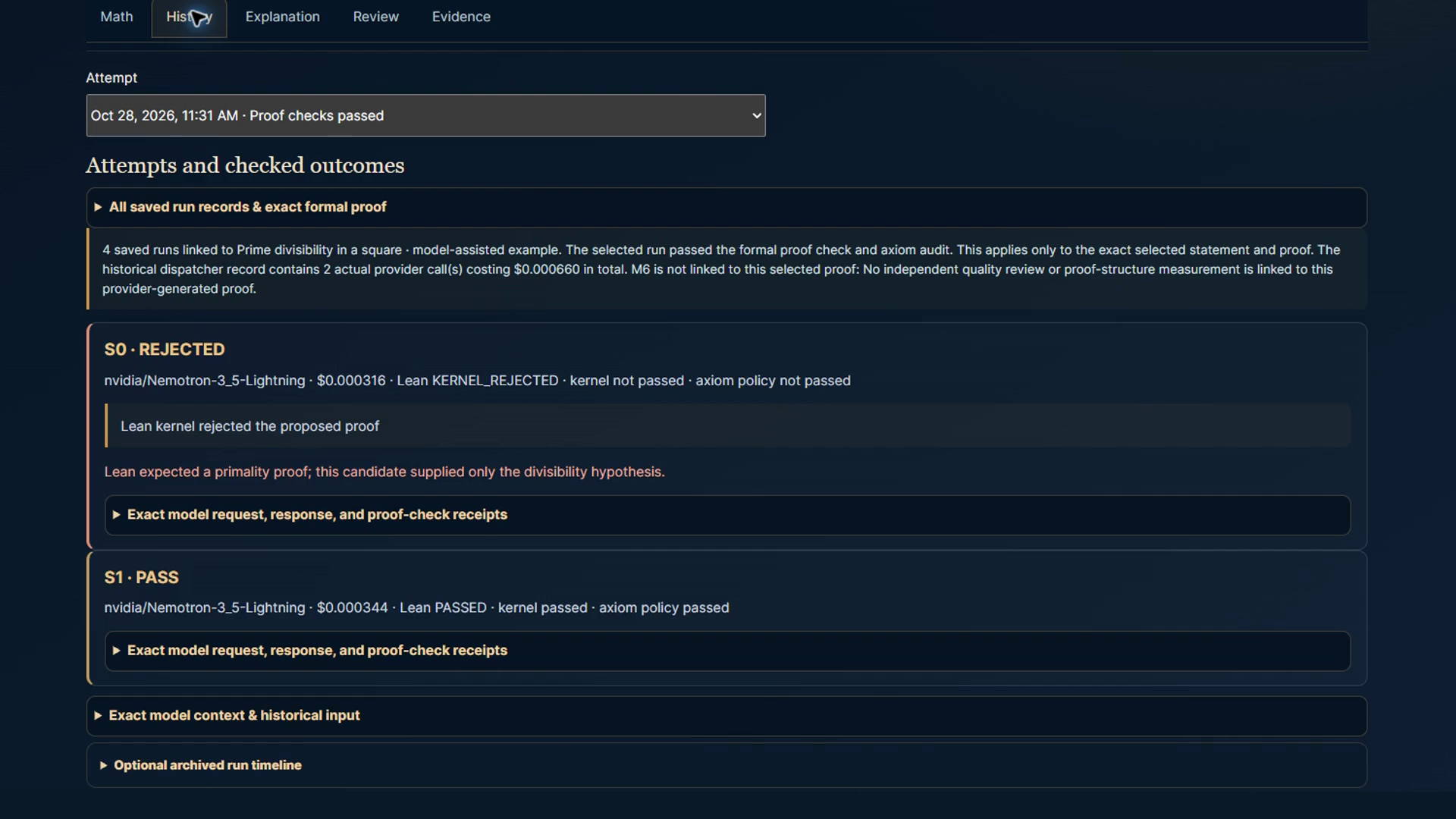
Try the demo: test d = 4, n = 2 → inspect Prime lemma · History → follow Build on it: √2.
Four divides two squared, but four does not divide two. That one counterexample breaks the illustrative claim, “If 4 divides n², then 4 divides n.” MathCase lets you test the arithmetic yourself. It then opens a separate saved case with one sound repair: when a prime p divides n², p divides n. Primality is sufficient here; it is not the only possible condition.
Watch a proposal become a checked building block
In the saved hero run, NVIDIA Nemotron 3.5 Lightning on Nebius Token Factory proposed Lean 4 proof code for the known prime-divisibility theorem. Its first candidate supplied divisibility where Lean needed a primality proof, so Lean rejected it. MathCase preserved the compiler diagnostic and carried it into one bounded retry. The second candidate passed the recorded Lean kernel and axiom checks for the exact formal statement. The two provider calls recorded $0.000660 in total provider cost. This is one observed case, not a cost or reliability benchmark.
Now follow the result into the next question. A saved √2 child module imports the exact compiled parent theorem and applies it at p = 2. For positive x and y with x² = 2y², that lemma makes x even; substitution makes y even. Halving them gives a smaller positive pair with the same equation: infinite descent. The child has a saved successful compilation with parent reuse. It does not have a separate standard M4 child receipt. Its plain-language explanation remains a draft that people can inspect and improve.
The Case Desk keeps the mathematical question and current step large. Previous steps collect as notes. Readers can switch Whiteboard, Chalkboard, and Paper views, inspect the exact Lean source and history, and reopen saved cases without a provider key. Changing the divisor and number runs an exact local arithmetic example. The public Case Desk profile follows the three saved hero cases; live model dispatch and review writes are separate from this reading flow.
The hosted demo opens directly in the Case Desk with these three saved cases, interactive arithmetic, proof history, and the parent-child links. No login or API key is needed. The public repository includes the actual Case Desk frontend and a Python preview backend for the saved cases, alongside the Go proof/provider core, a bounded BYOK Tavily search command, a read-only MCP connector, and Lean examples. The Case Desk preview opens with Python alone. New provider runs use the separately configured CLI with the operator's own credentials and authorization; opening saved cases makes no paid call.
Sources, other models, and the broader test
Tavily supplies a separate, opt-in source-search path in MathCase. A genuine app-origin runtime search for an addition-associativity case saved six results. In the hosted workbench, Tavily search opens the saved runtime summary, and Six saved source links reveals all six recorded titles and clickable URLs. Source excerpts remain private. The film reopens saved source cards from local cache; it makes no new search call. These references did not feed the historical prime proof; retrieved material is context to assess, not a formal verdict.
In a separate, one-call-per-model pilot on the same known statement, frozen context, and Lean checker, Qwen and DeepSeek each produced Lean-passing candidates with identical proof bytes; Nemotron returned no candidate in its matched call. Earlier Nemotron hero calls did succeed. This small pilot is a record of what happened, not a model ranking.
MathCase also ran a local, bounded Pantograph campaign over 30 distinct problem attempts and 39 tactic searches. Thirteen searches produced proof candidates; six results have a standard reopen. That campaign made zero provider calls and is separate from the Nebius hero and model pilot. Thirty attempts do not mean thirty solved theorems.
A separate Collatz research appendix publishes agent-authored Lean proofs covering 7,825 of 8,192 residue classes with descent within 21 steps, plus a separate 96-step family. Its model experiments preserve an earlier agent repair and a fresh DeepSeek proof that passed MathCase's Lean checks unchanged after receiving a previously checked proof as a worked example. All fifteen provider-call outcomes and $0.473748 in provider cost are documented, alongside sources, check outputs and a separate Tavily literature lookup. These are elementary partial results, not a proof of Collatz, a model benchmark or an established mathematical discovery.
Why it matters
AI can suggest mathematics faster than a person can understand it. MathCase makes the boundary visible: model output is a proposal; Lean checks the precise formal proposition; sources and explanation drafts stay open to human judgment; checked dependencies can be inspected and reused. These demonstrations involve known results. They do not establish novel discoveries, general problem-solving ability, or that every formalization captures the intended informal meaning.
Paul Erdős’s “My brain is open” is the invitation behind the demo. Steven Strogatz’s conversation about AI and human purpose helped sharpen the question: when a machine can produce an answer, how do we keep people active in the reasoning? MathCase’s answer is a workbench where you can question, check, understand, and build on what holds.
Built With
- deepseek
- javascript
- lean-4
- mathlib
- nebius-token-factory
- nvidia-nemotron
- pantograph
- python
- qwen
- tavily