-
-
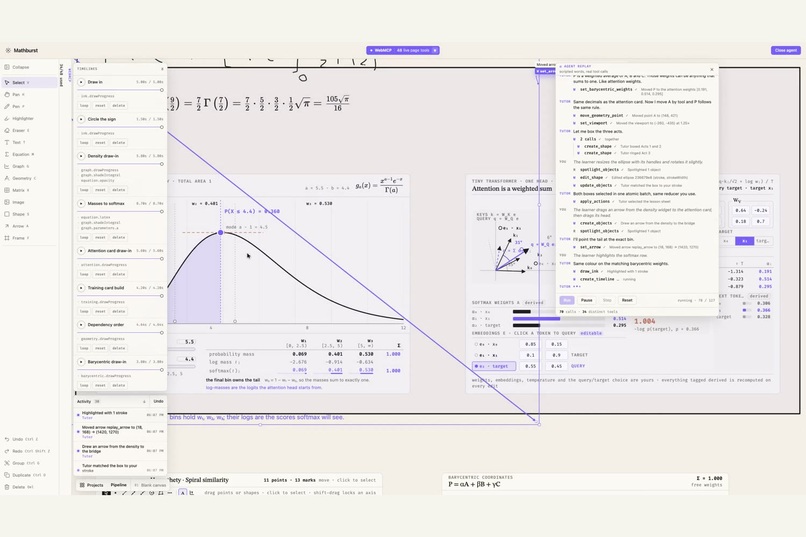
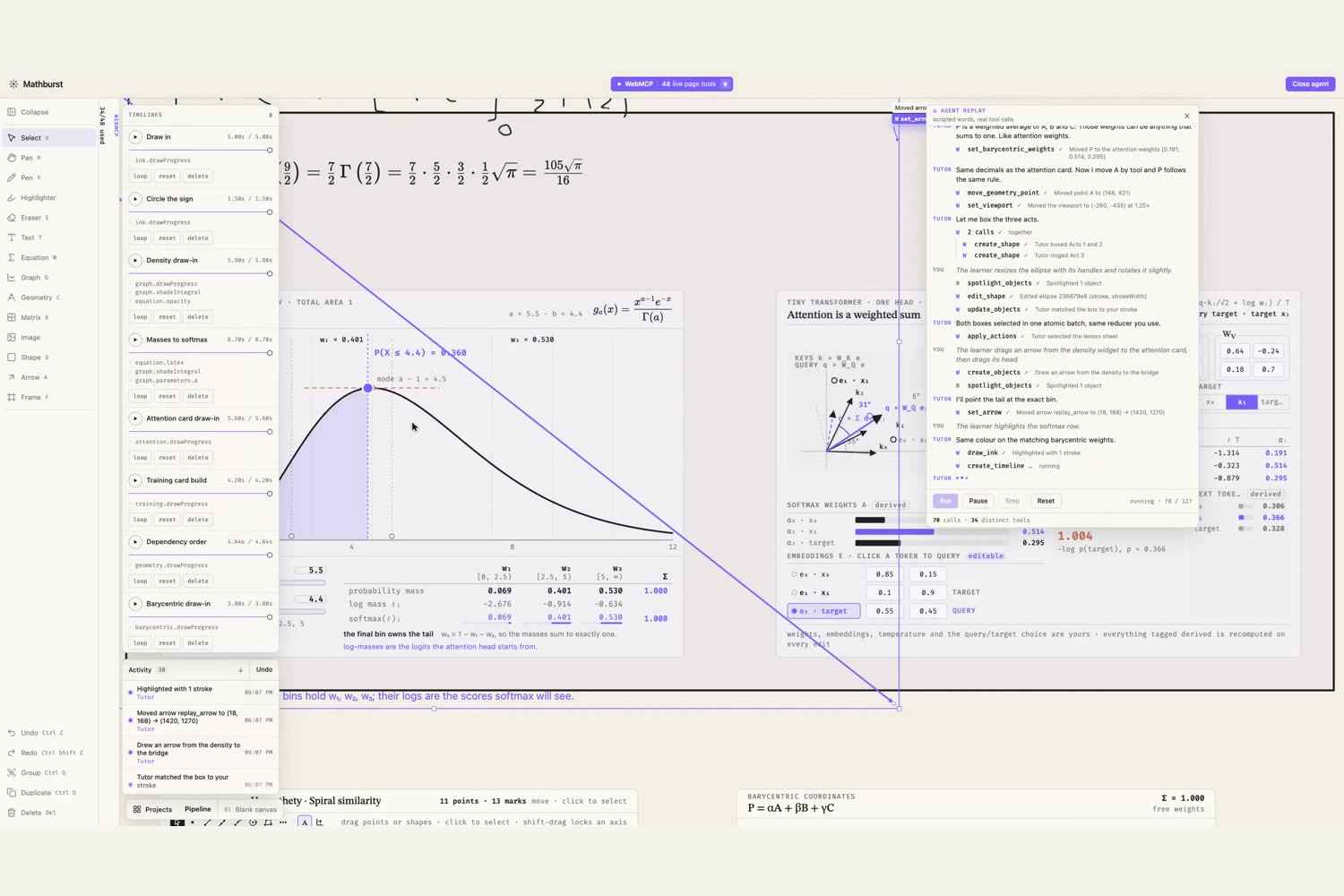
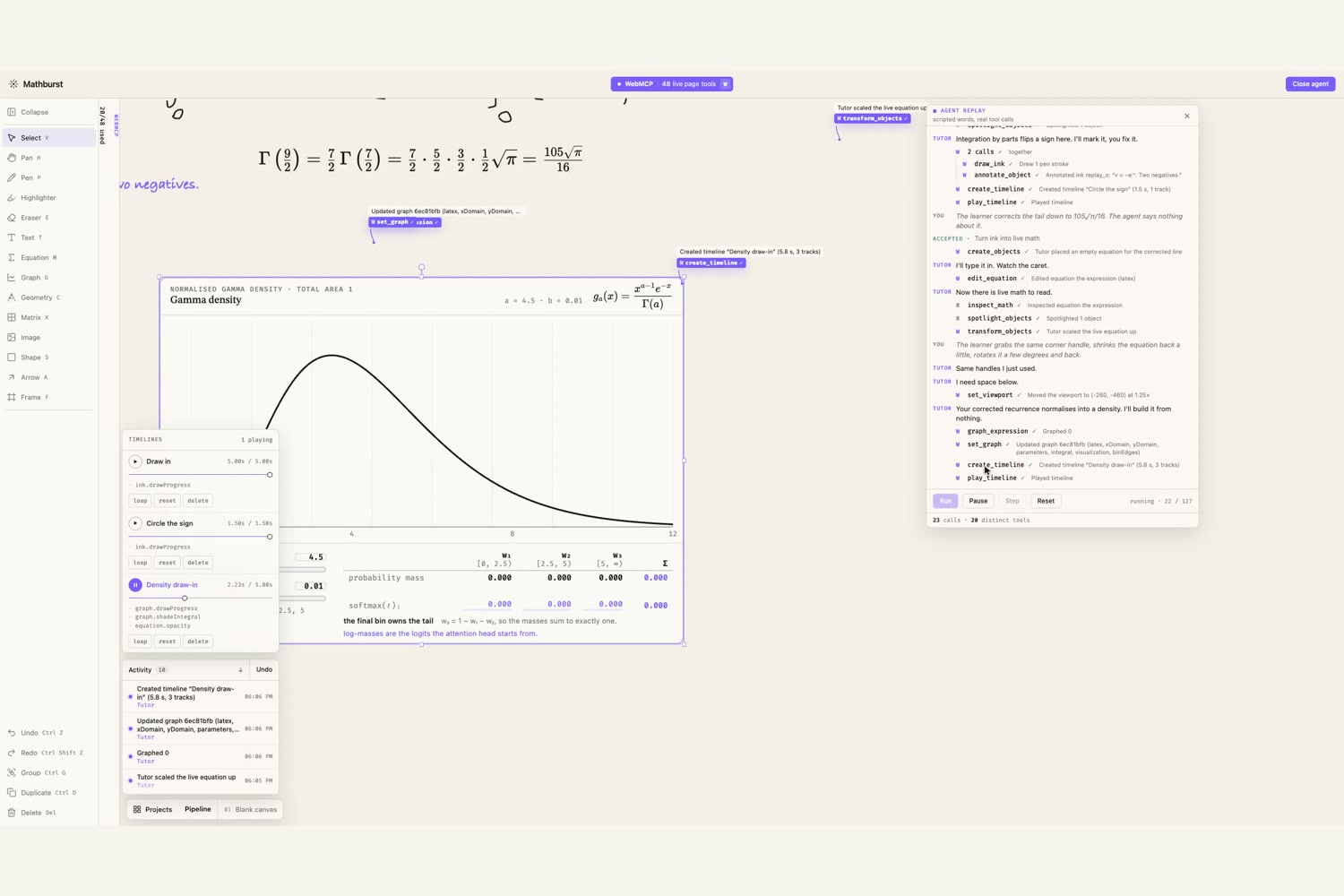
Shared live math world: learner and AI tutor editing one attributed, undoable canvas.
-
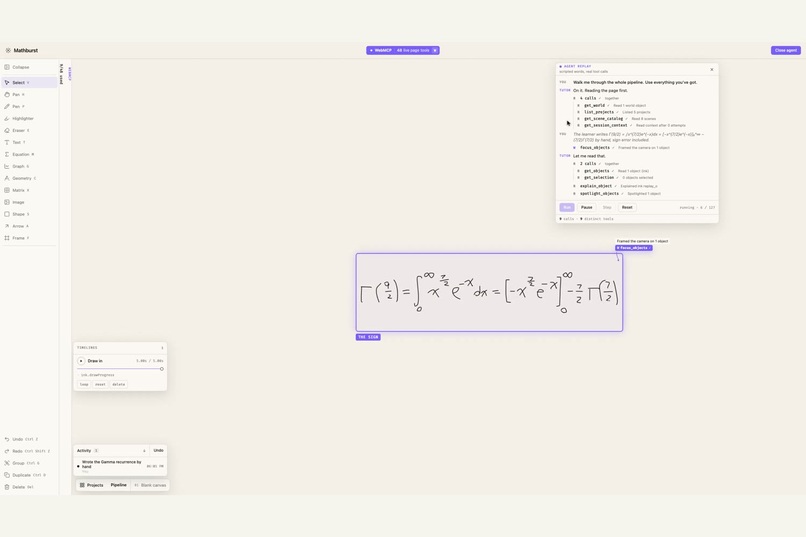
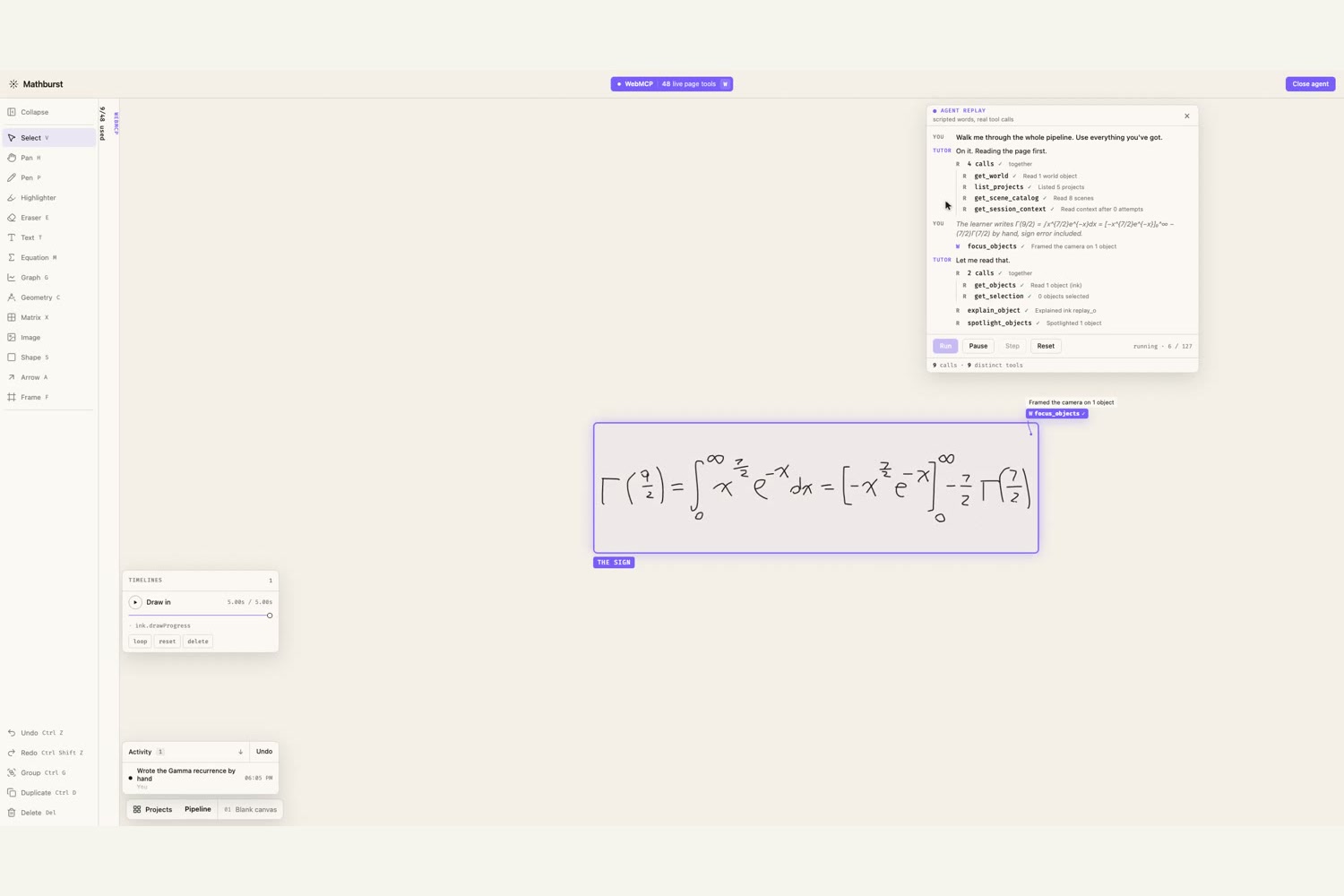
Semantic handwriting and Gamma clinic: reconstruct, audit, mark the error, and wait for learner approval.
-
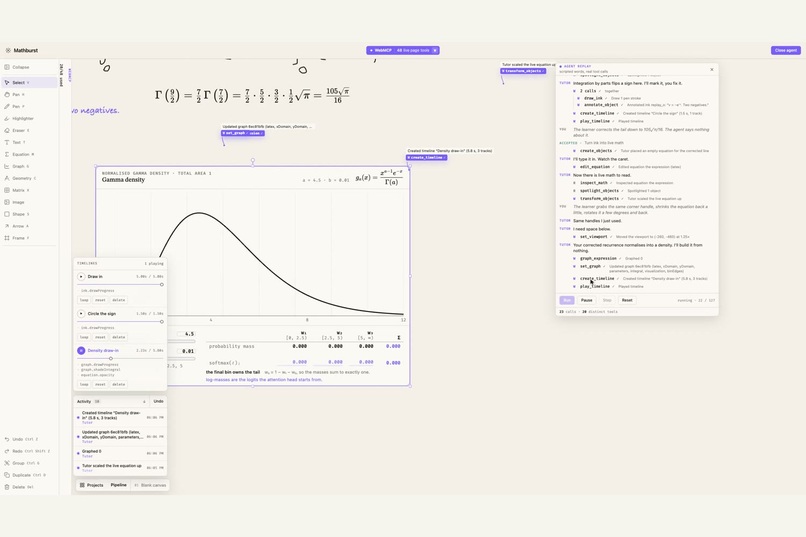
Native WebMCP inspector: all 48 registered page tools are visible and runnable without an external client.
-
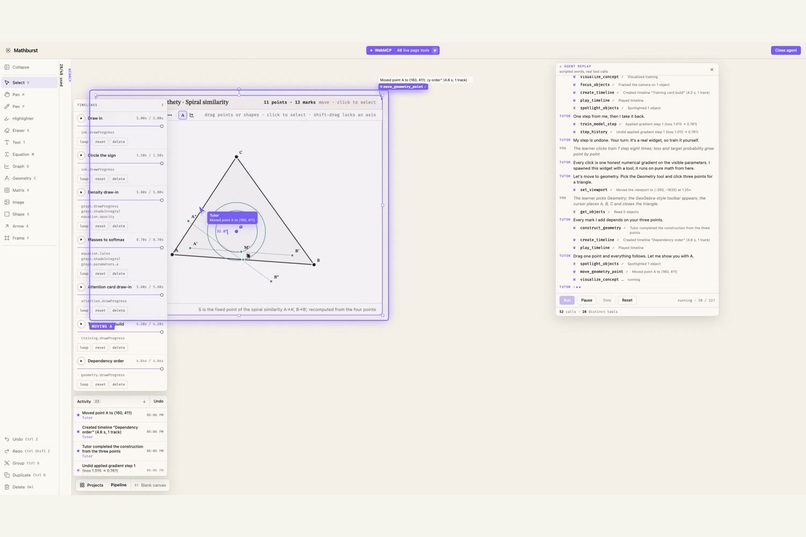
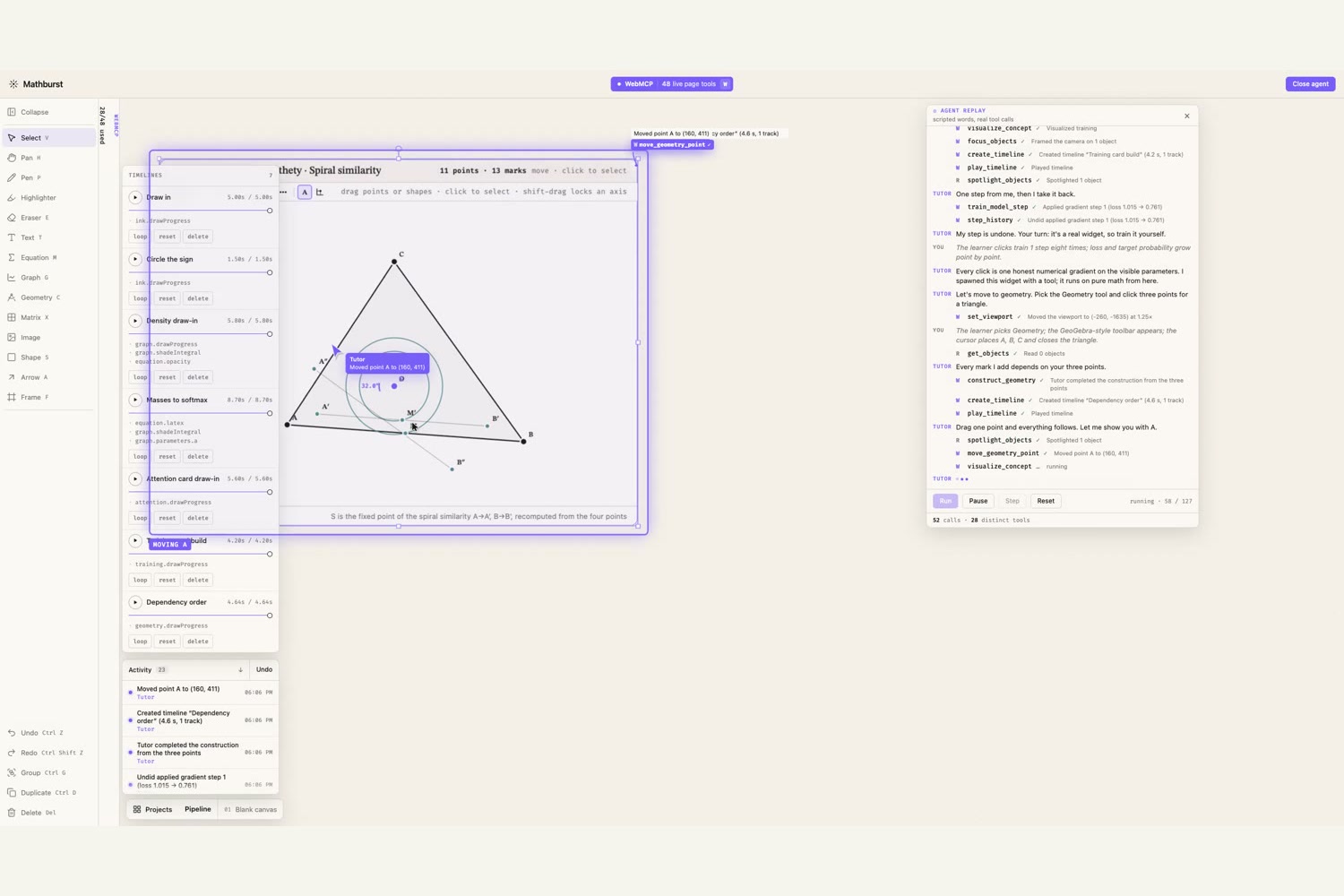
Olympiad geometry: live dependent constructions recompute as learner or tutor moves a point.
-
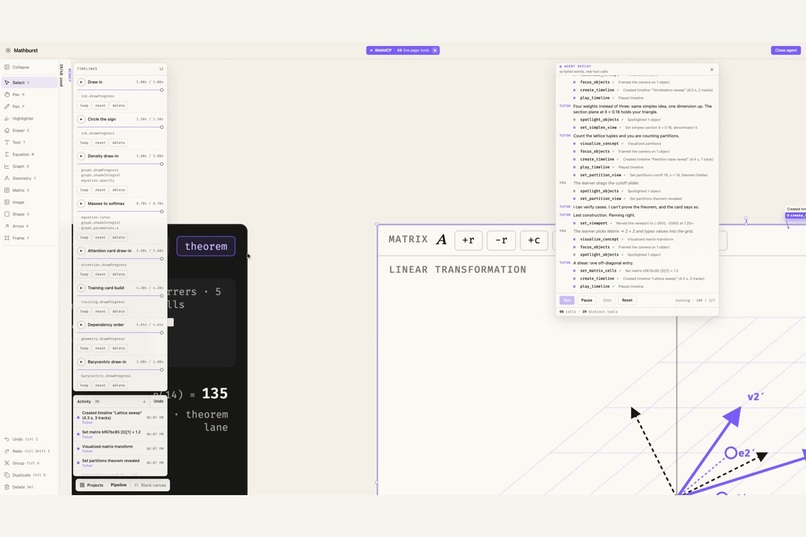
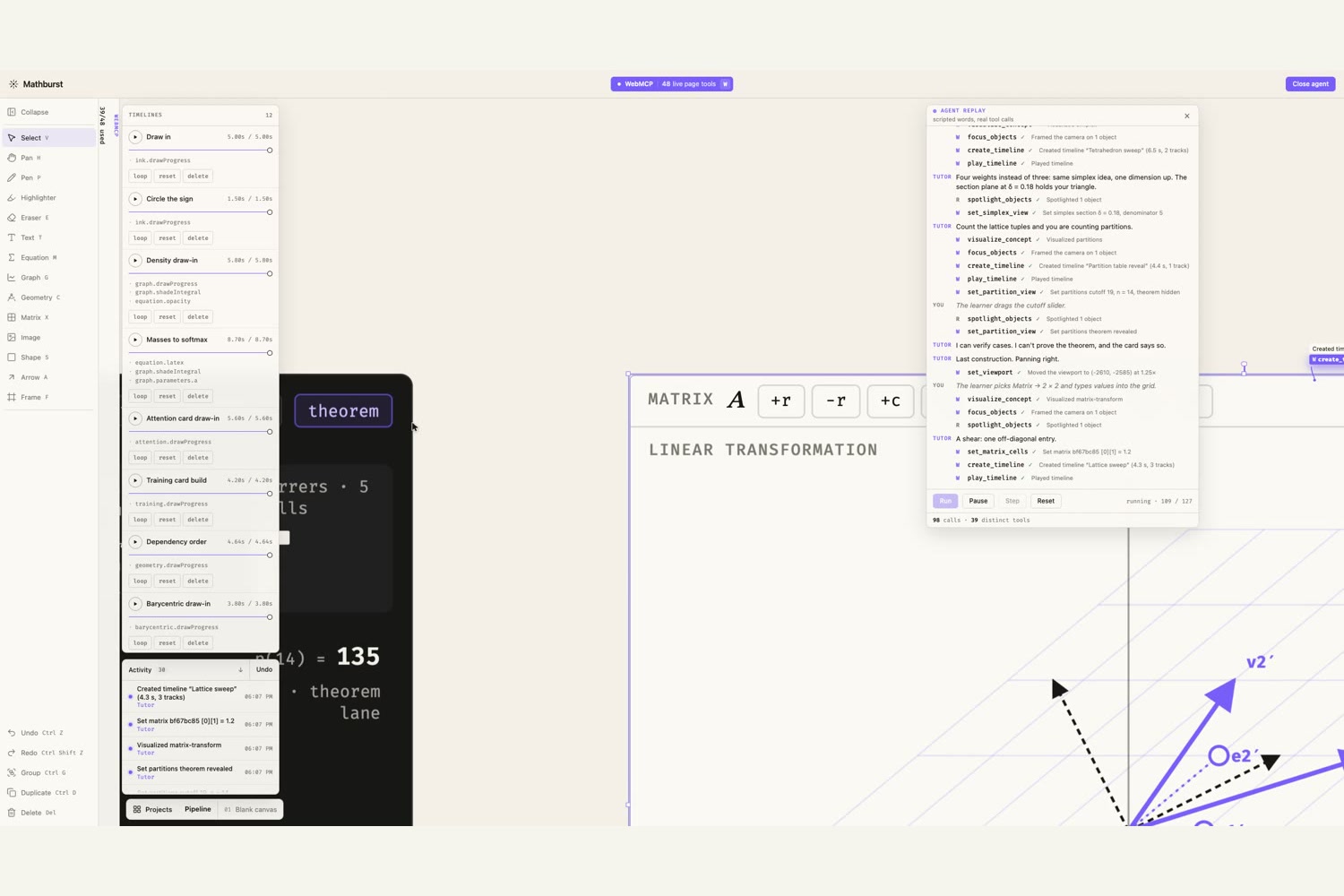
Matrix and attention lab: one cell edit propagates through vectors, weights, probability, and shared history.
Try it in 15 seconds
Open Mathburst in ChatGPT's WebMCP-capable browser or Chrome 149+ with chrome://flags/#enable-webmcp-testing. The page registers 48 native WebMCP tools. Open WebMCP · 48/48, run set_matrix_cells, and watch one call travel end to end: the matrix updates, a ring marks the target, the ledger names the tool, and the activity rail credits the tutor. Press undo once. The agent's edit reverses through the same history as a learner edit.
No WebMCP browser? The on-page inspector invokes the same registered handlers, so the complete tool surface remains demonstrable.
Inspiration
An AI tutor can talk about your math. It cannot touch it.
The work sits in a photograph, a notebook, or a canvas the model cannot reach. So the tutor explains around the problem. It describes a graph it cannot draw and suggests a correction it cannot make.
We moved the mathematics onto the page, then gave a WebMCP agent tools on that page. One rule shaped everything: every agent edit must produce the same typed operations as the learner's toolbar. That rule decides what the tutor may change and guarantees that the learner can see and undo it.
What it does
Mathburst is an infinite canvas for late high school and early undergraduate mathematics. A learner writes by hand, graphs functions, builds geometry, edits matrices, and explores live mathematical models. An in-browser AI tutor works on those same objects through WebMCP.
This is where WebMCP matters. Mathematics is spatial and live: reasoning appears as a graph, a construction, a matrix, or a half-finished line of algebra. None of that survives being described in a chat box. Mathburst lets an agent read the actual document and act at the exact place where help is needed.
Before WebMCP, the tutor could describe a change. Here it makes the change on the live object, and the learner can undo it. The tutor can drag a geometry point and every dependency recomputes. It can edit a matrix cell and the attention weights move. It can write an equation that stays editable. Human and agent operate one document through two interfaces, with one visible history.
A direct path to impact at scale
We are submitting Mathburst on behalf of Mathos AI, an active Y Combinator Winter 2024 company featured in Forbes 30 Under 30 Education 2025. Mathos's Google Play listing reports that its existing AI tutor is trusted by more than 2 million students across 200+ countries.
We already know how to reach math learners at scale. Mathburst gives us a clear next step: bring an agent into the learner's actual workspace, make every action visible and reversible, and test the result with real students. We will measure correction time, accepted and reversed tutor actions, and concept retention. With Mathos's distribution and educational experience, we can turn this working WebMCP model into a learning experience for millions of students. In addition, we look forward to fully integrating WebMCP into Mathos's products and services.
How WebMCP works
Mathburst registers 48 tools with document.modelContext.registerTool. Each tool has a typed input schema and an execute handler. Handlers never reach into the DOM. They compile input into canonical world operations and send those operations through the same reducer as a toolbar gesture.
The surface has three parts:
- 12 read-only tools inspect the world, selection, history, session context, mathematics, timelines, projects, and scenes without changing state.
- 28 committing tools create or update canvas objects, reconstruct work, graph expressions, build geometry, edit ink/text/equations/matrices, animate scenes, and drive the math labs. Every commit is attributed and undoable.
- 8 control tools manage the viewport, focus, projects, scenes, playback, and history itself.
That shared action kernel gives every agent change three properties:
- Visible: a ring marks changed objects and a toast names the tool.
- Attributed: the ledger records the tool and the activity rail records the author.
- Reversible: one undo reverses a tutor commit exactly as it reverses a learner commit.
Chrome's WebMCP budgets are enforced at load: names at most 30 characters, descriptions at most 500, and parameter descriptions at most 150. A violation fails before registration instead of disappearing silently. docs/WEBMCP_TOOLS.md documents every tool and schema.
We tested the native path end to end with Claude driving Chrome with WebMCP enabled. Claude used create_objects, get_objects, get_history, and step_history to create an object, read it back, inspect its commit, undo it, and verify that it was gone. The same call sequence remained visible in Mathburst's toast, Semantic Inspector, ledger, and activity rail.
Four connected mathematical projects
Gamma Lab. A seeded photograph of an integration-by-parts derivation becomes a semantic reconstruction proposal. The tutor audits it, rings a sign error, writes a note, and stops so the learner makes the correction. This demonstrates proposal, audit, and learner approval; it is not generalized OCR.
Tiny Transformer. Gamma log-masses seed a one-head attention model. Edit one query-matrix entry and the attention weights move while still summing to one. A deterministic numerical-gradient step is saved only when loss falls and target probability rises.
Olympiad Geometry. The same three attention weights become barycentric coordinates for a point in a triangle. Move a point and every dependent construction recomputes through the world dependency graph.
Simplex to Ramanujan. A fourth weight lifts the triangle into a tetrahedral distribution. Its lattice opens into finite partition coefficients. The scene verifies Ramanujan's congruence for finite cases and labels that boundary explicitly; it does not claim a general proof.
Challenges
One edit path for two authors. Pen, eraser, text, equations, graphs, geometry, matrices, shapes, arrows, frames, resize, rotate, and drag all needed a human route and a tool-call route to the same operation.
Keeping history honest. A tutor camera move once entered undo while the same learner pan did not. Both paths now filter camera operations. The final film's measured history records 27 tutor commits and 11 learner commits.
Rejecting flattering math. A transformer training step is kept only when loss falls and target probability rises. The graph drops a step that would make the demo look better without improving the model.
What we learned
Attribution and undo matter more than tool count. The 28 committing tools earn their place because each lands in a history the learner can read and reverse. Remove that, and an agent-native interface collapses into a chatbot with extra steps.
What's next
Accounts and sync so a canvas follows a learner across devices. More subjects on the same kernel. Several agents on one canvas, each attributed separately.
Current scope: one browser, one learner, one in-browser agent, no accounts, no cloud sync, no multiplayer server, and no generalized OCR.
Built With
- canvas
- chatgpt-sites
- cloudflare
- cortex-compute-engine
- elevenlabs
- katex
- localstorage
- react
- remotion
- svg
- typescript
- vite
- webmcp


Log in or sign up for Devpost to join the conversation.