-
-
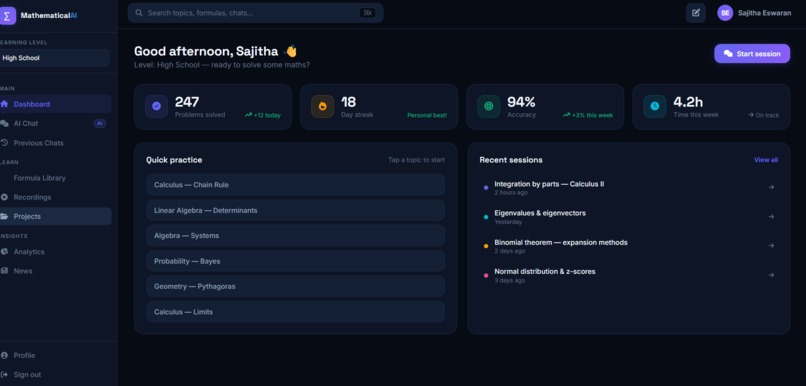
Mathematical AI
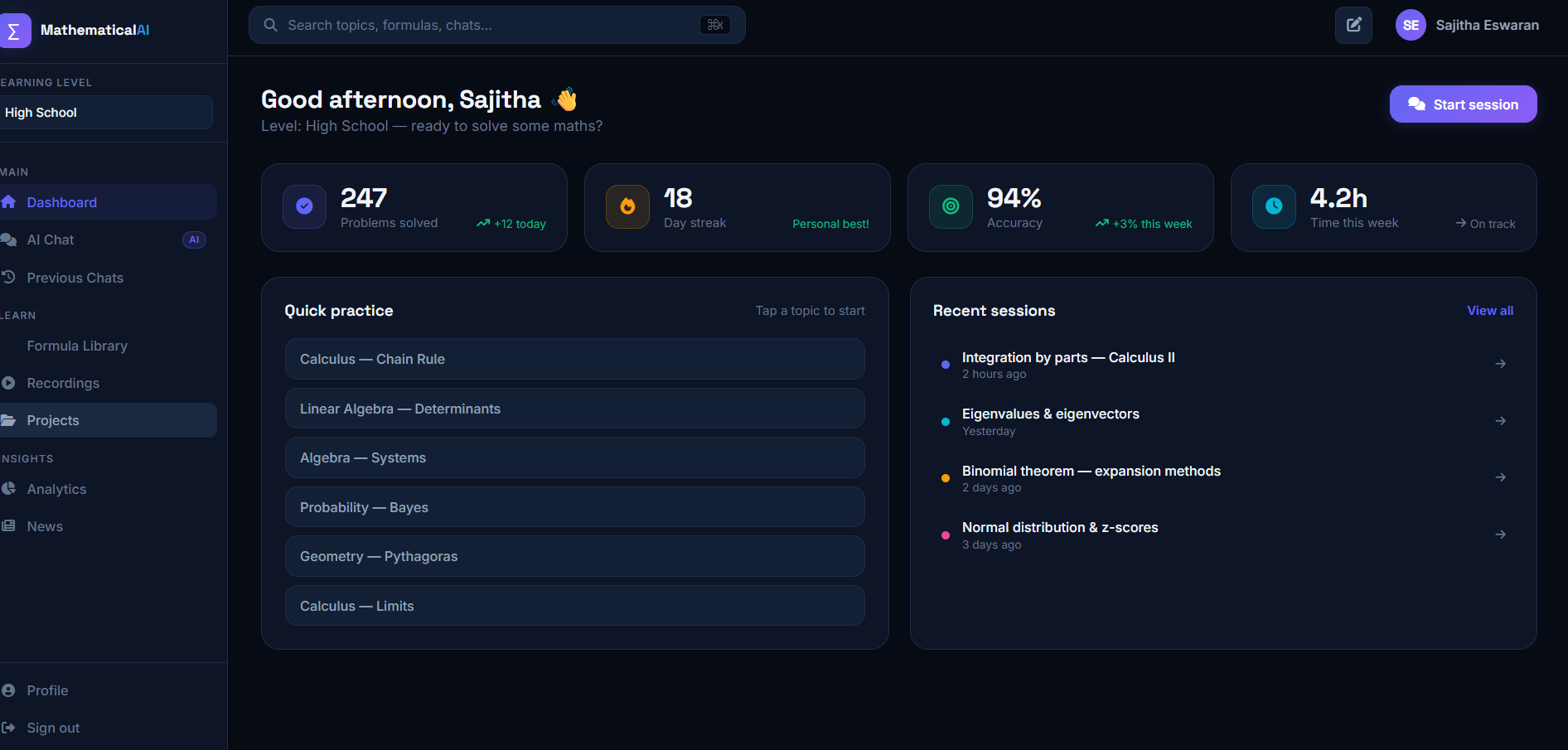
Mathematical AI
Inspiration
Mathematics is one of the most challenging subjects for many students because traditional calculators only provide answers without explaining the reasoning behind them. We wanted to create an AI-powered learning assistant that not only solves mathematical problems but also teaches users how to arrive at the solution. Our goal was to make learning mathematics more interactive, engaging, and accessible for students of all skill levels.
What it does
Mathematical AI is an intelligent web application that helps users solve mathematical problems across multiple domains, including:
- Algebra
- Geometry
- Trigonometry
- Calculus
- Linear Algebra
- Statistics
Users can enter mathematical expressions or questions and receive detailed, step-by-step explanations instead of just the final answer. The platform also supports generating practice problems, visualizing mathematical concepts, and providing clear explanations that improve conceptual understanding.
Some examples include solving equations such as
$$ ax^2 + bx + c = 0 $$
using the quadratic formula,
$$ x=\frac{-b\pm\sqrt{b^2-4ac}}{2a}, $$
and evaluating derivatives, integrals, and algebraic simplifications.
How we built it
The project was developed using a modern full-stack web development stack.
Frontend
- HTML5
- CSS3
- JavaScript
Backend
- Node.js
- Express.js
Database
- MongoDB
Authentication
- JSON Web Token (JWT)
- bcrypt.js
AI Integration
- AI model/API for mathematical reasoning and natural language responses
Other Tools
- Git & GitHub
- REST APIs
- dotenv for environment configuration
The frontend provides an intuitive user interface while the backend processes requests, manages user authentication, communicates with the AI service, and stores user information securely in MongoDB.
Challenges we ran into
During development, we encountered several technical challenges:
- Generating mathematically accurate AI responses.
- Maintaining consistent formatting for equations and explanations.
- Designing prompts that produced reliable, step-by-step solutions.
- Building secure authentication and user management.
- Optimizing backend performance for fast response times.
- Creating a responsive interface that works across desktop and mobile devices.
Each challenge helped us improve both the architecture and overall user experience.
Accomplishments that we're proud of
- Built a fully functional AI-powered mathematics assistant.
- Generated clear, educational, step-by-step explanations.
- Implemented secure user authentication.
- Designed a clean and responsive user interface.
- Successfully integrated AI into a practical educational application.
- Created a scalable architecture that can support additional mathematical topics and future features.
What we learned
Throughout this project, we gained valuable experience in:
- Full-stack web development
- AI integration and prompt engineering
- REST API development
- Authentication using JWT
- MongoDB database design
- Building scalable Node.js applications
- Creating educational software with an emphasis on user experience
We also learned the importance of balancing AI capabilities with mathematical accuracy and clear explanations.
What's next for Mathematical AI
Our future roadmap includes:
- OCR support for handwritten equations
- Interactive graph plotting
- Voice input for mathematical questions
- Personalized learning paths
- AI-generated quizzes and assessments
- Progress tracking and analytics
- Multi-language support
- Mobile application development
- Teacher dashboard and classroom integration
- Advanced symbolic computation and proof assistance
Our long-term vision is to build an AI-powered mathematics platform that helps learners understand concepts, practice effectively, and build confidence in mathematics.
Built With
- backend
- css3
- express.js
- frontend
- html5
- javascript
- mongodb
- node.js

Log in or sign up for Devpost to join the conversation.