-
-
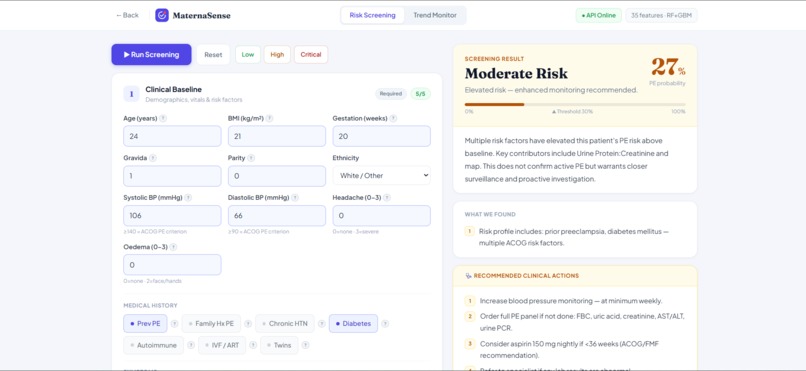
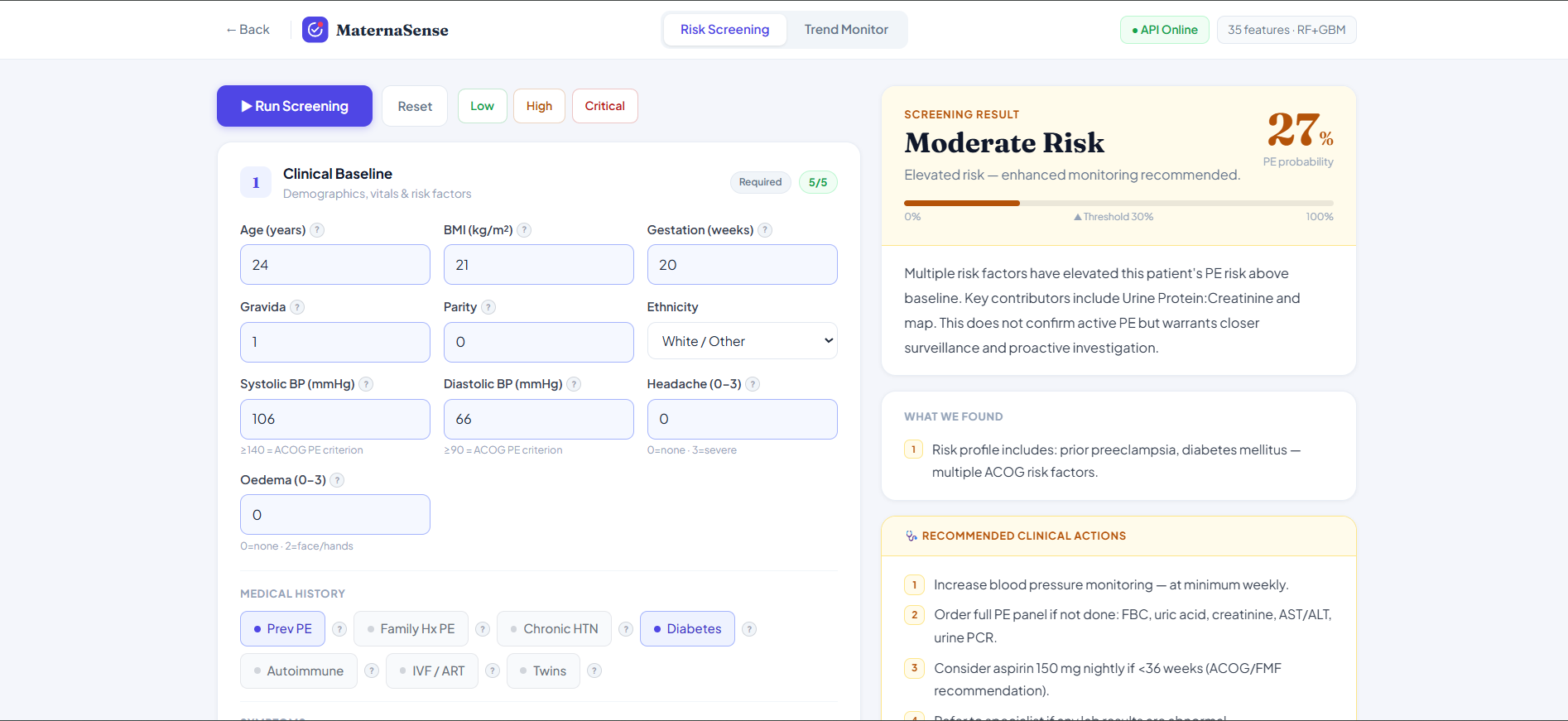
Hybrid ML + clinical rule engine output displaying calibrated probability, contributing risk factors, and guideline-backed next steps.
Inspiration
Preeclampsia is one of the leading causes of maternal and fetal mortality worldwide. What makes it dangerous is not just its severity but its unpredictability. A patient can appear stable during one visit and deteriorate rapidly within days
We were inspired by a simple but powerful question: "What if clinicians had a real-time, evidence-backed risk intelligence tool that combined vitals, labs, and biomarkers into one clear clinical decision support system?"
Many risk factors are scattered across guidelines, research papers, and lab reports. MaternaSense was born from the idea of consolidating that complexity into a single, interpretable, AI-powered interface.
What it does
MaternaSense is an AI-powered clinical decision support system for preeclampsia risk screening. It takes: Patient demographics Obstetric history Blood pressure readings Routine lab values Advanced biomarkers (PlGF, sFlt-1/PlGF ratio, uterine artery PI)
And outputs: A calibrated risk probability (0–100%) Risk category (Low, Moderate, High, Critical) Top contributing clinical drivers Plain-English explanation ACOG-based next clinical steps Confidence score based on data completeness Multi-visit trend analysis A downloadable structured clinical PDF report The system blends machine learning with evidence-based clinical rule adjustments to ensure interpretability and safety.
How we built it
MaternaSense is a full-stack AI web application. Backend Python 3.11 FastAPI Scikit-learn ensemble model: RandomForestClassifier GradientBoostingClassifier CalibratedClassifierCV (isotonic calibration) We trained a structured synthetic dataset simulating 1,500 pregnancies with 15% preeclampsia prevalence. The model incorporates 35 features across three tiers:
Tier 1 – Baseline clinical factors Age, BMI, parity, blood pressure Chronic hypertension Previous preeclampsia Autoimmune disease Diabetes IVF pregnancy Twin pregnancy
Tier 2 – Routine labs Platelets Creatinine Uric acid AST/ALT Urine protein (PCR)
Tier 3 – Advanced biomarkers PlGF MoM sFlt-1/PlGF ratio Uterine artery PI Fetal growth percentile
After model prediction, we apply a rule-based clinical adjustment layer grounded in: ACOG Practice Bulletin 222 Bartsch et al. meta-analysis (25M+ pregnancies) PROGNOSIS Study (NEJM 2016) This hybrid approach improves interpretability and aligns outputs with real-world medical standards.
Frontend React + Vite Fully custom UI Risk visualization components Trend monitoring dashboard jsPDF programmatic clinical report generation
Challenges we ran into
-Probability calibration Raw ensemble models tend to overestimate risk in imbalanced medical datasets. We had to apply isotonic calibration and threshold tuning to produce clinically reasonable outputs. -Handling missing lab data Not all clinics have access to Tier 3 biomarkers. We designed a confidence scoring system to account for incomplete inputs without penalizing patients unfairly. -Balancing AI with clinical safety Healthcare AI must be interpretable. We avoided black-box behavior by integrating guideline-based adjustments and transparent feature contribution displays. -Translating medical research into code Converting odds ratios and clinical criteria from research papers into structured programmatic logic required careful validation.
Accomplishments that we're proud of
Built a full-stack medical AI system within 8 hours Designed a 35-feature risk architecture Integrated research-backed clinical thresholds Implemented calibrated ensemble modeling Created a professional-grade UI suitable for clinical environments Generated structured two-page medical reports Implemented trend monitoring across visits
What we learned
Machine learning alone is not enough in healthcare — it must align with guidelines. Model calibration is critical in medical prediction systems. Interpretability builds trust. Clinical UX matters as much as model accuracy. Blending statistical models with domain rules improves reliability.
What's next for Maternasense
Authentication and patient history tracking Secure cloud deployment OCR-based lab report scanning Real clinical dataset validation Collaboration with obstetric specialists Regulatory pathway exploration Long-term, MaternaSense could become a scalable screening tool for resource-limited clinics.
Built With
- fastapi
- javascript
- jspdf
- numpy
- pandas
- python
- react
- render
- scikit-learn
- tailwind-css
- vite


Log in or sign up for Devpost to join the conversation.