-
-
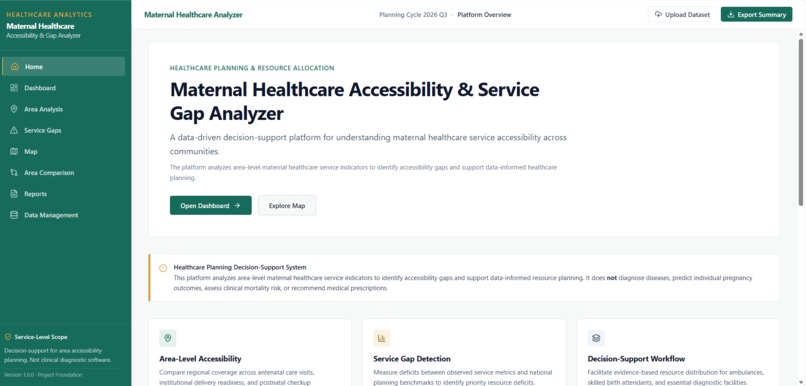
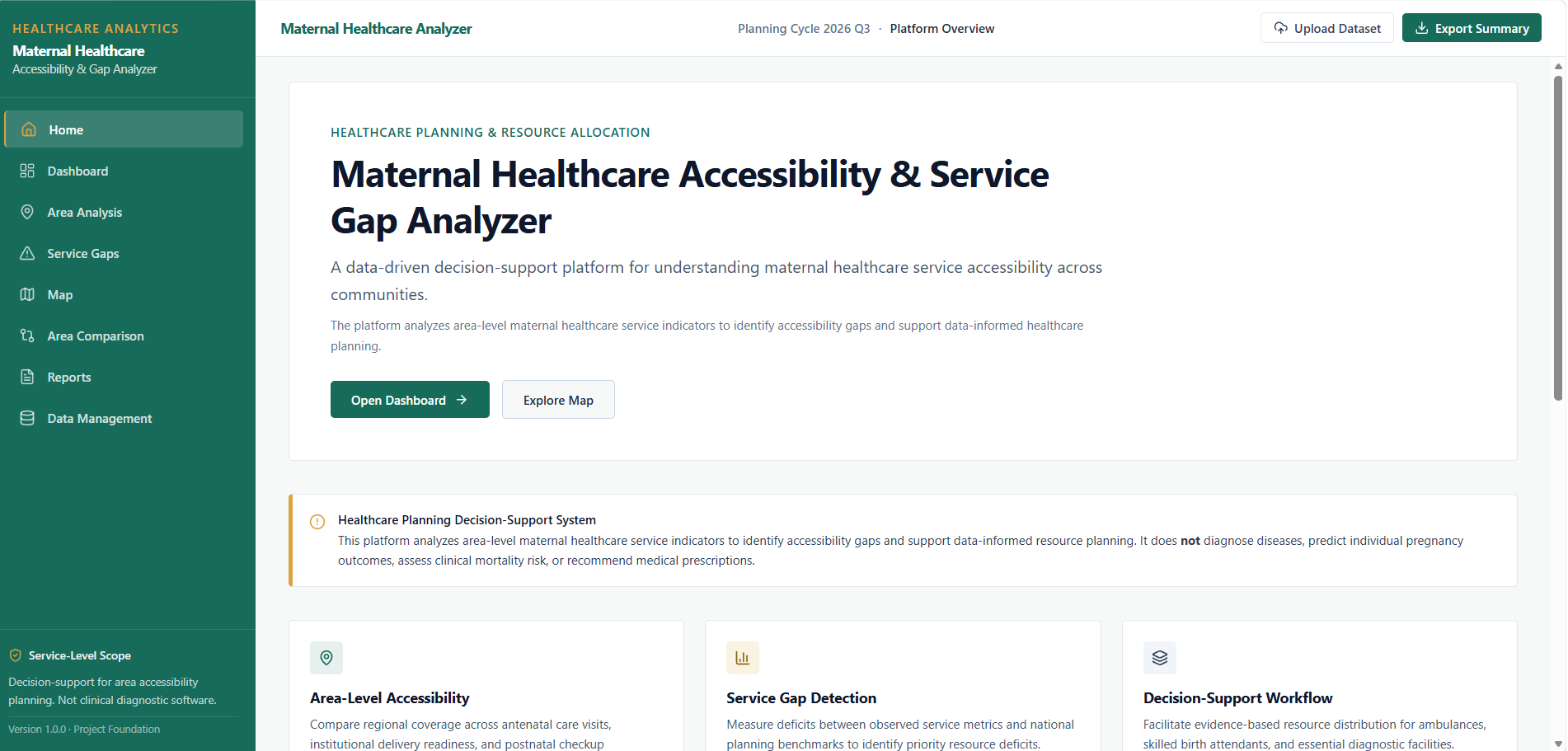
High-level overview presenting system capabilities and quick-navigation buttons.
-
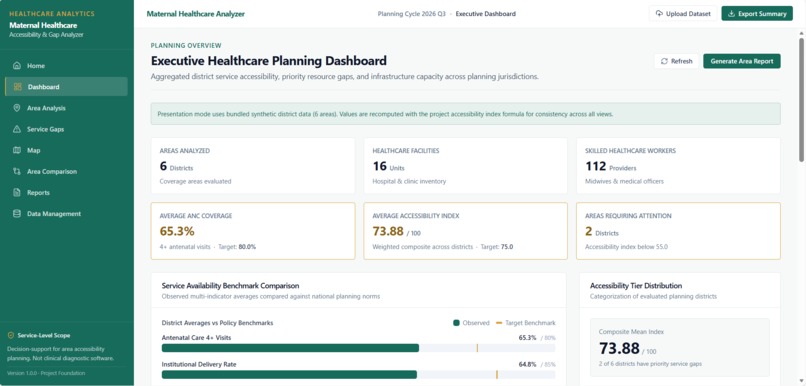
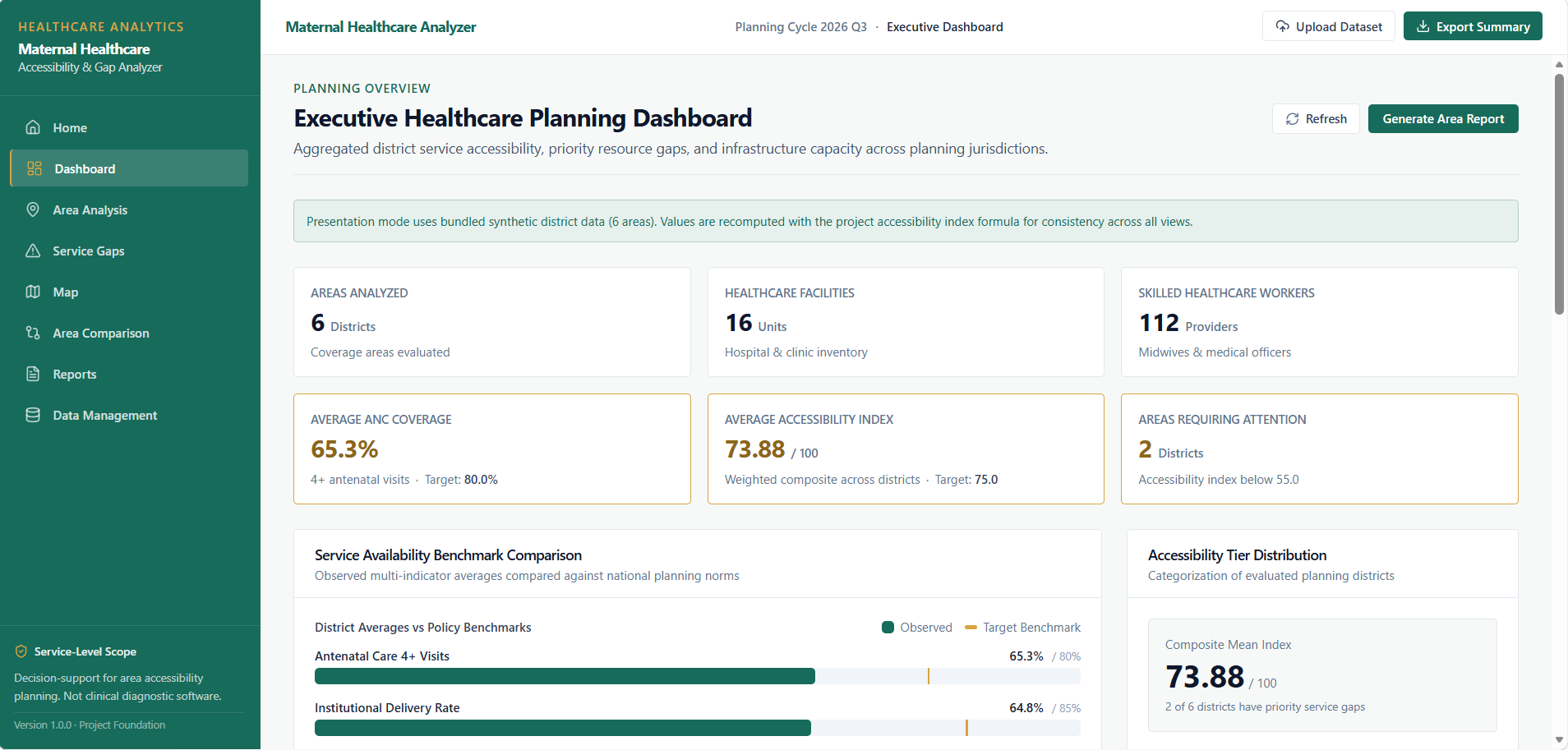
Aggregate summary displaying overall accessibility indices, total facilities, and key metric benchmarks across districts.
-
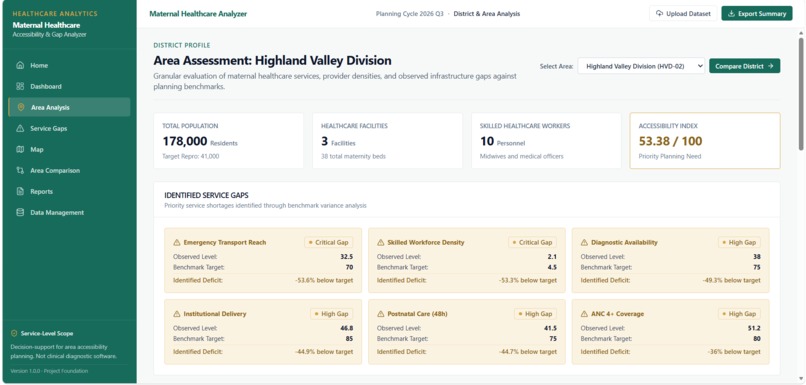
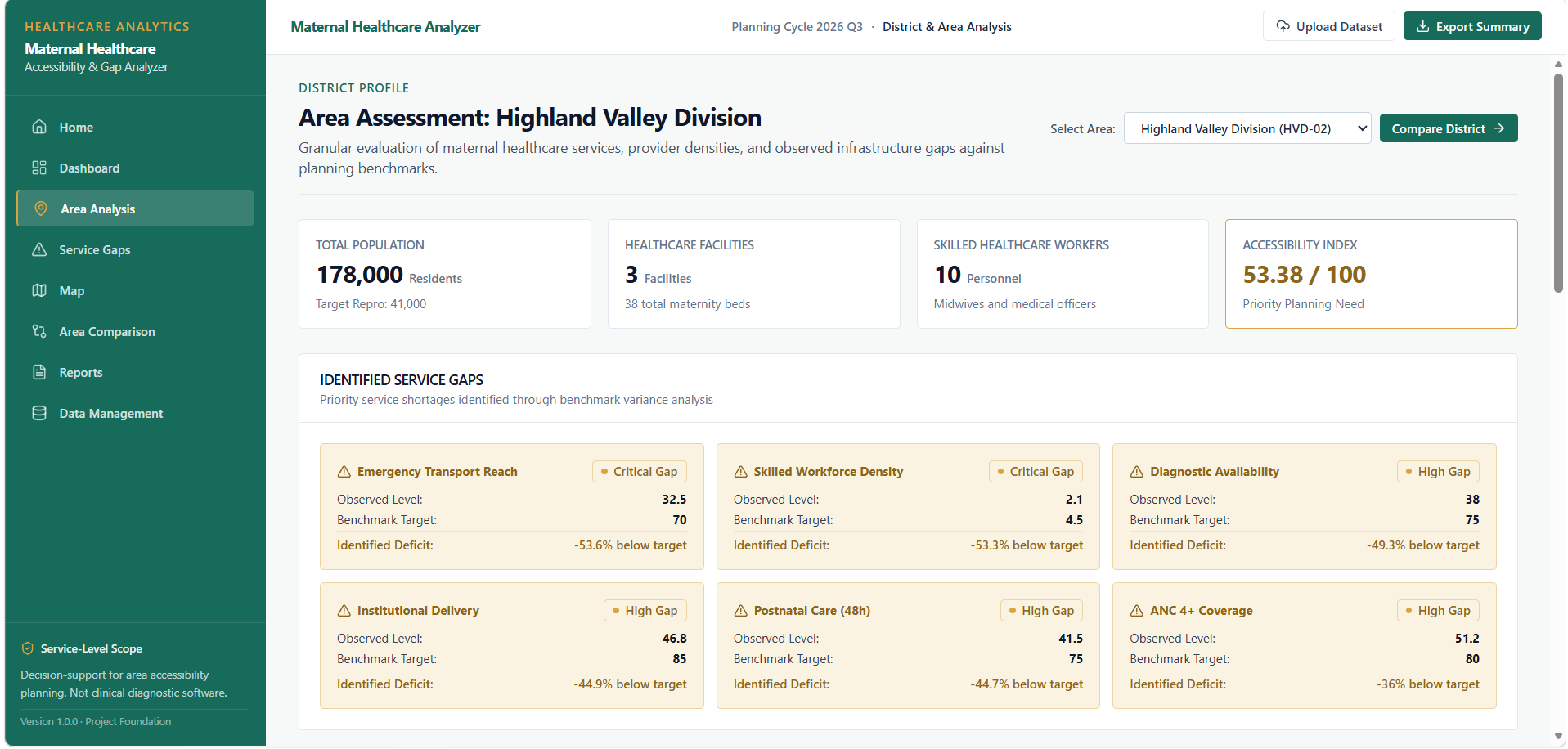
Deep-dive profile for selected regions highlighting population stats, workforce numbers, and critical gap breakdowns.
-
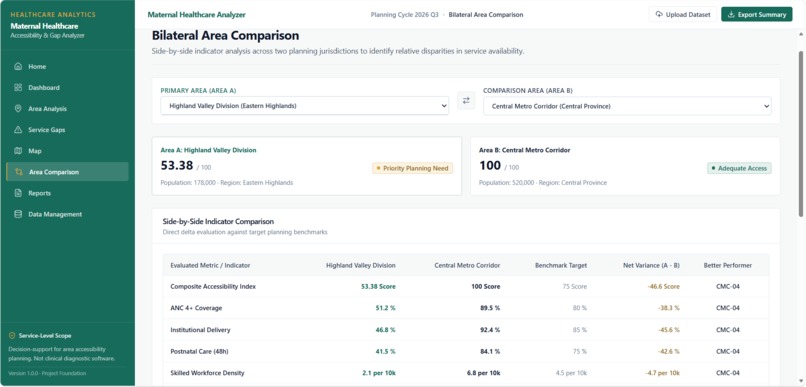
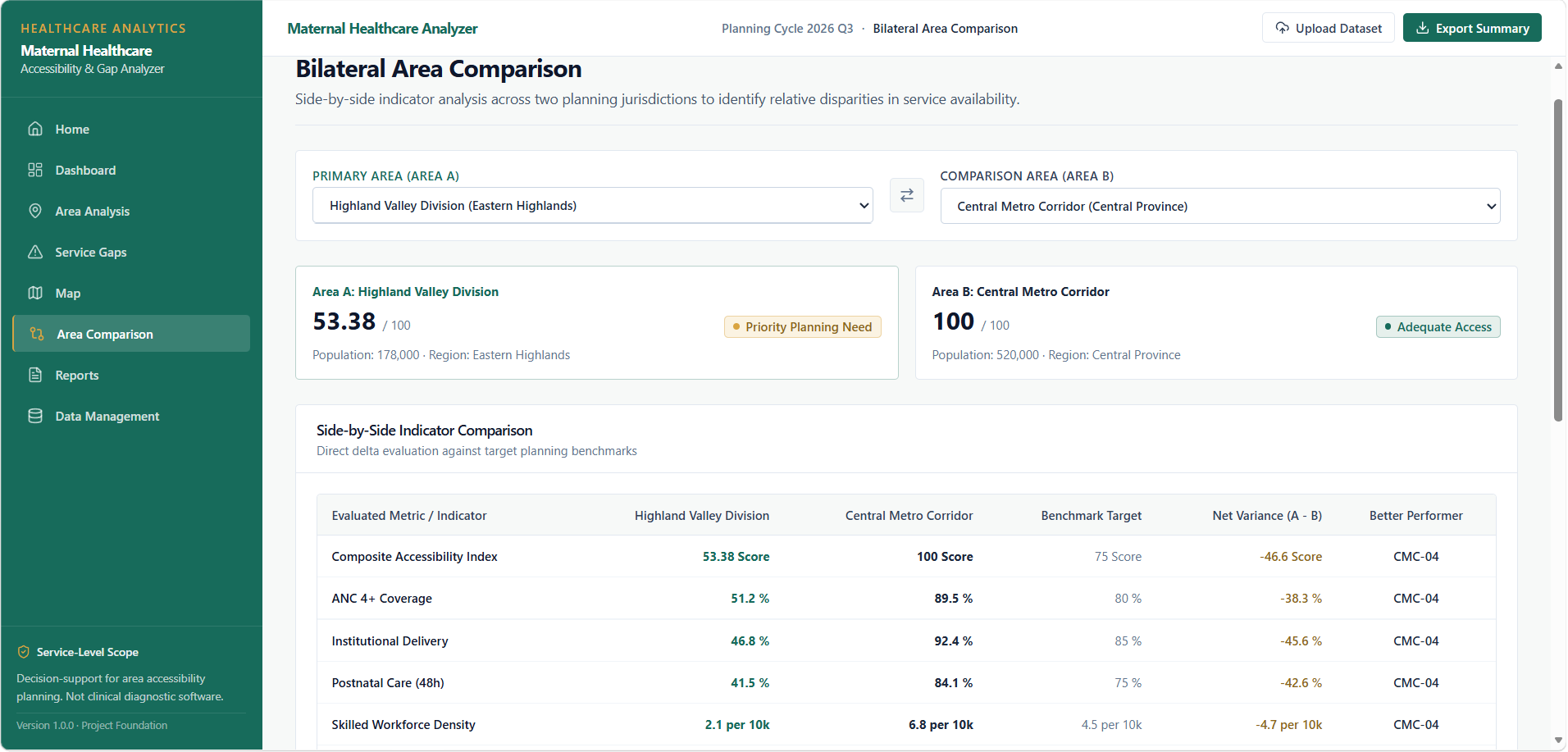
Side-by-side indicator analysis comparing two jurisdictions to pinpoint resource disparities.
-
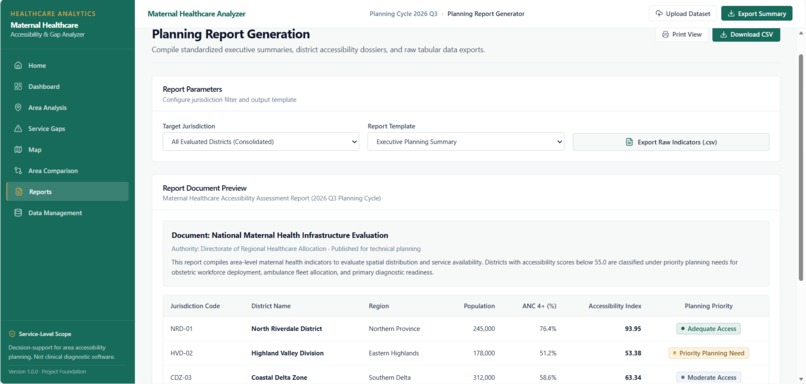
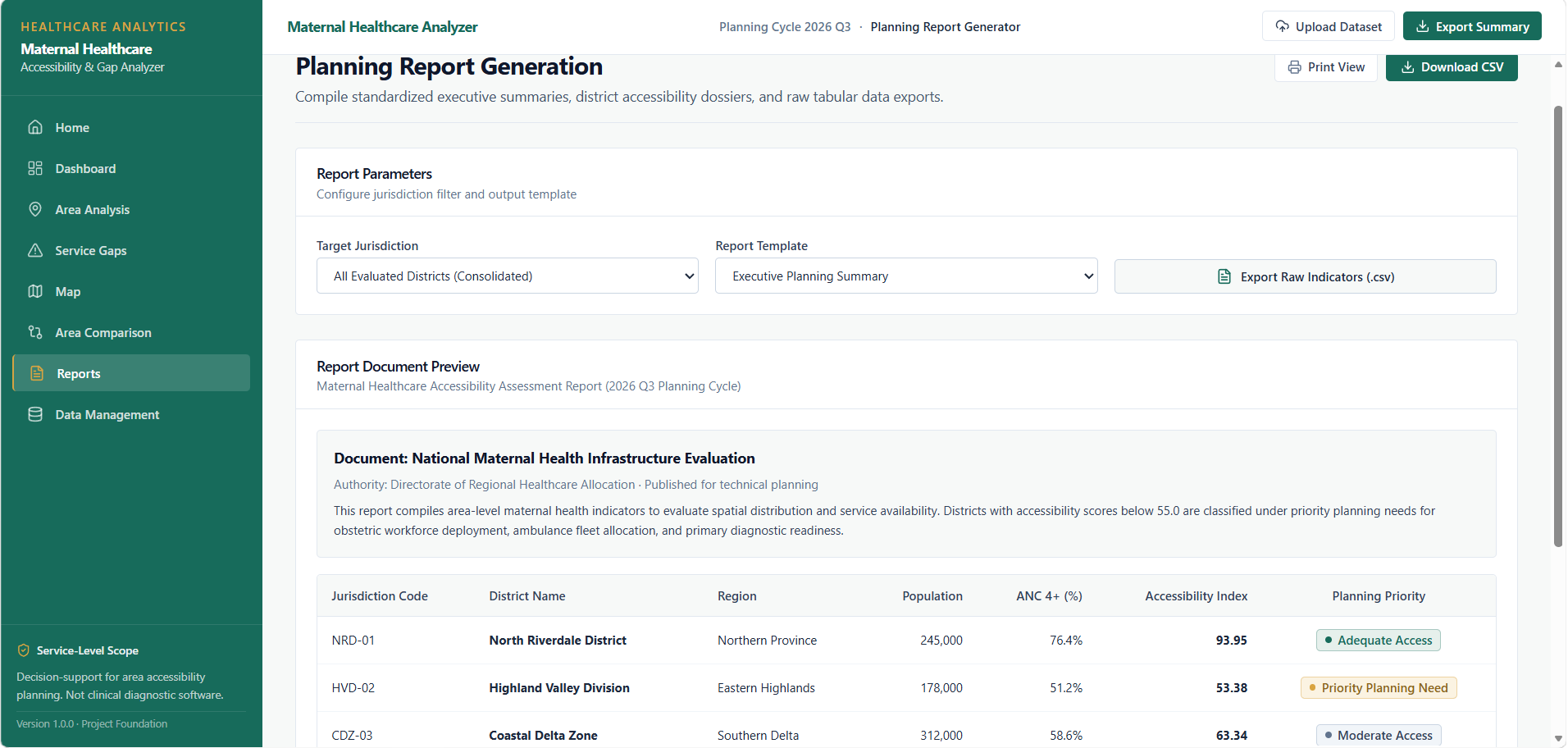
Export interface previewing standardized executive summaries and accessibility dossiers.
-
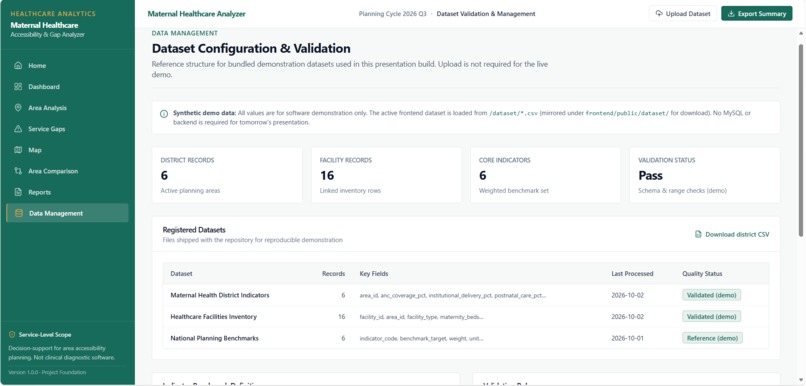
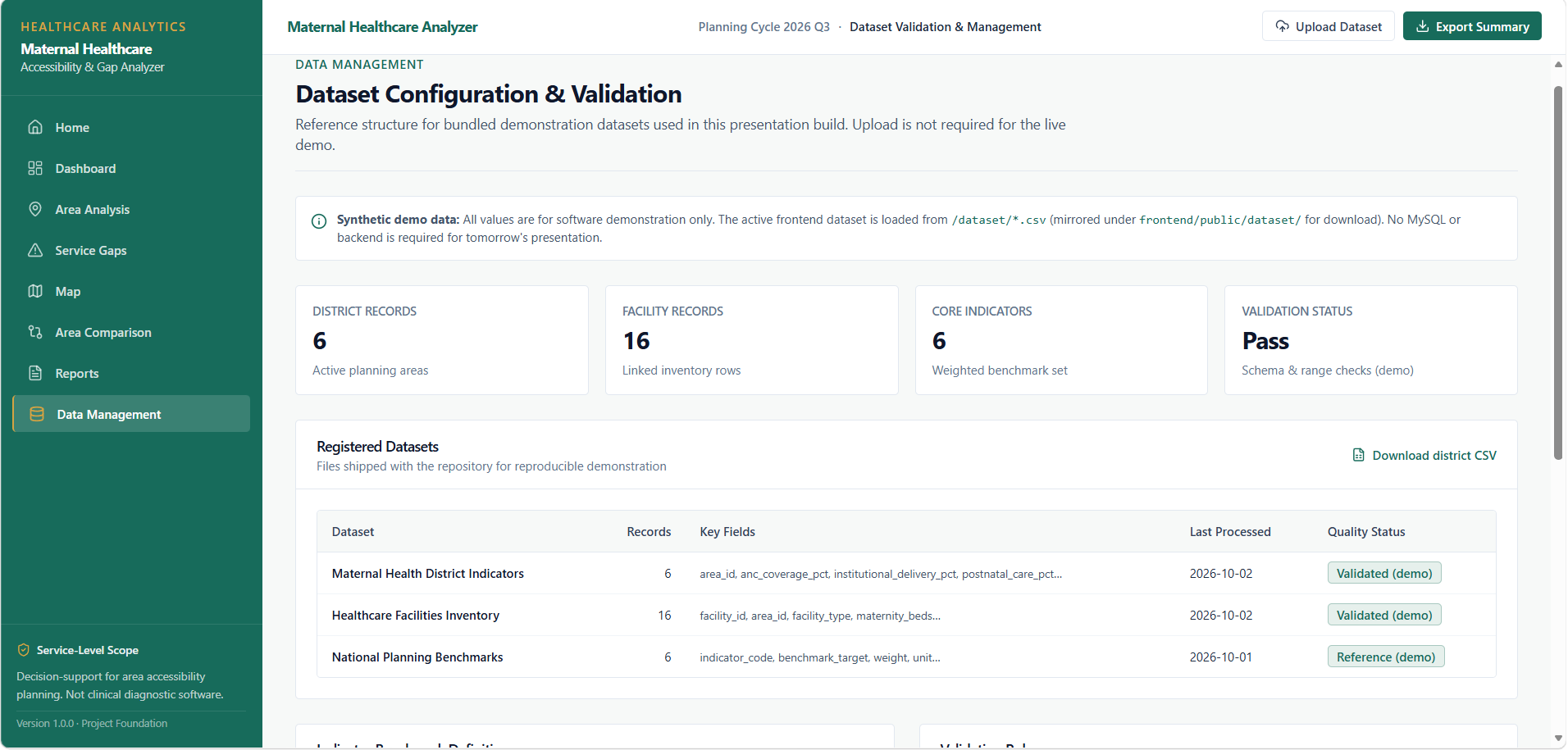
Dataset configuration panel tracking schema validations, record counts, and active CSV indicators.
-
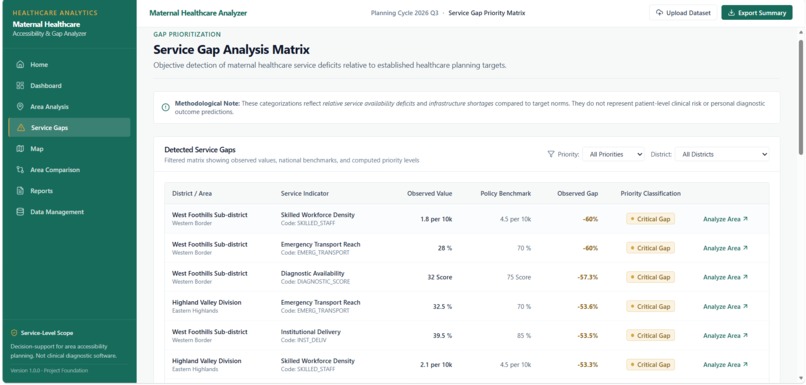
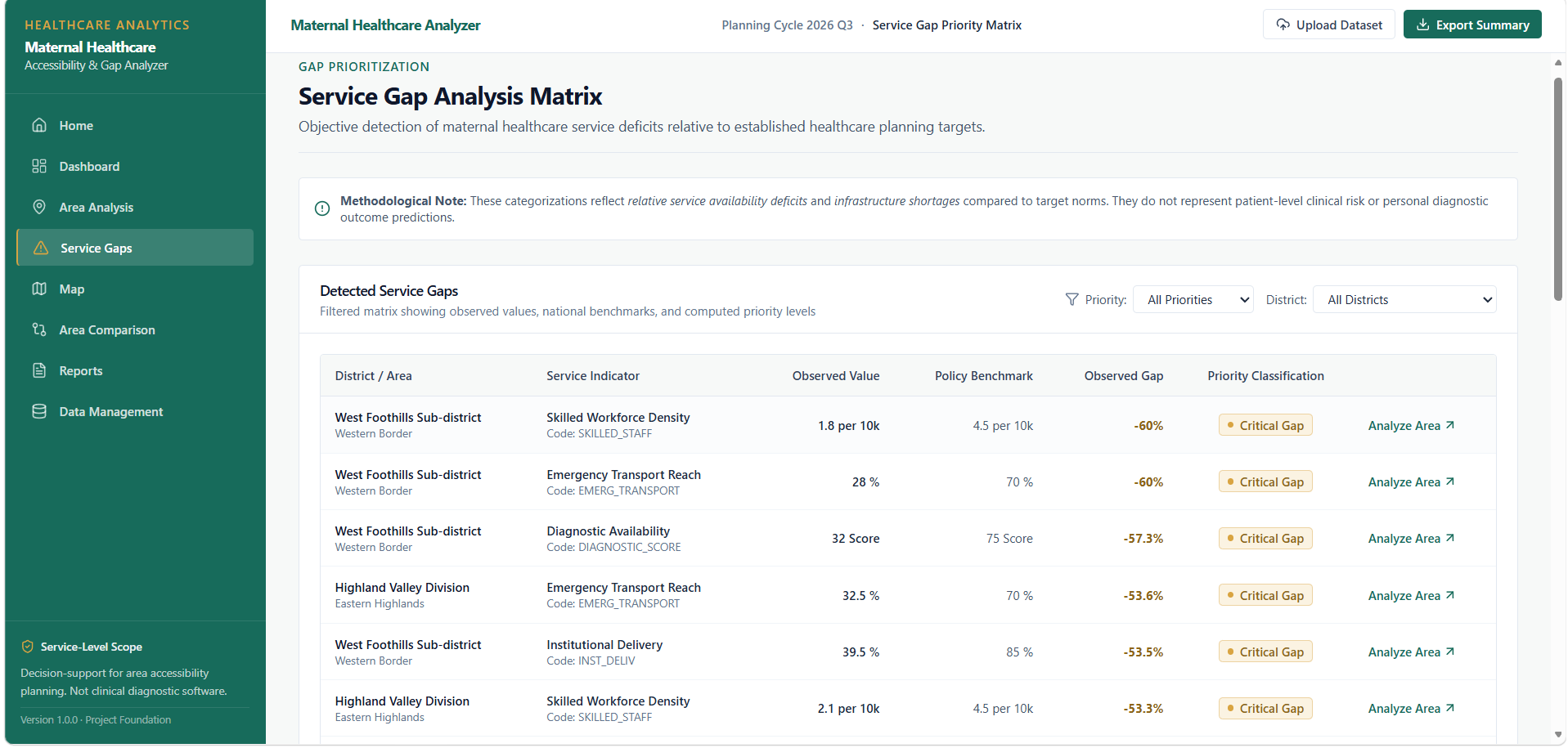
Prioritized table filtering major healthcare deficits—like transport and staffing—against policy targets.
-
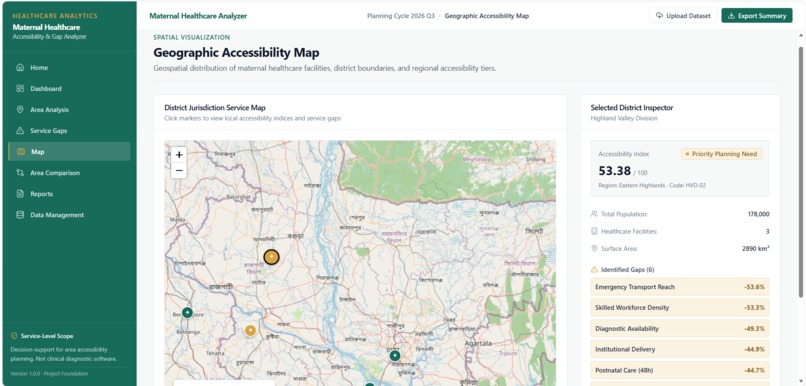
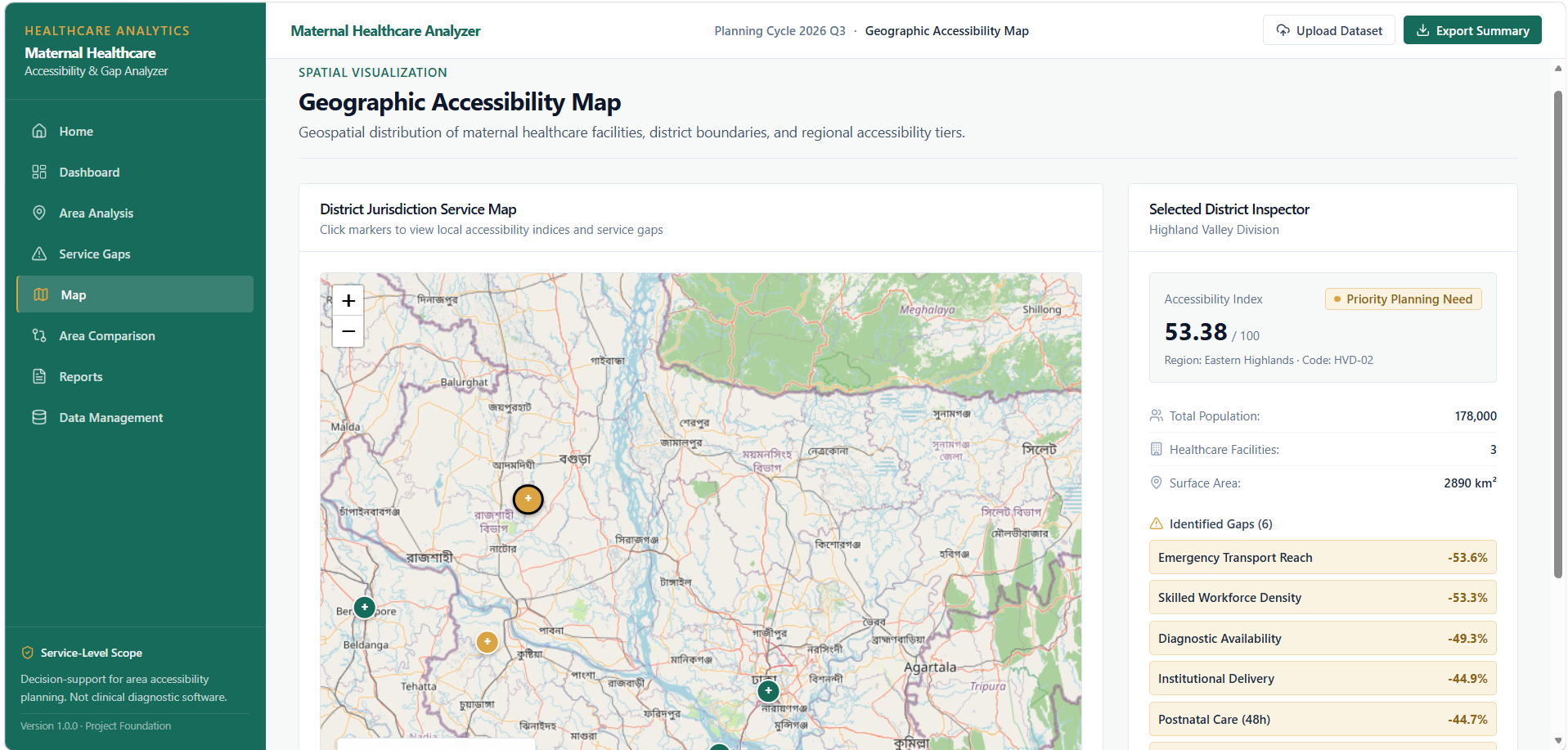
Interactive geospatial map mapping facility distribution, boundaries, and regional accessibility tiers.
Inspiration
Maternal healthcare is not only about whether a healthcare facility exists, but whether the right services are accessible to the people who need them. We were inspired by the challenge of identifying areas where maternal healthcare demand may be higher than the available healthcare resources and services.
We wanted to build a solution that transforms healthcare data into clear, actionable insights and helps identify underserved areas where healthcare resources may need to be improved.
What it does
Maternal Healthcare Service Gap Analyzer is a data-driven platform that analyzes maternal healthcare accessibility and identifies potential service gaps across different areas.
The platform:
- Analyzes healthcare indicators and facility availability
- Compares healthcare demand with available services
- Calculates accessibility-related indicators
- Identifies areas with high, medium, and low service gaps
- Provides area-wise comparisons
- Displays healthcare information through dashboards and charts
- Provides map-based accessibility visualization
- Generates reports to support decision-making
The main goal is to answer: Where are maternal healthcare services insufficient, and where should additional resources be prioritized?
How we built it
We built the project as a full-stack application with separate frontend, backend, database, and analytics components.
- Frontend: React and Vite for the interactive dashboard, charts, maps, comparisons, service-gap analysis, and reports.
- Backend: Java and Spring Boot for REST APIs and healthcare data management.
- Database: SQL database for storing areas, healthcare facilities, and service indicators.
- Analytics: C-based modules for normalization, accessibility index calculation, and service-gap calculation.
- Data Visualization: Charts, tables, maps, and status indicators to convert healthcare data into easy-to-understand insights.
The overall workflow is:
Healthcare Data → Data Processing → Database → Analytics → Accessibility & Gap Calculation → Dashboard → Actionable Insights
Challenges we ran into
One of our main challenges was integrating multiple technologies into a single working system. The project combines a React frontend, Spring Boot backend, SQL database, and analytics components.
We also had to make complex healthcare indicators easy to understand for users without a technical background. Designing consistent comparison and service-gap calculations for different areas was another challenge.
Managing datasets, connecting APIs, debugging different components, and creating a simple and user-friendly dashboard required continuous testing and improvement.
Accomplishments that we're proud of
We are proud of building a complete working prototype rather than only a concept.
Our key accomplishments include:
- Built an end-to-end maternal healthcare analysis platform
- Created an interactive healthcare dashboard
- Implemented area-wise healthcare comparison
- Developed accessibility and service-gap analysis
- Added map-based visualization
- Integrated frontend and backend components
- Organized healthcare datasets for analysis
- Created reusable APIs and analytics modules
Most importantly, we transformed complex healthcare data into meaningful insights that can help identify areas requiring greater attention and resources.
What we learned
Through this project, we learned how to approach a real-world healthcare problem from both technical and social-impact perspectives.
We gained practical experience in full-stack development, React, Spring Boot REST APIs, SQL database design, data processing, analytics, data visualization, API integration, and GitHub.
We also learned that building an impactful solution is not only about implementing technology. The results must be understandable, relevant, and useful for real-world decision-making.
What's next for Maternal Healthcare Service Gap Analyzer
Our current prototype provides a foundation for a larger maternal healthcare intelligence platform.
In the future, we plan to:
- Integrate real-time and verified healthcare datasets
- Improve geographic accessibility analysis
- Add travel-time and distance analysis
- Incorporate additional maternal and neonatal healthcare indicators
- Add predictive analytics to identify emerging service gaps
- Provide intelligent recommendations for resource allocation
- Add alerts for critically underserved areas
- Expand the platform to more regions and districts
- Improve integration with healthcare and government systems
- Develop a mobile-friendly version
Our long-term vision is to evolve the platform from a service-gap analysis tool into a decision-support system that helps stakeholders plan and prioritize maternal healthcare resources more effectively.
Built With
- c
- dashboard
- dataanalytics
- datavisualization
- healthcare
- java
- javascript
- react
- restapi
- springbot
- sql
- vite

Log in or sign up for Devpost to join the conversation.