-
-
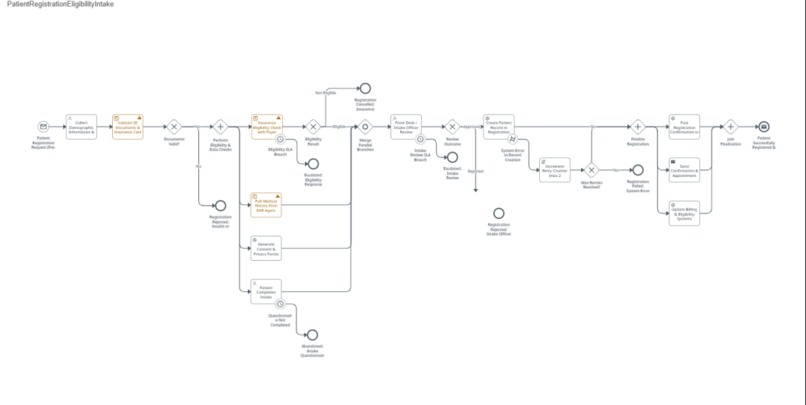
BPMN diagram
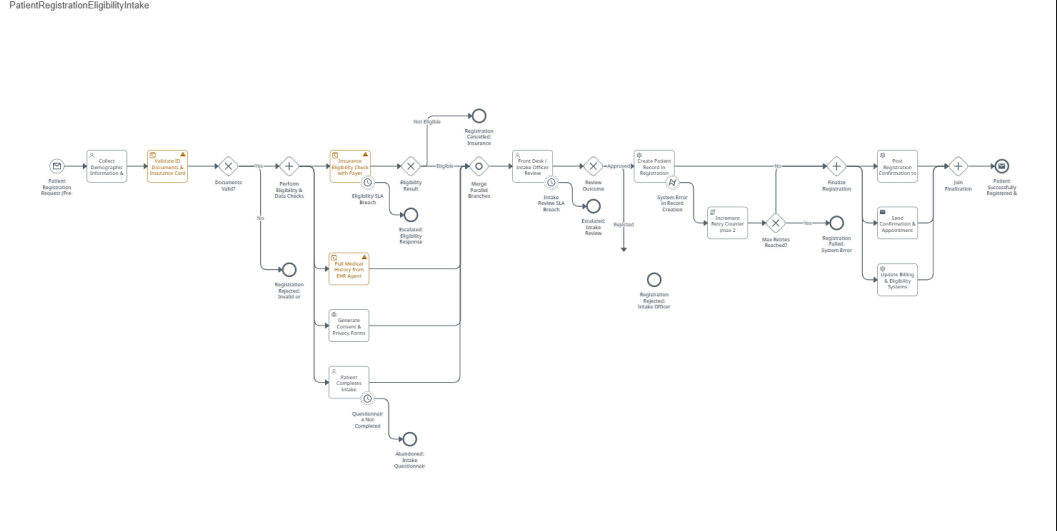
Inspiration
I work as a statistician and developer at the University of Calabar Teaching Hospital (UCTH) in Calabar, Nigeria. Every day I see what researchers call the ANC Paradox — women attend antenatal care clinics at reasonable rates, yet Nigeria still records over 512 maternal deaths per 100,000 live births. The problem is not attendance. It is what happens between visits.
A lab result comes back abnormal. No one tells the doctor for hours. A specialist referral is written on paper and lost. A patient misses her next appointment and no one follows up. These are not clinical failures — they are coordination failures. MaternaFlow is my attempt to model what a coordinated, trackable maternal care journey could look like using UiPath Maestro.
What It Does
MaternaFlow is a single end-to-end BPMN process built on UiPath Maestro that coordinates five stages of maternal care:
- Patient Registration & ANC Intake — retrieves patient FHIR history, validates documents, flags high-risk indicators, routes to midwife review
- ANC Visit Coordination — schedules visits per WHO guidelines, sends SMS reminders, escalates missed appointments after 48 hours
- Lab Result Routing — retrieves observations from FHIR, auto-logs normal results, creates a doctor review task for abnormal results with a 4-hour SLA timer, escalates SLA breaches to a senior doctor
- Specialist Referral — matches high-risk patients to specialists, generates referral letters, handles acceptance or rejection with escalation paths
- Delivery & Case Closure — records delivery outcome in FHIR, generates postnatal care plan, assigns community health worker follow-up, closes the case
Each stage has clear swimlanes for Patient, Nurse/Midwife, Doctor, Specialist, and System actors, with decision gateways and automatic escalation paths built into the BPMN.
How I Built It
The FHIR integration layer is built on CliniqBridge, an MCP server
I developed in Python/FastAPI that exposes six FHIR R4 tools —
get_patient_summary, get_conditions, get_medications,
get_encounters, get_observations, and create_observation —
deployed live on Render.
I used UiPath Studio with Autopilot to generate and refine the BPMN for each stage, then wired each system task to CliniqBridge via UiPath API Workflows — six live HTTP integrations across the five stages, each confirmed returning HTTP 200 responses with real FHIR-structured data.
Claude Code was used throughout development as a coding agent to design and extend the CliniqBridge FHIR integration layer, including the observation retrieval and creation tools that power Stages 3 and 5.
Challenges
The biggest challenge was learning UiPath Maestro from scratch as a solo developer while also managing my responsibilities at UCTH. The sandbox environment had constraints I had not anticipated, and several approaches I attempted — including connecting human tasks to Action Center — did not reach completion within the submission window.
I have documented these limitations honestly in the GitHub README rather than overstating what the prototype currently does.
What I Learned
Building MaternaFlow taught me how to model complex, exception-heavy healthcare workflows in BPMN, how to integrate external FHIR APIs into UiPath as API Workflows, and how to use UiPath Autopilot to accelerate process design. More importantly, it reinforced that the hardest part of building healthcare technology in Nigeria is not the code — it is accurately modeling the real, broken workflows that exist on the ground.
What's Next
- Connect human review tasks to UiPath Action Center for live interaction by nurses, doctors, and specialists
- Replace the public FHIR test server with anonymized real patient data from UCTH
- Add a UiPath App as a front-end interface for Health Record Officers
- Pilot with the UCTH maternal health unit
Built With
- claude-code
- fastapi
- fhir-r4
- python
- uipath-api-workflows
- uipath-maestro
- uipath-studio


Log in or sign up for Devpost to join the conversation.