-
-
Project Media
Inspiration
Every year in Nigeria, thousands of women complete all their antenatal care visits — they showed up, they did everything right — and still never deliver in a health facility. Maternal mortality claims over 82,000 Nigerian lives annually, yet the data shows that access alone is not the problem.
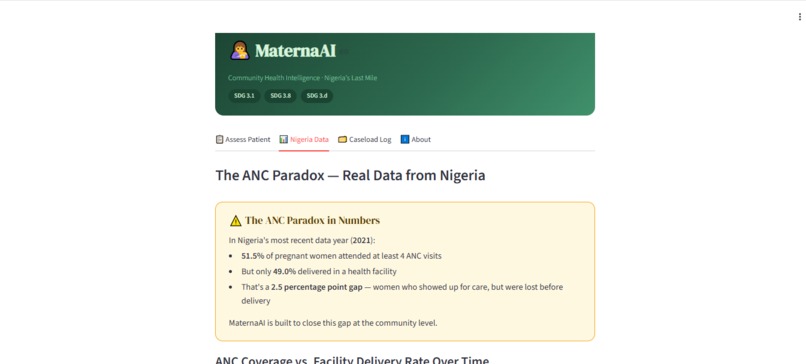
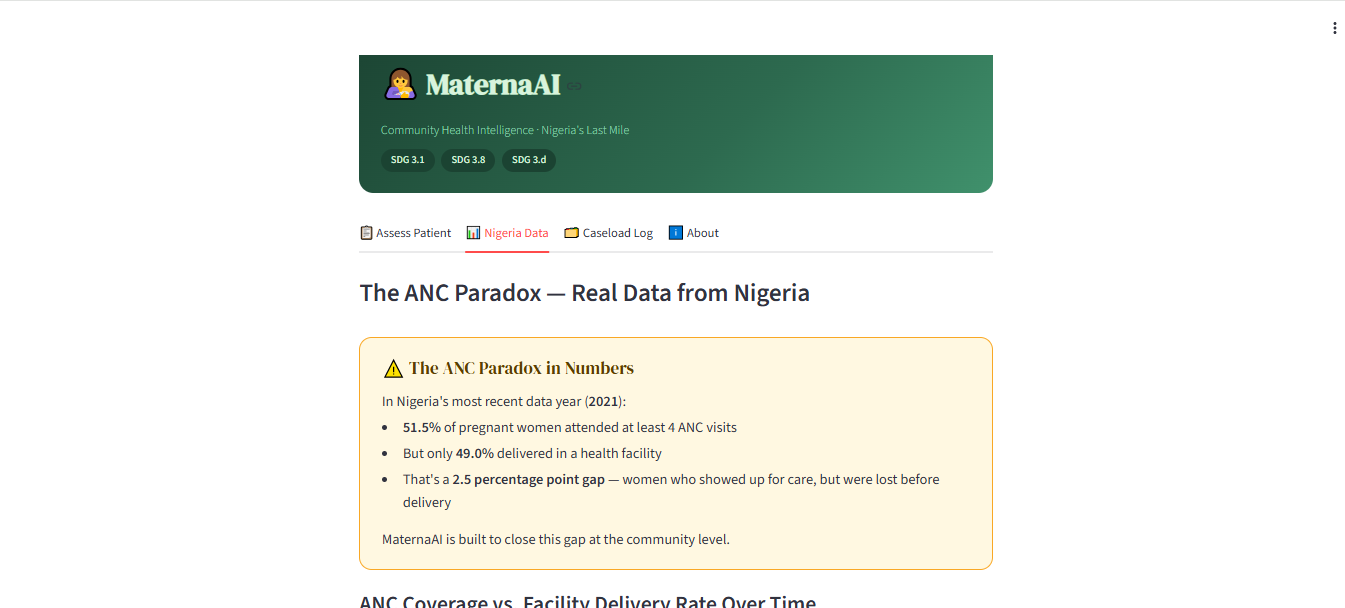
I discovered this pattern in my own data analysis and named it the ANC Paradox: in 2021, 51.5% of Nigerian pregnant women attended at least 4 ANC visits, but only 49.0% delivered in a health facility. That 2.5 percentage point gap has persisted for over two decades according to WHO Global Health Observatory data.
I wanted to build something a community health worker — with limited connectivity, no medical degree, and 40 women on her caseload — could actually use in the field to close that gap.
What It Does
MaternaAI is a mobile-first AI decision-support tool for frontline community health workers (CHWs) in Nigeria. Given basic patient information, it:
- Calculates a risk score (0–100) using evidence-based weights derived from Nigeria DHS and WHO data
- Flags risk level — Low / Moderate / High / Critical — with plain-language reasoning
- Recommends specific community actions — not generic advice, but exact next steps the CHW should take
- Identifies the nearest health facility for the patient's LGA
- Generates a downloadable referral card the patient presents at the facility
- Logs the full caseload with CSV export for LGA-level reporting
How I Built It
- Risk scoring engine: Python-based weighted scoring system with factors derived from Nigeria DHS 2018 and WHO ANC guidelines, weighted toward high-risk indicators in the Nigerian context including grand multiparity, low facility distance utilization, late ANC entry, and adolescent pregnancy
- Community Action Recommender: Decision logic mapping risk level and LGA tier to specific, actionable CHW steps
- Nigeria Data tab: 5 real charts built from WHO Global Health Observatory and Nigeria DHS datasets showing the ANC Paradox, anaemia prevalence, adolescent birth rate, and maternal mortality ratio trends
- Frontend: Streamlit with a CHW-optimized UX — large elements, color-coded risk alerts, minimal text input, works on 3G
- Deployment: Render.com
Challenges
Cleaning and harmonizing multiple national datasets with inconsistent formatting took significant effort. The bigger challenge was UX — designing for a CHW persona meant stripping away everything that seemed useful to an analyst but would confuse someone working in a rural community. Every screen went through multiple rounds of simplification.
Building solo also meant making hard prioritization decisions. I focused on the three things that matter most to judges and to real users: a credible data story, a working risk engine, and a clean actionable output.
What I Learned
Data tells you where the problem is. Design determines whether your solution reaches it. The biggest shift in this project was moving from "what does the data show?" to "what does the CHW need to do next?" Those are very different questions with very different answers.
What's Next
- Expand LGA coverage to all 774 LGAs with facility geocoding
- Add offline mode (Progressive Web App) for CHWs in areas with no connectivity
- Integrate with Nigeria's DHIS2 national health information system
- Pilot with State Ministry of Health in Cross River State
Built With
- dhs
- github
- numpy
- pandas
- python
- render
- scikit-learn
- streamlit
- who

Log in or sign up for Devpost to join the conversation.