-
-
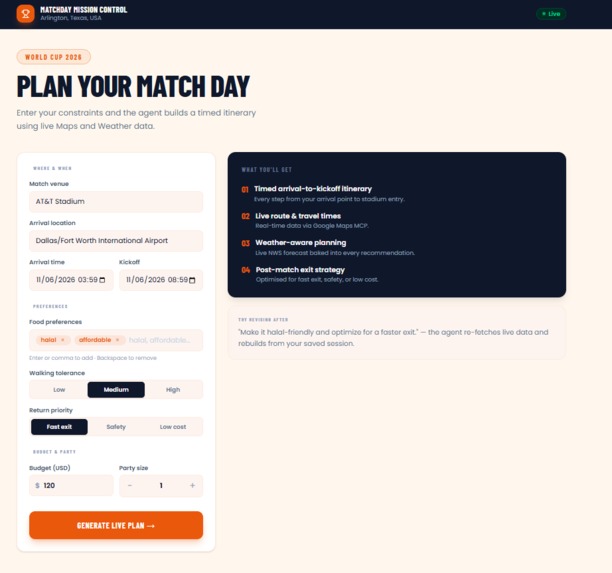
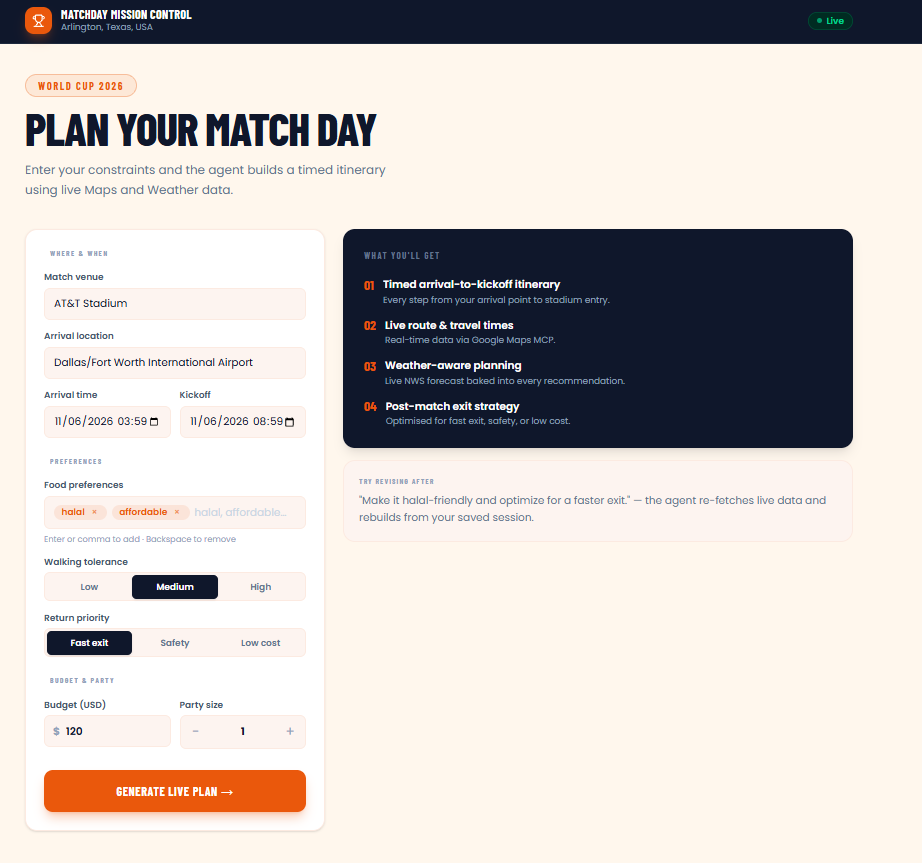
Plan your matchday with live Maps, Weather, and AI-powered itinerary generation.
-
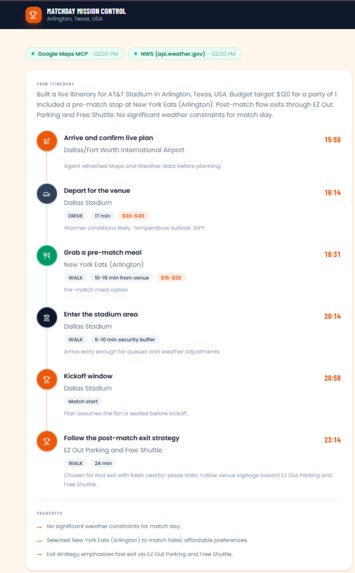
Generate a personalized itinerary with live routes, weather, costs, and venue insights.
-
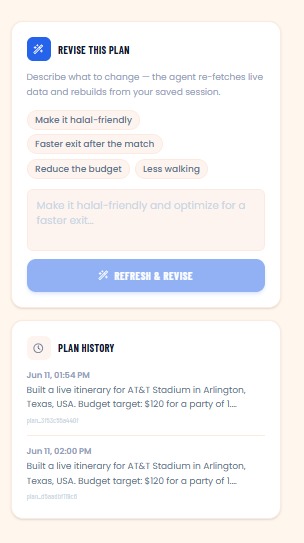
Revise plans with natural language while MongoDB preserves session history and context.
Inspiration
We wanted to build an AI agent that feels genuinely useful in a real-world, time-sensitive situation, not just a chatbot that gives generic advice. The 2026 World Cup use case stood out because match-day travel is stressful, fast-moving, and full of tradeoffs: arrival time, budget, food preferences, walking distance, transport options, and getting back safely after the game.
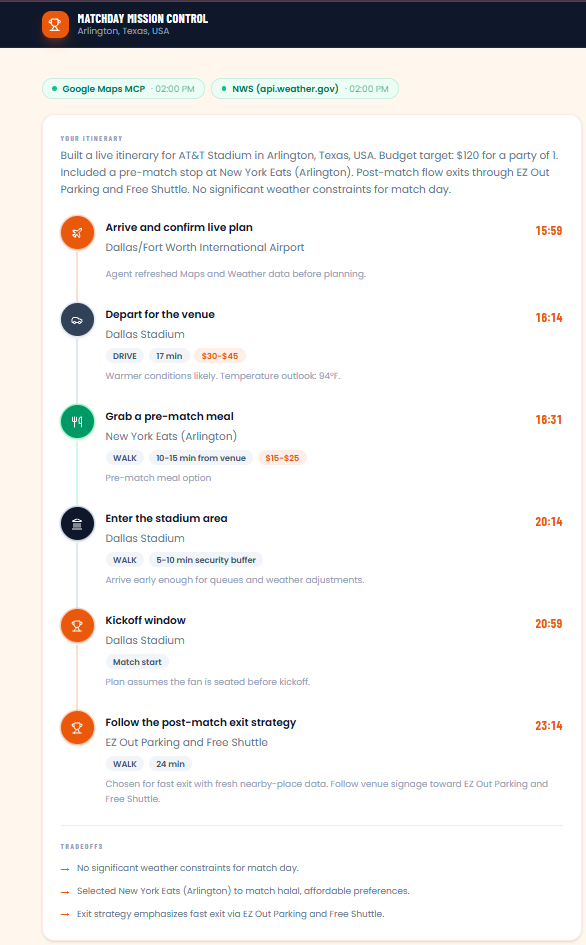
That led us to build MatchDay Mission Control, an agent that helps fans plan and adapt their full match-day journey. Instead of answering one question at a time, it takes a goal, asks follow-up questions, retrieves relevant local information, creates a personalized itinerary, and updates that plan when conditions change.
What it does
MatchDay Mission Control is a Gemini-powered planning agent for World Cup fans. A user can say something like:
“I’m landing at 2 PM, my match starts at 7 PM, I have a $120 budget, I want low walking, and I want a safe route back.”
The agent then:
- asks clarifying questions when needed
- retrieves venue, transit, food, and safety information
- builds a step-by-step itinerary
- explains the tradeoffs behind its recommendations
- saves the itinerary for later updates
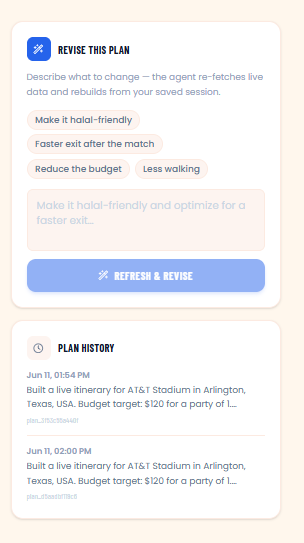
- revises the plan if the user changes constraints
This makes it an actual agent workflow, not just a Q&A assistant.
How we built it
We built the project using Google Cloud Agent Builder with Gemini as the reasoning engine, and integrated MongoDB through its MCP server as the project’s memory and retrieval layer.
MongoDB stores:
- venue information
- transit options
- nearby food spots
- safety notes
- sample local guidance
- saved user itineraries and preferences
Our agent workflow is:
- Accept the user’s trip goal and constraints
- Ask follow-up questions if key information is missing
- Use MongoDB MCP tools to retrieve relevant travel and venue context
- Generate a personalized time-based match-day plan
- Save that itinerary and decision context
- Re-plan when the user changes budget, food, timing, or transport preferences
We wrapped this in a lightweight web interface so judges can quickly test the experience end-to-end.
Challenges we ran into
One of the main challenges was keeping the itinerary both realistic and concise. A planning agent can easily generate advice that sounds reasonable but is too vague or too long to be useful in a real match-day situation.
Another challenge was structuring the data so the agent could retrieve the right information at the right time. We had to organize venue, food, and transit information in a way that made the MCP-powered retrieval step reliable and easy to reason over.
We also had to keep the scope disciplined. In a short hackathon, it is tempting to add maps, booking integrations, live transit feeds, and notifications. We deliberately focused on one strong user journey: plan, explain, save, and revise a match-day itinerary.
What we learned
This project taught us that the most valuable agent experiences come from structured tool use and multi-step execution, not from longer chat responses.
We also learned how important persistent memory is for agent behavior. Once the agent can store plans, preferences, and prior context, it becomes much more useful than a one-off assistant.
On the technical side, we learned how to combine:
- Gemini for reasoning and planning
- Google Cloud Agent Builder for orchestration
- MongoDB MCP for retrieval and persistent memory
That combination let us build something that is practical, testable, and aligned with the hackathon’s focus on real-world agent systems.
Challenges we ran into
One of the main challenges was keeping the itinerary both realistic and concise. A planning agent can easily generate advice that sounds reasonable but is too vague or too long to be useful in a real match-day situation.
Another challenge was structuring the data so the agent could retrieve the right information at the right time. We had to organize venue, food, and transit information in a way that made the MCP-powered retrieval step reliable and easy to reason over.
We also had to keep the scope disciplined. In a short hackathon, it is tempting to add maps, booking integrations, live transit feeds, and notifications. We deliberately focused on one strong user journey: plan, explain, save, and revise a match-day itinerary.
Accomplishments that we're proud of
We are proud of learning how to turn a random idea to reality!
What we learned
This project taught us that the most valuable agent experiences come from structured tool use and multi-step execution, not from longer chat responses.
We also learned how important persistent memory is for agent behavior. Once the agent can store plans, preferences, and prior context, it becomes much more useful than a one-off assistant.
On the technical side, we learned how to combine:
- Gemini for reasoning and planning
- Google Cloud Agent Builder for orchestration
- MongoDB MCP for retrieval and persistent memory
That combination let us build something that is practical, testable, and aligned with the hackathon’s focus on real-world agent systems.
What's next for MatchDay Mission Control
World Cup travel is a high-pressure coordination problem, but the same agent pattern can apply far beyond sports:
- event logistics
- tourist planning
- conference navigation
- city-based travel assistance
- last-mile personal itinerary planning
Our goal was to show how an AI agent can move beyond giving answers and actually help someone make and adapt a plan under real constraints.
Built With
- agent
- api
- atlas
- builder
- cloud
- gemini
- javascript
- mcp
- mongodb
- next.js
- node.js
- react
- rest
- run
- server
- typescript


Log in or sign up for Devpost to join the conversation.