-
-
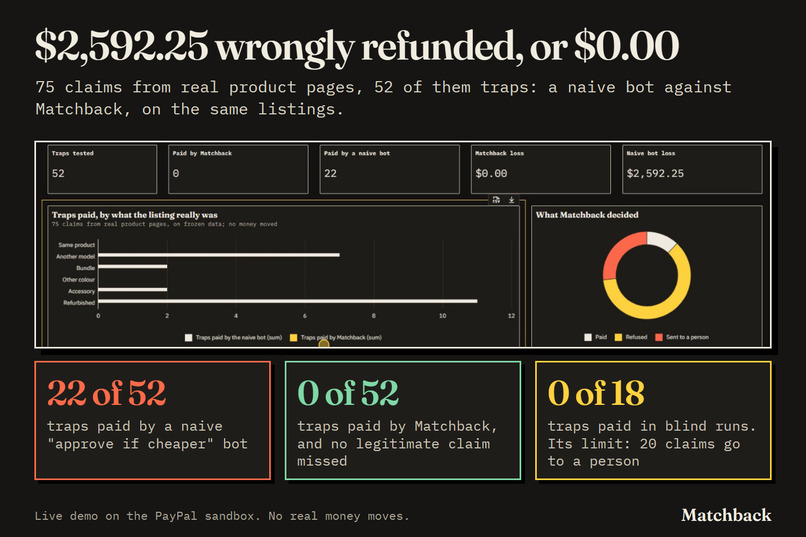
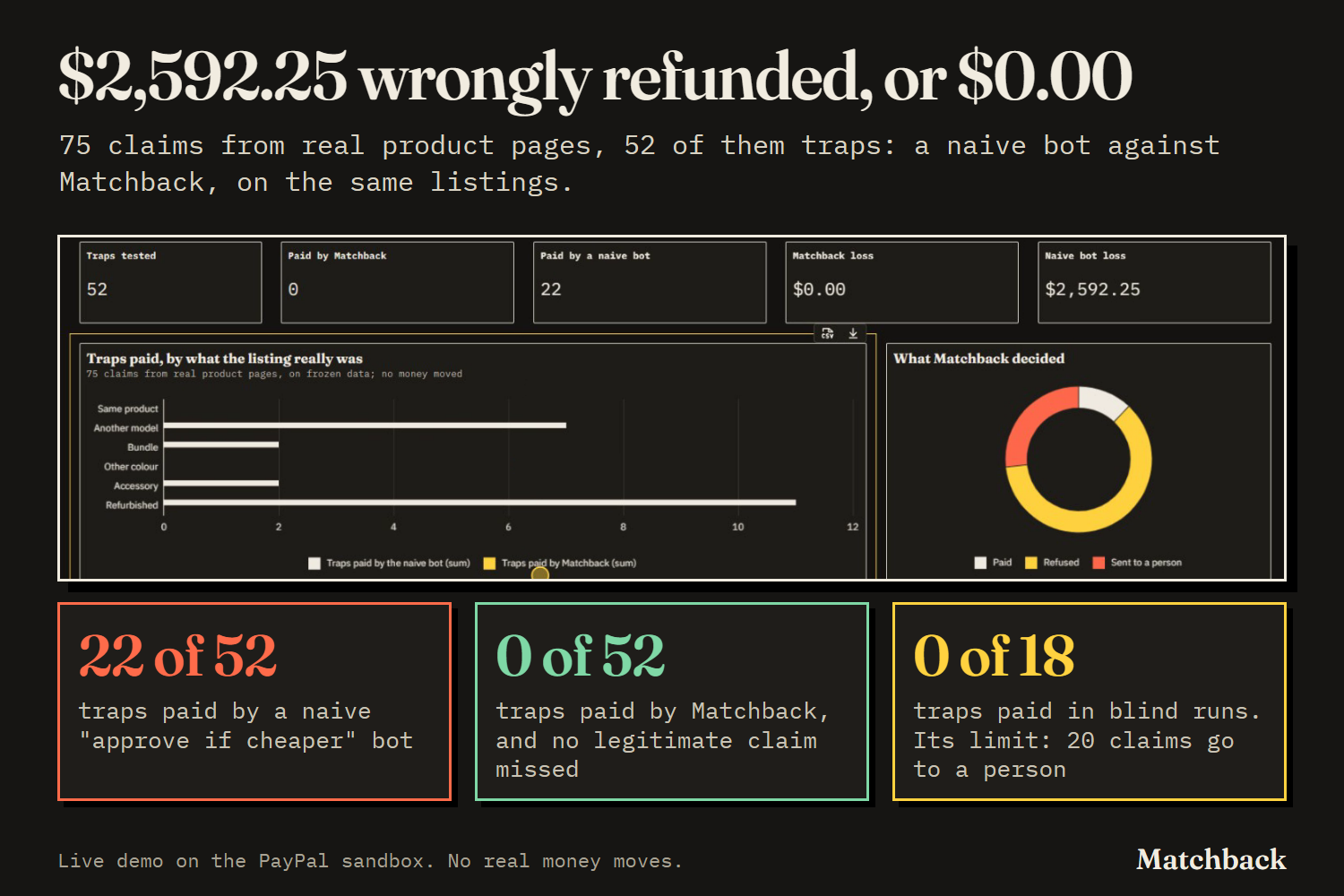
75 real claims, 52 traps: a naive bot wrongly refunds $2,592.25, Matchback $0.00. Blind runs: 0 of 18 traps paid. 20 go to a person.
-
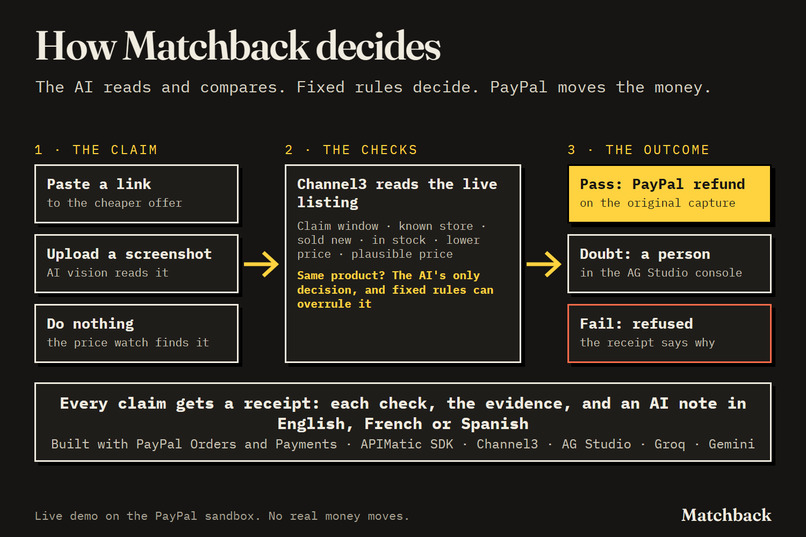
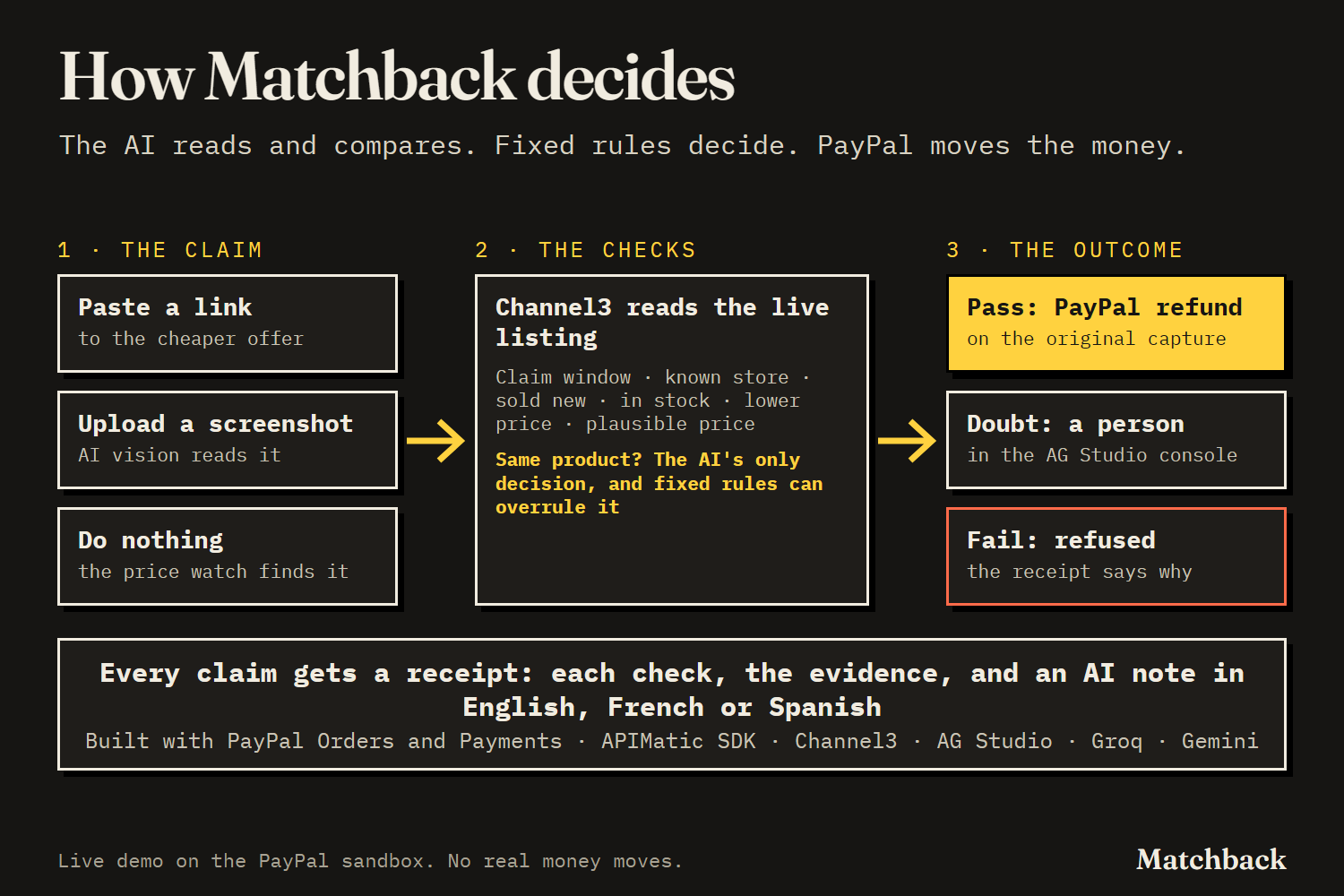
How Matchback decides: the AI reads and compares, fixed rules decide, and PayPal moves the money.
-
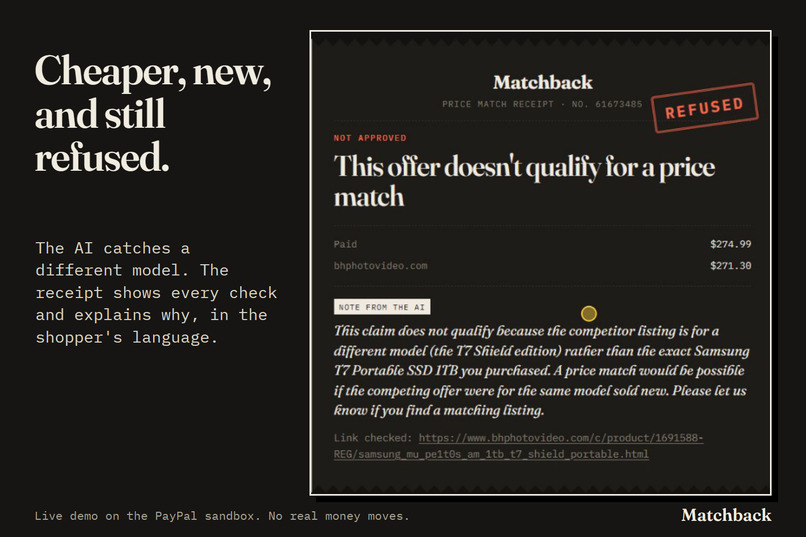
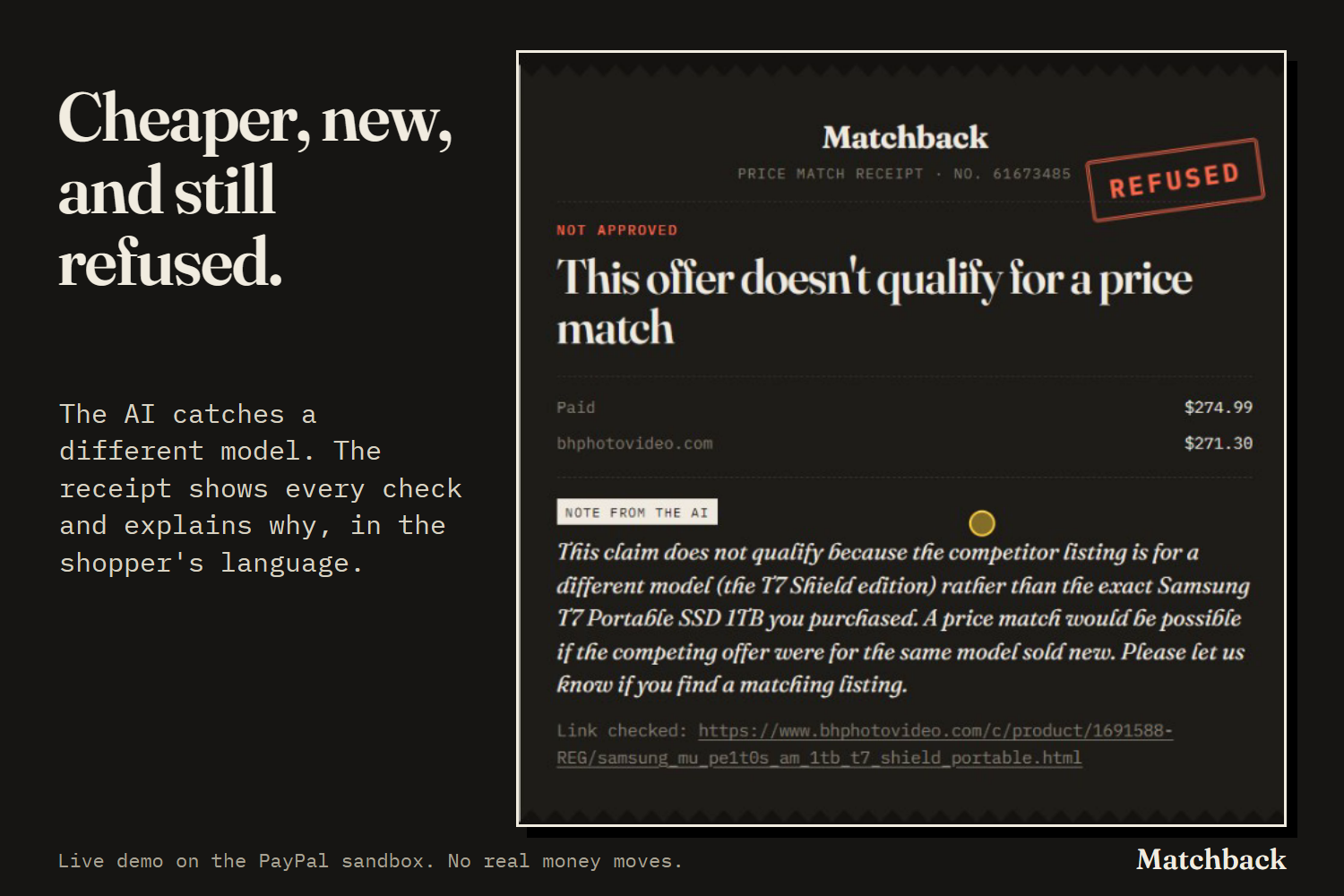
A trap, refused: the offer is cheaper and new, but the AI catches a different model and the receipt explains why.
-
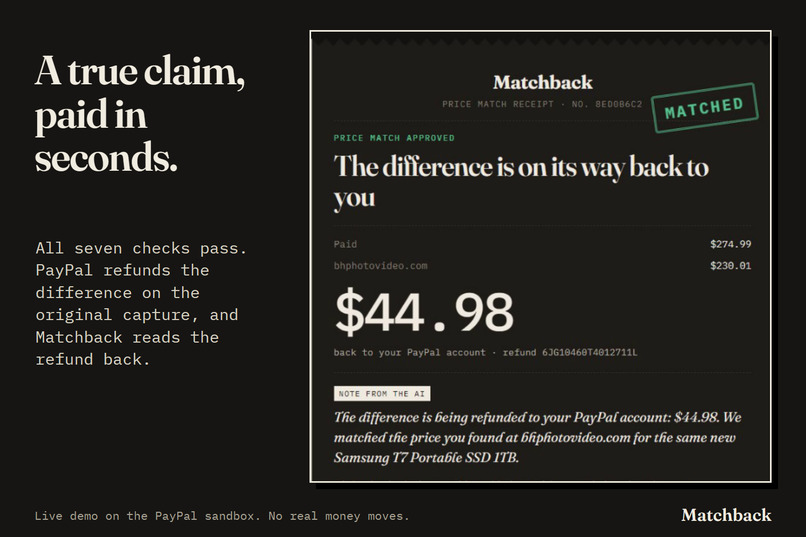
A true claim, paid: all seven checks pass and PayPal refunds $44.98 on the original payment, in seconds.
-
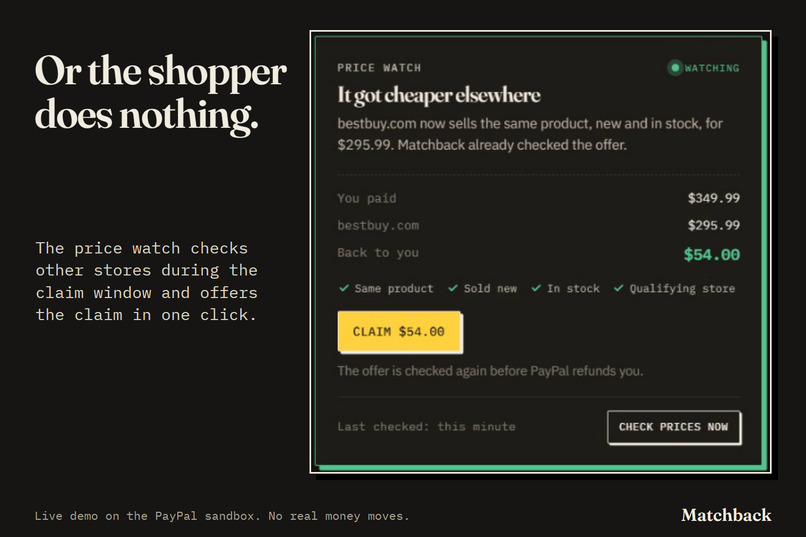
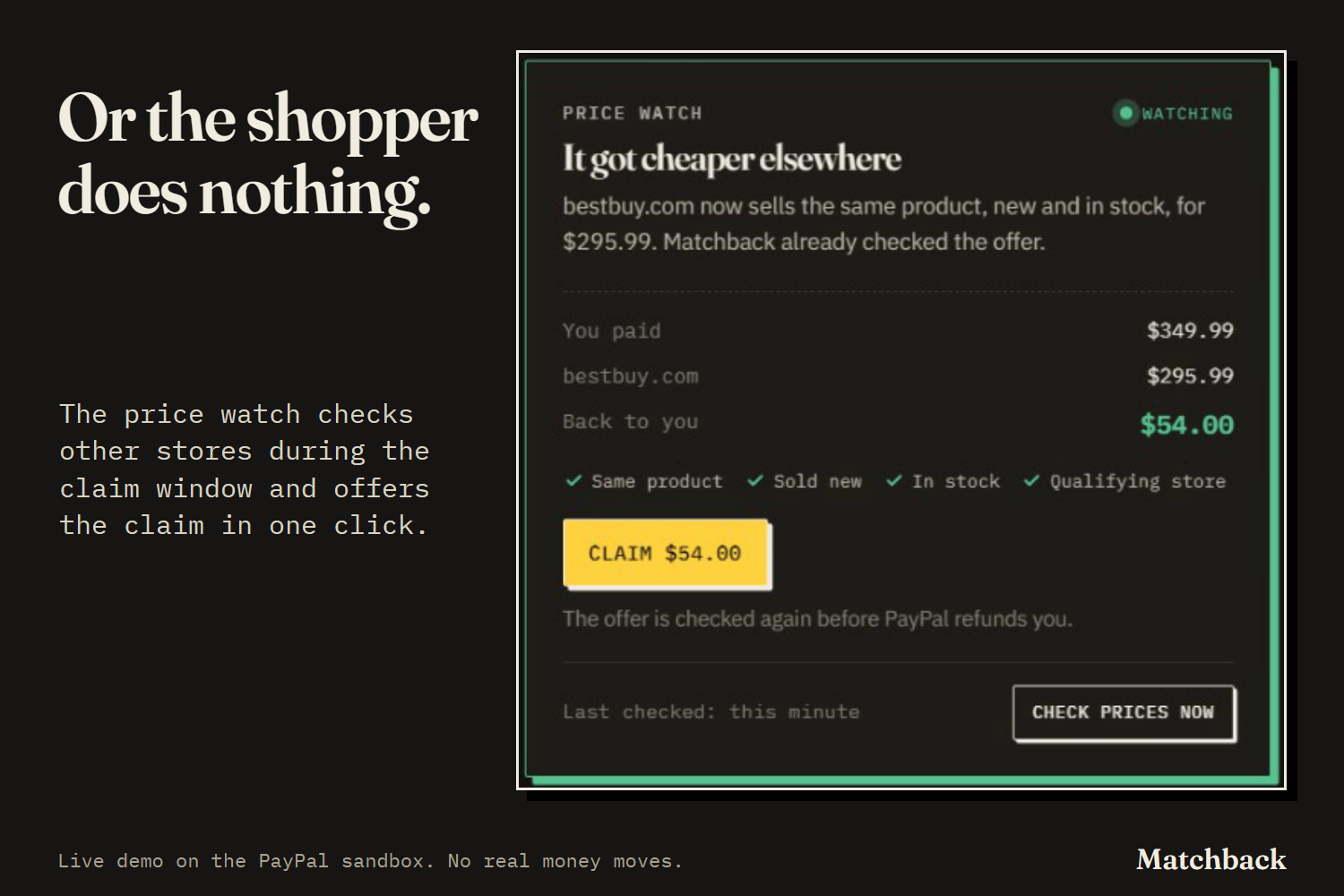
Price watch: Matchback finds a lower price at another store and offers the shopper a one-click claim.
-
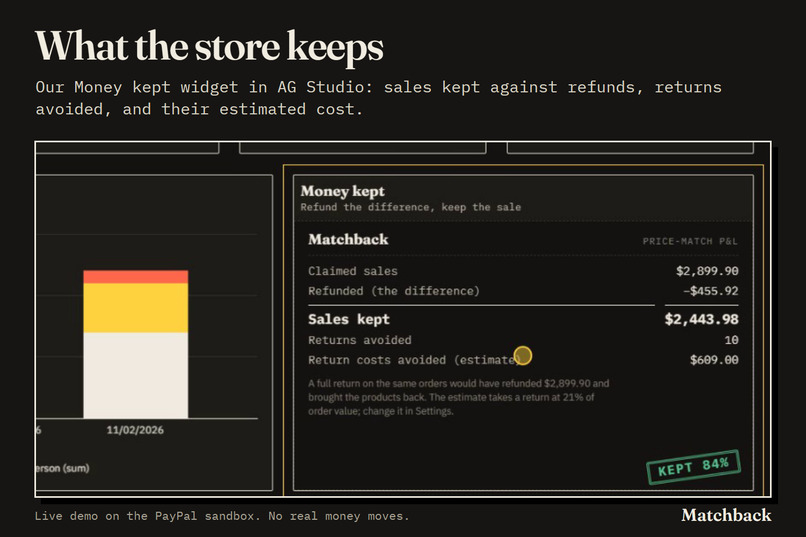
Money kept, our custom AG Studio widget: sales kept against refunds, returns avoided, and their estimated cost.
-
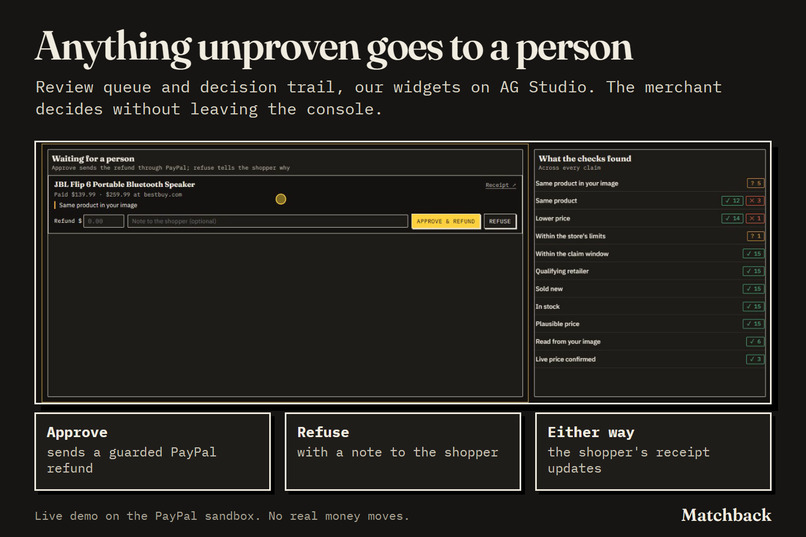
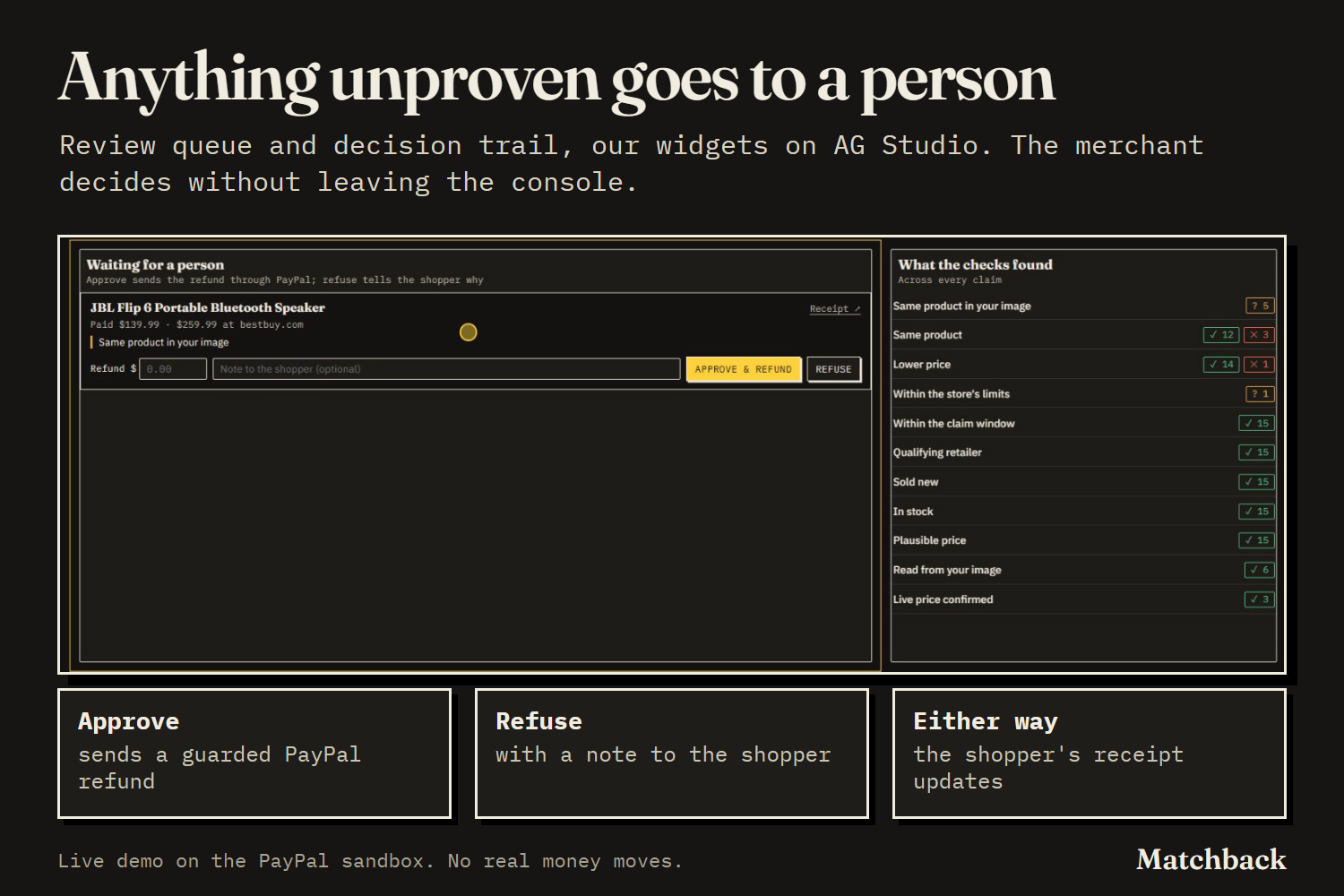
Review queue and decision trail, our custom AG Studio widgets: anything unproven goes to a person, who approves or refuses.
-
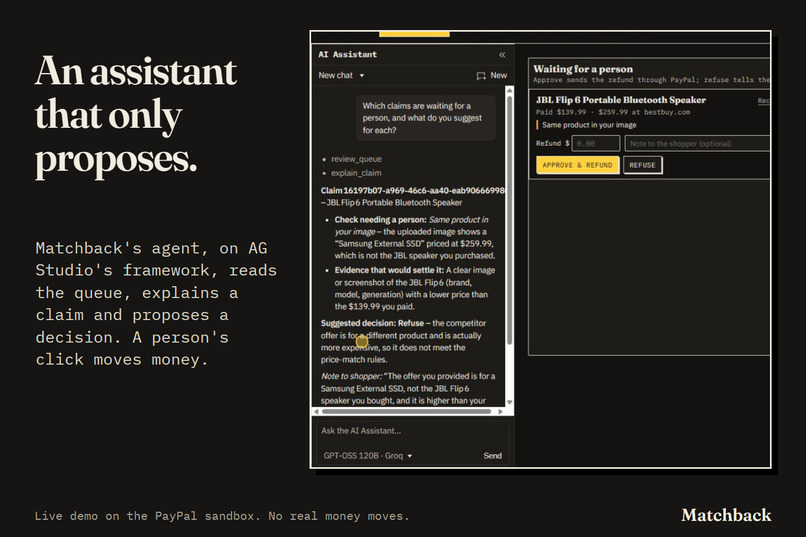
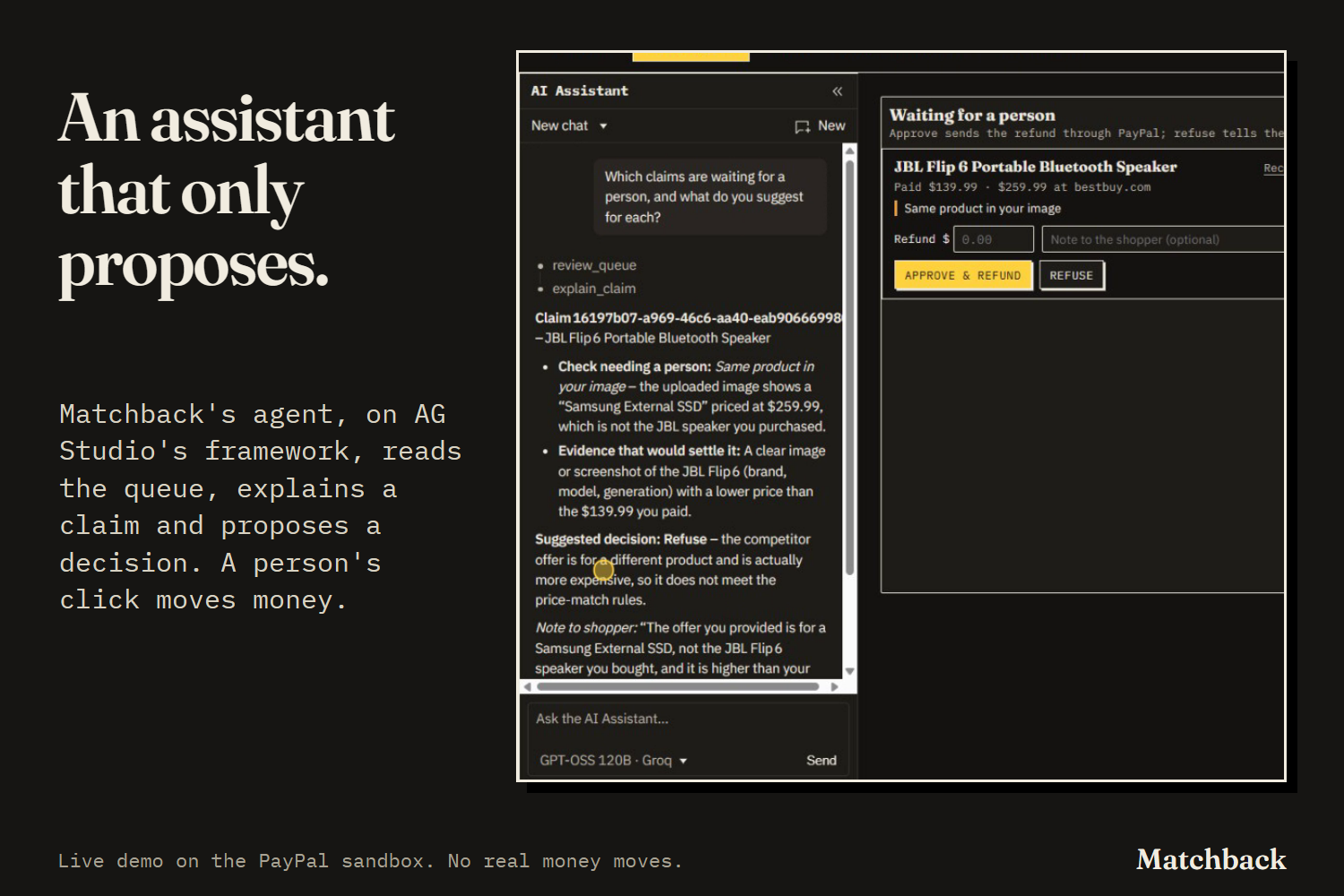
The console assistant, on AG Studio's agent framework: Matchback's agent explains a claim and proposes a decision.
-
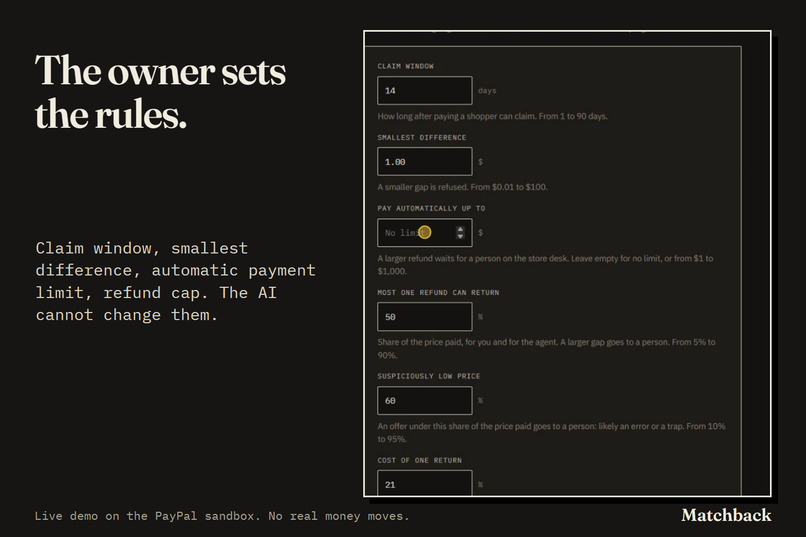
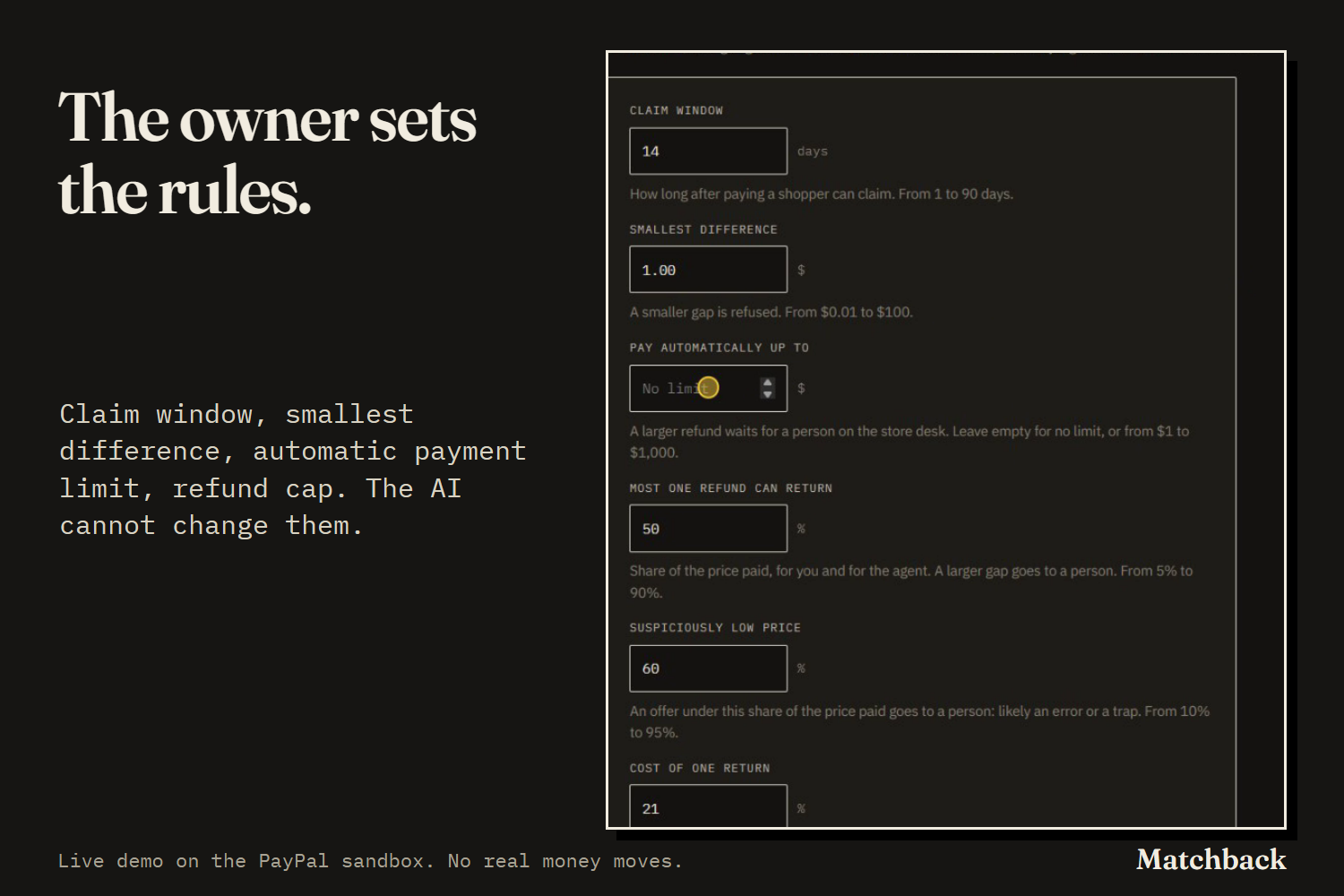
Store settings: the owner sets the claim window, automatic payment limit and refund cap. The AI cannot change them.
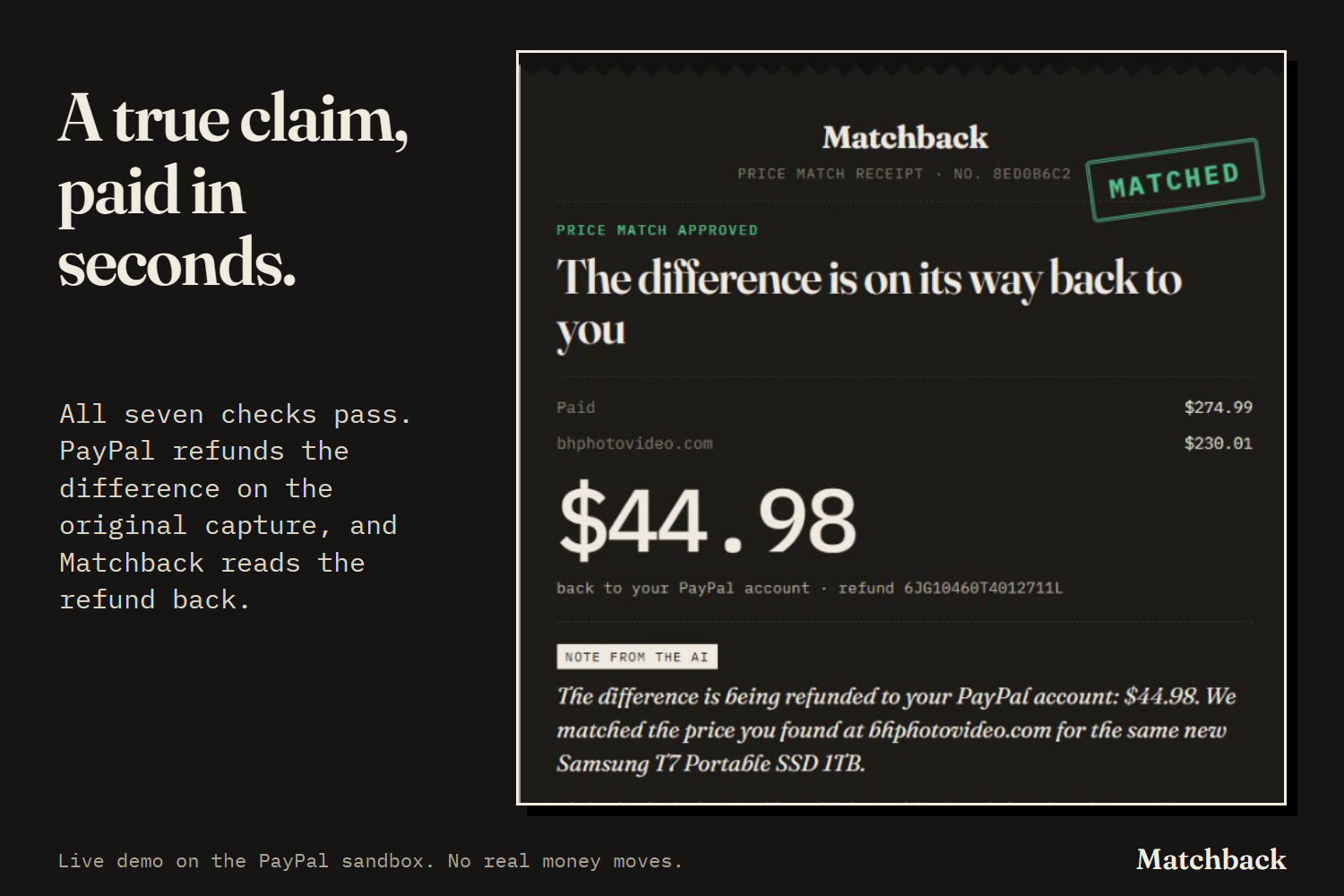
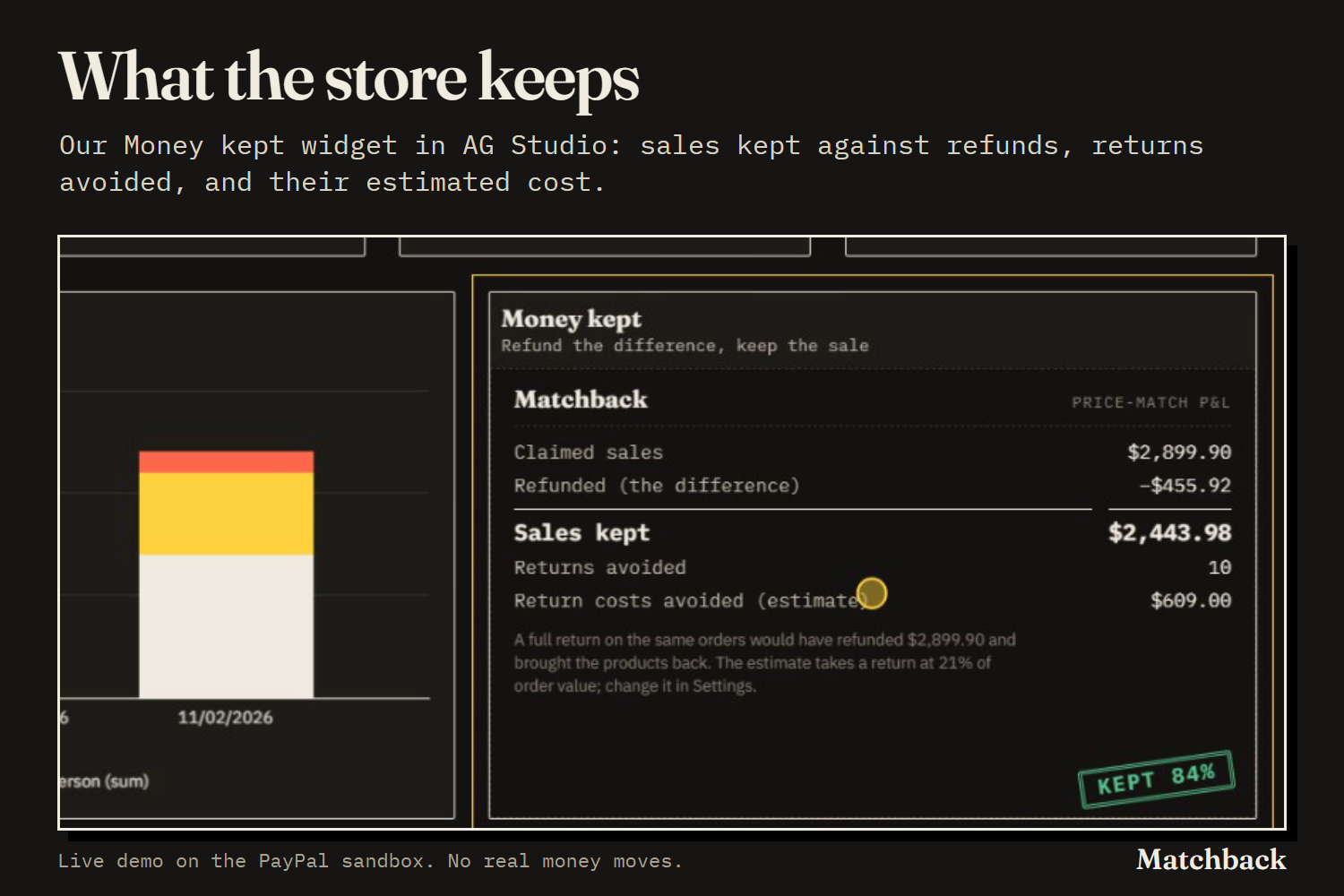
A partial refund instead of a return. When a shopper finds the same item cheaper, Matchback checks the other offer live with Channel3, fixed rules decide, and PayPal refunds the difference in seconds. Unlike a damage refund, a price-match refund prevents a return: the store keeps the sale for the difference (here $44.98) instead of paying, on average, 21% of the order value to handle a return. Try it: https://matchback-tau.vercel.app
Proof: on 75 real claims built from live product pages (52 traps), a naive "approve if cheaper" bot wrongly refunds $2,592.25; Matchback wrongly refunds $0.00 and misses no legitimate claim. Run blind on two held-out sets, it paid 0 of 18 traps (the naive bot paid 8).
Built for small stores: the AI reads and compares but never decides money, every refusal explains itself, and the owner's limits hold (a $50.00 claim above a $10 automatic limit waited for a person).
Inspiration
A shopper who finds the same product cheaper a few days after buying usually returns it and buys it again elsewhere. For the store that is the worst outcome: it refunds the whole price, pays shipping twice and gets back an opened box. US retailers expected $849.9 billion in returns in 2025, 15.8% of sales and 19.3% of online sales (NRF and Happy Returns, October 2025). Handling an online return costs retailers an average 21% of order value (Pitney Bowes survey of 168 US online retailers, 2022).
A price-match guarantee would keep the sale for the cost of the difference. Large chains staff price-match desks to check claims by hand; even they are narrowing their policies (Target stopped matching Amazon and Walmart in July 2025). A small online store has no desk, and price-match claims are easy to fake: another model, a bundle, a refurbished listing, a marketplace seller, an item out of stock. Appriss Retail puts return and claims fraud at $103 billion in 2024.
So we asked: can an agent run a store's price-match guarantee on its own, pay the true claims in seconds, and refuse the fake ones?
What a store owner told us. We showed the demo to Mikalia Yahya, owner of Boutique Consumer Electronics & Audio Accessories. They estimate that 10% to 15% of their return requests come from a customer finding a lower price elsewhere.
Asked whether they would use it in their store:
"Yes, but only in a 'human-in-the-loop' pilot phase where the agent drafts the refund and rationale, leaving the final click to a human team member."
Mikalia Yahya watched the demo and has not used Matchback in their store.
What it does
The shopper pays with PayPal. If they find the item cheaper within the claim window (14 days by default), they can:
- Paste a link to the cheaper offer. Channel3 reads the live listing: price, stock, condition, seller, 90-day price history.
- Upload a screenshot or a photo of a price tag. AI vision reads the product, store and price; Channel3 then finds that store's live listing. The refund always uses the live price, never the one in the image.
- Do nothing. A price watch checks the other stores selling the product during the claim window. When one is cheaper and passes every check, the order page offers a one-click claim.
Every claim runs through seven checks: claim window, a known store (a listed competitor or the brand's own store; resale marketplaces refused, unknown shops sent to a person), sold new, in stock, a large enough price gap ($1 by default), a plausible price, and the same product. The AI decides only the last one (same model, not another edition, a bundle, an accessory or a refurbished unit), and fixed rules overrule it when an edition word, a generation or a model year disagrees. When everything passes, PayPal refunds the difference on the original capture within seconds and Matchback reads the refund back from PayPal. When anything is uncertain, the claim goes to a person, never to a payout.
The shopper gets a receipt with every check, the evidence, and a short note written by the AI in their language (English, French or Spanish).
For shoppers' AI agents. A shopper's AI assistant can file the claim itself: Matchback is also an MCP server (https://matchback-tau.vercel.app/api/mcp) with four tools: read the store's price-match policy, look up an order, file a claim, follow it. The agent gets no more power than the shopper: the order id is the only key, the same checks, limits and PayPal refund apply, any doubt still goes to a person, and no tool can approve a claim, choose an amount or change the store's settings. Connect it in one line: claude mcp add --transport http matchback https://matchback-tau.vercel.app/api/mcp.
Tested on the hosted app with Claude Code as the shopper's agent: a $10.00 refund on a Sonos Era 100, all seven checks passed (receipt).
The store gets a store desk: a review queue for the claims sent to a person (approve with a refund amount, which goes through the same guarded PayPal refund, or refuse with a note), every decision, the share decided automatically, money refunded, sales kept, and the returns avoided with an estimate of what they would have cost (21% of order value by default, labelled as an estimate).
Store settings put the owner in control: the claim window, the smallest difference, how much is paid automatically before a person decides, per refund and per day, the most one refund can return, what counts as suspiciously low, other colours, and stores to add. New claims follow them at once, the shop and guide pages state them, and the AI cannot change them.
The merchant console, built with AG Studio, shows all of it as an interactive report in Matchback's own theme: claims per day by outcome, money kept against refunds, why claims were not paid automatically, the stores and products behind them, and a separate page with the 75-claim evaluation. Three widgets are our own, built on Studio's widget API: a receipt of the money kept, a decision trail of the checks, and a review queue where the merchant approves or refuses claims without leaving the console. Its assistant runs on Studio's agent framework: Matchback's agent reads the queue, explains a claim from its evidence and proposes a decision, and hands charts and data questions to AG Studio's built-in agents. It only proposes: a person's click moves money.
How we built it
- PayPal: Orders v2 (create, capture) and Payments (refund on the capture, then an independent read-back with getRefund and getCapturedPayment), through the PayPal TypeScript SDK generated by APIMatic. The integration was planned with the APIMatic Context Plugin; the plan and its checks are in
paypal-plan.md.- Every PayPal write is recorded in our database before it is sent; its key is also the
PayPal-Request-Id, so a retry never pays twice, and an unknown outcome is settled by reading the order back. - One price-match refund per payment (a unique index), a per-order cap, and the remaining-balance check.
- Every PayPal write is recorded in our database before it is sent; its key is also the
- Channel3: product lookup from any store link, every store's offer for a product (the price watch), condition, availability, price history, and text and image search (to find the listing a screenshot shows). Answers are cached so a claim's re-check, the evaluation and the demo read the same data.
- AI: OpenAI-compatible endpoints, Groq first with automatic fallback to Google Gemini. When no AI answers, the claim goes to a person; the AI never moves money on its own.
- App: Next.js 16, React 19, TypeScript, hosted on Vercel with Supabase Postgres (SQLite locally). 182 unit tests plus live tests against Channel3, the AI providers and the hosted database.
AI tools and how we used them
- Groq
openai/gpt-oss-120b: same-product decision (tool call with a fixed set of relations), shopper's note in English, French and Spanish. - Groq Qwen vision model: reading screenshots and price-tag photos: product, brand, model, store, price, condition words.
- Google Gemini Flash: automatic fallback for both.
- AG Studio agent framework + Groq gpt-oss (Responses API): merchant console assistant: Matchback's agent (review queue, claim evidence, totals, proposed decisions) delegating to Studio's built-in widget and data agents.
- APIMatic Context Plugin + generated PayPal SDK: planning and writing the PayPal integration.
- Claude Code: pair-programming assistant during development; screen capture, edit and animation of the demo video.
- Chatterbox, on Google Colab: demo video narration: an AI clone of the builder's own voice, made with the builder's consent.
Challenges we ran into
- Telling the same product from a near miss. "Samsung T7" and "Samsung T7 Shield" look alike on a page, as do a Kindle and its Signature Edition, a mouse and its "for Business" edition, or 2nd- and 1st-generation earbuds sold under one name. Our evaluation caught the AI confusing the last two; fixed rules now overrule it, and anything unsure goes to a person.
- A screenshot is not evidence of a price. Images can be edited, so the image only identifies the offer; the refund comes from the store's live listing. We also found, on the live site, that a screenshot of a different product at a store that sells the purchased one cheaper was approved. We fixed it the same day: the image must show the product that was bought.
- Never paying twice. Network errors and retries around a refund are where money gets lost. Every PayPal write is claimed in the database first and settled by reading PayPal back.
- Channel3 answers vary. The same page sometimes came back without its condition a minute apart, so a missing condition is checked against a second source before a claim goes to a person.
- Serverless Postgres. Supabase's transaction pooler hangs on pipelined queries; we measured it and send one query at a time per instance.
Accomplishments that we're proud of
- On 75 real claims built from live product pages (52 traps), a naive "approve if cheaper" bot wrongly refunds $2,592.25. Matchback wrongly refunds $0.00 and misses no legitimate claim. On two held-out sets, each run once blind, it paid 0 of 18 traps; the naive bot paid 8.
- End-to-end refunds on the hosted app: a price-watch claim refunded $54.00 and a pasted-link claim $44.98, each a few seconds after the claim, each read back from PayPal as COMPLETED.
- The owner's rules hold on the hosted app: with automatic payment set to $10, a verified $50.00 price-watch claim waited for a person instead of being paid.
- The agent's value shows in what it refuses, and every refusal explains itself in the shopper's language.
What we learned
- Keep the AI's job narrow, and check it. The AI reads screenshots, judges whether two listings are the same product, and explains the result. It does not decide money. That split paid off: our evaluation caught it calling a "for Business" mouse a colour variant, and in a blind run calling first-generation earbuds the same as second-generation ones. Each mistake became a fixed rule that can take a match away but never create one.
- Measure against the obvious alternative, on traps. An accuracy score would have hidden what matters. Running a naive "approve if cheaper" bot on the same 75 real listings gave a number a store owner understands: $2,592.25 wrongly refunded against $0.00. It also keeps us honest about the cost: 20 of those claims still go to a person.
- Only a run on the real product finds some bugs. All our tests passed while the hosted app approved a screenshot of a Samsung SSD on a GoPro order, because the store matched and the product was never compared. Later, a screenshot of another product was refused with a reason that made no sense to the shopper, and a size limit at the host would have blocked ordinary phone photos. We now walk the full path a judge or a shopper takes, with a real sandbox account, and read every refund back from PayPal.
- Limits shape the design. On a free AI tier, Studio's default lead agent used the whole per-minute budget in one turn. A short agent of our own, with few tools, handing charts to the built-in agents, fits the budget and calls its tools more reliably.
What's next for Matchback
- Live PayPal credentials and reviewer accounts for a real store.
- More retailers' pages readable (11 of the 75 evaluation links could not be read and went to a person).
- A browser extension that files the claim from the competitor's page.
Built With
- ag-grid
- ag-studio
- apimatic
- channel3
- gemini
- groq
- mcp
- nextjs
- openai-compatible-api
- paypal
- paypal-orders-v2
- paypal-payments
- postgresql
- react
- sqlite
- supabase
- typescript
- vercel
- vitest
