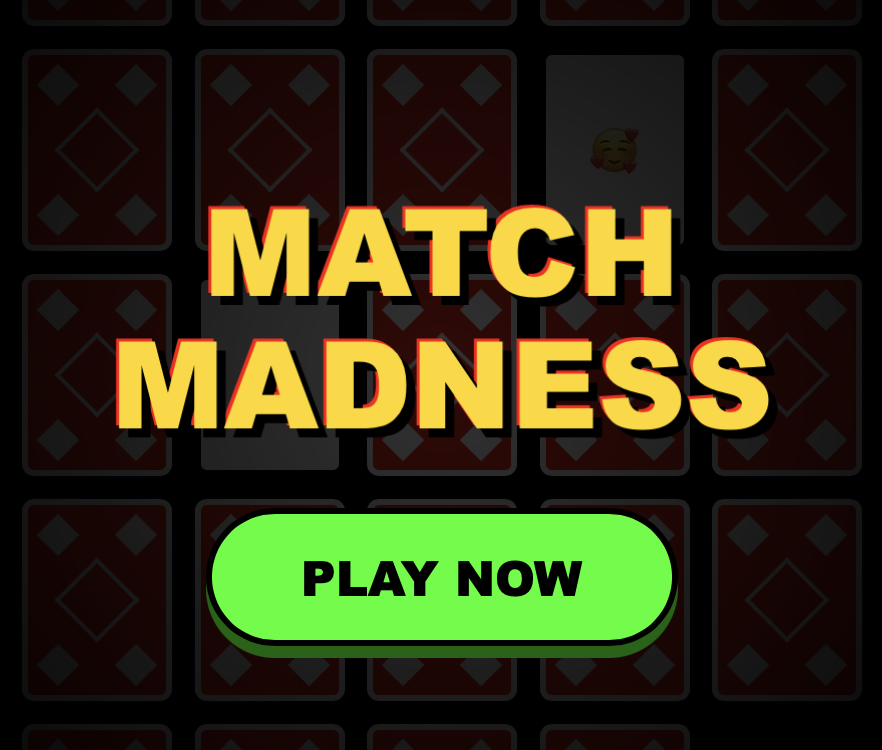
Inspiration The inspiration for this project came from a desire to take the classic memory match formula and add a high-stakes, arcade-style twist. I wanted to move away from casual "trial and error" gameplay and create a version that rewards absolute focus and perfect recall. The goal was to turn a simple childhood game into a tense, competitive experience where every click matters.
What it does Match Madness is an intense memory puzzle game where players must memorize an entire board of emojis in seconds. Once the cards flip, the player must match every pair perfectly; a single mistake results in an immediate game over. It features an Endless Mode for personal high scores and a Daily Challenge mode where the entire community competes on the same set of boards.
How I built it I built the game with a focus on quick state management and smooth card animations. The core engine handles the randomization of the emoji grid and manages the reveal/hide timers. I used a modular approach for the game modes, allowing the Daily Challenge to pull from a consistent seed so every player sees the same board, while Endless Mode scales in difficulty by increasing the grid size.
Challenges I ran into One of the biggest challenges was balancing the "memorization window." I had to perform a lot of playtesting to find the sweet spot where the game felt challenging but not impossible. Another hurdle was ensuring the "One Strike" logic was perfectly responsive..since the game ends on a single mistake, the input detection had to be flawless to avoid frustrating players with accidental clicks.
Accomplishments that I'm proud of I’m particularly proud of the "One Strike" mechanic, as it completely changes the psychological approach to the game compared to traditional memory puzzles. Successfully implementing the Daily Challenge system to ensure community-wide fairness was also a major milestone. The result is a game loop that feels fast, punishing, and highly addictive.
What I learned This project taught me the importance of "tension" in game design. I learned how small changes to the rules..like removing the ability to make mistakes...can drastically increase player engagement and focus. I also gained a deeper understanding of how to manage timed events and animations in a way that feels natural and intuitive to the user.
What's next for Match Madness The next steps involve getting feedback from the community
Built With
- devvit
- phaser.js
- typescript

Log in or sign up for Devpost to join the conversation.