-
-
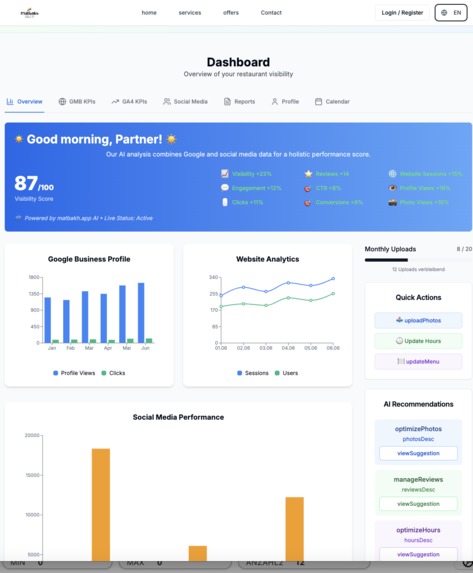
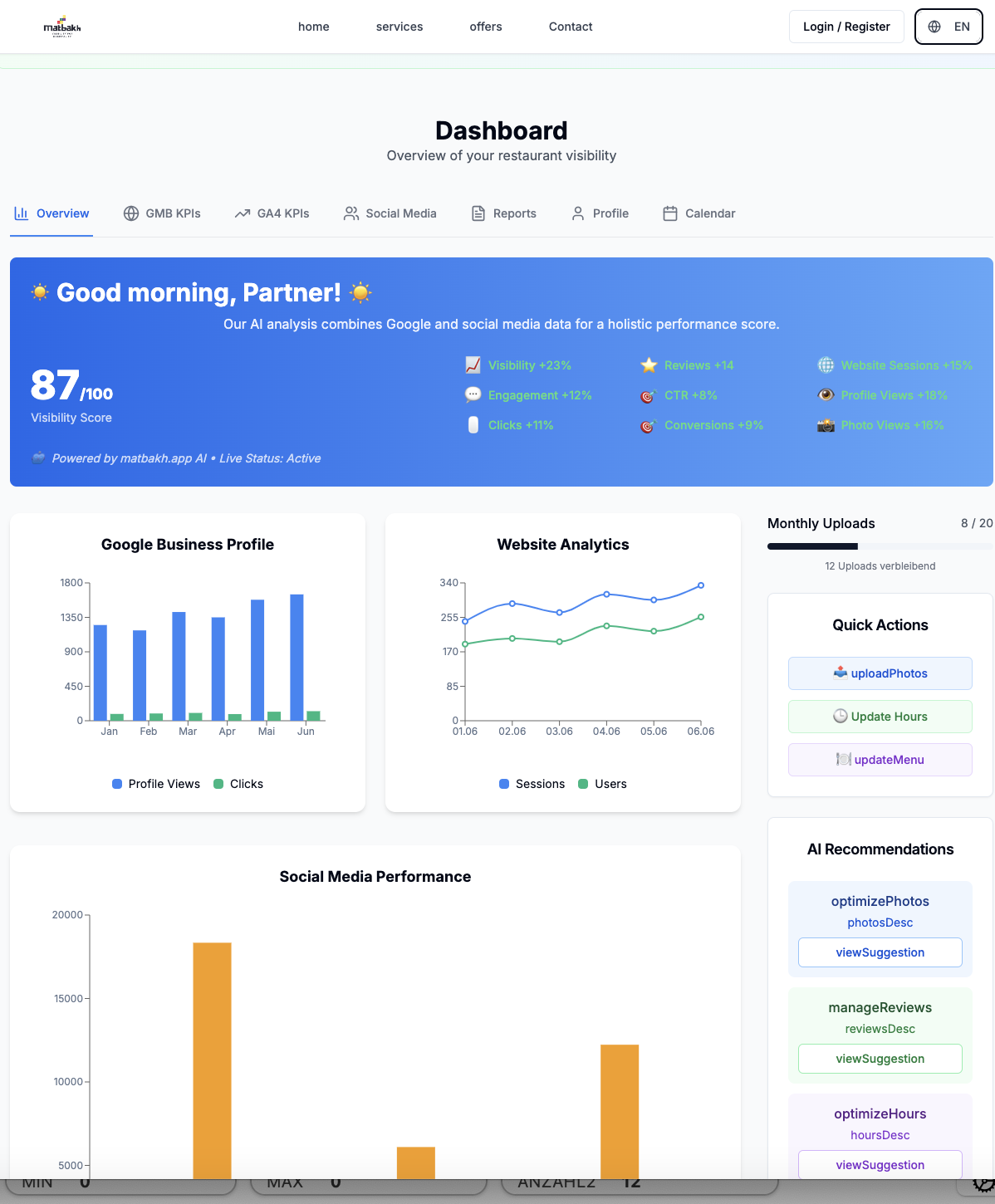
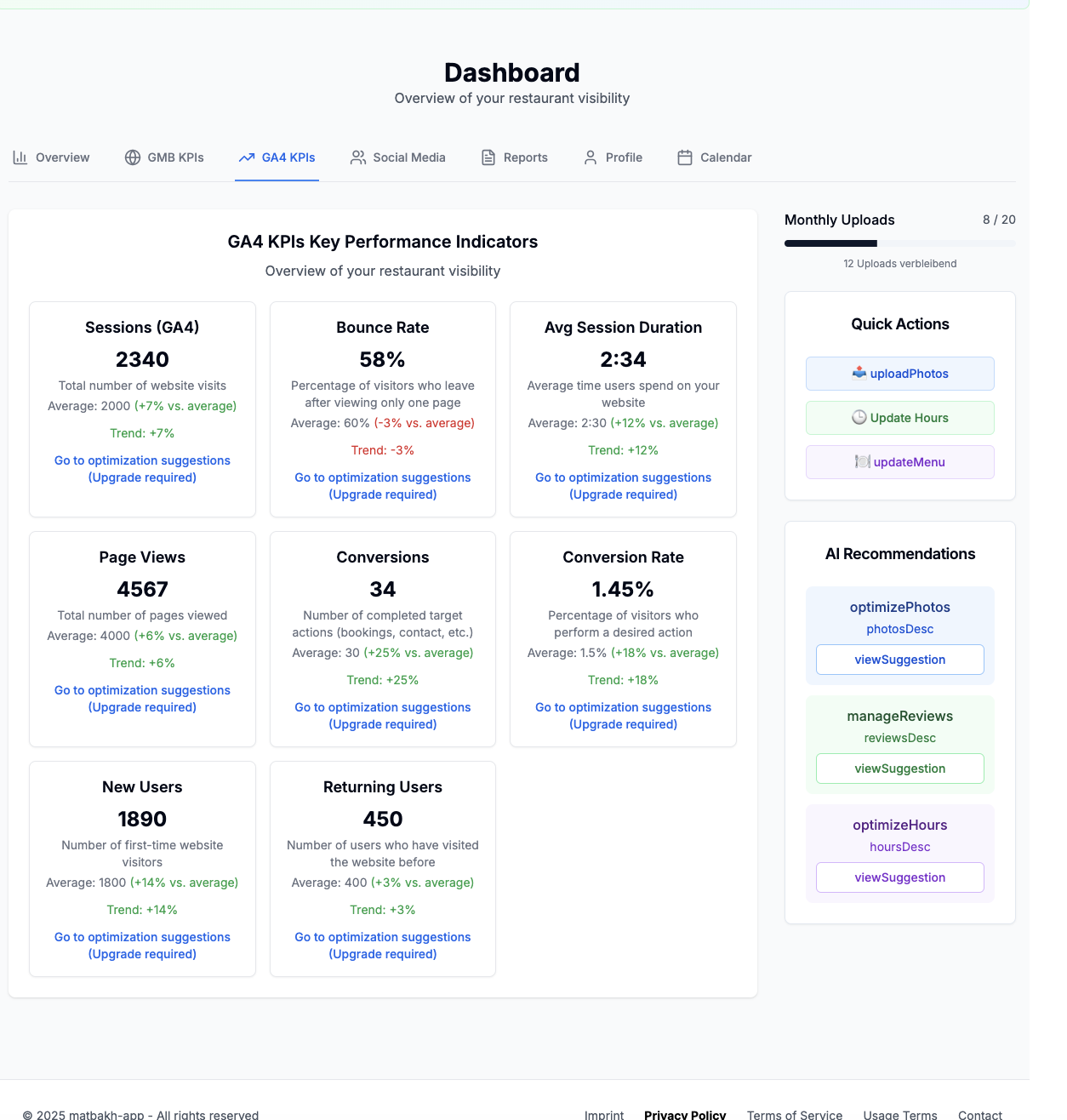
Interactive dashboard wit relevant KPIs, ranking, one click uploads based on AI recommendations
-
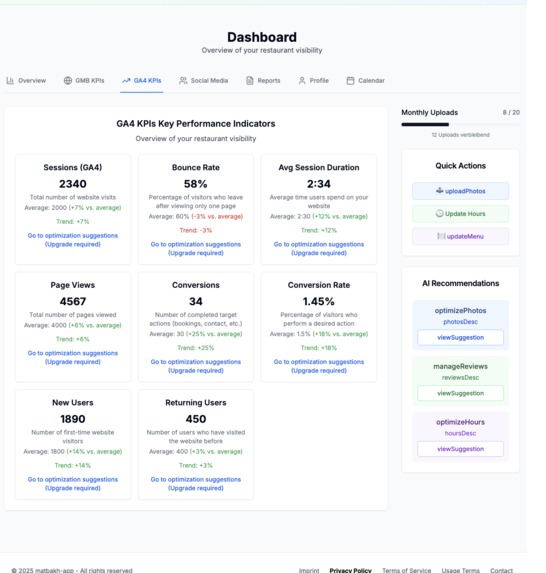
Over 20 KPIs to evaluate the current business status combined from Google My Business and from Meta
-
-
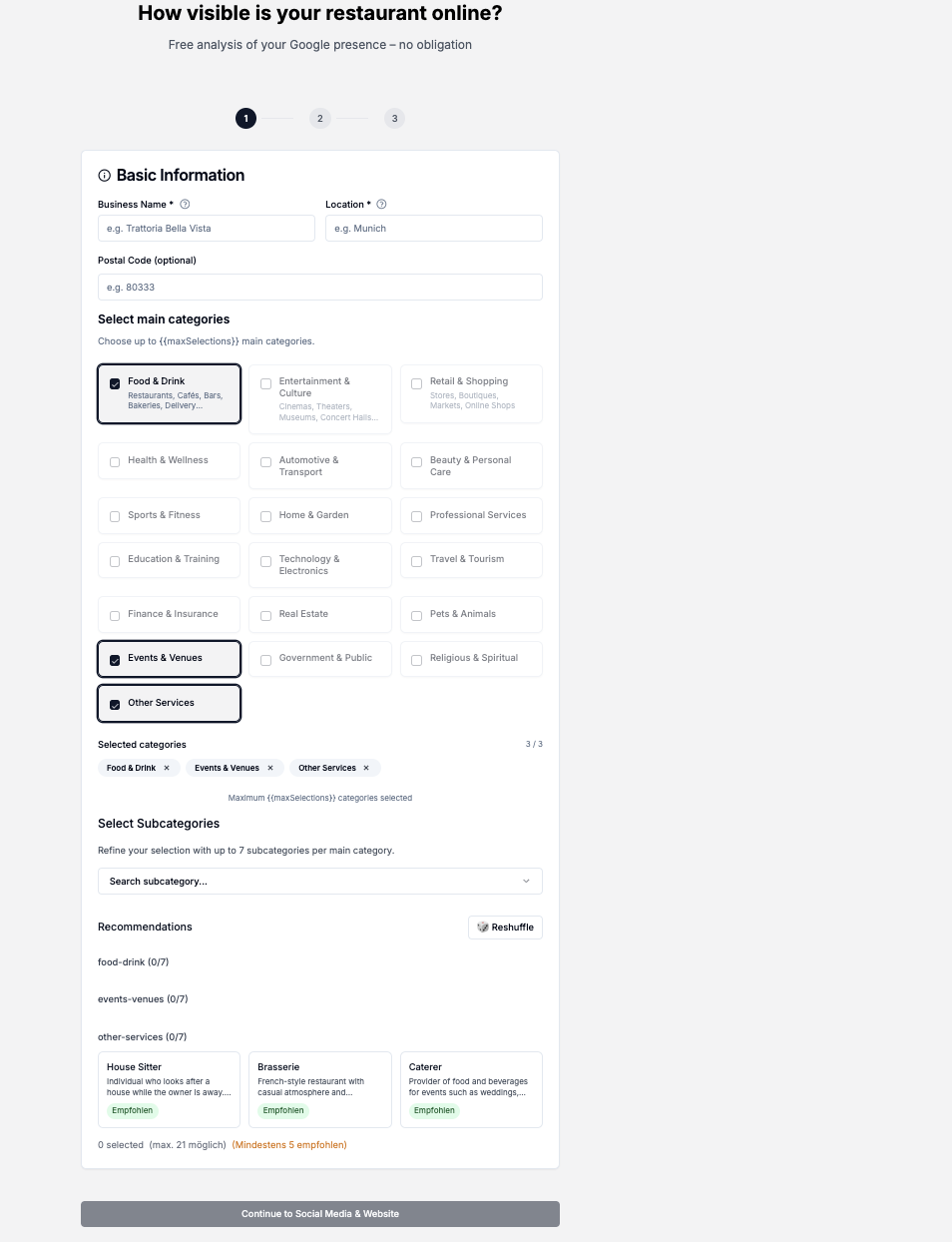
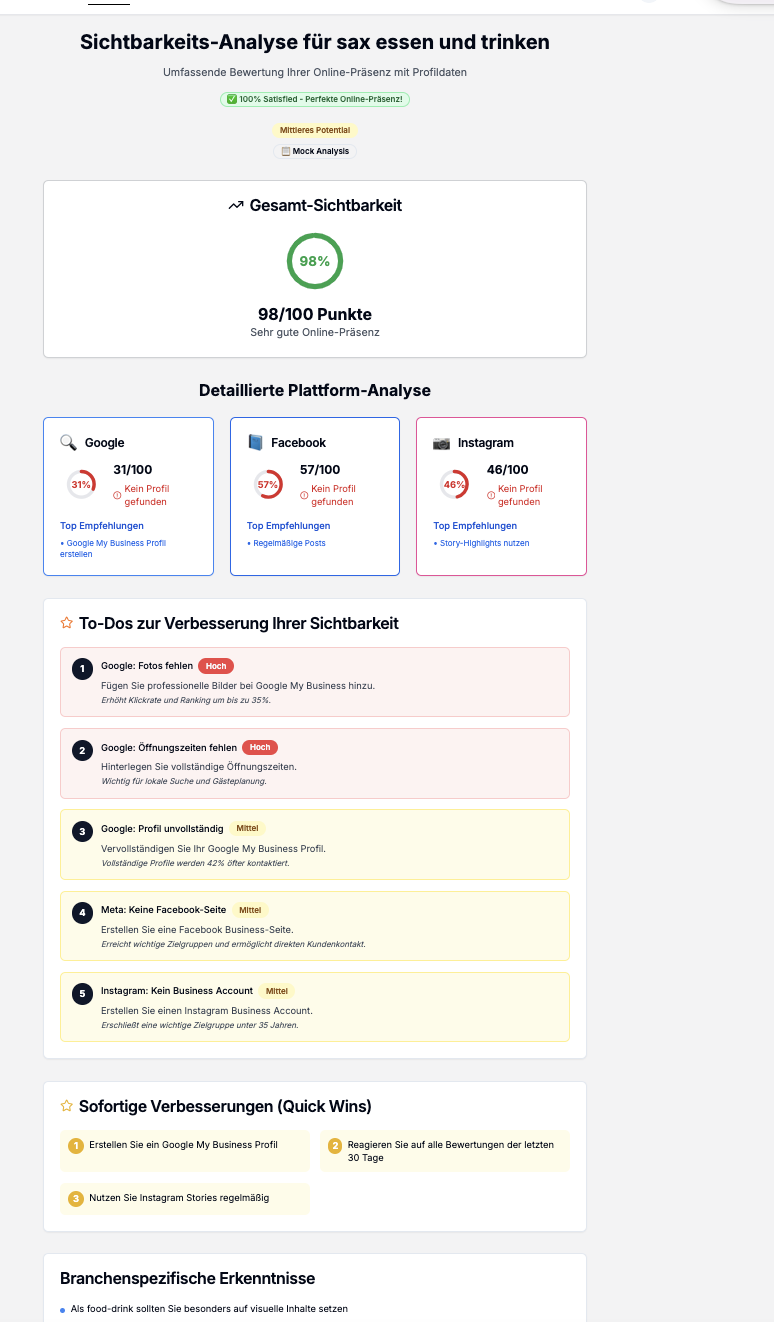
About the project - This is the valid and official matbakh.app project. The other submission was a mistake and could not be canceled.
Kiro × matbakh.app Visibility Coach is a focused productivity tool that turns a restaurant’s public footprint (URL or short profile) into Top-5 next best actions plus a one-page Markdown playbook. It’s designed for owners and small teams who excel at food and hospitality but don’t have time (or budget) for complex marketing stacks. The app showcases how an AI IDE (Kiro) can take a clear spec and produce production-grade code, tests, and repeatable automations in hours, not weeks.
Inspiration
After working more than 20 years in gastronomy, I know the industry and its people inside out. Most local restaurants and cafés struggle with visibility online. They are excellent at food, service, and atmosphere, but not at digital marketing. I wanted to change that by creating a tool that helps them shine without requiring a marketing team.
Two ideas shaped my ambition:
- Evidence wins: In the early Google days, a Stanford professor typed his own name into Google and saw Stanford University as the top result, a ranking quality competitors didn’t deliver at the time. That concrete proof changed minds. I want the same clarity for restaurateurs: inputs in, better answers out, instantly.
- Think (10\times), not (+10\%): Google’s culture popularized “10x thinking”, aiming for solutions an order of magnitude better, not incremental tweaks. As Larry Page and Google X’s moonshot ethos put it, bold, non-incremental leaps are the goal. I applied that mindset to local visibility: fewer dashboards, more decisive actions; less noise, more lift.
This also aligns with Blue Ocean Strategy, creating uncontested market space so competitors become less relevant. For small hospitality businesses, that means new playbooks (not just better checklists) that are hard to copy quickly.
How I built it (with Kiro)
Spec-to-Code with Kiro
I wrote a tight spec (user stories, acceptance criteria, test plan) and stored it in /.kiro/specs. Kiro generated initial modules and tests, which we iterated via conversational prompts.
Steering & hooks
A /.kiro/steering.yaml enforces architecture and quality gates ((tsc), ESLint/Prettier, Jest). Hooks in /.kiro/hooks run on spec changes and pre-commit, keeping code and tests in lockstep.
Small surface, high clarity
- Input: URL or mini-profile (
{ name, city, category }). - Core: Lightweight scorers for visibility pillars (Google Profile, Social Content, Menu Clarity, Locality Signals, Consistency).
- Planner: Picks exactly five actions with brief rationales.
- Output: Deterministic Markdown playbook for instant sharing.
(Under the hood, I keep the math simple and auditable:) [ \mathrm{priority}(a_i) \;=\; w_i \cdot \Delta \mathrm{impact}(a_i) \;-\; \mathrm{effort}(a_i) ] so recommendations remain explainable and testable.
What I learned
- Specs are force multipliers. A crisp spec makes AI pair-programming reliable, not lucky.
- Determinism beats “wow.” For judges and users, reproducible outputs > flashy but fragile demos.
- Evidence > claims. Borrowing Google’s early “convince by results” lesson, we made the app prove value in one run: paste a URL → get five actions that obviously matter.
Challenges
- Scope control: It’s tempting to add scraping, embeddings, and dashboards. I resisted and kept a narrow MVP so the 3-minute demo tells one clean story.
- Quality under time pressure: Enforcing type safety, tests, and formatting via Kiro hooks prevented last-minute breakage.
- Explaining the (10\times) bar: I translated “10x” into user-visible outcomes (clearer actions, faster time-to-value), not just technical ambition.
Closing thought
Restaurants don’t need another analytics maze; they need confidence: “Do these five things next.” By combining Kiro’s spec-driven development with a product philosophy inspired by Google’s 10x mindset and Blue Ocean framing, I built a tiny tool with outsized practical impact, easy to adopt today, extensible tomorrow.
What it does
matbakh.app is a visibility and performance platform for gastronomy.
It aggregates data from Google Business, Instagram, and other sources, then uses AI to generate:
Capabilities
- Top-5 Next Best Actions: Clearly prioritized actions with a brief rationale and estimated impact/effort (\text{priority}=w\cdot\Delta\text{impact}-\text{effort}).
- Persona-adaptive Playbooks: One-page plans (Markdown/PDF) for owners, marketers, and multi-location teams.
- Multimodal Extraction: Structured info from menu PDFs, screenshots, and posts (e.g., vegan options, price ranges, opening-hours gaps).
- “Restaurants like yours” Similarity Search: Vector-based recommendations including best-practice content templates.
- Forecasting & What-if: Visibility-score forecasts and scenarios (e.g., 3 reels/week vs. 1 reel).
- Benchmarking: Comparison with local/typological peers (category, price tier, location).
- Anomaly/Threat Detection: Detection of review spam, data drift, and platform inconsistencies.
- Channel Guidance: Concrete to-dos per platform (Google, IG, FB) including posting and profile optimizations.
- GDPR Audit & Exports: Consent/prompt logs, revision-safe, with PDF/JSON export.
- Executive Snapshot: Compact management view with score trends, risks, and immediately actionable steps.
Inputs
- Public profile URL or short profile (
{ name, city, category }) - Optional files: menu PDFs, screenshots, sample posts
Outputs
- Markdown playbook (1 page) with the five prioritized actions
- Brief report/widget for the dashboard (“Do these five things next”)
- Export as
.md/.pdffor quick sharing
How we built it
The project started during the Lovable Shipped Competition June 14th, and was further developed using Kiro as the core AI-powered IDE.
- I used spec-driven prompts to define the architecture and generate code with Kiro.
- I worked closely with my AI coach (ChatGPT — GPT-5 Thinking), sharing virtually all Kiro outputs and recommendations end-to-end. This continuous review loop provided guardrails, clarified acceptance criteria, and used red-team checks to keep Kiro on track and avoid hallucinations or drift.
- The backend runs on AWS Lambda, DynamoDB, and RDS, with AI services via Claude 3.5 Sonnet on AWS Bedrock.
- The frontend is a React + Tailwind app, structured with persona-adaptive components.
- Kiro helped manage the
/.kirodirectory for specs, tasks, and agent prompts, ensuring alignment between architecture and implementation. - Automated tests and validation frameworks were built directly with Kiro’s support, enabling a CI-ready workflow.
Challenges I ran into
- GDPR compliance: balancing powerful AI analysis with strict data protection requirements.
- Auth migration: I had to unify multiple auth providers (Supabase, SimpleAuth, Cognito) to avoid context mismatches.
- Persona logic: mapping abstract personas to concrete, persona-adaptive outputs in prompts and UI components.
- Prompt QA: ensuring AI responses are consistent, accurate, and cost-efficient required a custom quality assurance system.
Kiro-specific context (what worked well):
Kiro is a powerful instrument and being directly connected to our AWS setup is a long-term advantage (matbakh.app repos are hosted on AWS, so Kiro can keep maintaining code post-launch). Working in specs lets me package tasks, discuss details, and hand off precise instructions for implementation.
Kiro-specific pain points (from our experience):
- Spec tunnel vision & duplication: Kiro focuses narrowly on the current spec and may create new files that already exist from a prior spec → repo bloat, dispersed causality across files, and a more brittle system.
- Inconsistent naming: Kiro lacks disciplined naming conventions; identical parameters get different names, causing imports/commands to miss targets.
- Session transitions: Session drops and switching to a new session can lose information; continuity is not guaranteed/stable.
- Run/Deploy auto-actions without checkpoint: After a CLI command (run/deploy), Kiro starts executing immediately, sometimes in the wrong or overly complex direction, without giving the user a chance to intervene. A pre-execution confirmation would help experts adjust and beginners proceed safely.
- Overload crashes & history loss: When overwhelmed, Kiro can crash and lose the chat history; users must reconstruct events, with uncertainty whether prior implementations were reverted or still exist.
- Forgetting despite steering files: Even with agent steering/memory files, Kiro often doesn’t leverage existing repo knowledge, leading to duplicate functions for the same purpose.
- Unclear background work: The “working” indicator isn’t always shown; sometimes Kiro runs silently. Issuing
statuscan interrupt, flood with logs, and then resume, raising doubts about whether it retained state or lost context. - Partial prompt execution: Kiro sometimes executes only the first instruction in a multi-step prompt and omits the rest (not always, but too often).
- Non-actionable intent: Kiro may state it intends to implement something, then nothing happens, leaving the user without guidance on next steps.
- Access uncertainty after 15.09.: I rely on Kiro; what happens after test access expires? Clarifying continuity terms would reduce risk.
Accomplishments that we're proud of
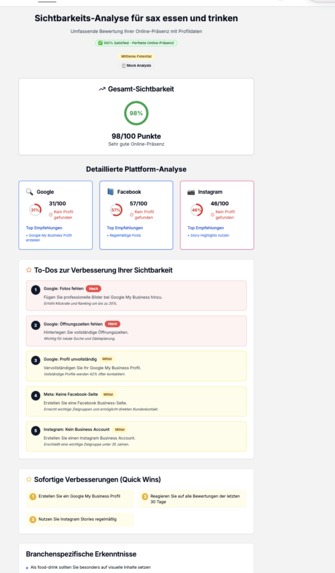
- Built a production-ready Visibility Check system with Claude-powered insights.
- Implemented a Prompt QA framework for enterprise-grade reliability.
- Integrated forecasting and anomaly detection into the visibility analysis.
- Achieved a working persona-adaptive output pipeline, bringing personalized strategies to life.
- Designed a DSGVO-compliant consent and audit system to make the project legally viable.
- Completed Test Suite Cleanup & Business Validation Layer
- Centralized Jest setup & mocks, deterministic UUID v4, shared context factories, strict business validations, and deduplicated mocks - $18/18$ AB Testing Manager specs green, deterministic CI, and traffic-split enforcement $\sum_i p_i = 100%$ for a uniform testing process
- Delivered multi-framework strategic analysis as part of the VC results:
- SWOT Analysis for growth opportunities and risks in visibility
- Porter’s Five Forces for competitive landscape assessment
- Balanced Scorecard for aligning actions with strategic objectives
- Utility Value Analysis for stability and prioritization of improvement measures
- Hofstede’s Cultural Dimensions for location-based and persona-specific recommendations
- SWOT Analysis for growth opportunities and risks in visibility
What we learned
- How to combine AI agents, prompt templates, and audit layers into a resilient system.
- The importance of prompt versioning and testing in real business applications.
- That spec-driven development with Kiro shortens the path from idea to production while keeping architecture clean.
- Working with real-world restaurant pain points reinforced that AI is most valuable when it produces clear, actionable outcomes.
What's next for matbakh.app
Ship the VC as a complete MVP
Finalize the end-to-end Visibility Check (persona outputs, PDF/Markdown export, stable scoring). Define go/no-go criteria and QA gates.Run first customer tests (4 early adopters)
Start field trials with our interested pilots in Munich (e.g., Brenner Bar & Grill, Goldene Bar, Sappralott, Oktoberfest tents).Package offers + Stripe payments
Assemble initial packages (Basic/Pro + CTA implementation services), enable Stripe checkout, billing, and receipts.Acquire the first 100 customers in Munich
Focused outreach in the home market; Oktoberfest hosts are a high-interest segment and early lighthouse users.Admin Audit Dashboard (GDPR & anomalies)
Build the audit UI for transparency, consent/prompt logs, anomaly detection, and export (PDF/JSON).Persona-adaptive prompt templates
Finalize templates, A/B test wording and action framing per persona.Forecasting expansion with external AI providers
Keep the forecasting layer pluggable; evaluate Gemini and Meta LLaMA integrations for time-series and content recommendations.
Matbakh’s vision is to give every restaurant, café, and creative hospitality space the digital visibility they deserve, turning local passion into lasting success.
Built With
- auth
- aws-(in-migration)
- built-with:-languages:-typescript
- i18next-(internationalization)
- javascript-frameworks:-react
- lovable
- meta-business-api-(planned)
- next.js-platforms:-supabase
- openai-databases:-postgresql-(supabase)-other:-tailwind-css
- resend-(email)-apis:-google-my-business-api-(in-development)
- storage)
- vercel-cloud-services:-supabase-(postgres-db

Log in or sign up for Devpost to join the conversation.