-
-
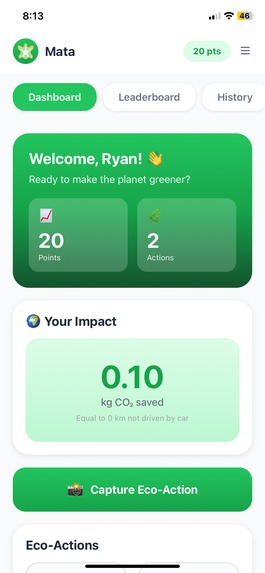
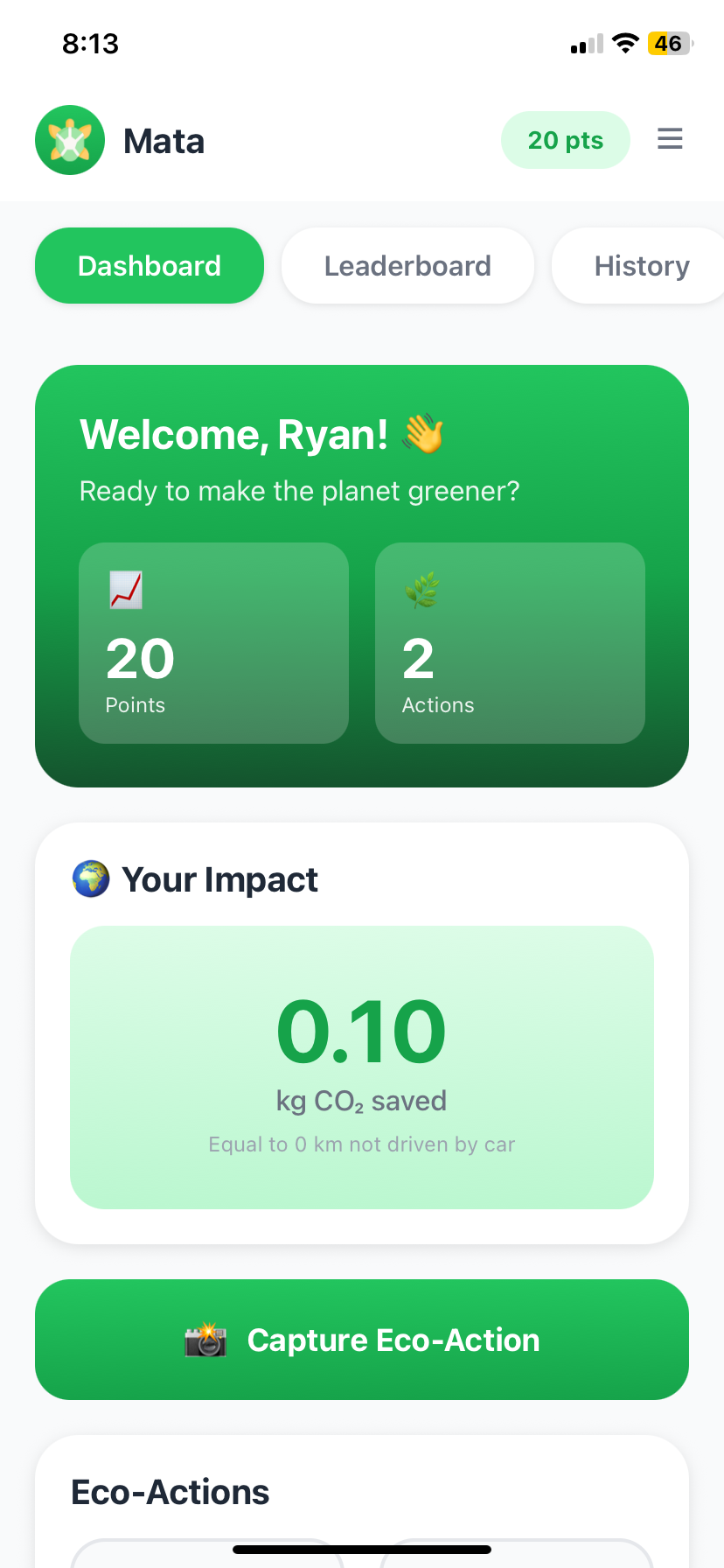
Home Page
-

Leaderboard
-
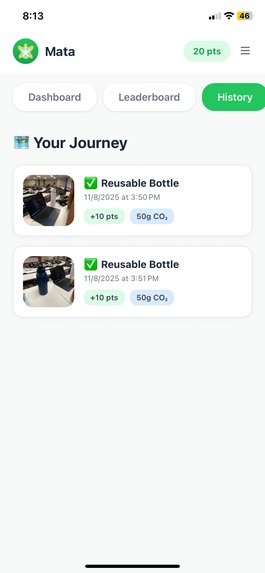
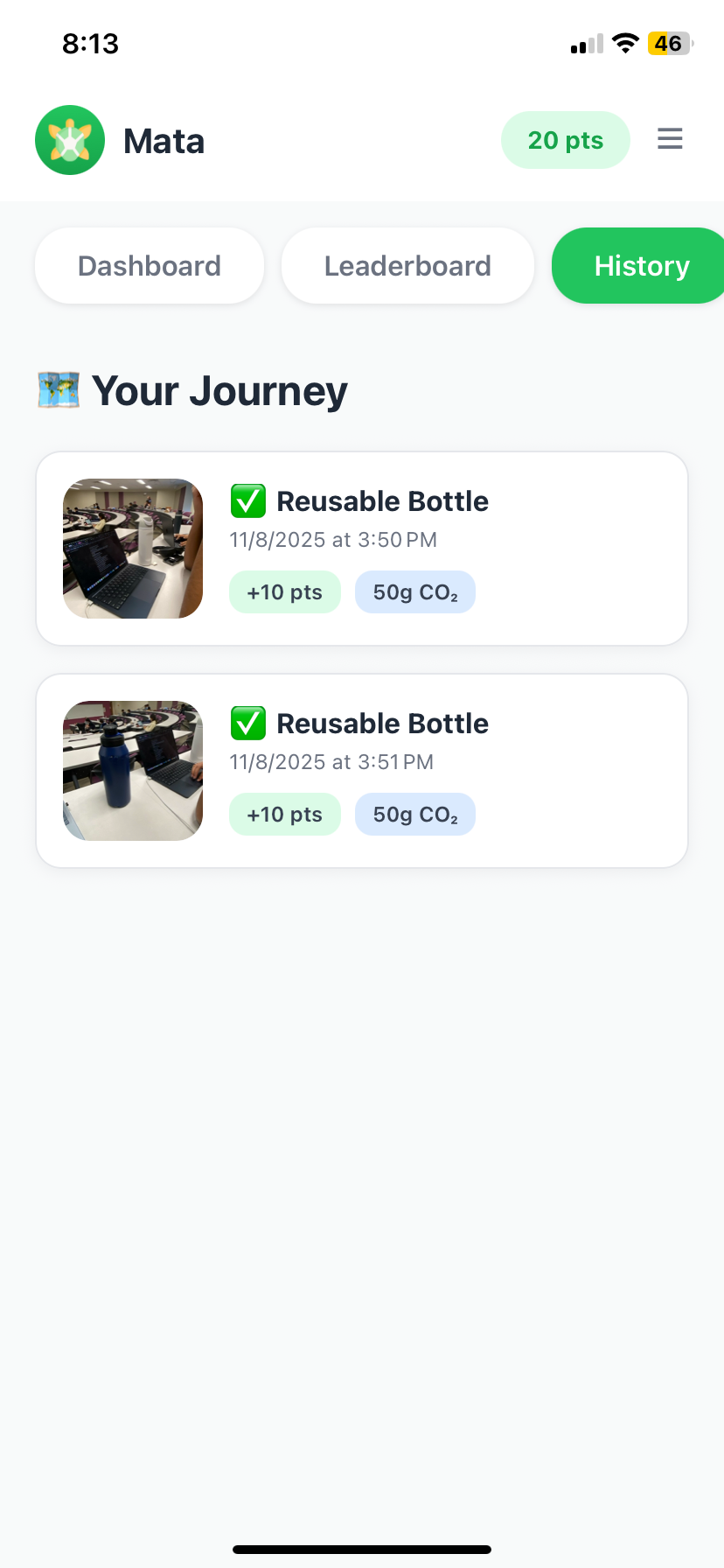
History
-
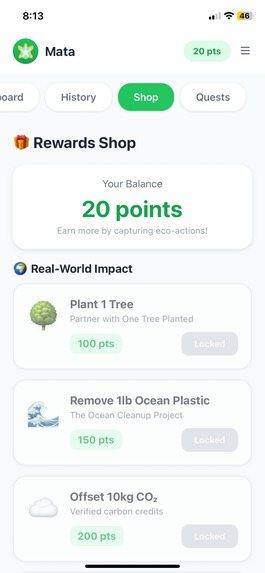
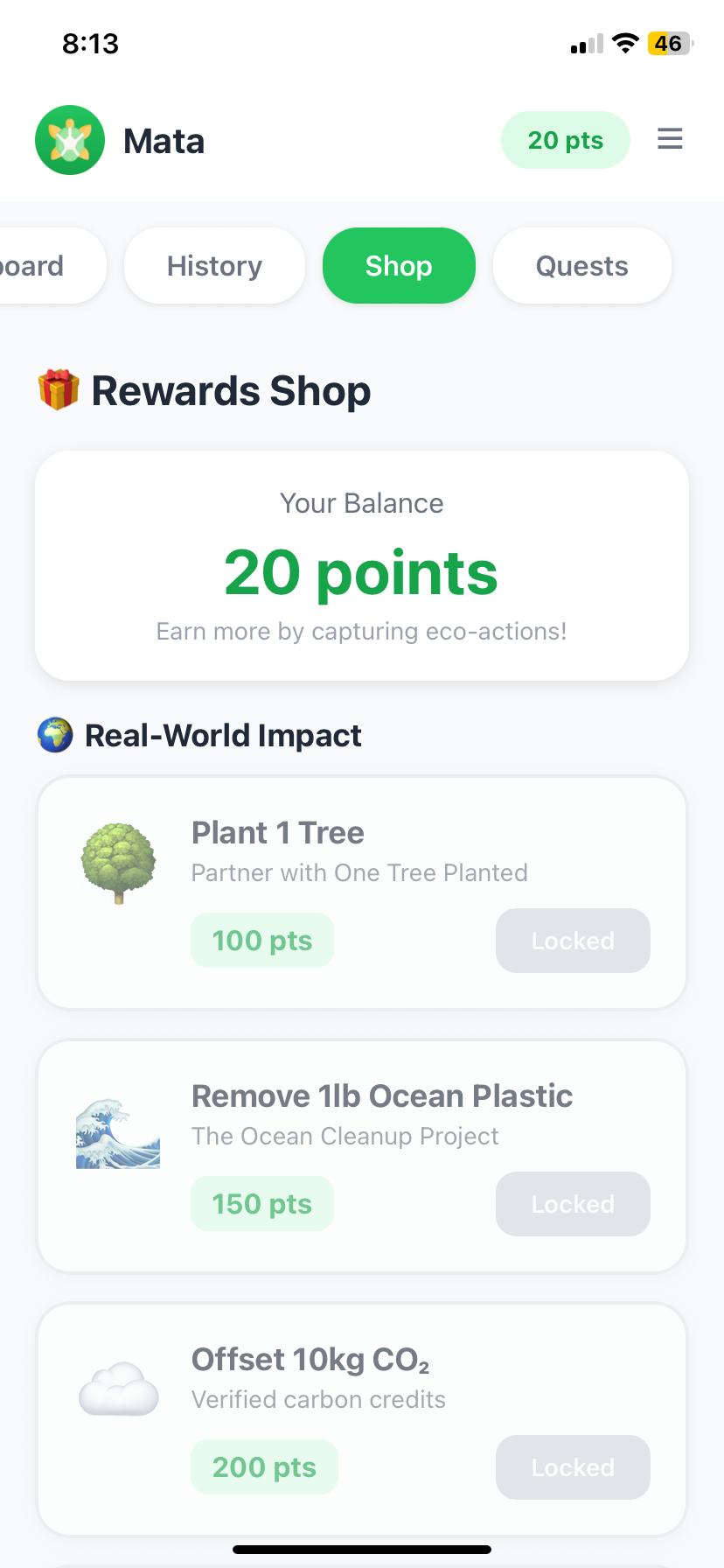
Redeemable Rewards
-
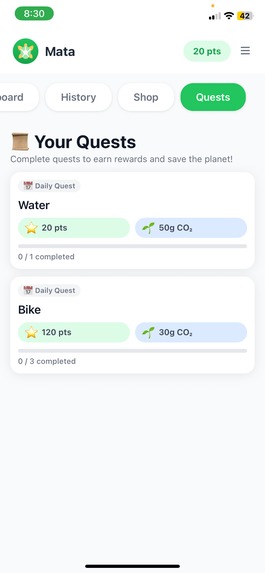
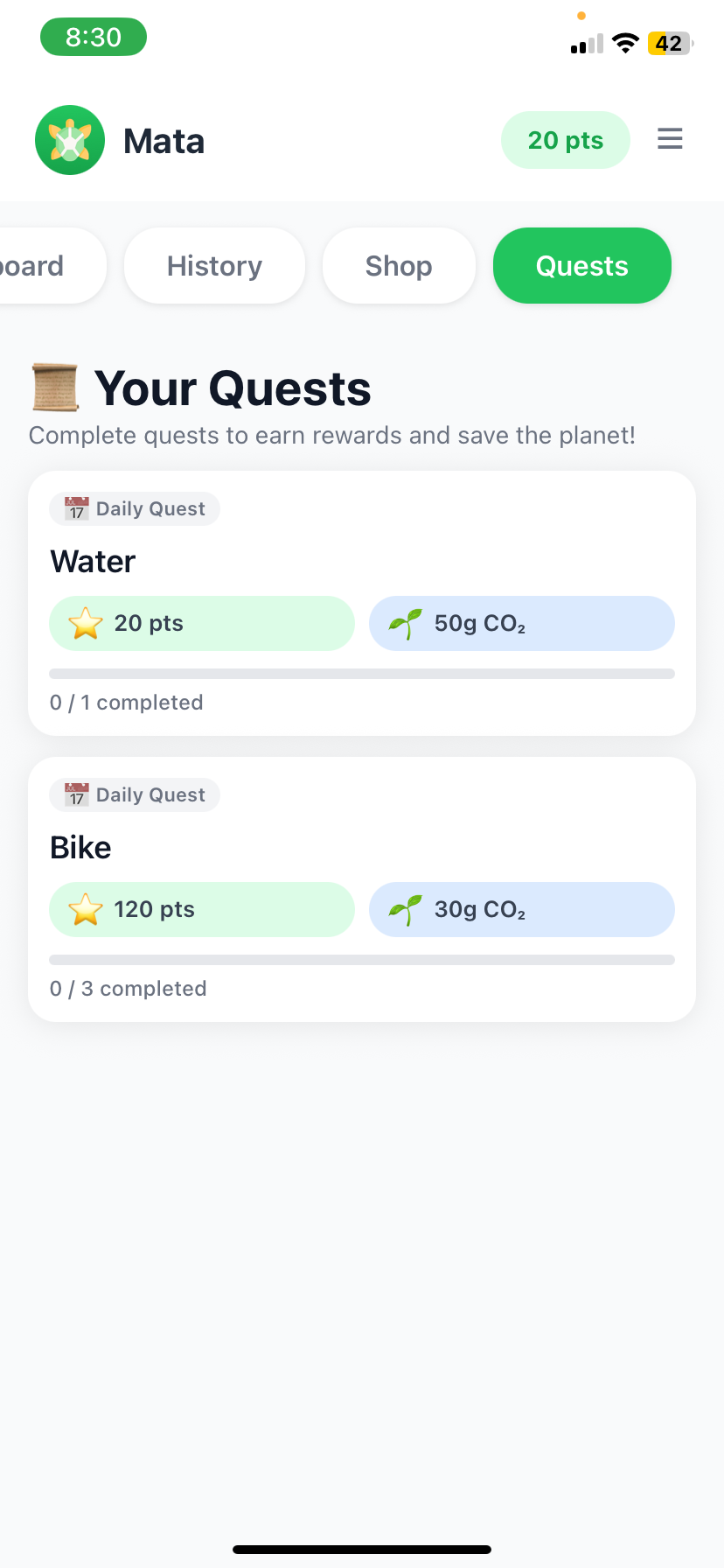
Daily Quests

Mata - Turning Sustainability Into a Game
The Inspiration
The idea for Mata came from a simple observation: people want to help the environment, but intentions rarely translate into action. The issue isn't a lack of concern. Instead, it's that sustainable choices often feel effortful and don't provide immediate, tangible feedback
What if every small action from refilling a water bottle to sorting recycling gave you instant gratification? That's where Mata was born: at the intersection of gamification, AI, and environmental impact.
The name "Mata" comes from the Sanskrit word for "mother," a reminder that these small actions are love letters to Mother Earth.
What We Learned
1. AI IS Probabilistic
We learned that GPT-4 Vision is incredibly powerful but requires careful prompt engineering. Our first attempts at verification were too lenient (giving points for random photos) or too strict (rejecting legitimate actions). We iterated on our prompt design until we reached the sweet spot between automation and accuracy.
2. Mobile Development ≠ Web Development
React Native taught us that mobile users expect:
- Instant feedback (we added skeleton loaders and optimistic updates)
- Offline resilience (AsyncStorage for auth tokens)
- Native feel (Expo Camera instead of web-based alternatives)
3. Firebase Is Versatile
We leveraged Firebase for:
- Authentication (passwordless future with email magic links)
- Firestore (real-time leaderboard updates)
- Future-proofing (ready for Storage and Cloud Functions)
4. CO₂ Math Is Harder Than It Looks
Calculating environmental impact required research into Life Cycle Assessments (LCAs). For example:
- Reusable bottle: Saves ~75g CO₂ per use vs. single-use plastic
- Bike commute: Saves ~120g CO₂ per km vs. driving
- Recycling: Saves ~50g CO₂ per item (aluminum/plastic mix)
We converted these to relatable metrics: "That's like not driving 0.4km in a car!"
$$\text{km}_{\text{saved}} = \frac{\text{CO}_2\text{ grams}}{195 \text{ g/km}}$$
(Average car emissions: 195g CO₂/km)
How We Built It
Step-by-Step Build Process
Phase 1: Foundation
- Set up Expo with TypeScript
- Implemented navigation (stack + bottom tabs)
- Designed green-first UI theme with gradients
- Firebase project initialization
Phase 2: Authentication
- Firebase Auth integration
- Login/signup forms with validation
- AsyncStorage for persistent sessions
- Error handling for duplicate emails
Phase 3: Camera & AI
This was the hardest part. Initial challenges:
Image size limits: Phone photos were 5-10MB. Solution: Compressed to base64 with quality reduction
API latency: GPT-4 Vision took 3-5 seconds. S Solution: Added loading animations and optimistic UI
Prompt engineering: Balancing false positives/negatives. Solution: Iterative testing with 50+ sample images
// Our final prompt structure
const prompt = `You are an environmental expert. Analyze images and determine if they show eco-friendly actions. Valid eco-actions: reusable bottles/cups, recycling, composting, biking, public transport, reusable bags, solar panels, planting trees, general proper disposal of trash in bins.

Estimate the CO2 savings in grams based on what you see:
- Reusable bottle/cup: 20-100g (vs single-use plastic)
- Recycling items: 50-200g depending on amount
- Biking: 100-500g depending on distance (avg car emits 200g CO2/km)
- Composting: 50-300g depending on amount
- Public transport: 150-400g vs driving
- Reusable bags: 10-50g vs plastic bags
- Proper trash disposal: 10-50g (prevents littering/pollution)
- Other eco-actions: estimate reasonably


Respond ONLY with valid JSON in this exact format:

{
"isEcoFriendly": true,
"actionType": "bottle",
"confidence": 85,
"reasoning": "Shows a reusable water bottle being refilled",
"estimatedCO2Saved": 75,
"impactDescription": "Equal to 0.4km not driven by car"
}
actionType must be one of: "bottle", "recycle", "bike", "compost", "trash", "other"
estimatedCO2Saved should be a realistic number in grams based on the visible action`
}`;
Phase 4: Gamification
- Points system for different action types
- Quest system to encourage spontaneous actions
- Marketplace for redeeming rewards with points
- Animated reward popup (confetti coming next!)
- Leaderboard with real-time Firestore queries
- History timeline with photo previews
Phase 5: Data Persistence
- Firestore schema design
- Optimistic updates for better UX
- Leaderboard caching to reduce reads
- Error recovery for failed uploads
Challenges We Faced
1. The "Black Box" Problem
Challenge: GPT-4 Vision sometimes misidentified actions (e.g., calling a green thermos "recycling").
Solution: Added a confidence threshold system:
if (confidence >= 60) {
  // Auto-approve
} else if (confidence >= 40) {
  // Ask user: "Did you mean [action]?"
} else {
  // Reject with reasoning
}
2. Cost Optimization
Challenge: At $0.001/verification, 10,000 users submitting 5 actions/day = $50/day.
Solution:
- Switched from
gpt-4-vision-previewtogpt-4o-mini(80% cost reduction) - Future: Add local on-device ML model for common actions (bottles, bags)
3. The Cold Start Problem
Challenge: Empty leaderboard isn't motivating.
Solution: Working on implementing achievement badges and seeded test users during demo phase.
4. Image Storage Costs
Challenge: Storing base64 images in Firestore hits document size limits (1MB).
Current: Images stored as data URIs locally
Future: Firebase Storage with CDN for $0.026/GB
What's Next?
Mata is just getting started. Our roadmap includes:
- Social Layer: Challenge friends, share achievements to Instagram Stories
- Corporate Partnerships: White-label for companies' sustainability programs
- Smart Predictions/Notifications: "You usually bike on Mondays—ready to earn 50 points?"
- Further Integrations: Connection to fitness trackers for more accurate tracking.
Why This Matters
Climate change feels overwhelming because individual actions seem insignificant. Mata reframes the narrative:
Every action counts. Every choice cascades.
If 10,000 users each saved 100g CO₂/day, that's 365 tons/year—equal to planting 16,000 trees.
By making sustainability:
- Visible (see your impact in real-time)
- Verifiable (AI ensures authenticity)
- Viral (compete with friends)
...we believe behavior change becomes inevitable.


Log in or sign up for Devpost to join the conversation.