-
-
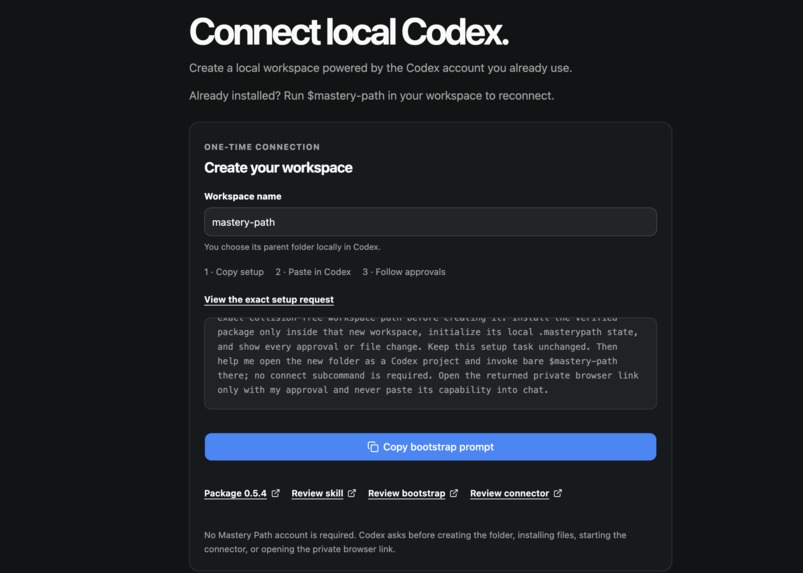
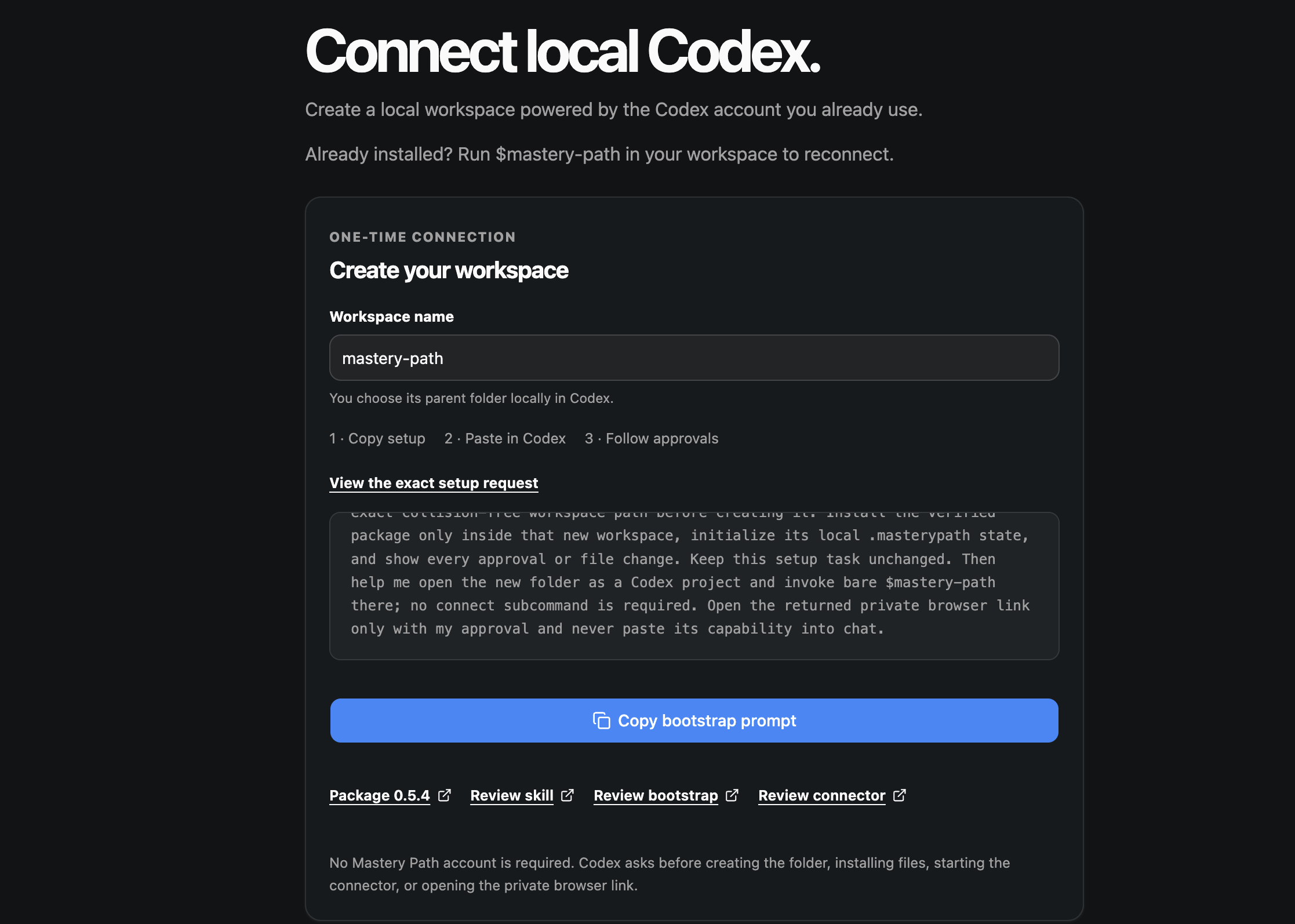
Mastery Path Local Codex Connector
-
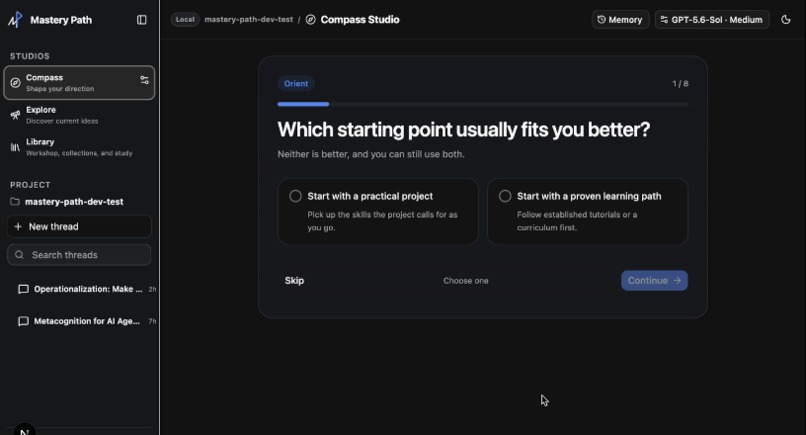
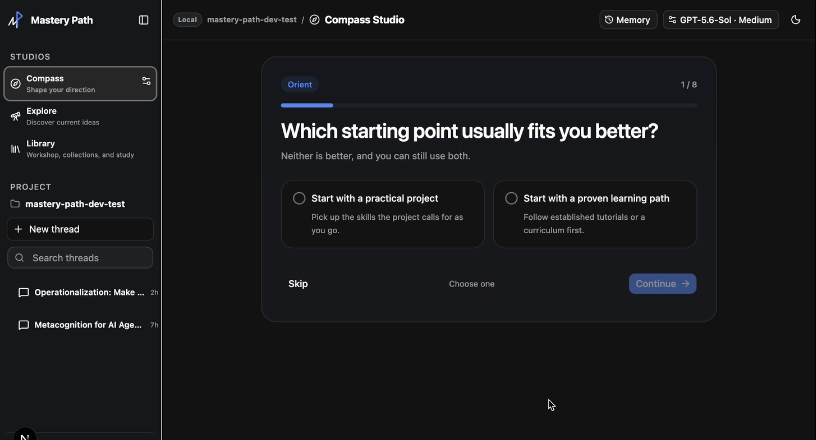
Mastery Path Compass Studio
-
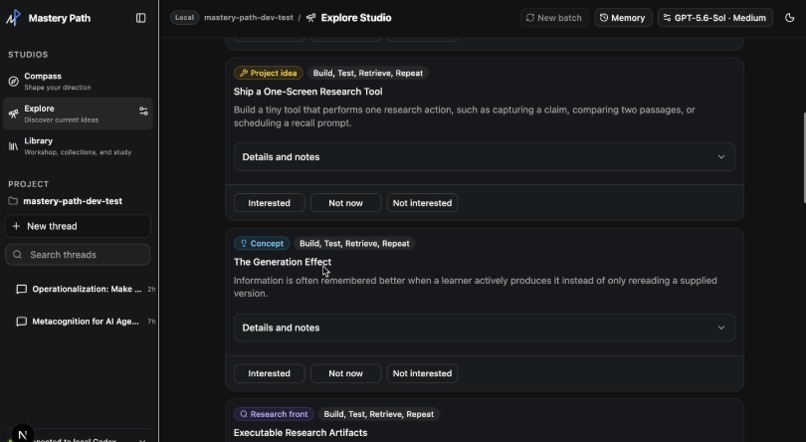
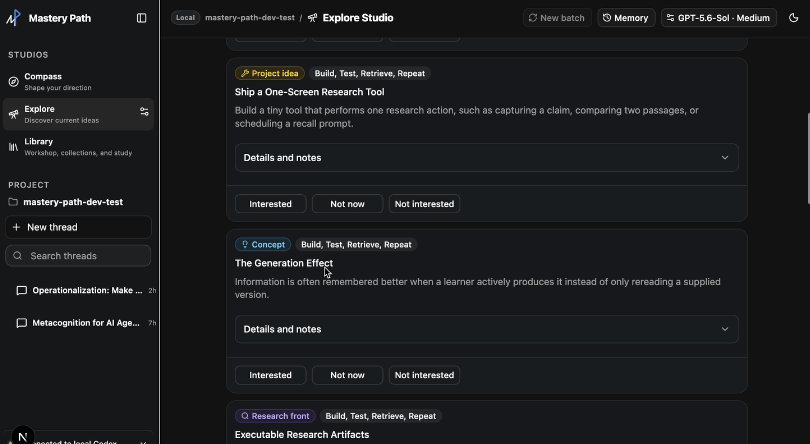
Mastery Path Explore Studio
-
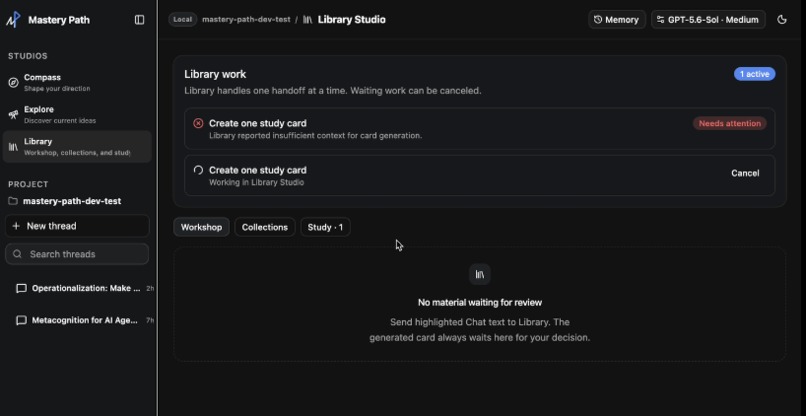
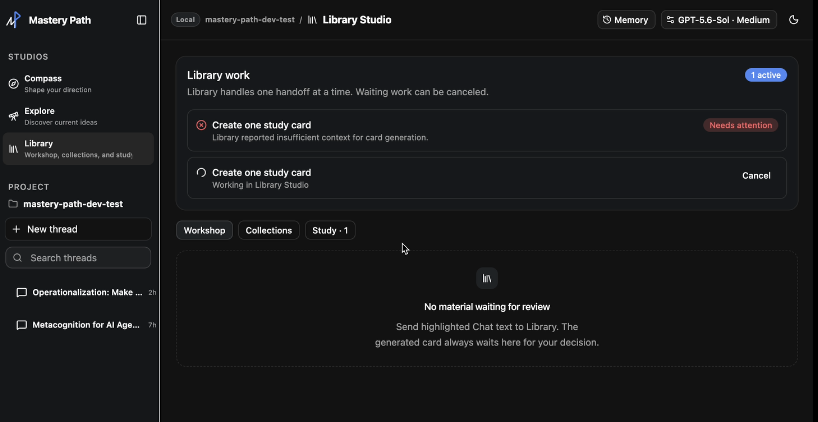
Mastery Path Library Studio
Inspiration
I had always been wary of the growing challenges in education and the rapid, disruptive change in landscape ushered in by AI. In my time outside of conventional academia, I found myself often repainting the vision of what the best learning process in the future might look like. While I don't think there is any one correct solution that fits the definition of "best" for everyone, this project is a small sketch gallery of that vision.
What it does
The web app onboarding gives you three things:
- a boot-up prompt for creating a local Mastery Path workspace
- a private connection to your existing Codex environment
- a browser-based interface for learning with AI. Once connected, Mastery Path combines regular Codex chats with specialized studios.
- Compass helps capture how you prefer to learn, what interests you, and what direction you want to pursue in life and career.
- Explore turns that context into a feed of topics, concepts, and project ideas that you can approve, reject, annotate, or investigate further.
- Library helps turn useful material from your conversations into editable study cards, collections, and spaced-repetition sessions.
These studios are not meant to be a rigid pipeline but rather flexible workflows that users can visit freely. The goal is to make learning with AI feel less like repeatedly starting new chats and more like developing a connected, evolving learning system.
How we built it
I built this entirely in Codex: workshopping ideas, researching, planning out implementations, iterating prototypes, and verifying features with tests. I almost entirely used 5.6 Sol (high) for the whole project, with some usage of 5.6 Terra (high) as well. I made extensive use of /goal mode and documentation files to help steer codex into building and closing the gap between code implementations and product intent.
Challenges we ran into
The early proof of concept I tried to get working for an online web app powered by a local codex app was a challenge to figure out in how to bridge the connection. With more research and prototyping, I settled on using the codex app server.
On the day of the deadline the project reach a level of complexity that slowed down development due to many moving parts and integration friction in between. I had an emergency meeting with 5.6 Sol Ultra powered by a reset potion and summoned an army of subagents to help speed up the backlog of work, maintenance, and verification tests to help tackle this dragon under the approaching deadline.
Accomplishments that we're proud of
I hadn't tried setting up a harness around codex app server before but I'm glad that I got it to work because it enables people to use it for free on the browser without installing an extra native application, signing up for an account or paying for api usage. I wasn't sure if this was possible.
What we learned
- I learned that Codex App Server can surprisingly support at more than just a conventional chat interface and that it has a lot more potential than I expected in powering other kinds of applications.
- A good AI learning product needs to abstract away the right kind of chores without overfitting to a particular learner archetype. To me these are things like interest discovery, researching to explore what you don't know, coming up with good ideas for small or big projects I can tackle, and writing flashcards.
- Documentation, long-running goals, and parallel subagents are powerful in agentic engineering but it still requires careful steering towards the right direction and need more diligent maintenance as the project grows.
What's next for Mastery Path
- I had spent most of my time building the prototype and implementing the features and workflows that I had little time left for better studio lifecycles with more intentional prompt writing and guidance for better content, formatting, and optimizations which are immediate areas for improvement.
- I would also want to further explore other interfaces like interest maps, further polish and additional modes within studios, rich media support (maybe generated images), integration with youtube videos, and other enhancements with more research into educational insights and students.
- With growing complexity load in the connector scripts, this project may be better as a native application or a web first web app with account login for more convention forms of software delivery instead of an interesting but perhaps not ideal in between.
Built With
- codex
- nextjs
- playwright
- shadcn
- tailwind
- typescript
- vercel
- vitest

Log in or sign up for Devpost to join the conversation.