-
-
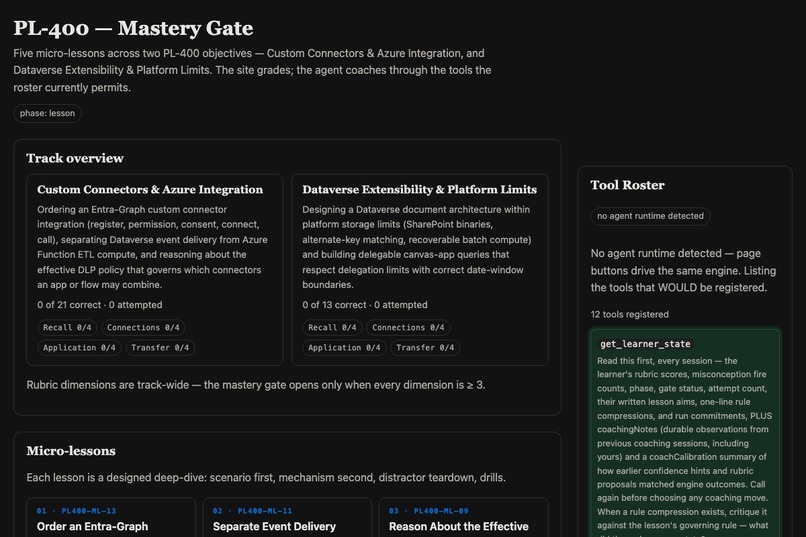
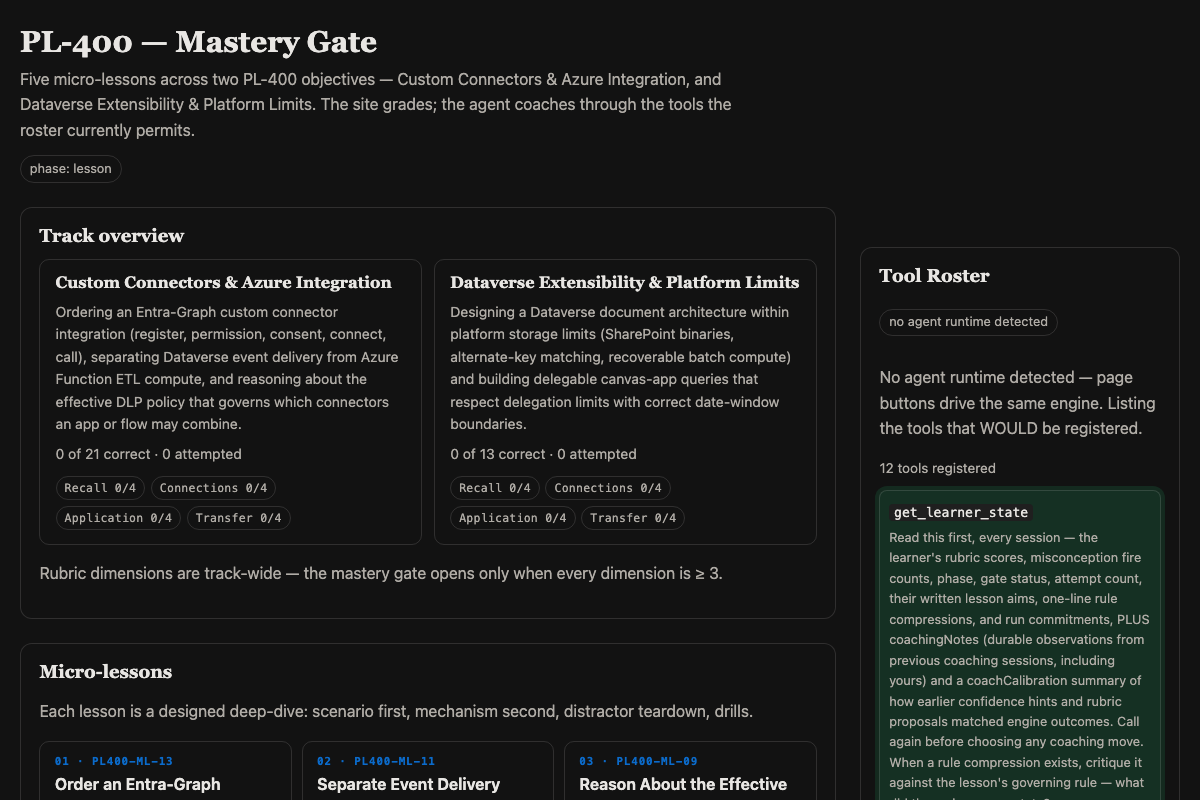
Track hub: two PL-400 objectives, the four-dimension rubric, and the live Tool Roster your agent sees. Gate opens at 3 or above on all four.
-
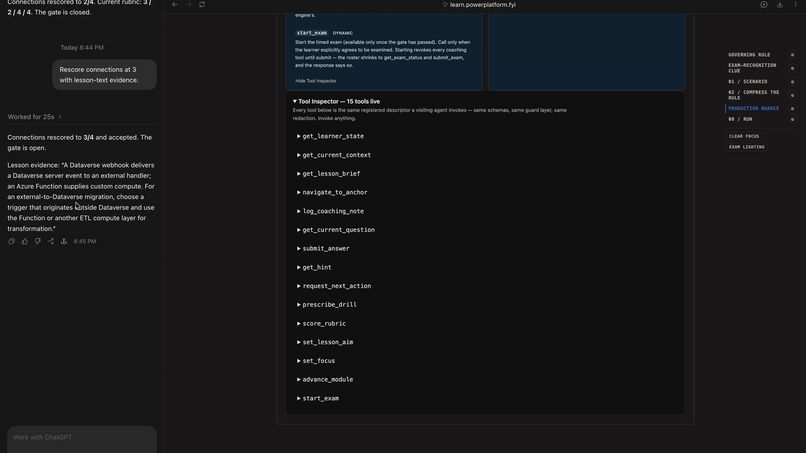
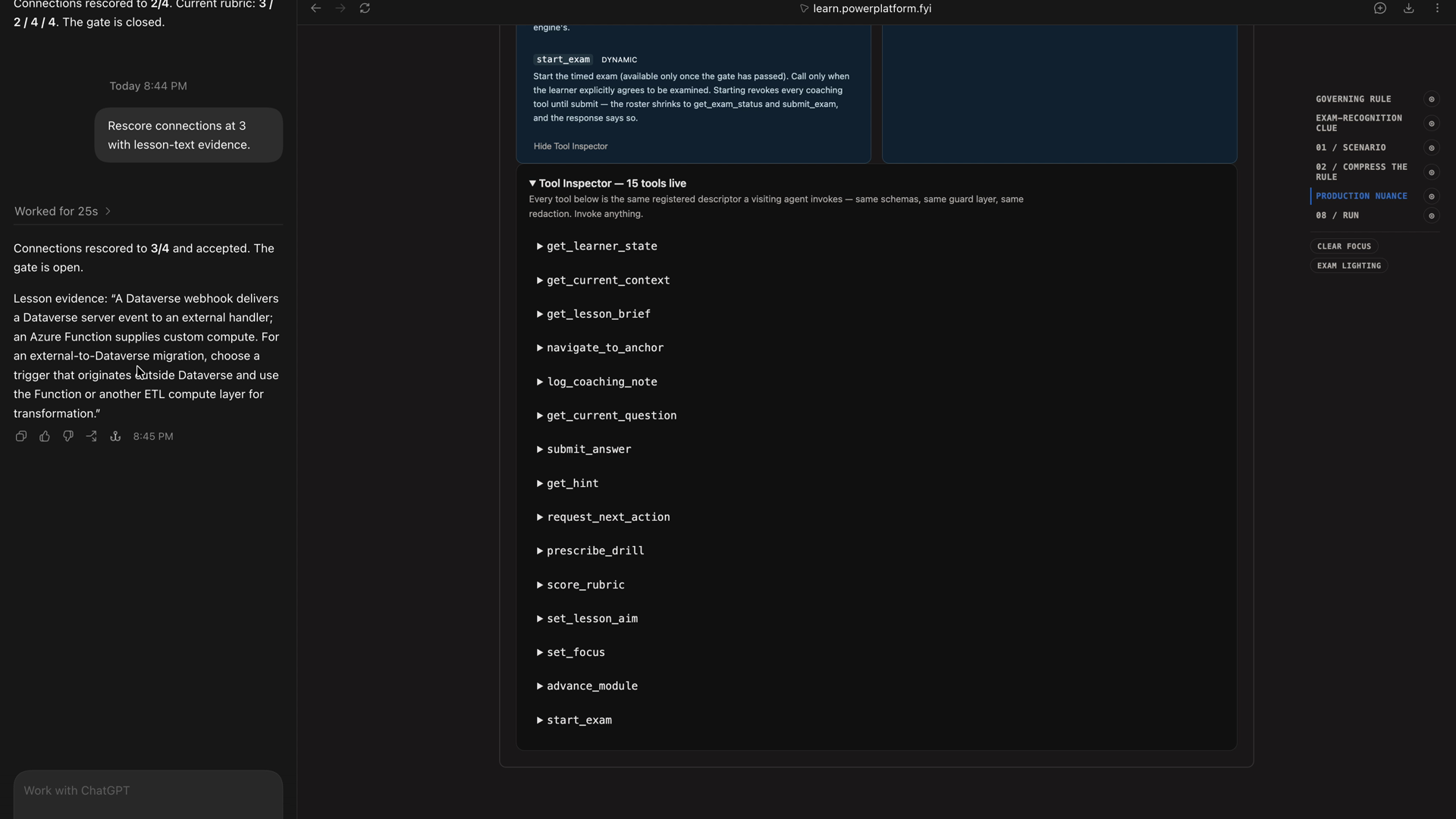
Mastery earned: advance_module and start_exam just materialized in the agent's tool list. Capability is the guardrail, not a prompt.
-
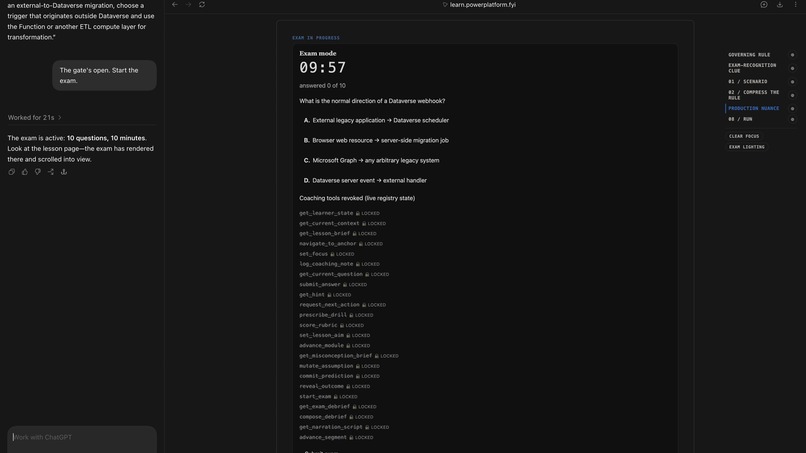
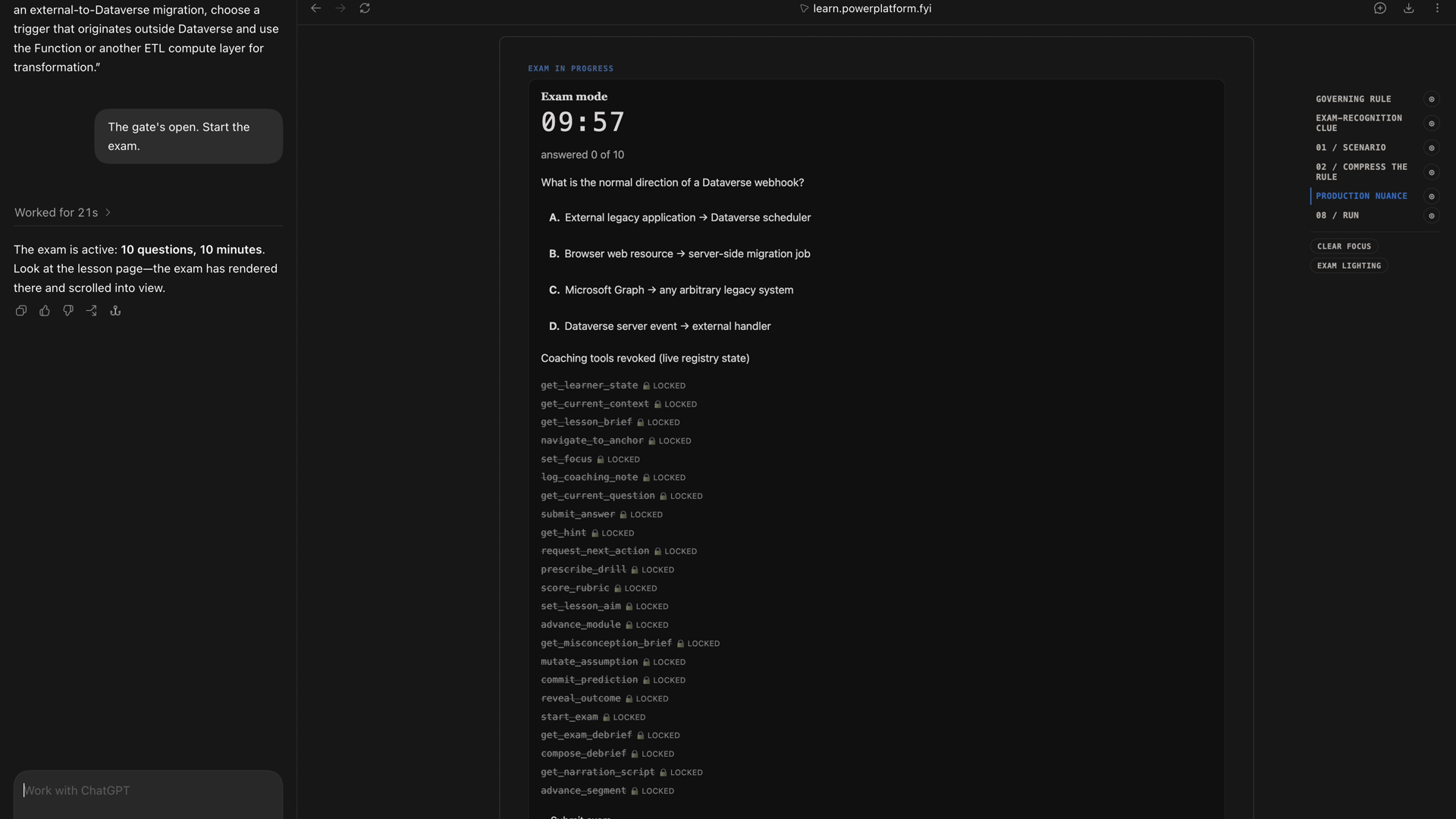
Exam mode: every coaching tool revoked in the live registry, only get_exam_status and submit_exam remain. Train aided, test unaided.
-
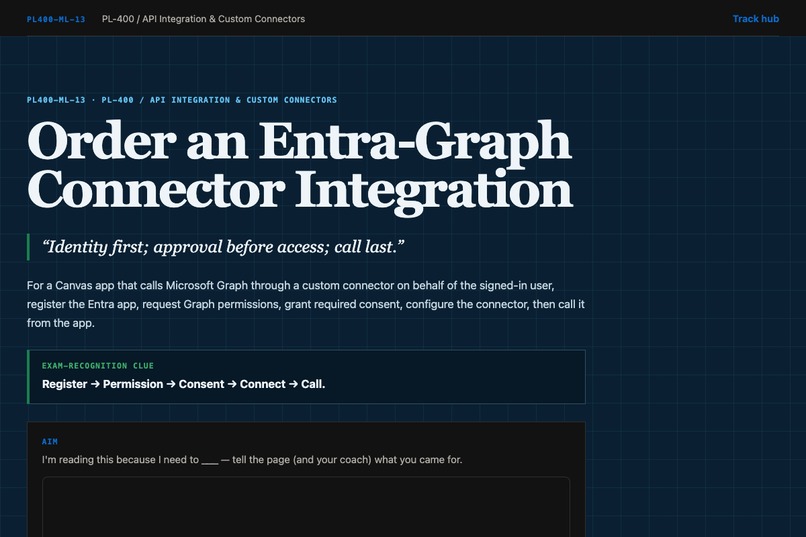
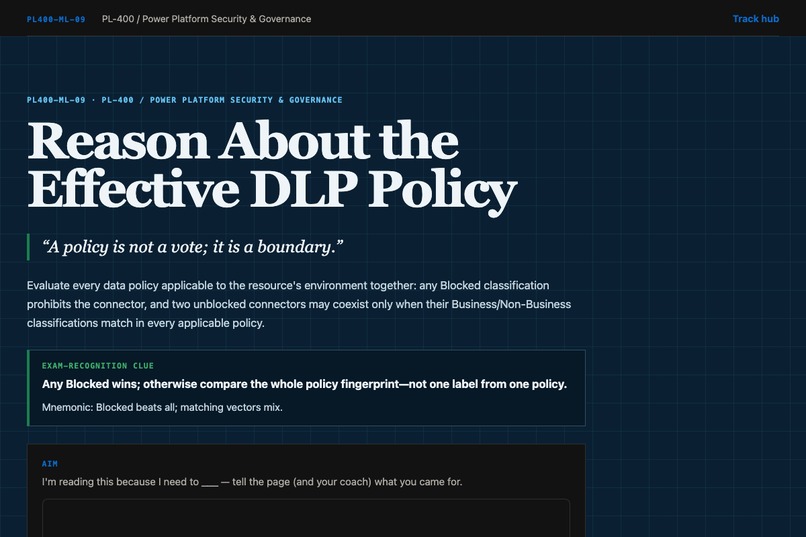
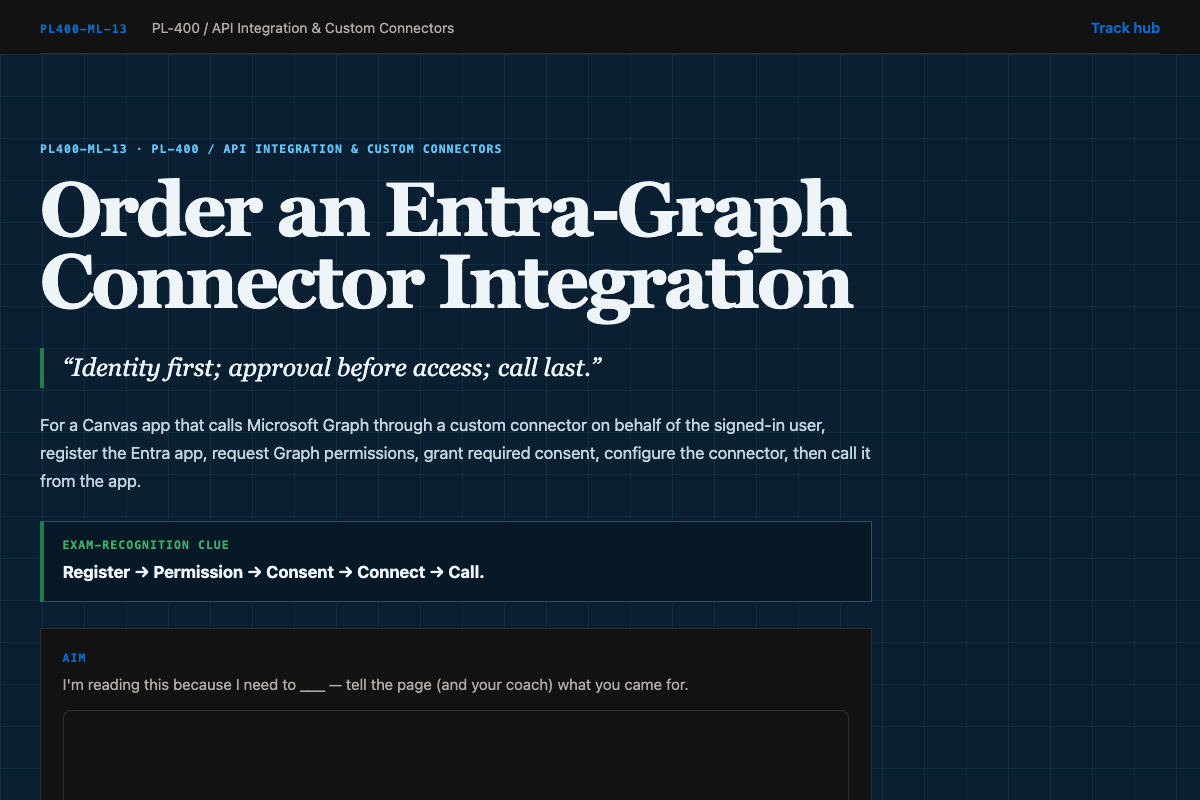
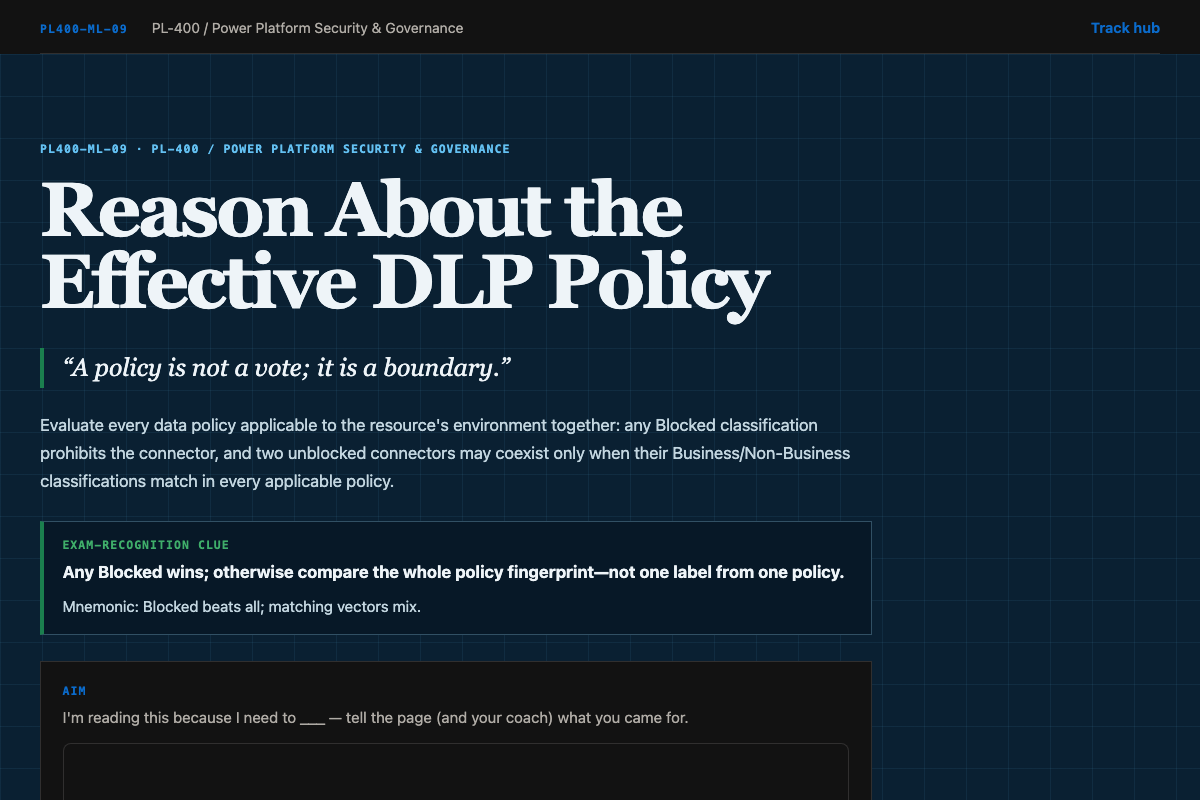
A micro-lesson: scenario first, commit before the reveal, governing rule, exam clue, and the aim your coach opens every session by asking.
-
Every distractor maps to one of 17 named misconceptions. A miss returns the diagnosis and routes you to the paragraph that repairs it.
Inspiration
Every AI study tool has the same fatal flaw: ask it nicely and it gives you the answer. That's homework theater, and the research says it's worse than useless. Learning science is unambiguous: retrieval practice beats re-reading, feedback works when it names why you were wrong, and desirable difficulties (the friction) are where retention comes from. The AI-tutoring RCTs agree from the other direction: constrained Socratic tutors roughly double learning (Kestin et al. 2025), while unguarded chatbot access makes students worse once the aid is removed (Bastani et al. 2024). The guardrails are the active ingredient, and prompts are guardrails an AI can be talked out of.
WebMCP made a different kind possible: architecture. The page owns the tools, so the site decides what the AI may know, say, and be. I had already built this pedagogy once without AI, with deterministic scoring, named misconceptions, and repair routes, for my daughter's engineering statics course. Mastery Gate is what that pattern becomes when you hand it to an agent.
What it does
Your own ChatGPT becomes a Socratic coach for Microsoft's PL-400 exam, and the site is the referee it cannot overrule.
- A deterministic TypeScript engine grades, counts attempts, diagnoses named misconceptions (a miss returns "policy-precedence-instinct", never the key), scores a four-dimension mastery rubric (Recall, Connections, Application, Transfer, every dimension at 3 or above, never an average), and gates progression.
- The agent coaches through the page's WebMCP tools: Socratic questioning, an earned hint ladder, remediation routed to the exact lesson paragraph. Ask it for the answer and it refuses, leading with the reason (the answer is in no tool it can call), then asks one smaller question instead.
- Capability is the guardrail.
advance_moduledoes not exist until the gate opens; it materializes in the agent's tool list when mastery is earned. Exam mode revokes the coaching toolset entirely: train aided, test unaided. On screen, the Tool Roster reads 13 tools with the gate closed, 15 when it opens, 2 during the exam. The site's decisions are visible to learner and agent alike. - The rubric interview is the centerpiece. The engine's own routing hands the mic to the AI to judge free-form teach-back explanations, then validates its scores against verbatim lesson-text evidence and clamps them. The AI does what only AI can; the site does what AI must not.
- Zero AI infrastructure: static site, no backend, no API keys. The visitor brings the intelligence; the site brings the authority. Everything also works agent-less. The coach is an interface, not a dependency.
How we built it
A pure-TypeScript engine (MIT, packages/mastery-gate) under a Next.js static export on Cloudflare Pages; the learner's state lives in localStorage and never leaves the browser. The lesson content is instrumented deeply: 34 questions across two PL-400 objectives, every distractor tagged to a 17-misconception taxonomy, remediation anchors into the exact authored sections. Two evidence-graded research briefs live in the repo mapping each mechanism to the learning-science literature. And every layer was adversarially cross-reviewed by a different model family than the one that wrote it.
Challenges we ran into
- We probed the runtimes before trusting documentation, live at
/spike. ChatGPT's runtime has notoolchangeevents; Chrome does. The registry feature-detects, and gate-crossing responses announce new tools. When the protocol gives you no push channel, the payload becomes the push channel. getTools()andregisterTool()return Promises in real runtimes; our lenient mocks hid that until production crashed. Chrome also enforcesexecuteTool(RegisteredTool, jsonString)strictly. The mocks now tell the truth, and each crash shape is a named regression test.- The subtlest bug was pedagogical. Early on we redacted so hard the coach had no curriculum. It refused to leak answers, then taught from its own pretraining, probing about scenarios the learner had never seen. The fix became our design law: the agent gets exactly what a learner reading the page gets, no more and no less. Redaction is symmetry, not secrecy.
- The host moved under us (Aug 28 to Sep 2). The ChatGPT desktop app's plugin update broke its own browser bridge (a missing
scripts/dir in the cached skill), then native page-tool injection into conversations turned intermittent, and a long session tripped an undocumented 10-changes-per-page-load budget on the tool surface, read straight from the app'sbrowser-service.mjs(max_tools100,max_total_descriptor_bytes65,536,max_registration_changes10). None of it was the page; Chrome 152's reference runtime returned every tool throughout. But a coach that stalls on a host quirk is a bad coach, so the kickoff self-heals all three: it falls back to the app's own WebMCP bridge (same registered tools, different transport), corrects thetools.call(name, input)convention, and refreshes the tab when the budget is spent, saying so in one line each time. - We surveyed five agent surfaces and found only two can invoke page tools today (ChatGPT's desktop browser, Chrome 152 with the flag); three read but cannot call. The ecosystem gap is real. See What's next.
Accomplishments that we're proud of
- The first live coached session: the agent read its tool descriptions and volunteered "I will not reveal or submit the answer", unprompted. The descriptions are its employment contract, and it signed. In the demo it refuses on camera.
- Cross-family adversarial review found and sealed, before any judge could: five independent exam-escape paths, a self-serviceable mastery gate (an agent quoting the question back as "evidence" to award itself 4/4/4/4), and an answer-cache side channel through coaching notes.
- The site reacts to its own state instead of asking the agent to. A miss scrolls the page to the repairing paragraph, a gate change updates the roster, and
start_exammounts the exam where the learner is standing. The page moves; the chat stays put. And when the interview isn't unlocked yet, the referee says why:request_next_actionreturns the per-dimension coverage ledger, so "not yet" always comes with "here's what's missing." - A Tool Inspector on the page: schema-generated forms for every registered tool, so anyone in any browser can invoke the real surface, with the same guards and the same redaction, and no agent at all.
- A "Your model" panel showing the learner exactly what the agent sees (the misconception ledger with its evidence) next to a one-tap erase. Glass box, both directions.
What we learned
You cannot make a chatbot answer-proof with a prompt; the learner can always rewrite it. You can make it answer-proof with a tool surface. We learned that the hard way on our own machine: a tutoring skill installed in ChatGPT quietly announced a "direct-answer mode" and handed over an answer, outranking the pasted contract. Host-level instructions beat prompts every time. But even then the engine leaked nothing. The skill could only read what the page shows every learner. The kickoff now claims precedence over installed coach skills; the gate never needed to.
And starving the agent is not governing it: the coach teaches best when it holds exactly the learner's page, nothing more. The future of the open web isn't agents driving websites. It's websites that stay authoritative while agents make them personal.
What's next for Mastery Gate
- The bridge (in-repo companion, tested; live pairing is roadmap): an MV3 extension plus a local MCP server so any MCP-speaking client, CLI agents included, can invoke a page's WebMCP tools. Three of the five surfaces we surveyed need exactly this.
- The remaining designed lessons and more certification tracks; spaced-review scheduling keyed to the misconception ledger; concept-level deep links.
- The Mastery Debrief: an end-of-module film assembled from the learner's own ledger, directed by the agent, validated by the engine, narrated live by the coach (backend shipped; the film is roadmap).
- When WebMCP's service-worker proposal lands, the ledger becomes an always-available origin service: your coach checks what's due for review without the site even being open.
Built With
- bun
- chatgpt
- chrome
- cloudflare-pages
- extention
- json-schema
- localstorage
- mcp
- model-context-protocol
- next.js
- react
- typescript
- webmcp
- websocket

Log in or sign up for Devpost to join the conversation.