🎮 ML Hyper-Trainer: Gamified Machine Learning
ML Hyper-Trainer is an interactive, visual playground that demystifies machine learning (ML) workflows and makes model training accessible to everyone—no coding required.
By gamifying the core concepts of data preprocessing, feature selection, network architecture design, and hyperparameter tuning, the application bridges the gap between complex mathematical theory and practical, intuitive learning.
🌟 Why This Project Helps People
Traditionally, learning machine learning requires a steep double-curve: understanding the underlying mathematical concepts and learning how to write complex Python code (using libraries like pandas, scikit-learn, numpy, or PyTorch). This code barrier prevents many curious learners, domain experts, and students from acquiring ML intuition.
ML Hyper-Trainer solves this problem by:
- Eliminating the Syntax Barrier: Users manipulate real datasets, configure neural network layers, and adjust training hyperparameters entirely through graphical controls (sliders, switches, dropdowns).
- Providing Immediate Visual Feedback: Instead of waiting for terminal script outputs or reading static logs, users watch live, real-time training charts update dynamically.
- Gamifying the Workflow: The app introduces a competitive, feedback-driven grading system (Grades A-F, Scores out of 100, and Star Ratings) that encourages users to experiment, fail fast, and optimize their pipelines iteratively.
- Teaching the Entire Pipeline: Machine learning is not just about training a model; it's about data preparation. The app guides users through a structured wizard covering data previewing, feature selection, scaling, architecture setup, and training.
👥 Who Is This For?
- Students & Beginners: Anyone interested in AI/ML who wants to build a solid foundational understanding of concepts like overfitting, learning rate, outliers, and regularization before writing their first line of code.
- Domain Experts (Analysts, Product Managers, Marketers): Professionals who work alongside data science teams and want to build a shared vocabulary and intuition of how machine learning works.
- Educators: Teachers and professors looking for an interactive classroom demonstration tool to explain machine learning workflows visually.
- Curious Gamers: Puzzle and strategy lovers who enjoy optimization challenges and want to "beat the dataset" by scoring 3 stars.
🚀 Core Product Features
1. The Preprocessing Wizard
Before training a model, the data must be clean. The application takes users through a structured preprocessing pipeline:
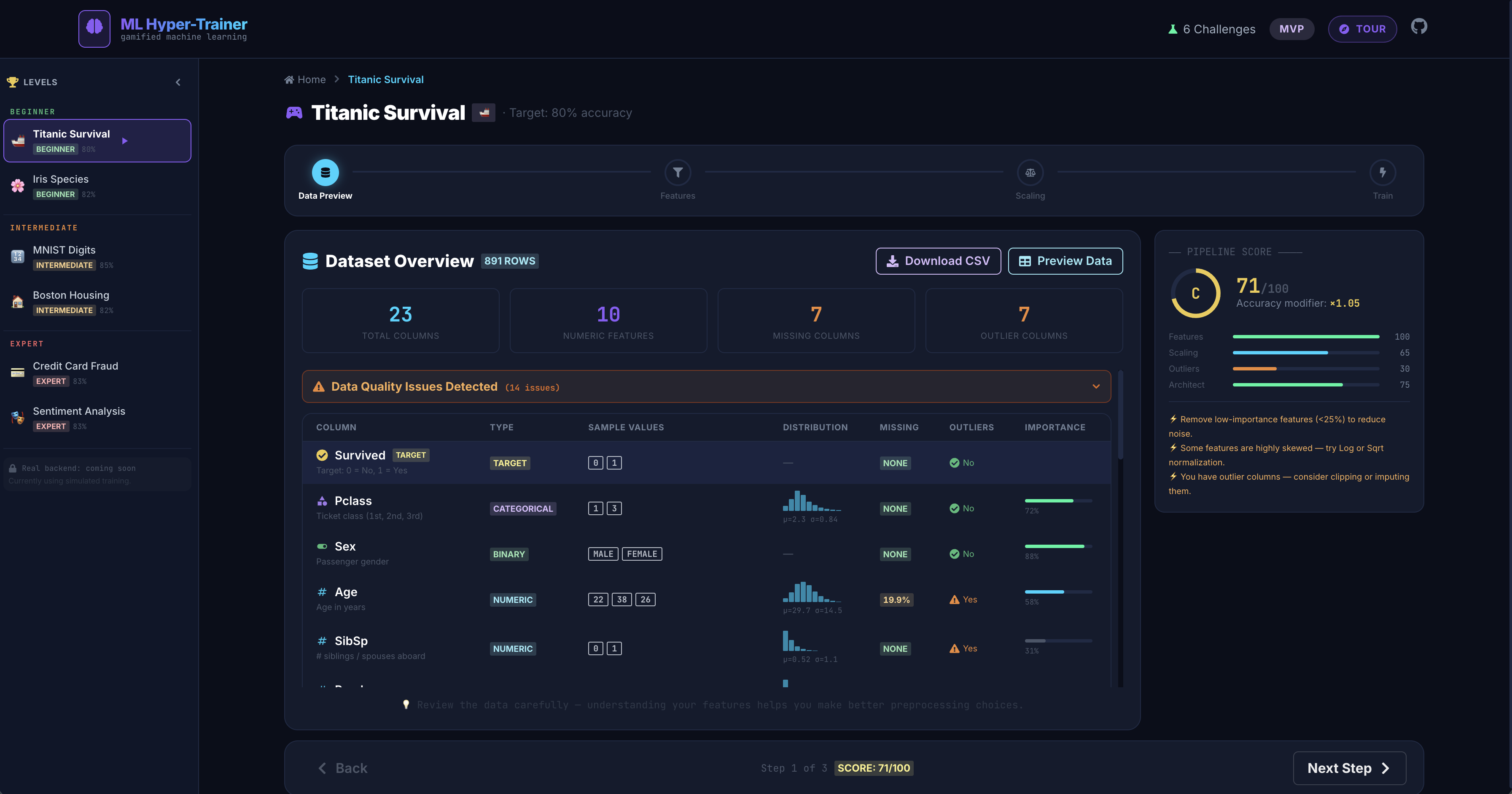
- Data Preview: Visualizes dataset shapes, missing data percentages, data types (numeric, categorical, text, target), outliers, and sample values.
- Feature Selection: Teaches the concept of feature importance. Users learn to drop noisy, irrelevant features (e.g., random noise columns) to prevent overfitting and improve training accuracy.
- Data Scaling: Highlights the importance of normalizing/standardizing features. Users toggle between MinMaxScaler, StandardScaler, or no scaling and immediately see the impact on downstream algorithms.
- Network Architecture Design: For neural network models, users can visually add, remove, and configure hidden layers and node counts to match the complexity of the task.
2. Live Pipeline Scoring & Advice
As users make choices in the Preprocessing Wizard, a Pipeline Score Widget calculates their performance in real-time. It awards a grade (A–F) and a score (out of 100), accompanied by contextual tips (e.g., "Warning: High outlier percentage detected. Consider scaling your features!").
3. Interactive Hyperparameter Panel
Users configure models using standard hyperparameters:
- Algorithm Choice: Switch between Random Forest, Neural Network, Support Vector Machine (SVM), Logistic Regression, and K-Nearest Neighbors (KNN).
- Tuning Controls: Fine-tune the model with learning rates, training epochs, batch sizes, estimators, tree depths, and L2 regularization switches.
- Simulated Real-Time Training: Click "Train" to trigger a training simulation with dynamic, flowing charts showing training vs. validation accuracy and loss curves.
4. A Gamified Challenge Loop
Each challenge is rated by a star system based on how close the model's accuracy gets to a target objective:
- 1 Star: Got the basic pipeline running.
- 2 Stars: Successfully preprocessed the data and tuned basic settings.
- 3 Stars: Optimized features, scaling, architecture, and hyperparameters to hit peak performance!
📊 Available Challenges & Datasets
The application features 6 curated challenges across 3 difficulty levels, representing real-world ML problems:
| Difficulty | Challenge | Objective | Description |
|---|---|---|---|
| Beginner | 🚢 Titanic Survival | 80% Accuracy | Predict whether a passenger survived based on age, gender, and class. Teaches basic feature selection. |
| Beginner | 🌸 Iris Species | 82% Accuracy | A classic multi-class classification task mapping iris measurements to flower species. |
| Intermediate | 🔢 MNIST Digits | 85% Accuracy | Recognize handwritten digits (0–9) using grayscale pixel regions. Ideal for neural network experimentation. |
| Intermediate | 🏠 Boston Housing | 82% R² Score | Predict median home values. Introduces regression metrics. |
| Expert | 💳 Credit Card Fraud | 83% F1-Score | Identify fraud in an extremely imbalanced dataset. Requires precise tuning to prevent false positives. |
| Expert | 🎭 Sentiment Analysis | 83% Accuracy | Classify movie reviews as positive or negative. Focuses on Natural Language Processing (NLP) challenges. |
🎨 Design & Aesthetics
The product is wrapped in a high-fidelity Neon-Vibrant Dark Mode built with Chakra UI. Modern design practices like glassmorphism, floating micro-animations, glowing interactive borders, and colorful gradients make the training experience feel like an engaging dashboard game rather than a dry programming environment.
ML Hyper-Trainer shifts the focus of machine learning education from **writing code* to building intuition, empowering the next generation of AI practitioners.*
Built With
- nextjs
- vercel

Log in or sign up for Devpost to join the conversation.