Inspiration
Mason was born out of frustration while running my digital agency, ED3N. During an intense 49-day stretch of building AI infrastructure and technical writing, features that looked flawless on paper kept breaking during implementation due to hidden logical contradictions. We were wasting days rewriting code to fix flaws that should have been caught at the whiteboard. I realized we have brilliant tools to scan code after it’s written, but nothing to audit system logic before the first line is typed. I built Mason out of pure necessity to catch architectural flaws at the blueprint stage and protect our development velocity at the source.
What it does
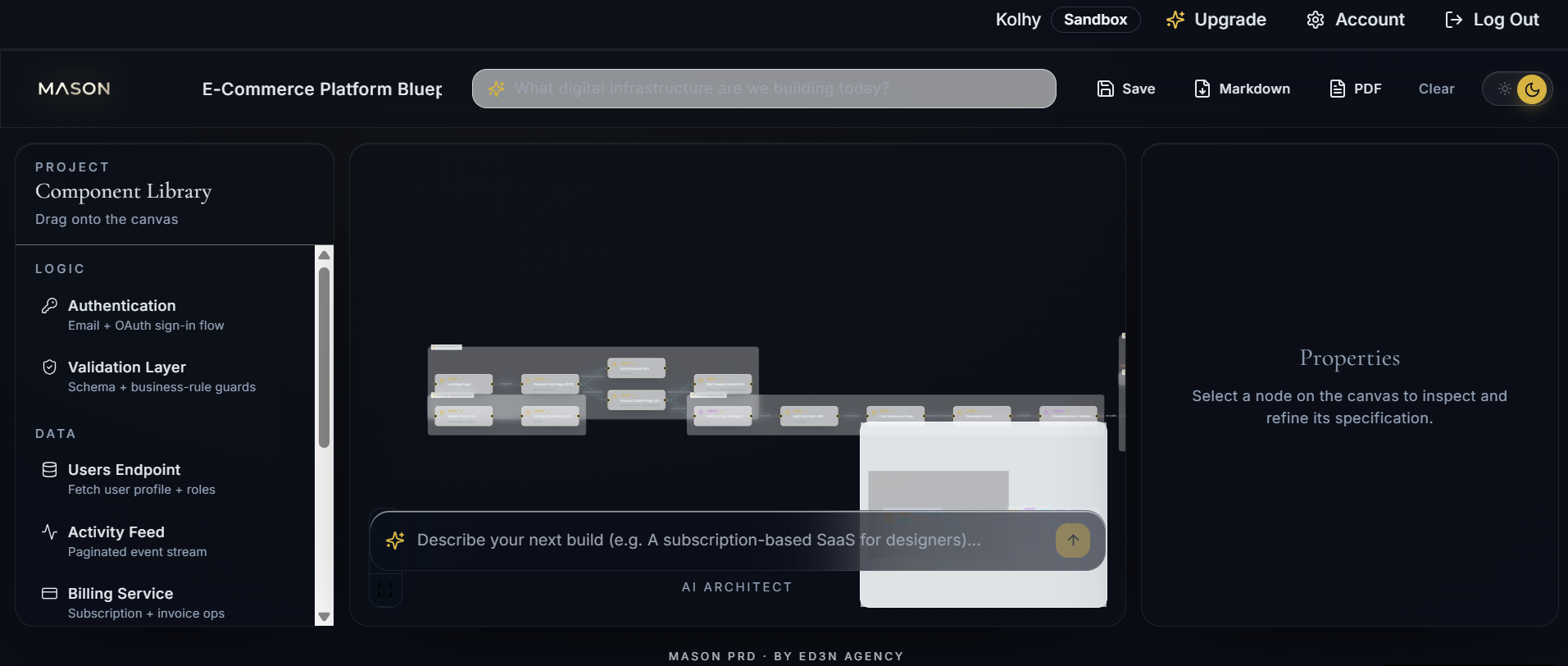
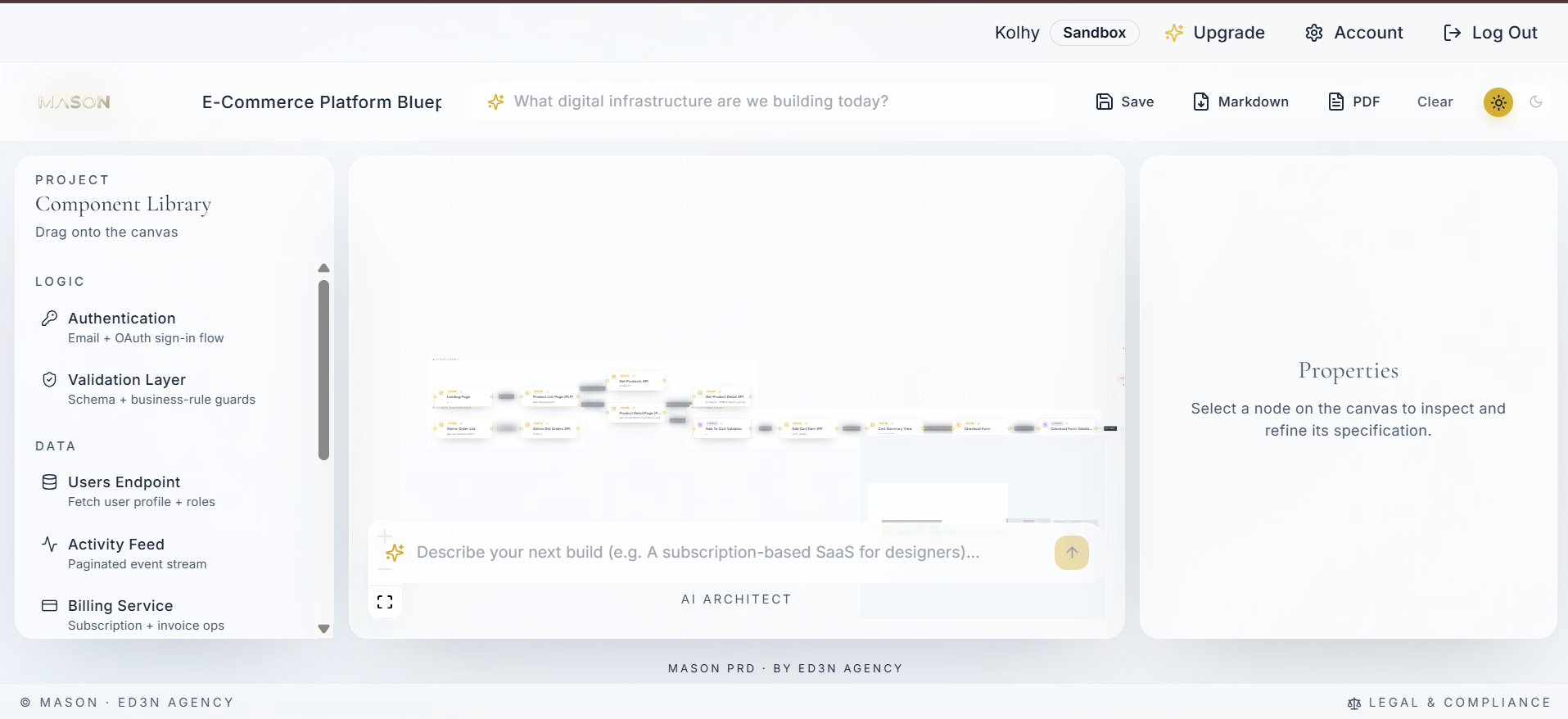
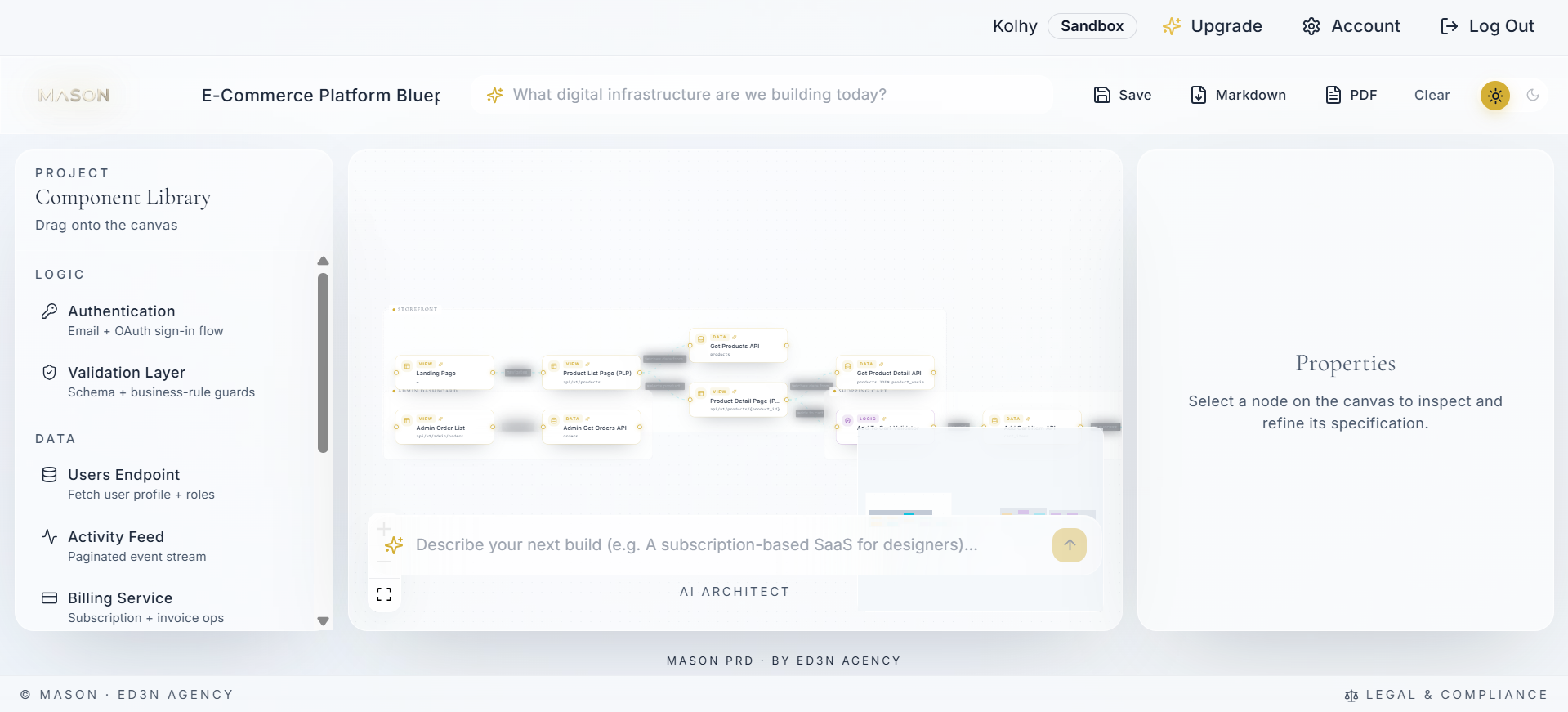
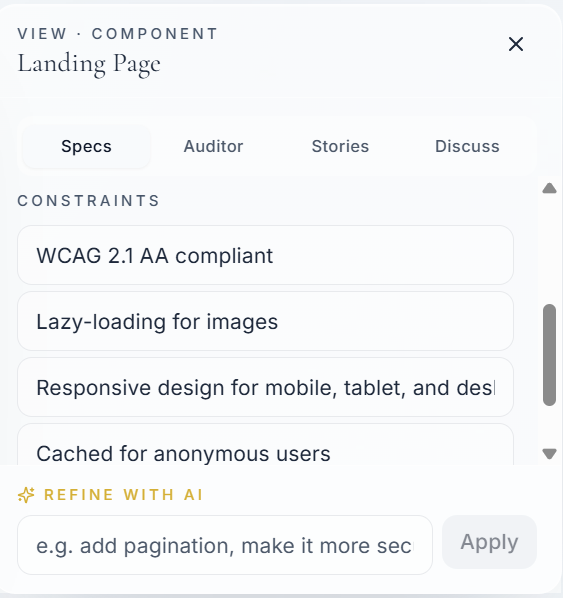
Mason is an automated systems architect that audits the structural logic of your software before you write code. You drop in your technical specifications or Markdown PRDs, and Mason's engine extracts the data flows, state changes, and functional dependencies into an absolute validation model. It instantly flags circular logic, conflicting access rules, and unhandled edge cases at the blueprint stage saving your engineering team from wasting cycles on expensive, post-launch architectural refactoring.
How we built it
We built Mason with a clean, low-latency stack engineered to move fast. The Frontend & User Experience: Designed under the ED3N Agency banner with a focus on a minimal, high-end "Quiet Luxury" aesthetic. The interface is clean and entirely focused on developer utility. The Ingestion & Graph Engine: We built a custom parser that reads structured Markdown PRDs and technical specs, extracting user actions and data boundaries. It maps these requirements into a directed Abstract Syntax Graph to mathematically track every potential state transition. The Global Infrastructure: To ensure frictionless, global access for teams looking to scale, we engineered the subscription backend to handle agile billing flows, integrating flexible payment networks like Flutterwave alongside decentralized Web3 crypto gateways.
Challenges we ran into
Building Mason forced us to confront two massive technical walls: The Ambiguity of Human Language: Product managers and engineers write requirements using highly inconsistent nomenclature and unstated assumptions. Translating loose, contextual human prose (like "the wallet locks if anything goes wrong") into a rigid, deterministic mathematical state without losing the original business intent required intense refinement of our semantic parsing rules. The State-Space Explosion: As a system blueprint grows in complexity, the matrix of potential state transitions expands exponentially. Running exhaustive constraint evaluations across intricate multi-user corporate workflows began to drag down performance. We had to spend sleepless nights optimizing our graph traversal algorithms and implementing aggressive path-pruning matrices to ensure the engine remained fast and lightweight.
Accomplishments that we're proud of
Zero-Hallucination Logic Auditing: We successfully moved past superficial AI keyword-matching. We engineered a translation layer that actually maps messy, conversational human requirements into rigid mathematical models guaranteeing 100% deterministic flaw detection with zero AI hallucinations. Taming the State-Explosion Bottleneck: We optimized our graph traversal algorithms to prune dead execution paths instantly. The engine can now stress-test thousands of potential system state transitions in seconds without crashing or lagging the workspace. True Frictionless Global Infrastructure: We successfully built a unified billing pipeline under the ED3N Agency infrastructure that supports traditional card networks via Flutterwave alongside borderless Web3 crypto payments. This makes Mason instantly deployable and billable for any engineering team globally, completely bypassing restrictive payment boundaries.
What we learned
Software Quality is an Architectural Challenge, Not a Syntax Problem: Building Mason reinforced that the costliest bugs don't stem from typos or broken code compilation they are baked directly into the original human logic at the whiteboard stage. Merging Fluidity with Rigor: We learned how to gracefully bridge the gap between fluid semantic language models and strict, discrete mathematics. Merging these two opposite worlds taught us how to turn ambiguous text into absolute system invariants without losing the product manager’s intent. The Absolute Value of Guarded Execution: We realized that the fastest way to ship software isn't to push code frantically and patch the bugs later; it is moving the QA boundary entirely upstream. Ensuring a blueprint is mathematically sound before a sprint starts completely alters a team's delivery velocity.
What's next for Mason: Upstream Logic Auditing for Product Teams.
We are transitioning Mason from a high-performance prototype into a fully scalable B2B SaaS asset. CI/CD & IDE Integrations: We are building native GitHub Actions and VS Code extensions. The moment a product manager pushes a new PRD or documentation update, Mason will automatically audit the logic directly inside the pull request. Predictive Mitigation Engine: Moving beyond just flagging structural deadlocks, the next iteration will actively suggest mathematical correction models, offering engineers pre-vetted architectural pathways to fix the logic loop instantly. Enterprise Infrastructure: We are hardening Mason’s compliance layers with secure role-based access control and isolated logs, preparing the platform for deployment within highly regulated, enterprise-grade engineering environments.

Log in or sign up for Devpost to join the conversation.