-
-
-
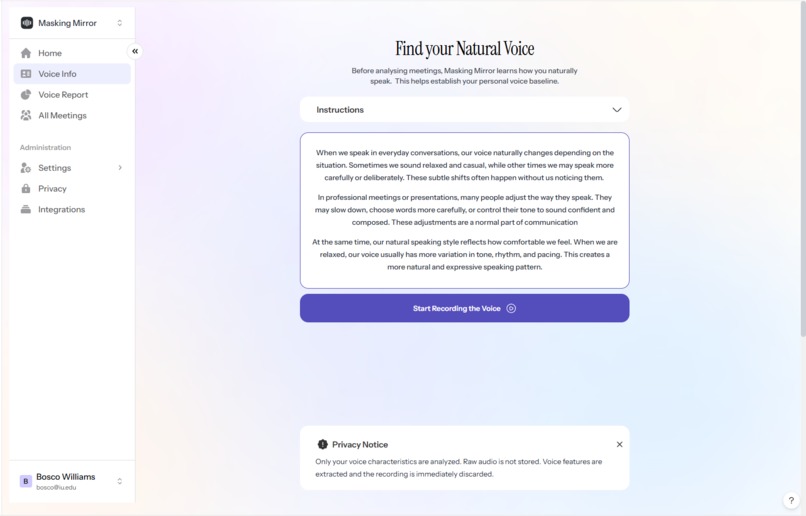
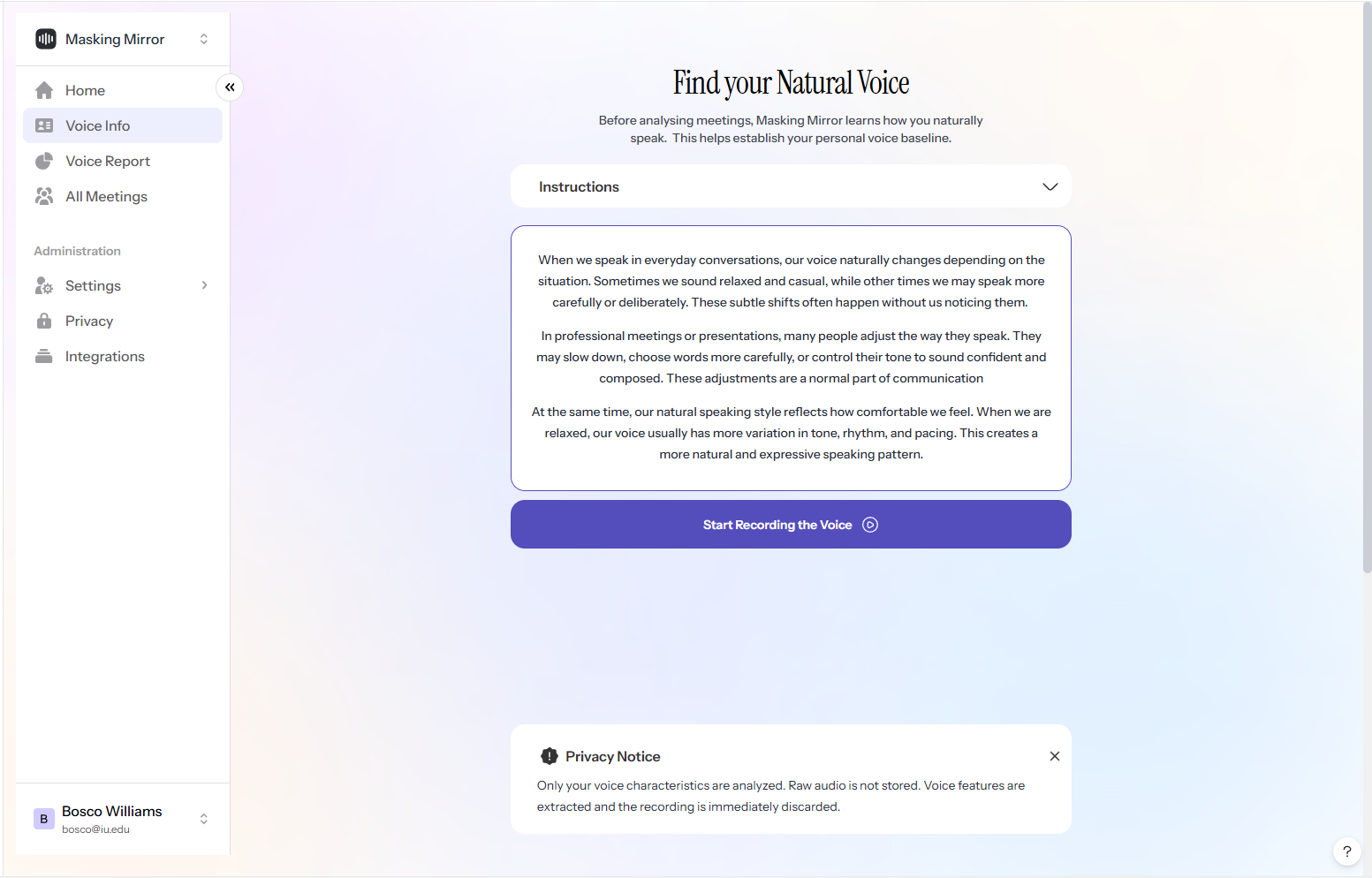
Voice Capture screen
-
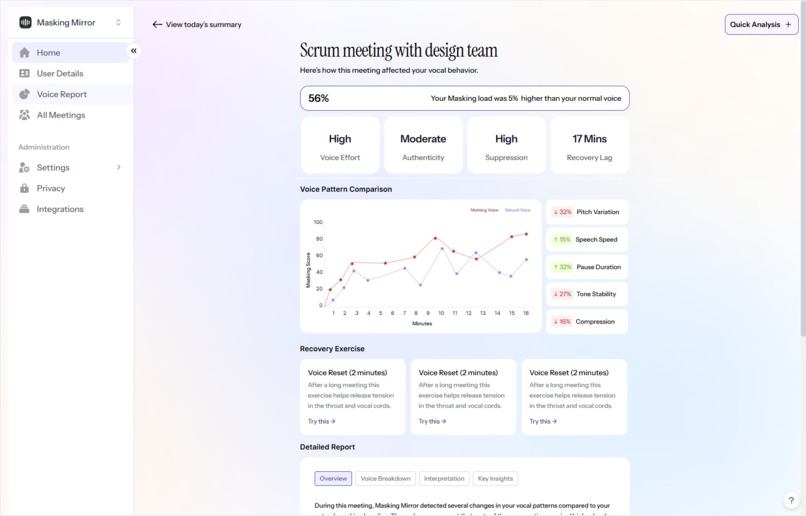
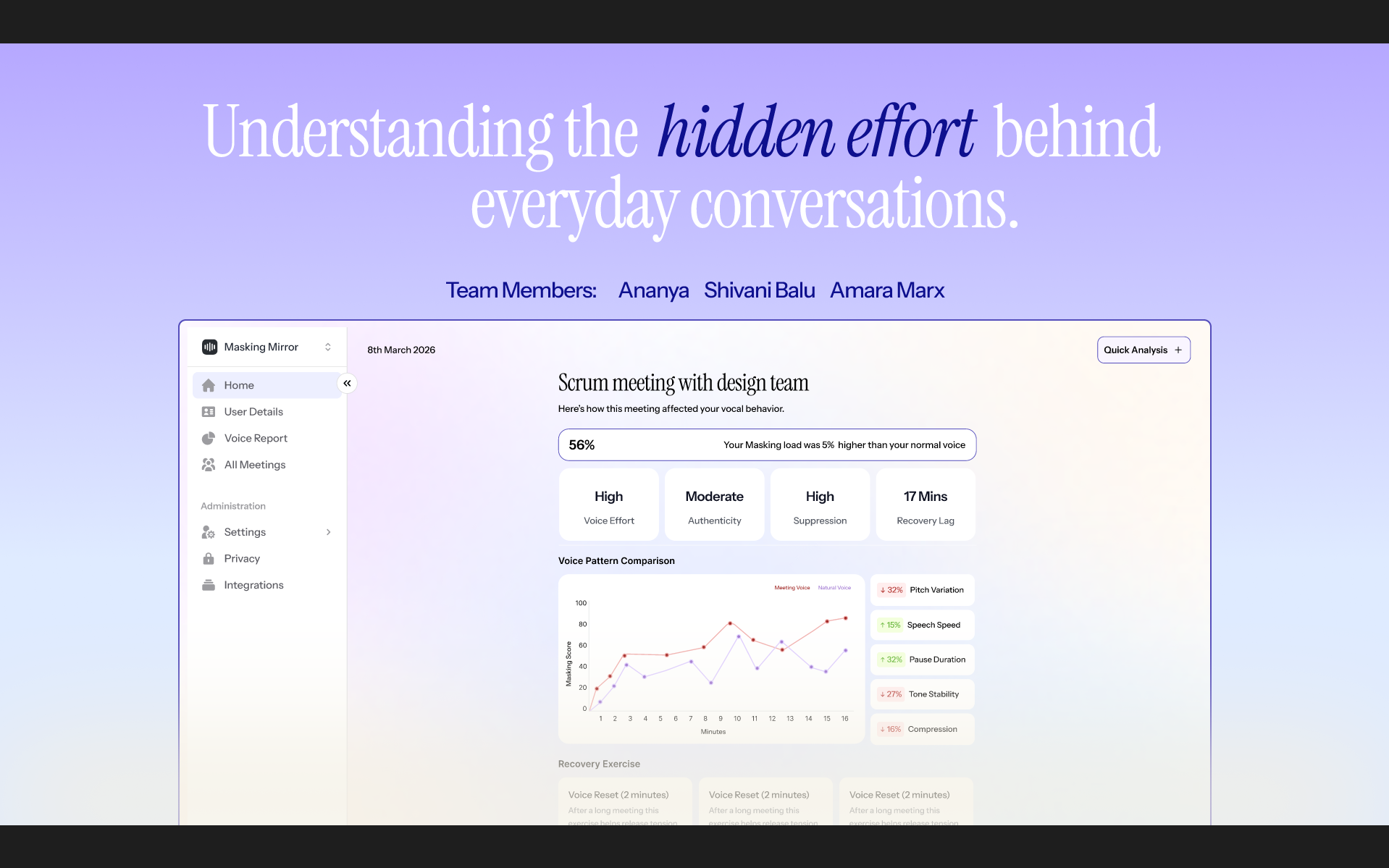
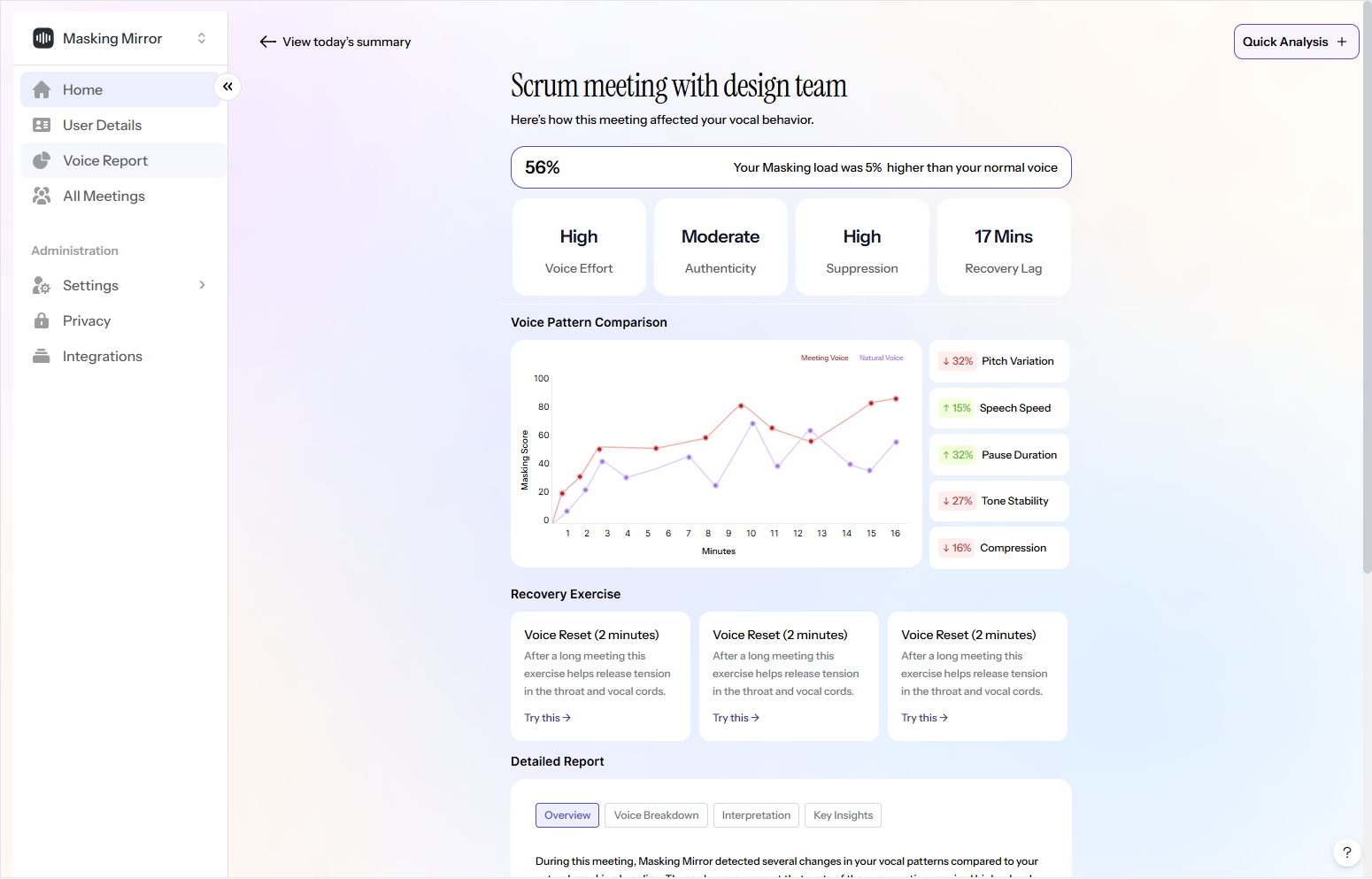
Analysis screen
-
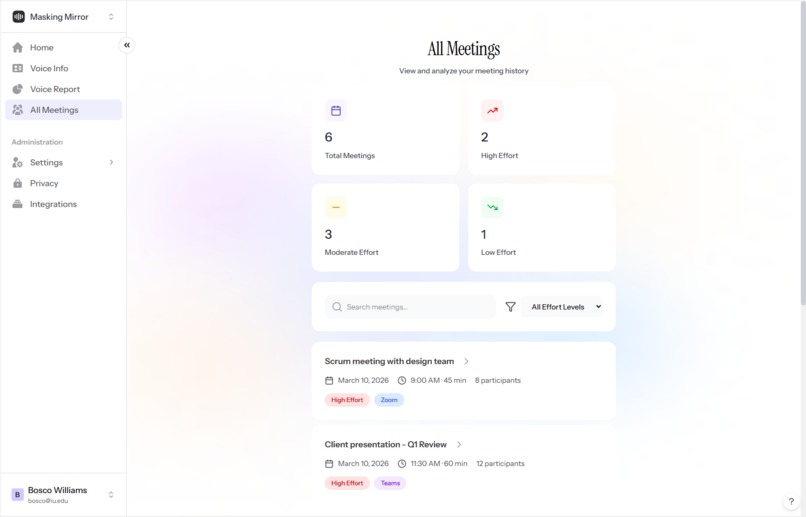
-
Masking Mirror
A real time awareness tool that helps people detect when they are masking in meetings and understand the emotional cost of social performance.
Inspiration
Many professionals experience a hidden cognitive burden during meetings. They consciously or unconsciously adjust their tone, pacing, and speaking style to match perceived expectations.
This behavior is known as masking.
Masking is especially common among neurodivergent individuals, early career professionals, and anyone navigating power dynamics in the workplace. While masking can help people adapt socially, it can also create fatigue, stress, and burnout.
The problem is that masking usually happens subconsciously. Most people cannot tell when it begins or how intense it becomes.
We wanted to build a tool that acts like a mirror for communication behavior.
Just like a physical mirror helps us see our appearance, Masking Mirror reflects our communication patterns back to us, helping users notice shifts in how they speak.
Masking Mirror was created to make the invisible cognitive load of masking visible.
The Problem
People constantly adjust their communication style in conversations.
They may:
• raise their pitch when speaking to authority figures
• speak faster when nervous
• reduce pauses to appear confident
• compress their tone to sound more controlled
These changes can happen dozens of times during a single meeting.
The challenge is that these shifts are difficult to detect while they are happening. Without awareness, users cannot recognize patterns or understand what situations cause communication stress.
Over time this hidden effort contributes to:
• meeting fatigue
• communication anxiety
• emotional exhaustion
• reduced authenticity in conversations
We realized the key problem was not communication itself. The problem was lack of visibility into our own behavioral shifts.
Our Solution
Masking Mirror is a desktop application that analyzes voice patterns during conversations and reflects communication shifts back to the user after the interaction ends.
The system first records a short baseline sample of the user's natural speaking style.
During meetings, the tool listens to the user's microphone and analyzes five key voice metrics:
• pitch variation
• speaking speed
• pause duration
• tone stability
• vocal compression
Instead of displaying real time feedback that could interrupt the conversation, Masking Mirror quietly analyzes voice patterns in the background.
After the meeting, the tool provides a simple reflective insight such as:
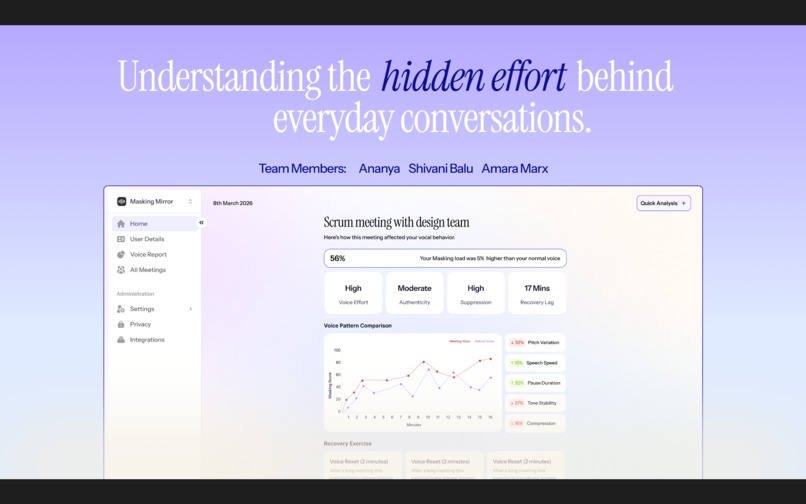
"Your masking load increased by 53% during this meeting."
The summary also highlights which vocal signals contributed most to that change and when the largest shifts occurred.
The goal is not to judge communication, but to help users reflect on it.
Who is this for
Masking Mirror is designed for people who regularly participate in conversations where communication pressure is high.
Primary users include:
• remote workers in meeting heavy roles
• early career employees navigating workplace dynamics
• students participating in virtual classes
• neurodivergent professionals
• individuals interested in improving communication self awareness
Most users are between ages 18 and 45 and participate in frequent virtual meetings or presentations.
These users often want to communicate effectively while reducing the hidden mental load of constantly adjusting their behavior.
What can they perceive now that they couldn’t before?
Masking Mirror introduces a new type of self awareness: perception of vocal masking patterns.
Humans naturally interpret vocal signals from others, but we rarely notice subtle changes in our own voice during conversations.
Masking Mirror transforms those subtle signals into understandable reflections.
Users can now perceive:
• when their pitch consistently rises above their baseline
• when their speaking speed increases under pressure
• when pauses disappear from their speech
• when their tone becomes more rigid or compressed
This effectively adds a new reflective sense for communication effort.
Instead of only realizing hours later that a meeting felt draining, users can understand which moments required the most adaptation.
Wellness Goal
Masking Mirror supports emotional, mental, and social wellbeing.
The primary behavioral goal is to help users:
• recognize when they are adapting their communication style
• identify environments that require more effort
• reflect on how different interactions affect their energy
• Avoid burnout
Over time this awareness can lead to:
• reduced meeting fatigue
• improved communication confidence
• healthier social boundaries
• greater authenticity in conversations
Masking Mirror does not attempt to eliminate masking. Instead it provides the awareness needed to understand when and why it happens.
How does the tool work in everyday life?
Masking Mirror runs quietly in the background during virtual conversations.
Before first use, the user completes a short calibration session where the system records their natural speaking patterns.
During meetings the application analyzes voice signals without displaying notifications or feedback that might interrupt the conversation.
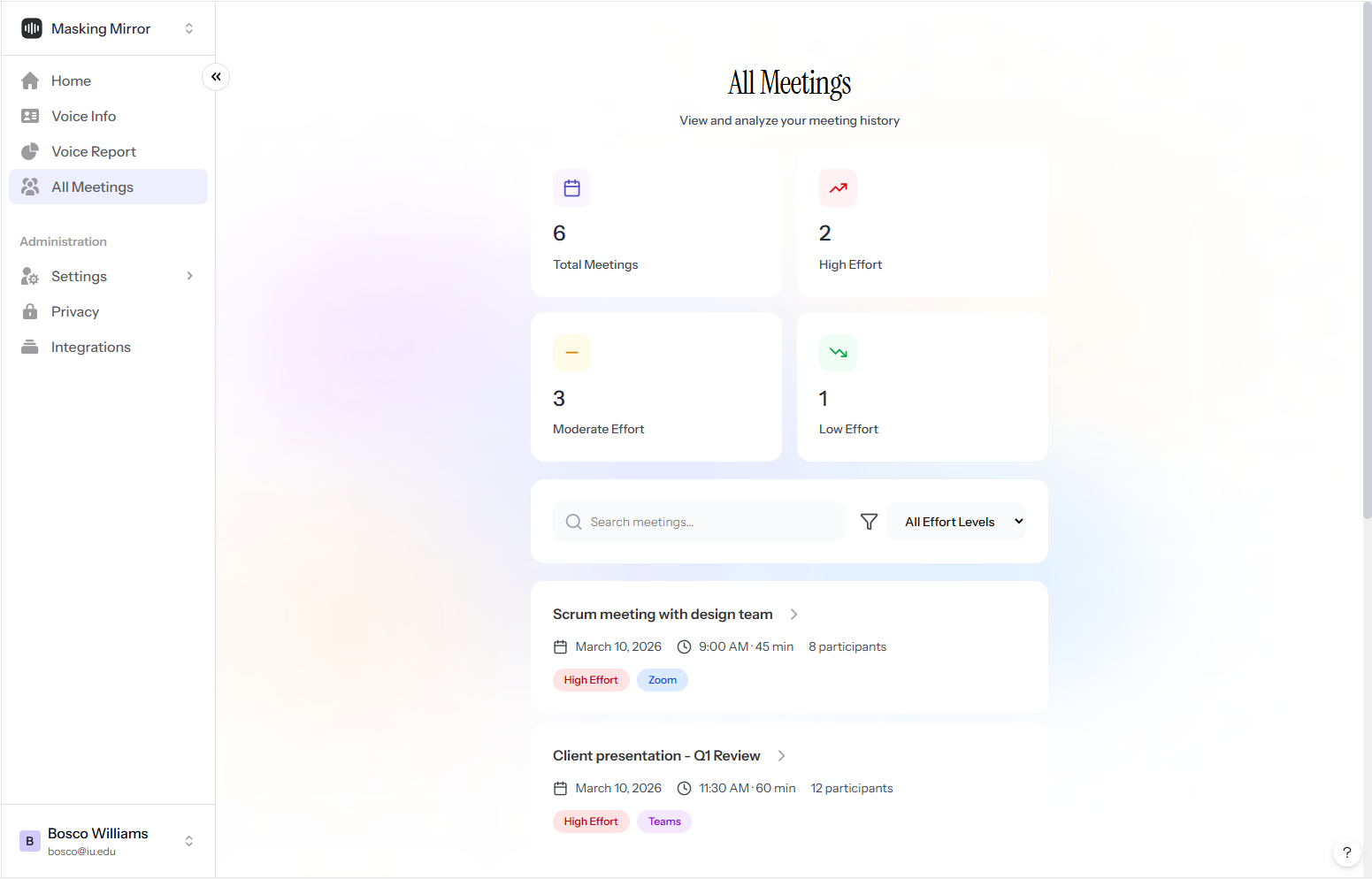
After the meeting ends, the user receives a short reflection that summarizes how their communication patterns changed.
This includes:
• overall masking load change
• key vocal signals that shifted
• moments in the meeting where communication effort increased
The experience is designed to support reflection without disrupting the meeting itself.
Real World Use Cases
Use Case 1
Presenting to leadership
A junior employee gives a presentation to senior leadership.
During the presentation their pitch increases and their speech becomes faster compared to their baseline.
After the meeting, Masking Mirror highlights that masking load increased significantly during presentation segments.
The user recognizes that presentations create communication pressure and begins practicing pacing strategies.
Use Case 2
High pressure decision meetings
A product manager participates in a strategy meeting with executives.
Masking Mirror detects that their pauses decrease and their tone becomes more compressed during difficult questions.
The post meeting reflection helps them understand which parts of the meeting required the most effort.
This awareness helps them prepare more intentionally for future discussions.
Use Case 3
Virtual classroom participation
A student participates in a remote seminar.
Masking Mirror detects more vocal shifts when the student speaks directly to the professor compared to when they speak with classmates.
The reflection reveals how different social contexts influence their communication style.
The student uses this insight to build confidence speaking in academic discussions.
Managing the New Information
Masking Mirror is designed to avoid information overload.
Instead of showing real time analytics, the system surfaces insights only after the conversation ends.
Users receive a clear summary that includes:
• the overall change in masking load
• which voice signals changed the most
• key moments where communication effort increased
This allows users to reflect on their communication patterns without being distracted during the interaction itself.
Insights are intentionally simple and supportive rather than evaluative.
Safeguards and Responsible Design
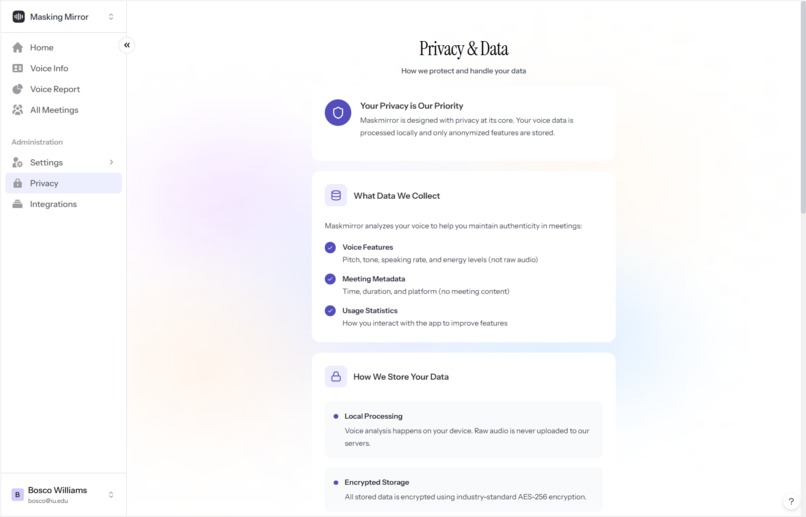
Because communication data is sensitive, Masking Mirror prioritizes privacy and responsible use.
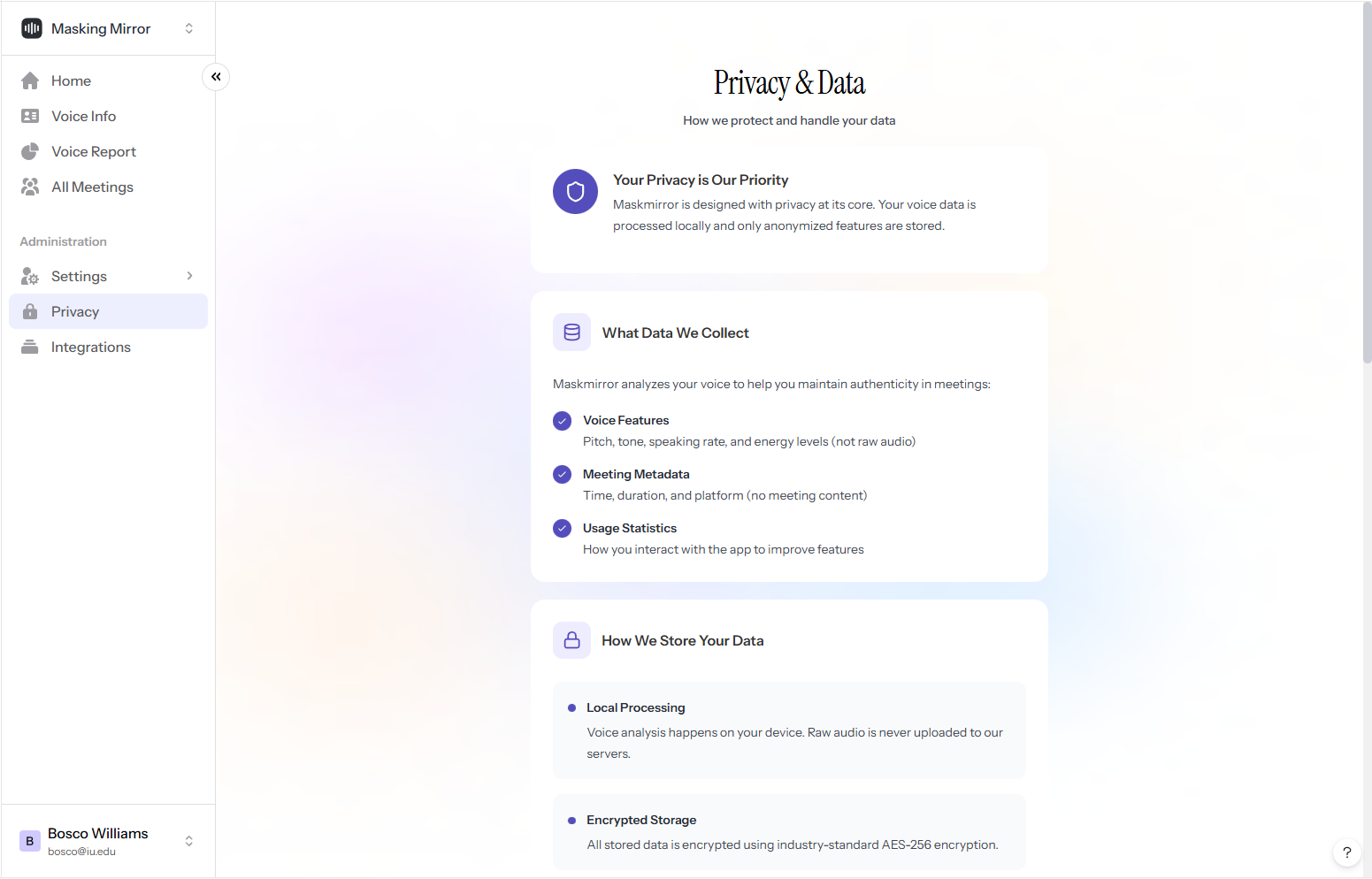
Voice Only Analysis
The system analyzes only voice metrics.
It does not process facial expressions, camera data, or visual signals. This reduces privacy concerns and avoids visual surveillance.
User Consent
Voice analysis begins only after explicit user permission.
Users can pause monitoring or delete recordings at any time.
Local Processing
Voice features are processed locally whenever possible so that raw audio does not leave the user's device.
Preventing Misuse
Masking Mirror is designed as a personal reflection tool, not a performance monitoring system.
Communication insights are private to the user and cannot be shared with employers or meeting participants.
What We Built
Masking Mirror is a desktop application that:
• establishes a personalized vocal baseline
• analyzes pitch, speech speed, pauses, tone stability, and compression
• measures changes in communication patterns during meetings
• provides post meeting reflections on masking load
• highlights moments where communication effort increased
By holding up a mirror to how we speak, Masking Mirror helps users understand the invisible effort behind everyday conversations.
Built With
- fig-board
- figjam
- figma
- figma-make
- figma-slides


Log in or sign up for Devpost to join the conversation.