-
-
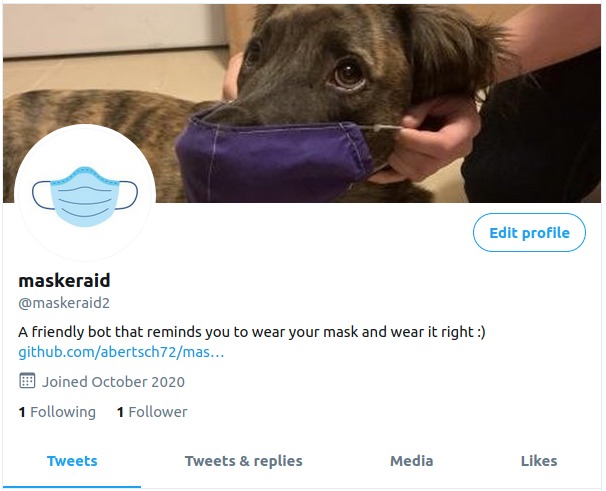
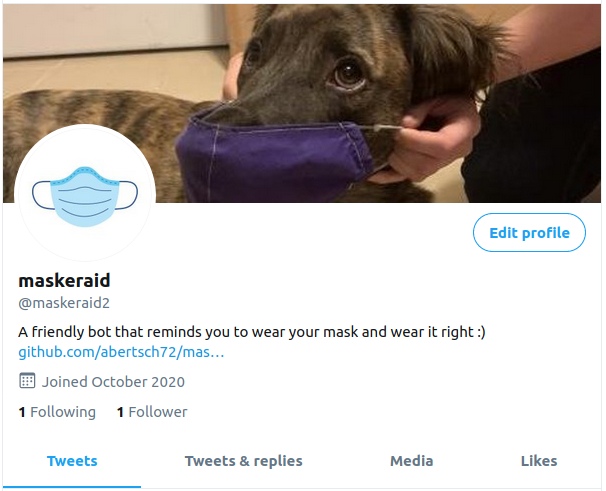
The twitter bot's profile, featuring our "maskot" Alfie!
-
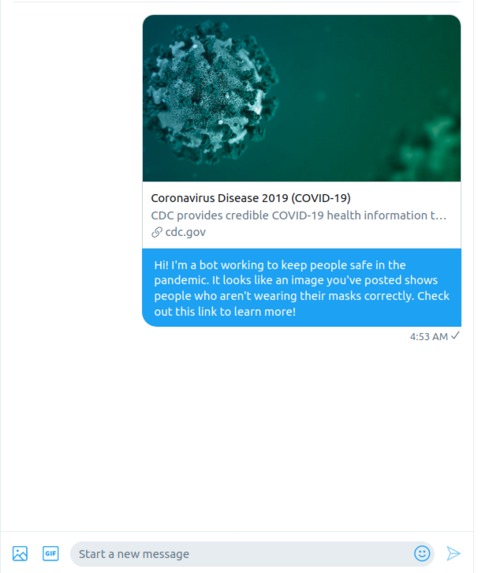
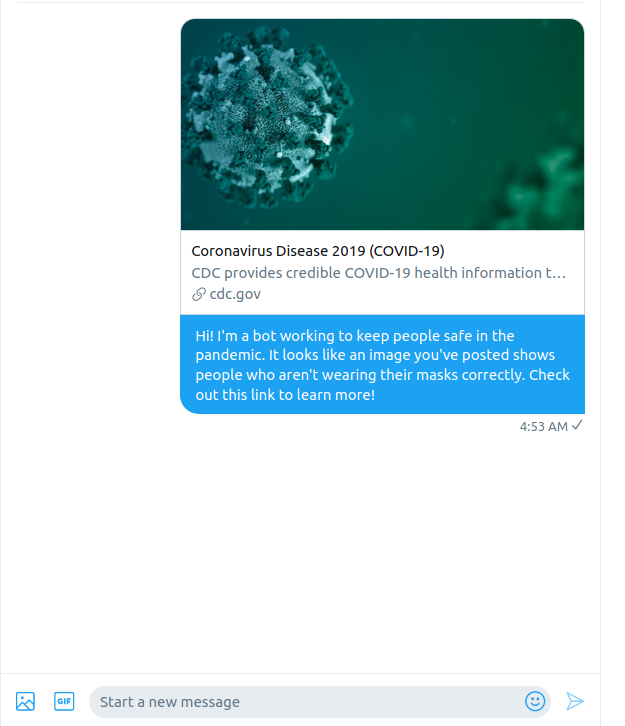
The twitter bot private messaging a person resources about mask wearing.
-
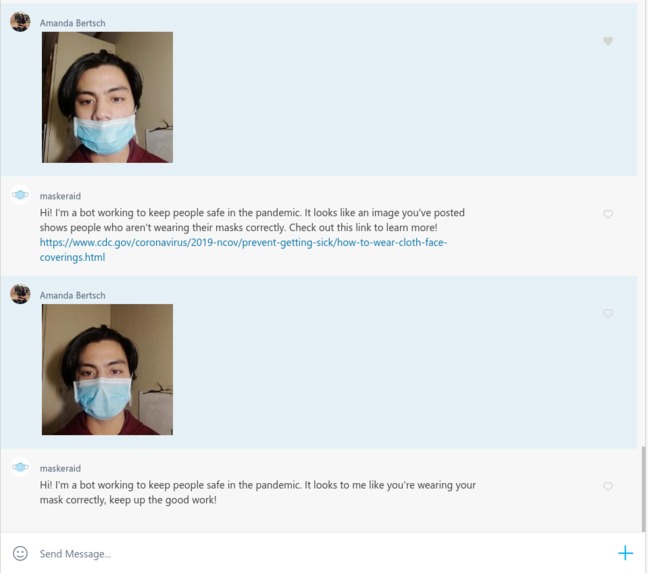
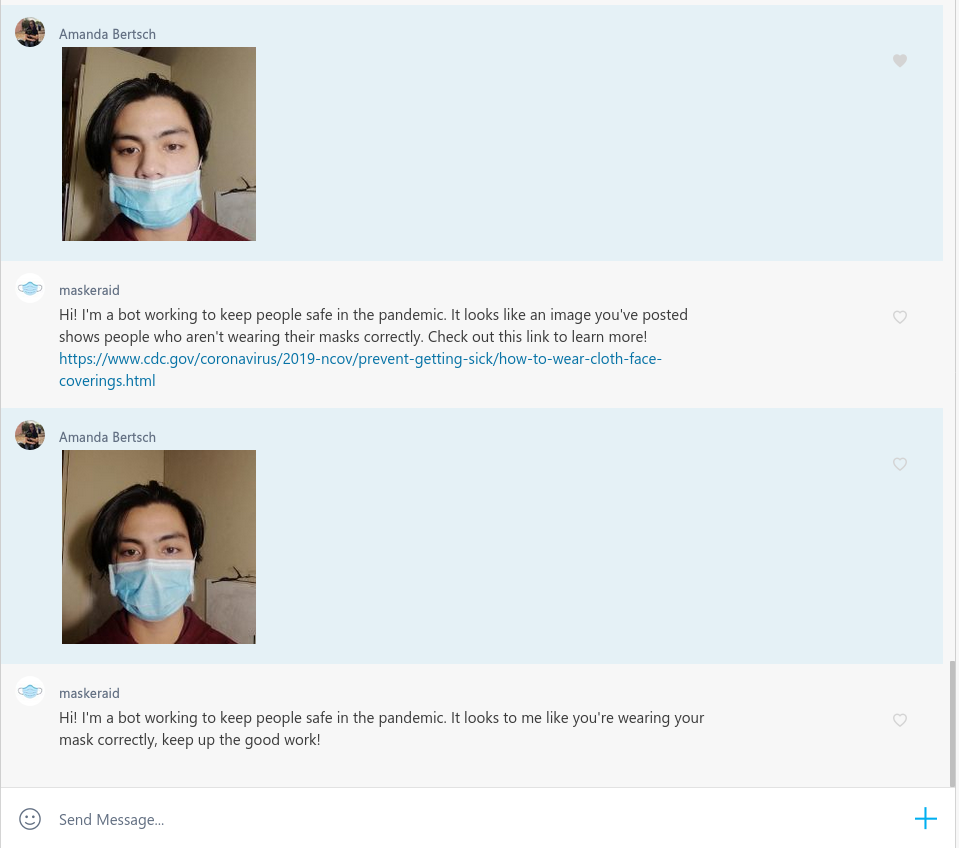
The groupme bot judging pictures posted to the group.
-
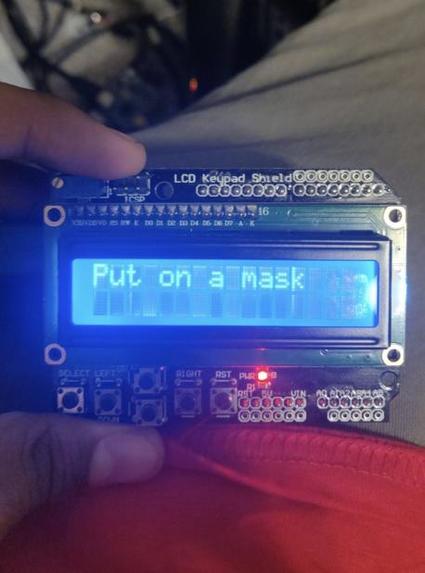
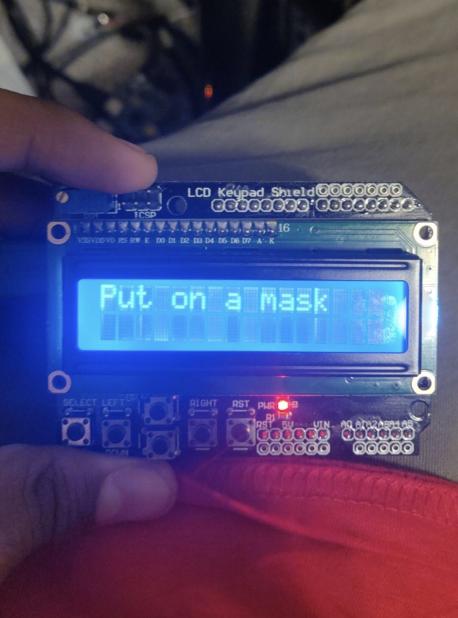
The LCD display when the webcam captures a picture of someone who is not wearing a mask.
Inspiration
We all know how frustrating it can be to see people posting photos with their masks worn incorrectly, or walking into stores without masks on at all. It's uncomfortable and awkward to confront someone about their mask-wearing-- so why not have a program do it for you?
This project does just that, using computer vision models to identify whether people are wearing masks and setting this technology to work to improve the way people wear masks in our community. The final models are versatile, highly accurate, and culturally considerate; they correctly identify whether people are wearing masks and wearing them correctly, even on pictures of people with headscarves, hats, sunglasses, piercings, and/or facial tattoos.
What it does & how
We trained two Google AutoML Vision models. The first, trained on greyscale photos of people wearing masks and people without masks, identifies whether a person in an image is wearing a mask at all. The second, trained on greyscale and color photos of people wearing masks correctly and incorrectly, identifies whether a person in an image is wearing their mask correctly. Both models are deployed on a Google Cloud project and can be called to make predictions.
From this base, we built out three possible applications:
- Mask validation for businesses: This hardware hack asks people to stand in front of a camera briefly, then checks whether they are wearing a mask and display a message on a LCD display, either asking them to put on a mask or telling them they are okay to come in. This raspberry pi-webcam setup is lightweight and could easily be generalized to move a servo motor to unlock a door or play a warning sound, acting as a doorman for small businesses to encourage customers to wear their masks.
- GroupMe chatbot: This bot listens in on a GroupMe group, posting whenever someone posts a picture where they are wearing a mask incorrectly. It can be easily customized and installed in different GroupMe groups-- all it needs to run is a Google Cloud Function on a Google Cloud project (or an equivalent server or severless setup), plus access to the model to predict with. The bot comes with careful and detailed documentation for setting up forks that best suit individual groups' needs.
- Public information campaign for Twitter: This bot trawls Twitter, looking through popular hashtags for posts where people are wearing masks incorrectly. If it finds a photo of improper mask use, it attempts to direct message the user a short, polite message linking to information about wearing a mask properly from the CDC. If the user does not accept DMs from accounts they do not follow, it will post a reply to the post instead.
Of course, many more applications are possible with this setup-- but the weekend is only so long! maskeraid's image cropping system and model predictions can easily be put to work for other use cases.
See it work, try it out!
A longer version of the hardware hack demo excerpted in the video is available here, and so is a more conceptual walkthrough of the use case.
You can join this GroupMe group and try posting images of people wearing masks incorrectly to see what the model does!
The Twitter bot cannot yet respond to being tagged, but you can see the public replies it's made here. Note that there won't be many replies, though more will come over time-- the bot prefers to direct message (DM) users whenever possible, and there is a relatively low rate of pictures of people wearing masks incorrectly to begin with.
Challenges we ran into
The webcam we used for the mask validation is a much better camera than the CCTV cameras that stores commonly have-- and when we tried greyscaling the images, we found our model performance dropped significantly. We duplicated the original training data, producing both color and greyscale versions, and trained a model on both so that the model learned to tell if people were wearing masks without needing to see color in the image. We also had to adapt the data we sent and received between many different formats as it passed between subsystems. The interactions between APIs, Python libraries, our Google Cloud project, the hardware, and locally hosted code were often complex, requiring careful testing and reformatting.
Accomplishments that we're proud of
When we designed our training dataset, we took special care to consider people who may be adversely affected by a mask-law-enforcing model that is not trained with them in mind. Specifically, we were concerned about women who wear hijab and people of color, two groups that were severely underrepresented in the "naive" training data found in the first image search results for any query. The extra time we spent collecting a diverse dataset paid off in good performance on pictures of hijabi women, with no observable performance differences based on the ethnicity, race, or head wear of the image subject in any of our data.
What we learned
This project was an immense crash course in Google Cloud Platform and specifically Google AutoML, which showed surprisingly good performance for training on a relatively small dataset. We gained more experience working with hardware and with social media APIs as well!
What's next for maskeraid
Some codebase cleanup and refactoring is necessary to more cleanly expose the prediction API. As more test data comes in, the models will likely need to be refined. These applications can be improved for ease of use and efficiency, and more applications can be added to the maskeraid family.
Full technical details
For more information, including how the model data was collected and cleaned, please see the documentation on the project's Github repository.
Built With
- cnn
- dnn
- gcp
- google-automl
- google-cloud
- machine-learning
- python
- raspberry-pi
- tweepy
- webcam


Log in or sign up for Devpost to join the conversation.