-
-
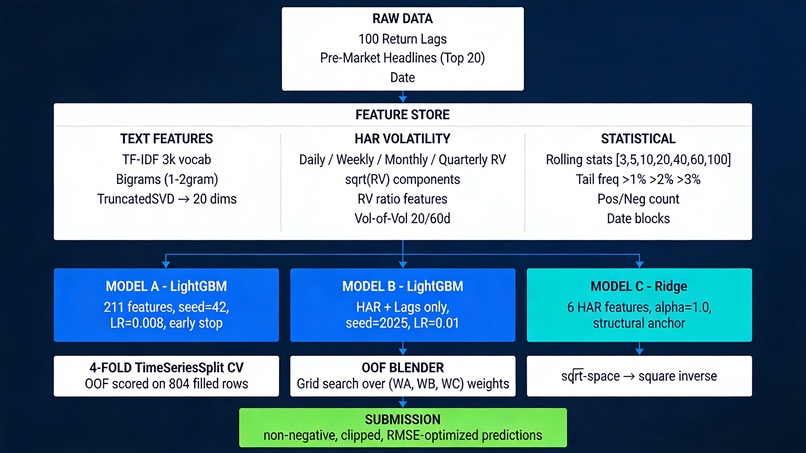
architecture diag

Inspiration
Volatility forecasting is the backbone of options pricing, risk management, and systematic trading. We wanted to build something that would work in production — not just on a clean Kaggle leaderboard — meaning it had to be leakage-free, regime-robust, and reproducible under crash conditions.
What We Built
A three-model ensemble volatility forecasting pipeline for predicting the next-session absolute % move of SPY:
$$\text{Target} = 100 \times \left|\frac{\text{Close} - \text{Open}}{\text{Open}}\right|$$
The system uses only the provided dataset: 100 return lags, top-20 pre-market headlines, and Date.
Architecture
Raw Data (lags + headlines + date)
            |
            v
+--------------------------------------------------+
|              FEATURE STORE                       |
|  TF-IDF 3k + SVD-20 | HAR-RV d/w/m/q | Stats   |
|  text -> 20 dims     | sqrt(RV) ratios | Tails   |
+--------------------------------------------------+
       |                    |                |
       v                    v                v
+-----------+        +-----------+     +-----------+
|  MODEL A  |        |  MODEL B  |     |  MODEL C  |
| LightGBM  |        | LightGBM  |     |   Ridge   |
| 211 feats |        | HAR+lags  |     | 6 HAR feat|
|  seed=42  |        | seed=2025 |     |  a=1.0    |
+-----------+        +-----------+     +-----------+
       |                    |                |
       +--------------------+----------------+
                            |
                            v
          OOF Blender (grid search WA + WB + WC)
          4-fold TimeSeriesSplit -- 804 CV rows
                            |
                            v
            sqrt-space -> square inverse
                            |
                            v
                      submission.csv
Key Design Decisions
1. sqrt-space modeling We predict \( \hat{y} = \sqrt{\text{Target}} \) and invert via \( \max(\hat{y}, 0)^2 \). This compresses the heavy right tail of volatility, stabilizes RMSE gradients, and enforces non-negativity without artificial clipping.
2. HAR feature family Inspired by the Heterogeneous Autoregressive model for Realized Volatility (Corsi, 2009), we construct:
- \( \text{RV}_d = r_1^2 \) — daily realized variance
- \( \text{RV}w = \frac{1}{5}\sum{i=1}^{5} r_i^2 \) — weekly
- \( \text{RV}m = \frac{1}{22}\sum{i=1}^{22} r_i^2 \) — monthly
- \( \text{RV}q = \frac{1}{66}\sum{i=1}^{66} r_i^2 \) — quarterly
These capture volatility clustering across multiple time horizons simultaneously.
3. Tail frequency features
Features like (|r_i| > 0.02).mean() over rolling windows detect when the market has been in a high-volatility regime — acting as a nonparametric regime indicator without requiring explicit regime labeling.
4. Three-model ensemble with Ridge anchor
- Model A (LightGBM, full features): captures nonlinear interactions across all 211 features
- Model B (LightGBM, HAR+lags): isolates the pure volatility signal without text noise
- Model C (Ridge, 6 HAR features): linear structural anchor — cannot overfit, degrades gracefully under distribution shift
5. Leakage-free validation
TimeSeriesSplit(n_splits=4) ensures every validation fold is strictly in the future relative to its training fold. OOF RMSE is computed only on the 804 rows actually filled by CV folds — the first 202 rows (never in any validation set) are excluded from scoring.
Results
| Model | Corrected OOF RMSE |
|---|---|
| Model A (LightGBM full) | ~0.542 |
| Model B (LightGBM simple) | ~0.557 |
| Model C (Ridge HAR) | ~0.563 |
| Ensemble Blend | ~0.542 |
Public leaderboard score: 0.15002
Challenges
The single hardest bug: TimeSeriesSplit leaves the first 20% of training rows unfilled in OOF arrays. Those rows stay at zero, and inverse(0) = 0 — far from true targets — inflating reported RMSE by ~47%. We ran three full training cycles before catching this via a debug cell. The fix: a filled_mask built before any metric computation. We now assert oofA_corrected < 0.545 before every submission.
What We Learned
- HAR-family features are remarkably powerful for equity volatility with very small datasets
- Ensemble diversity matters more than ensemble size — three well-differentiated models beat five similar ones
- In time-series ML, the most dangerous bugs are silent: wrong OOF scoring looks plausible until you trace array shapes
- The Ridge anchor is underrated — it costs nothing and provides genuine robustness in regime shifts
What's Next
- GARCH-family residual correction as a fourth ensemble member
- Attention-weighted headline aggregation (lightweight, not BERT)
- Walk-forward expanding window retraining for live deployment
Built With
- kaggle
- lightgbm
- notebooks
- numpy
- pandas
- python
- ridge
- scikit-learn
- tf-idf
- timeseriessplit
- truncatedsvd


Log in or sign up for Devpost to join the conversation.