-
-
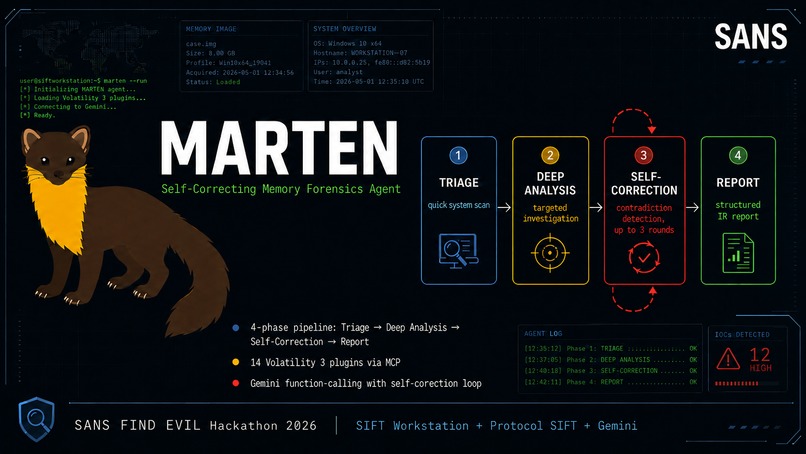
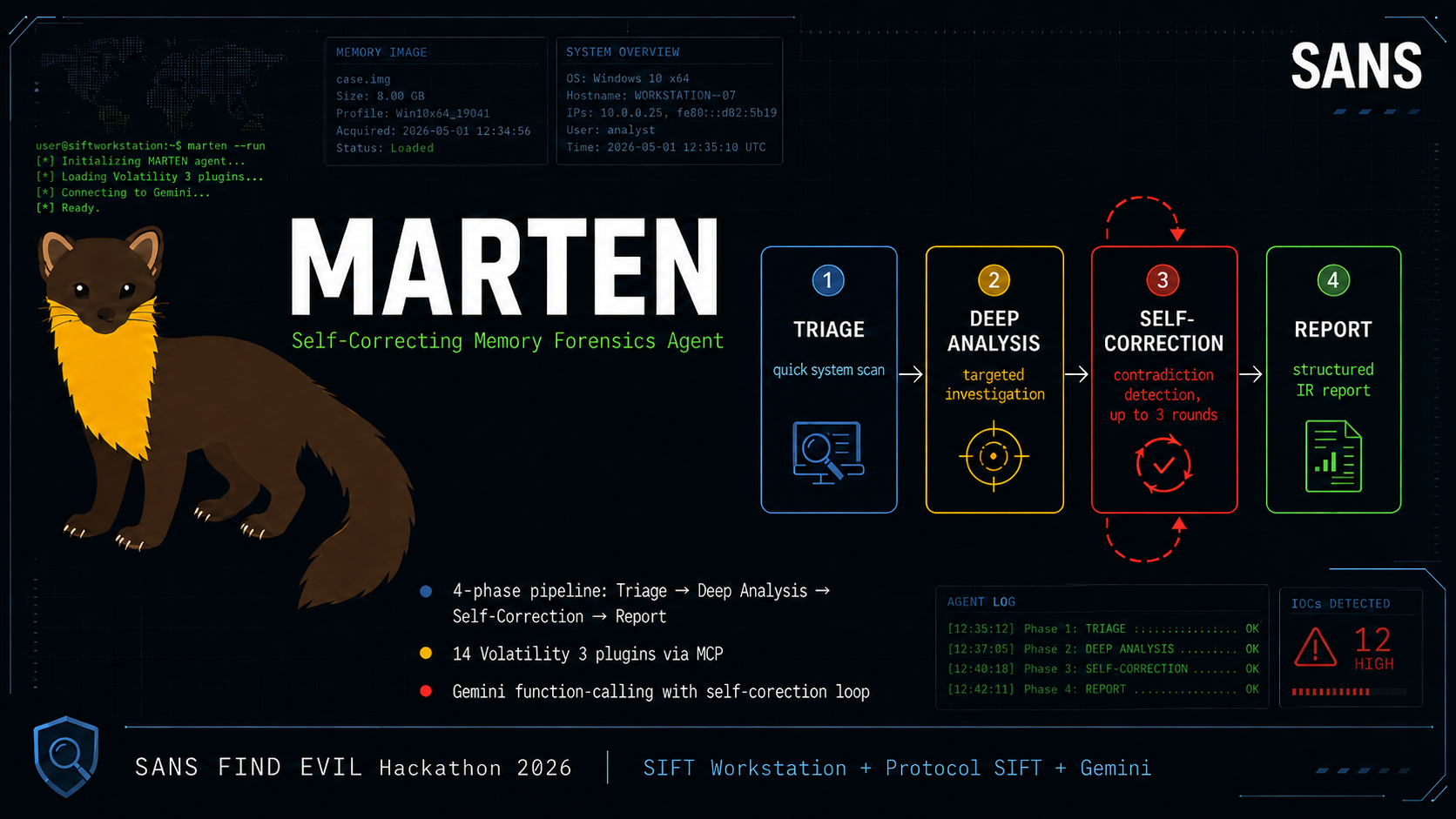
Marten — self-correcting memory forensics agent. 4-phase pipeline with 14 Volatility 3 plugins via MCP, powered by Gemini function-calling.
-
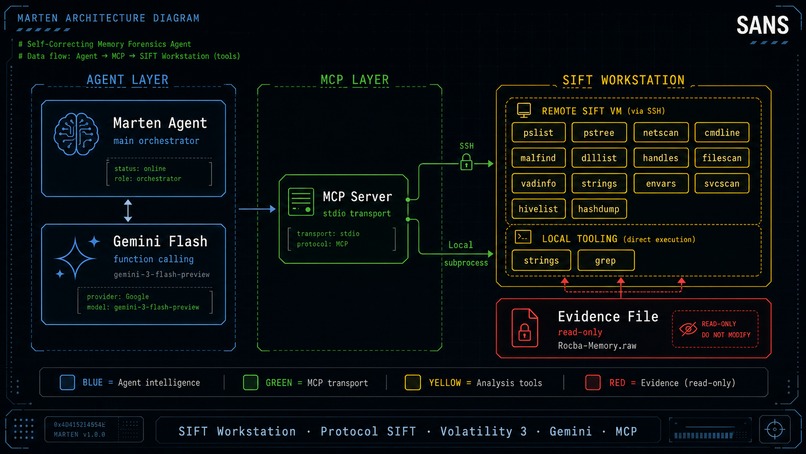
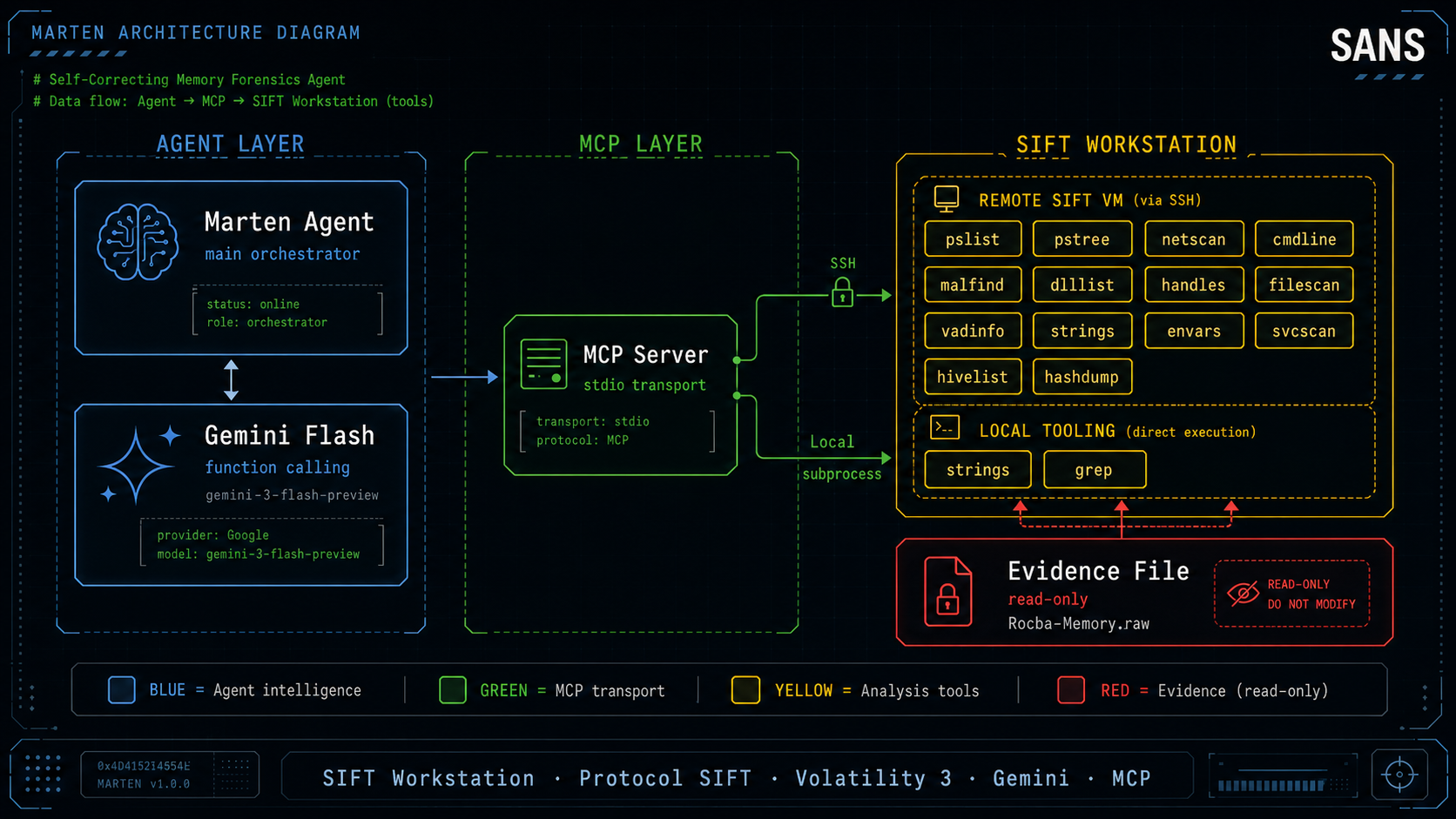
Architecture: Marten Agent + Gemini Flash → MCP Server → SIFT Workstation (14 Volatility plugins + strings/grep). Evidence file read-only.
-
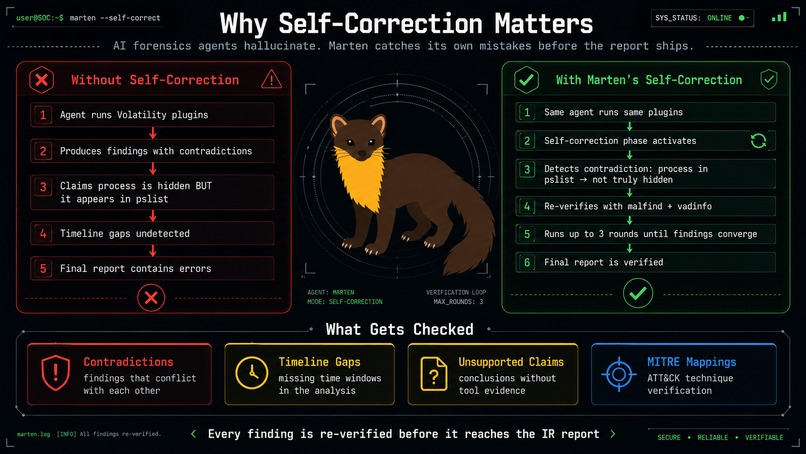
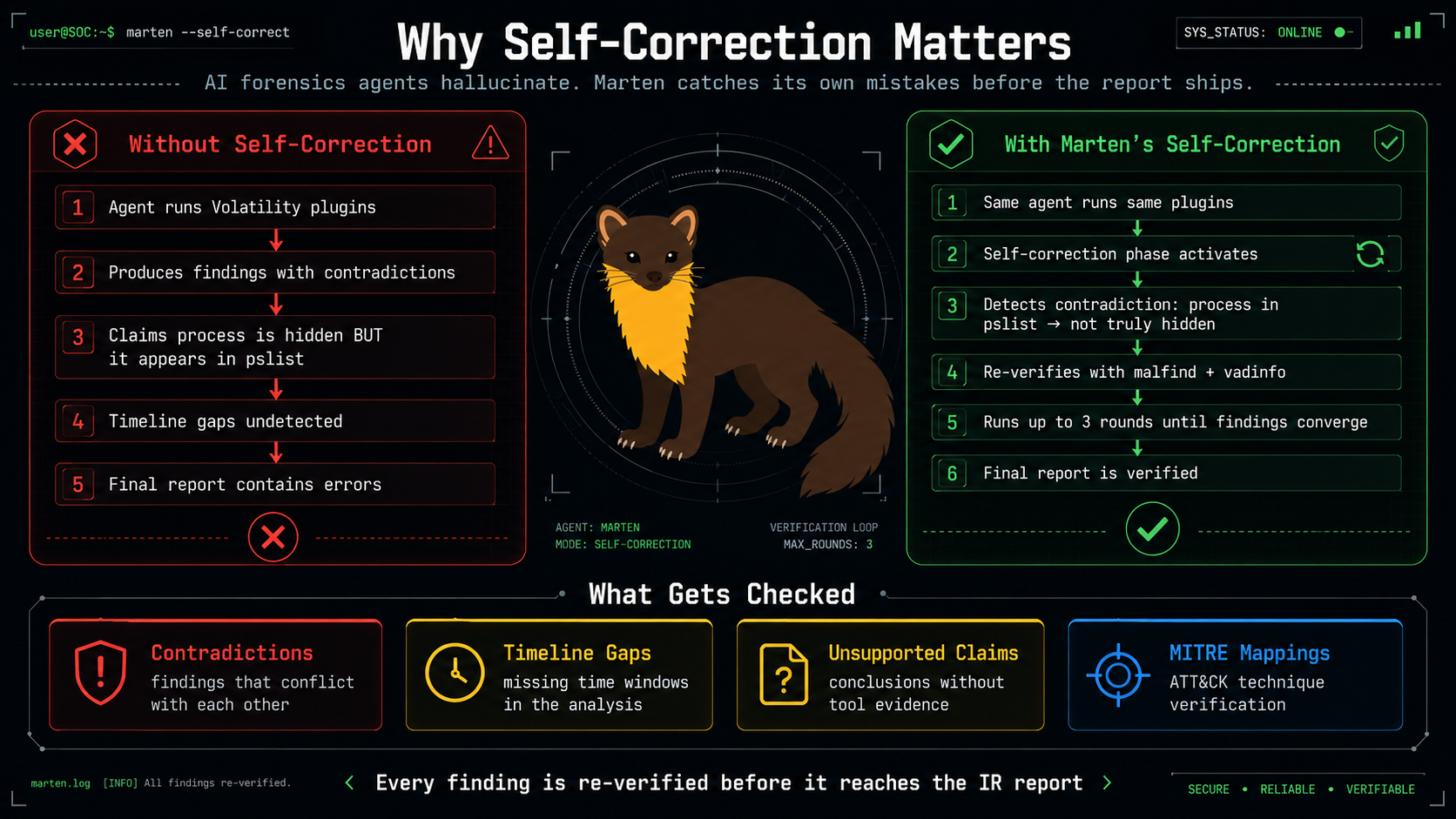
Why self-correction matters: detect contradictions, timeline gaps, unsupported claims. Re-verify up to 3 rounds before the IR report ships.
Inspiration
Incident responders inherit massive memory dumps and a clock. Protocol SIFT gives Claude Code a memory-analysis skill that knows which Volatility plugins to run — but no agent checks its own work before writing the report. We wanted that self-correction loop.
What it does
Marten extends Protocol SIFT's memory-analysis skill with a self-correcting Gemini-driven investigation loop. Given a memory image, it runs a 4-phase pipeline — Triage → Deep Analysis → Self-Correction → Report — calling 14 Volatility 3 plugins over SSH into a SIFT Workstation. Every finding carries the tool-call IDs it was derived from, so a reviewer can replay any conclusion back to the exact Volatility output.
On the Rocba memory dump (18 GB Windows 10, SRL FOR508 lab), Marten identified process hollowing (PID 30216), lateral movement via RDP, service persistence, and USB exfiltration — catching a contradiction that signature-based tools missed and confirming it through structural anomalies across three rounds of self-correction.
How we built it
- Gemini Flash (Vertex AI) as the reasoning engine with function calling
- 14 Volatility 3 plugins dispatched via
gcloud compute sshinto a SIFT Workstation VM — operator machine never touches the evidence file - Marten MCP Server exposes the same plugins for Claude Code / Claude Desktop / Gemini CLI
- Architectural guardrails (code-enforced): read-only evidence, per-call tool budgets, output caps (3-5 KB per plugin), context compression at 80 KB, shell arguments via
shlex.quote - Prompt-based guardrails: investigation scope, JSON output schema, self-correction convergence
Challenges we ran into
- Context management: An 18 GB dump produces enormous tool outputs. Three-layer truncation (VM-side head, agent-side cap, context compression) keeps the LLM productive.
Inspiration
Incident responders inherit massive memory dumps and a clock. Protocol SIFT gives Claude Code a memory-analysis skill that knows which Volatility plugins to run — but no agent checks its own work before writing the report. We wanted that self-correction loop.
What it does
Marten extends Protocol SIFT's memory-analysis skill with a self-correcting Gemini-driven investigation loop. Given a memory image, it runs a 4-phase pipeline — Triage → Deep Analysis → Self-Correction → Report — calling 14 Volatility 3 plugins over SSH into a SIFT Workstation. Every finding carries the tool-call IDs it was derived from, so a reviewer can replay any conclusion back to the exact Volatility output.
On the Rocba memory dump (18 GB Windows 10, SRL FOR508 lab), Marten identified process hollowing (PID 30216), lateral movement via RDP, service persistence, and USB exfiltration — catching a contradiction that signature-based tools missed and confirming it through structural anomalies across three rounds of self-correction.
How we built it
- Gemini Flash (Vertex AI) as the reasoning engine with function calling
- 14 Volatility 3 plugins dispatched via
gcloud compute sshinto a SIFT Workstation VM — operator machine never touches the evidence file - Marten MCP Server exposes the same plugins for Claude Code / Claude Desktop / Gemini CLI
- Architectural guardrails (code-enforced): read-only evidence, per-call tool budgets, output caps (3-5 KB per plugin), context compression at 80 KB, shell arguments via
shlex.quote - Prompt-based guardrails: investigation scope, JSON output schema, self-correction convergence
Challenges we ran into
- Context management: An 18 GB dump produces enormous tool outputs. Three-layer truncation (VM-side head, agent-side cap, context compression) keeps the LLM productive.

Log in or sign up for Devpost to join the conversation.