Inspiration
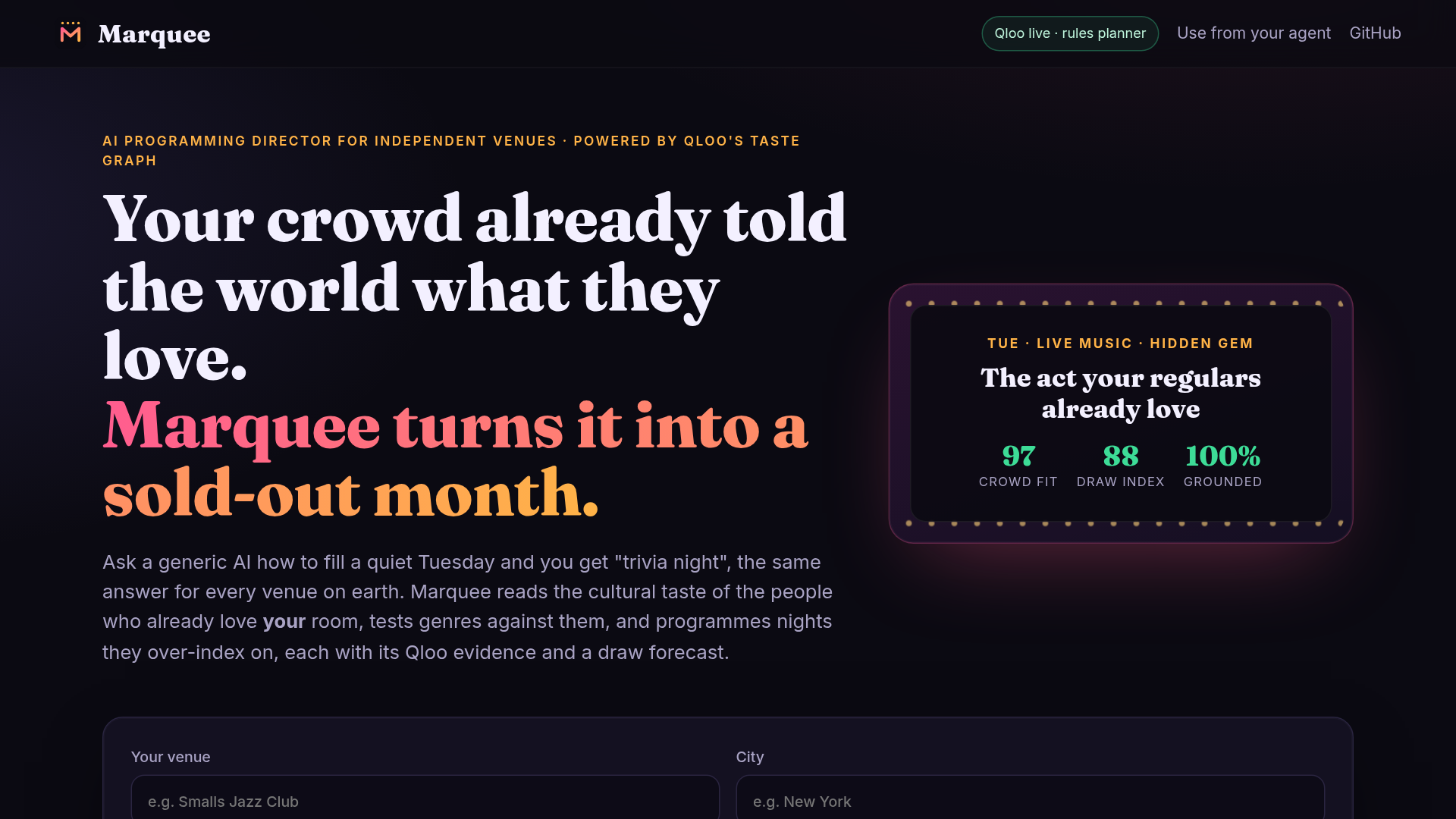
Ask an AI how to fill a quiet Tuesday and you'll probably hear "trivia night", an answer that fits any venue on earth. That is the "culturally blind agent" problem. Independent rooms (jazz clubs, bookshops, indie cinemas, bars with a stage) win or lose on their quiet nights, but they have no audience-research team. Yet the people who already love a room have left a rich trail of taste. Qloo's graph links a place to the music, films, books, podcasts and brands its audience over-indexes on. We wanted to hand that to the person holding the booking calendar.
What it does
Type a venue, a city, a goal ("fill quiet Tuesdays, attract younger fans") and optionally an idea you're unsure about ("salsa night"). Marquee's agent works live on screen:
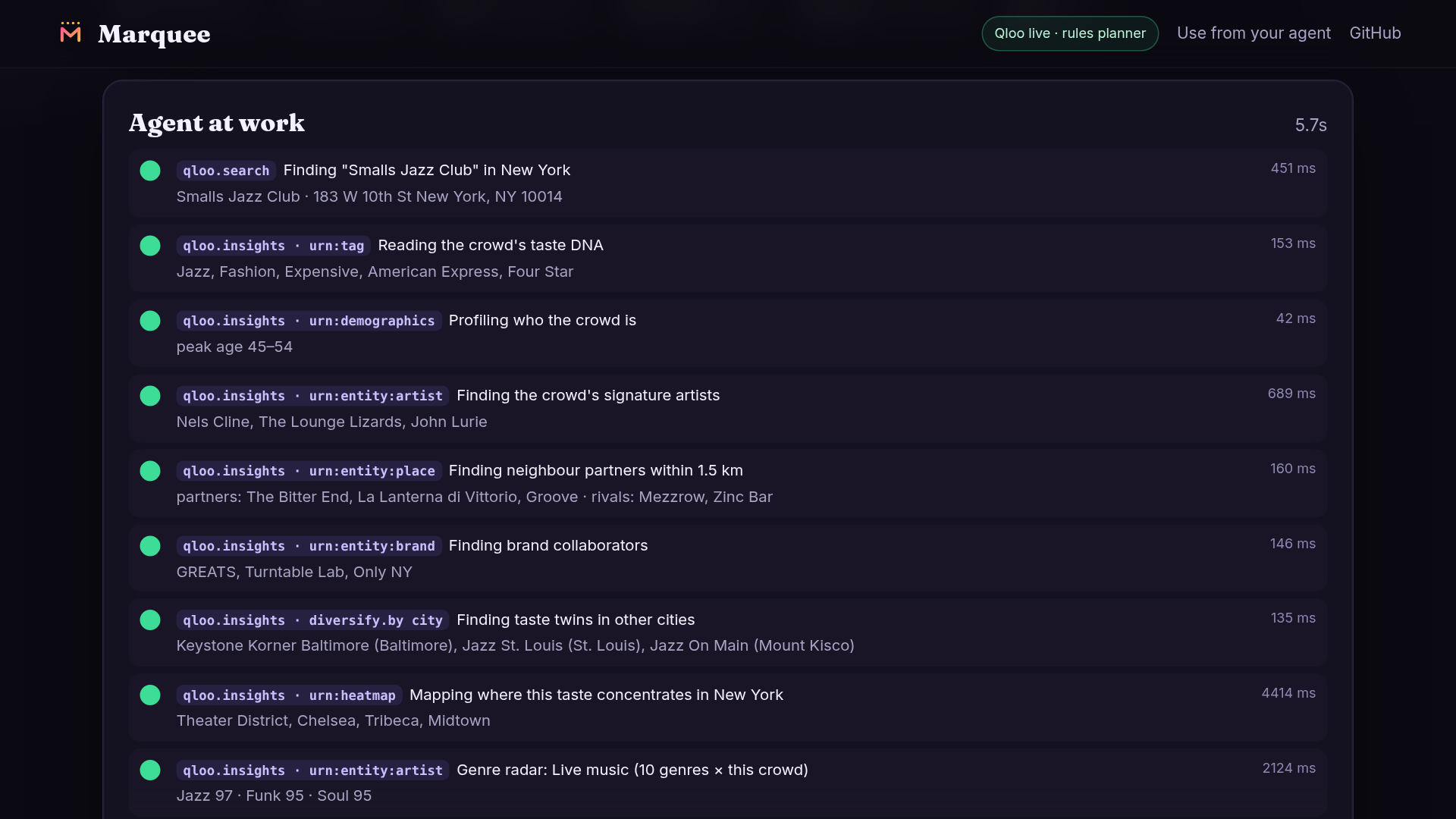
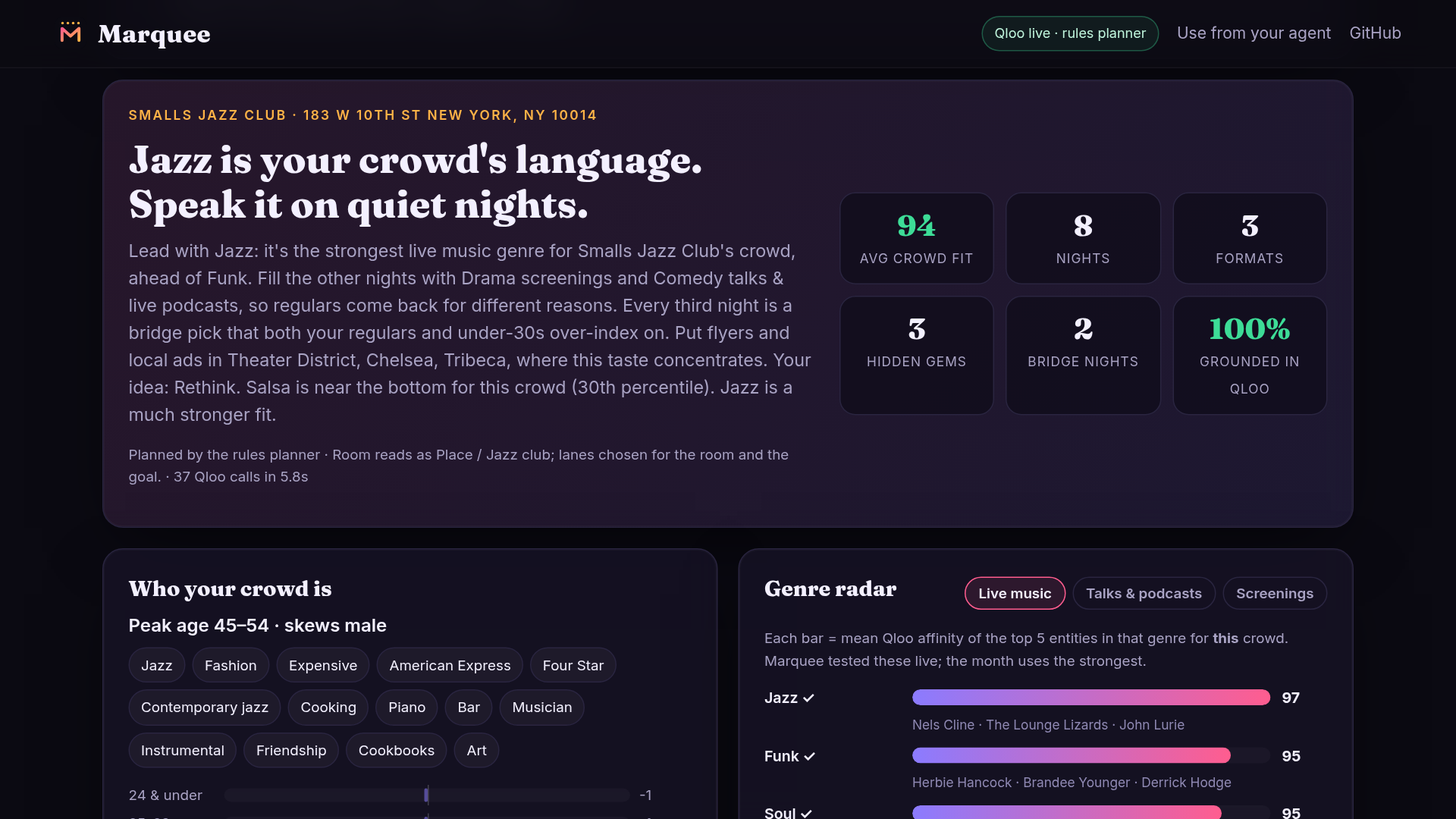
- Reads the crowd. It finds the real venue in Qloo and pulls its taste DNA, age and gender skew, and its crowd's signature artists.
- Runs a genre radar. It scores every candidate genre against this crowd, across live music, screenings, talks and podcasts, and books.
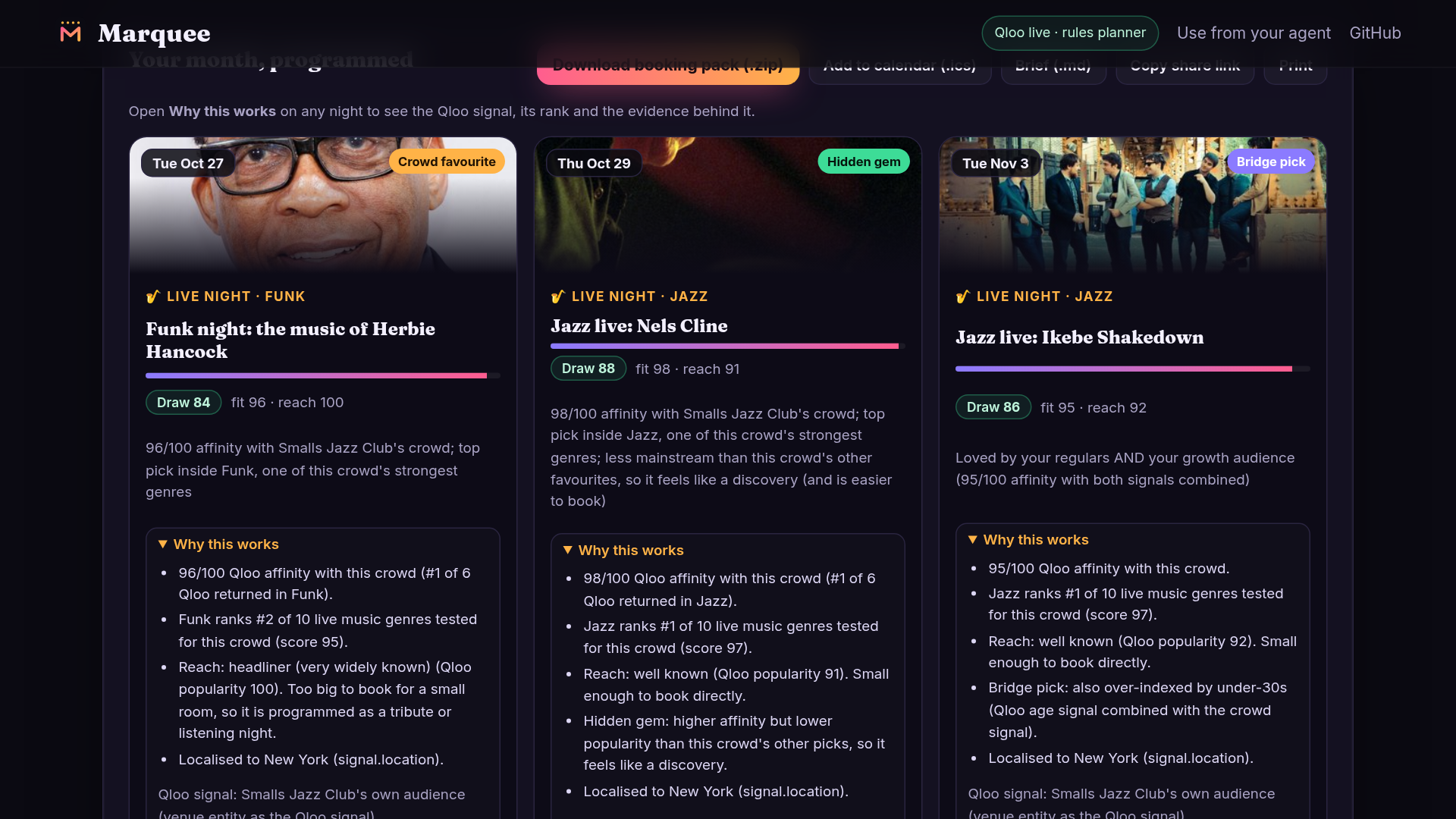
- Programmes the month. Dated nights on the days you chose, each anchored on a specific act, film or podcast this crowd over-indexes on. Hidden gems alternate with crowd favourites, and every night carries its Qloo score, a "why", promo copy and a one-click poster.
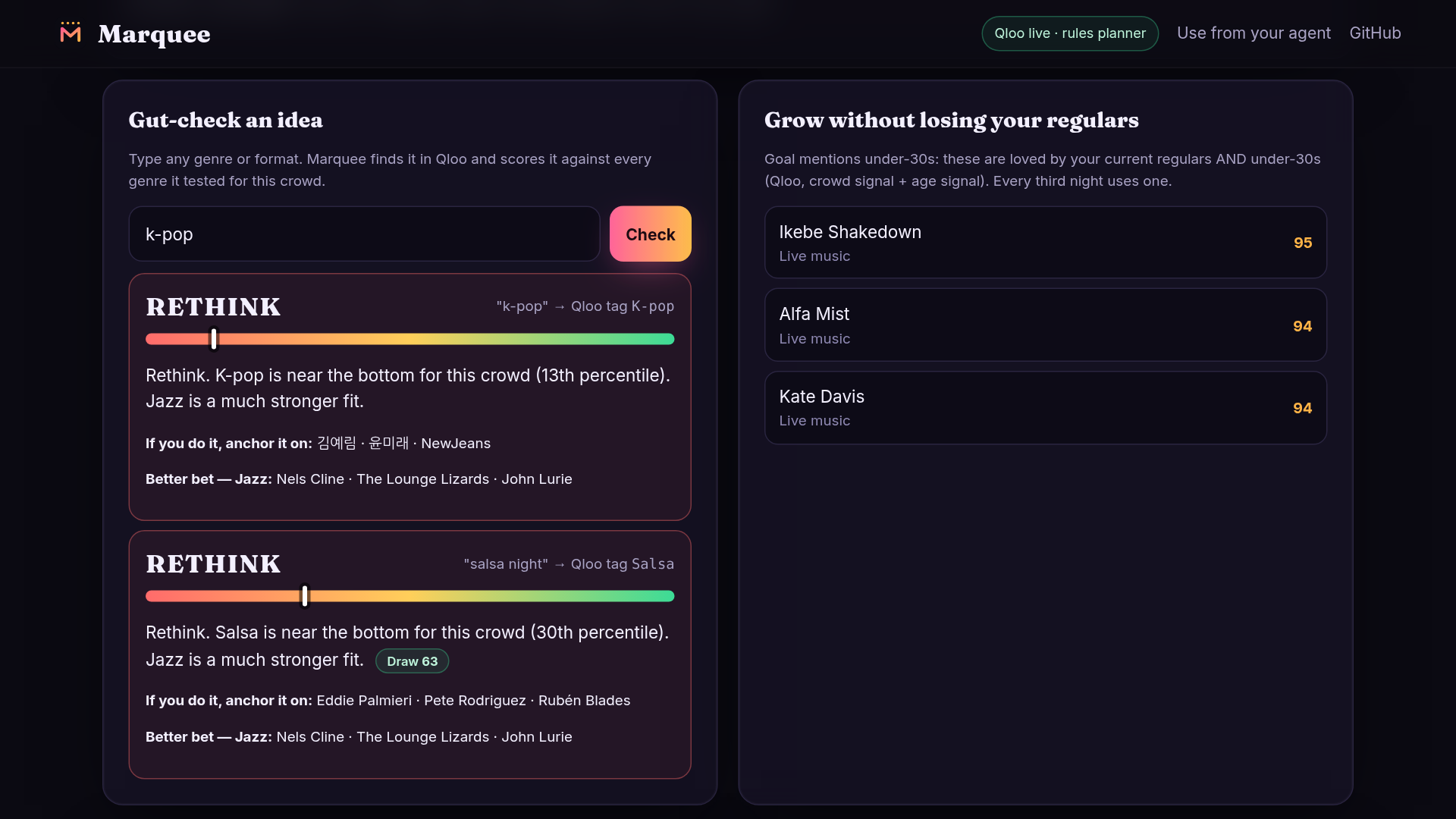
- Gut-checks your idea. It finds the idea in Qloo's tag graph and ranks it against everything it tested. At Smalls Jazz Club, "salsa night" lands around the 30th percentile ("Rethink") and "k-pop" in the 13th. Then it tells you what to book instead.
- Grows without losing regulars. Bridge picks are acts loved by your current crowd and the age group you want, combining Qloo's crowd signal with its demographic signal.
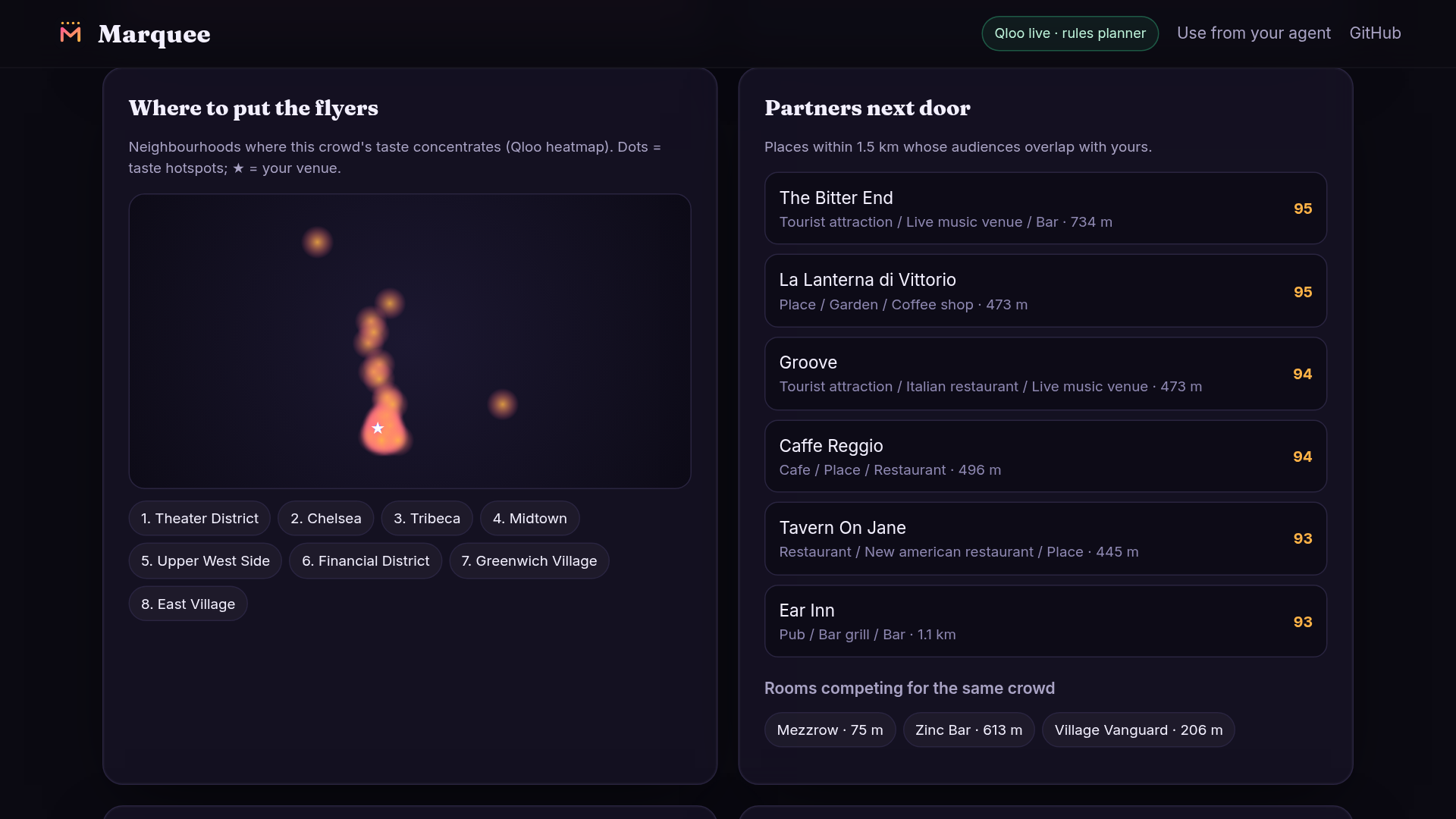
- Says where to put the flyers. A Qloo heatmap of the neighbourhoods where this taste concentrates.
- Finds partners and rivals. Places within 1.5 km whose audiences overlap yours, split into cross-promo partners and rooms competing for the same crowd.
- Finds taste twins. Rooms in other cities with the same kind of crowd, for swapping notes and routing tours. It drafts the outreach emails too.
- Checks itself. A critic verifies every night is grounded in a Qloo result, nothing repeats and the formats vary, then publishes a scorecard ("100% grounded in Qloo").
- Explains every night ("Why this works"). The Qloo signal used, the act's affinity rank inside its genre, the genre's rank for this crowd, its reach tier, and whether to book the act or run a tribute night. At Smalls, Nels Cline scores 98, the top Qloo pick in jazz, which is this crowd's number-one genre; Herbie Hancock is too big for the room, so he becomes a tribute night.
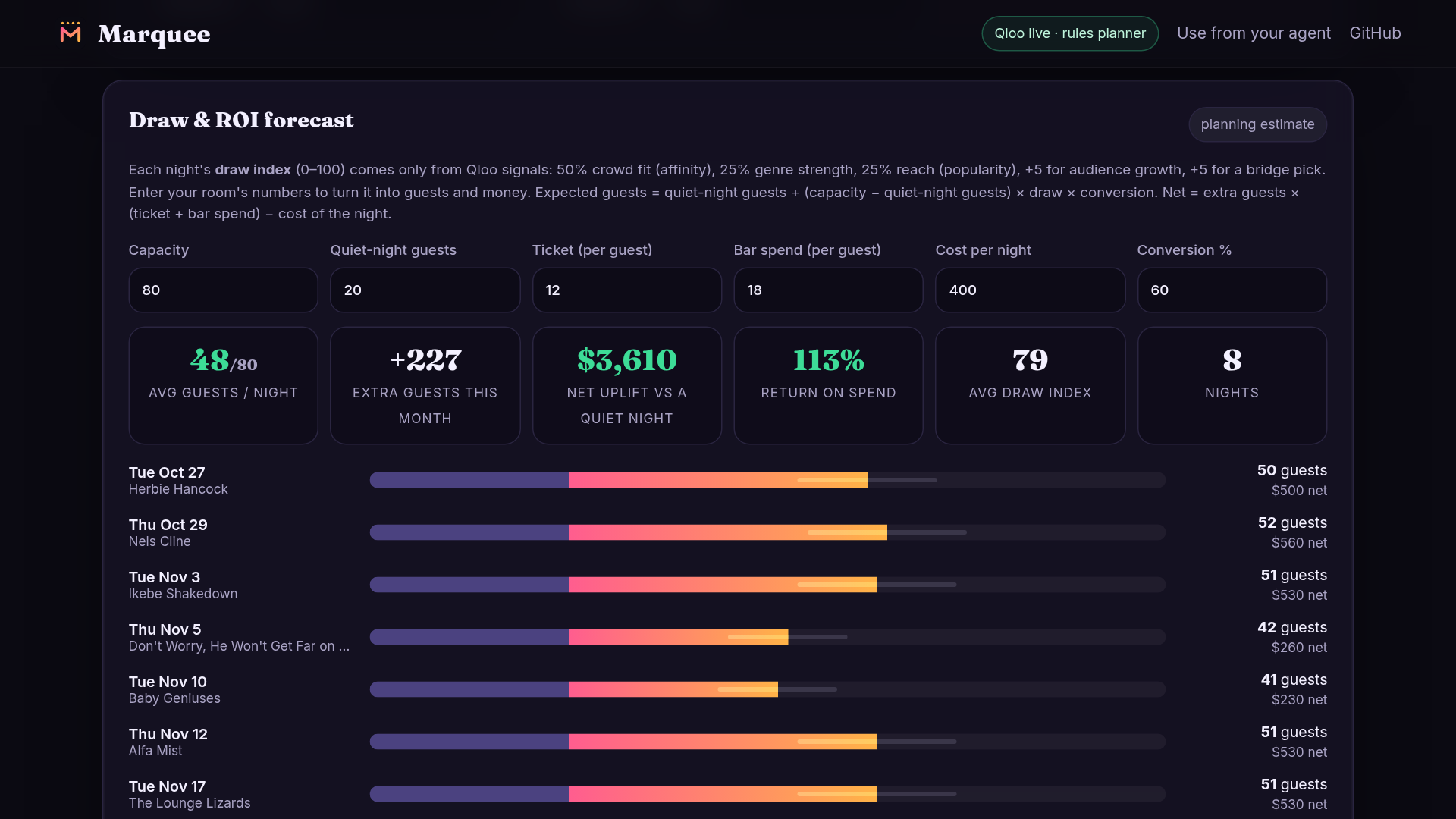
- Forecasts the turnout and the money. Each night gets a 0–100 draw index built only from Qloo signals (50% crowd fit, 25% genre strength, 25% reach, plus growth and bridge bonuses). Enter capacity, quiet-night guests, prices, cost and a conversion rate, and Marquee estimates guests per night, net uplift and return on spend, labelled as a planning estimate. With conservative defaults, Smalls' month averages about 48 guests a night against 20 on a quiet night, and the salsa idea comes in lower than the plan.
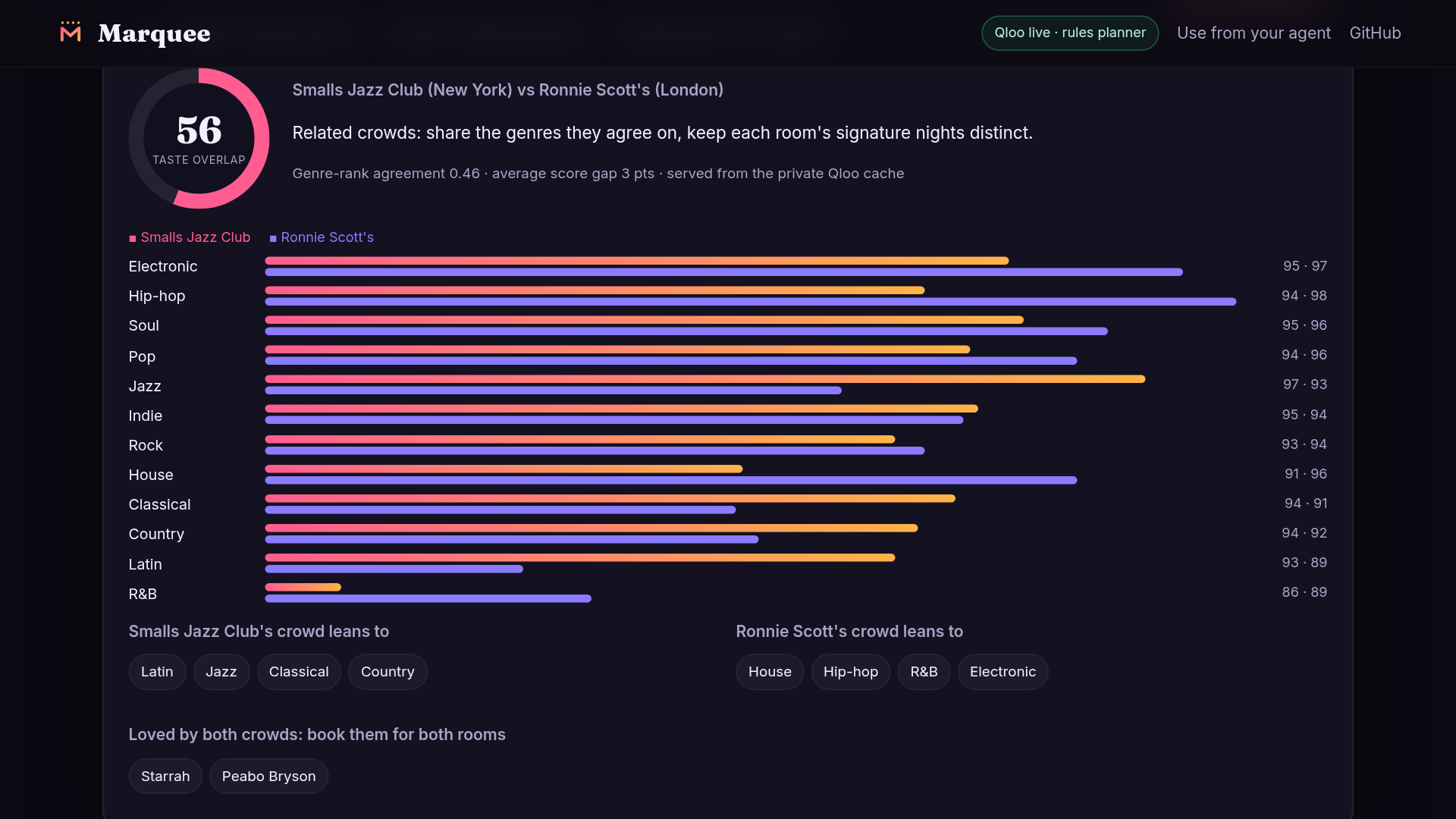
- Compares any two venues, in any two cities. The same 12 music genres are scored against both crowds, giving a taste-overlap score, side-by-side bars, what each crowd leans to, and acts both crowds love. Smalls vs Ronnie Scott's (London) scores 56: Smalls leans Latin, jazz and classical, Ronnie Scott's leans house, hip-hop and R&B, and both love Peabo Bryson. Smalls vs the Village Vanguard scores 74, "near-identical taste".
- Shows its provenance. Every Qloo call behind the plan (endpoint, parameters, latency, cache hit) appears in a table. The key is never shown.
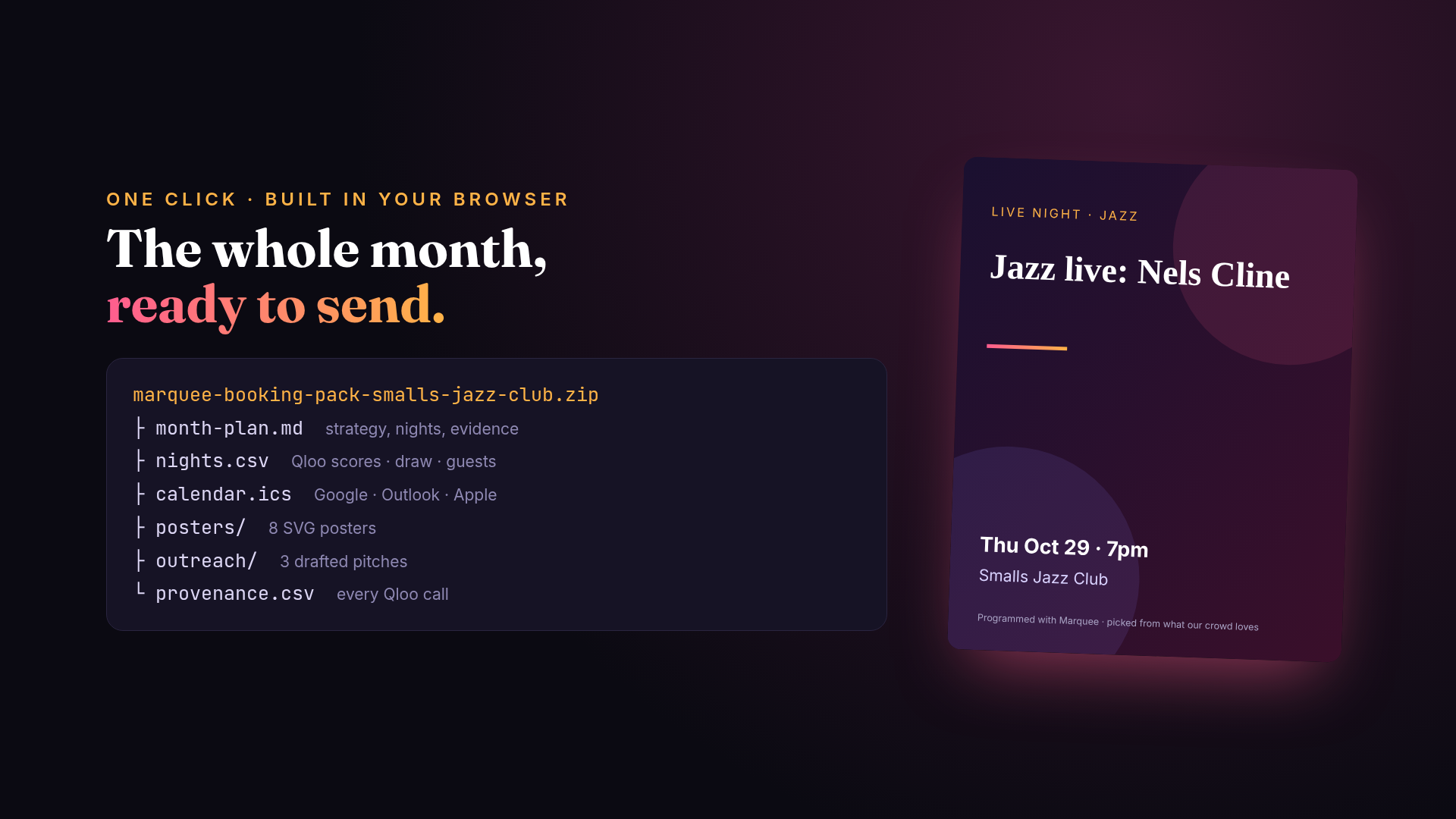
- Exports the whole month in one click. A booking pack
.zipbuilt in the browser: the brief with the evidence,nights.csv(Qloo scores, draw, expected guests), an.icscalendar, one SVG poster per night, drafted pitches andprovenance.csv. Share links and print view too.
Marquee is also a public MCP server (marquee_plan_month, marquee_gut_check, marquee_crowd_profile, marquee_compare_venues), so Claude, Cursor or any agent can programme a venue, or compare two, with Qloo.
How we built it
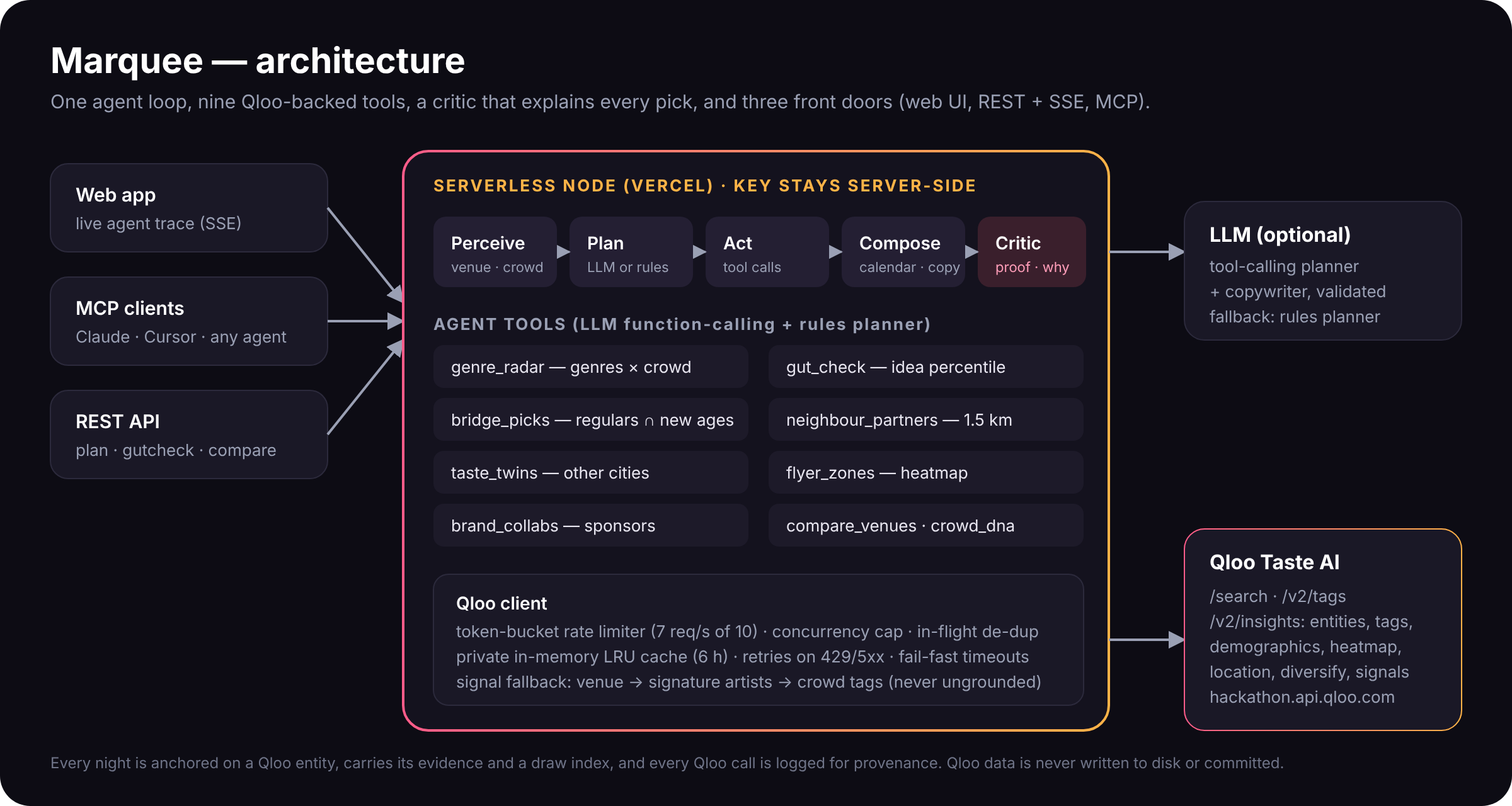
- Agent loop: perceive → plan → act → compose → critique, streamed to the browser with Server-Sent Events so judges can watch each tool call, its Qloo endpoint, timing and result. The planner is deterministic and rules-based. The code also has an optional LLM planner (function calling) that is switched off on the live demo, so every pick you see comes from Qloo data and the rules, not from an LLM. The badge in the header says "rules planner".
- Qloo usage:
/search(venue resolution, re-ranked by name and city),/v2/tags(mapping a free-text idea to a Qloo tag), and/v2/insightswithurn:tag(diversified by subtype),urn:demographics,urn:heatmap(locality boundaries and geohash cells), and entity insights for artists, movies, podcasts, books, brands and places. Insights usefilter.tags,filter.locationwith a radius,diversify.by=properties.geocode.city,signal.location.query,signal.demographics.ageand the venue assignal.interests.entities. - A reliable client on a shared hackathon key: a token-bucket rate limiter (7 req/s against the 10/s limit), a concurrency cap, in-flight de-duplication, retries with backoff on 429/5xx, fail-fast timeouts, and a private in-memory cache. Following Qloo's guidance, no Qloo data is stored on disk or in the repo.
- Stack: zero-dependency Node 20, one serverless function on Vercel, vanilla HTML/CSS/JS front end (keyboard focus states, labelled controls, reduced motion, a 390 px mobile layout), 31
node:testtests, a secret scan, MIT licence.
Challenges we ran into
- Silent signal drops. For some places, Qloo ignores the venue as a signal for certain entity types: it returns a 400, or results without an affinity score. At first this made every gut-check idea score the 100th percentile. Marquee now detects it and falls back from the venue to its crowd's signature artists, then to its taste tags. Anything without an affinity is dropped, so nothing ungrounded is ever programmed.
- Huge payloads. A city heatmap with locality boundaries can be tens of megabytes. We cut result sizes, drop polygons and run slow tools early in parallel.
- Partners vs competitors. "Nearby places with an overlapping audience" includes rival jazz bars, so Marquee separates partners from rivals by category.
- Noise. London locality heatmaps surfaced tiny housing estates, so we filter by popularity and clean the names.
Accomplishments we're proud of
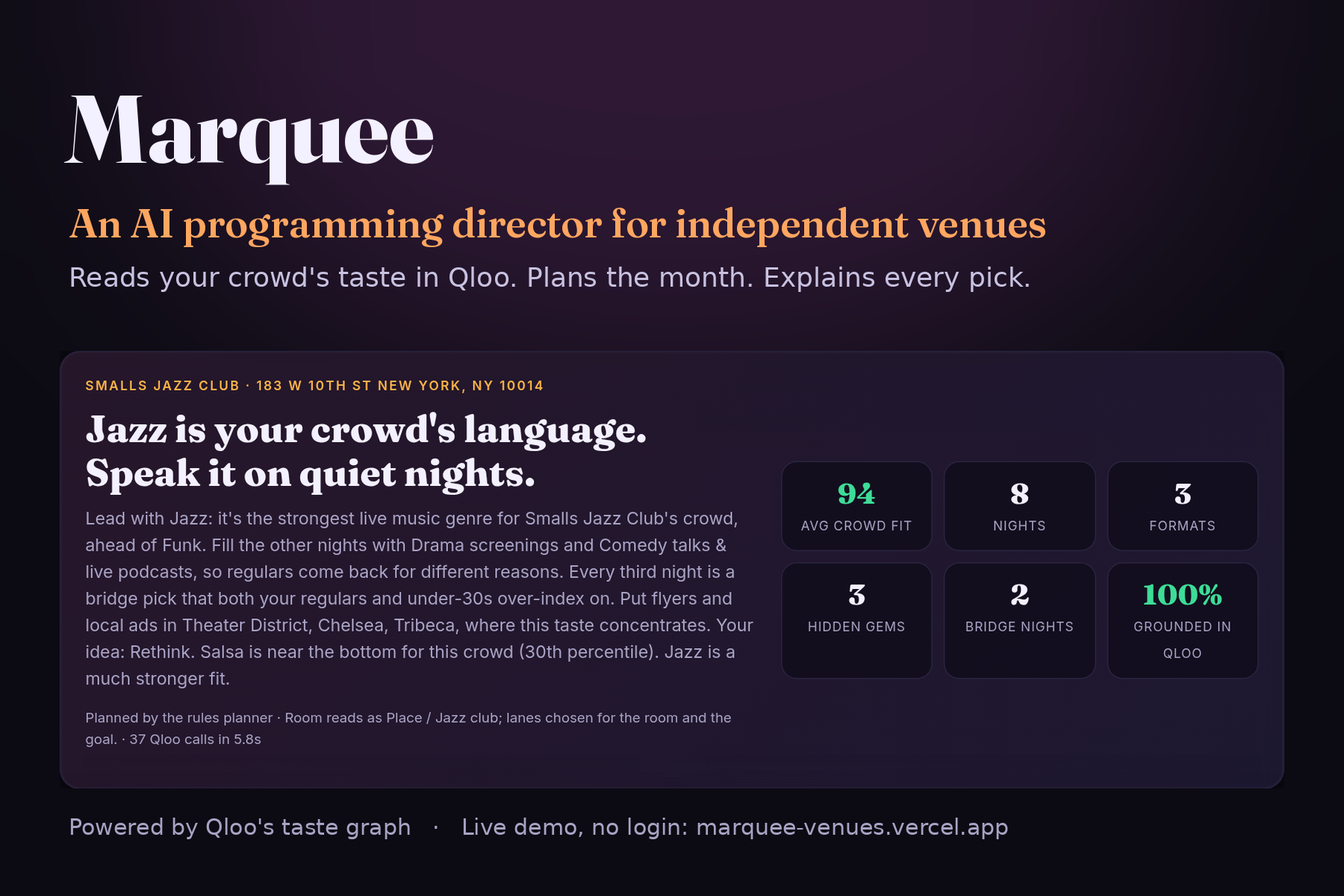
- A full plan for a real venue in seconds: Smalls Jazz Club takes 35–39 Qloo calls and finishes in about 6–15 s depending on load (repeats are cached), with an average crowd fit of 94, an average draw index of 79 and 100% grounding.
- Every recommendation is explainable and traceable to the Qloo call that produced it.
- Cross-format programming: the same jazz-club crowd also gets drama screenings and comedy podcast nights that Qloo says it loves.
- A gut check that turns Qloo into a decision tool, not just a recommender.
- An agent anyone can plug into theirs via MCP.
What we learned
Taste is local and cross-domain: two jazz clubs in the same city can need different months. Grounding an agent means measuring with the data, not only retrieving it, so we built a critic and percentile scoring on top of affinities.
What's next for Marquee
- Ticketing and RSVP integrations, to calibrate the draw-to-guests conversion against each venue's real door counts.
- Artist-availability and fee data, so "book this" becomes "book this, for this much".
- A weekly re-plan as tastes shift (Qloo audience growth signals).
Built during the hackathon
Marquee was created for this hackathon. The first commit is dated Oct 20, 2026, inside the submission period (Sep 30 to Oct 30), and the full history is in the public repo.
Testing instructions for judges
Open the live demo; no login is needed. Click a preset venue (Smalls · New York, Ronnie Scott's · London, Shakespeare and Company · Paris, Alamo Drafthouse · Brooklyn) or type your own. In the result, open Why this works on any night, change the numbers in Draw & ROI forecast, try the gut-check box with any genre ("horror films", "k-pop", "poetry"), click Download booking pack, and use Compare two venues (presets included).
To try MCP, add {"mcpServers":{"marquee":{"url":"https://marquee-venues.vercel.app/api/mcp"}}} to an MCP client.
Built With
- ai-agent
- javascript
- mcp-server
- model-context-protocol
- node.js
- qloo
- qloo-insights-api
- server-sent-events
- vercel
