-
-
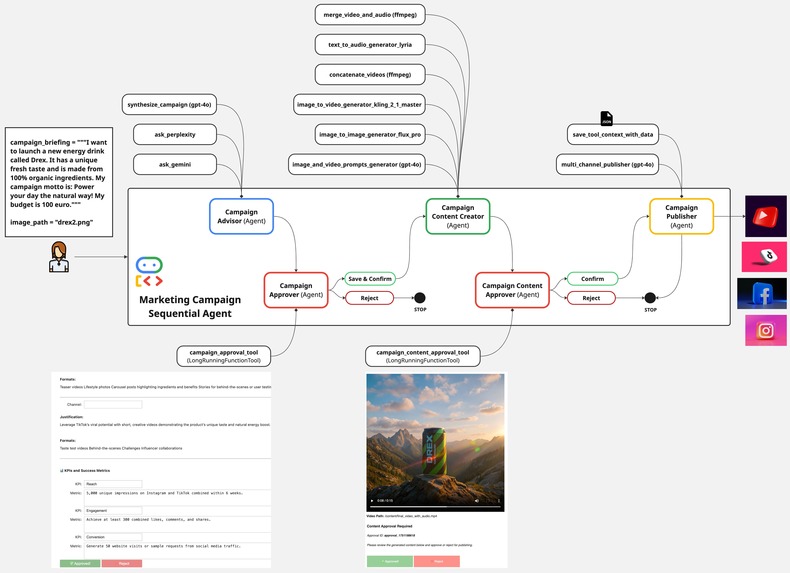
MarMesh Architecture
-
Juggle Your Marketing
Inspiration
My inspiration came from leading the development of marketing tools in recent years and closely observing the vast, fragmented landscape marketers have to navigate every day. Marketing automation is that long-coveted dream which is still elusive, and bridging both ends of campaign planning and goal achievement remains a major challenge. I wanted to explore how far I could go with an agentic workflow (powered by Google ADK), where humans and AI collaborate closely to deliver smart results, faster. I didn’t make it all the way, but it’s been an exciting journey and I hope you’ll enjoy it with MarMesh!
What it does
MarMesh transform your campaign brief into a complete multi-channel marketing campaign in minutes! Just describe your product and budget and MarMesh handles the rest.
Campaign Strategy - AI researches your market and creates data-driven strategies
Human Approval - Review and edit all campaign details before execution
Content Creation - Automatically generates video content for your campaigns
Multi-Channel Publishing - Publishes to YouTube, Instagram, TikTok, ... simultaneously
Complete Automation - From brief to live campaign with minimal manual work
How It Works
- Input: Example "Launch energy drink Drex, organic ingredients, 100€ budget" & Product image
- AI Strategy: Generates target audience, channels, KPIs, messaging
- Your Approval: Review and tweak the campaign plan
- Content Creation: AI creates promotional video content
- Your Final OK: Approve the creative before it goes live
- Auto-Publish: Deploys across all selected social channels
- Data Persistence: Campaign data stored in the agent's tool_context is automatically saved to a local JSON file for future analytics and reference
Turn hours of campaign planning into minutes of smart automation!
How I built it

Generated Video 
Product Image Input: drex2
Architecture Overview
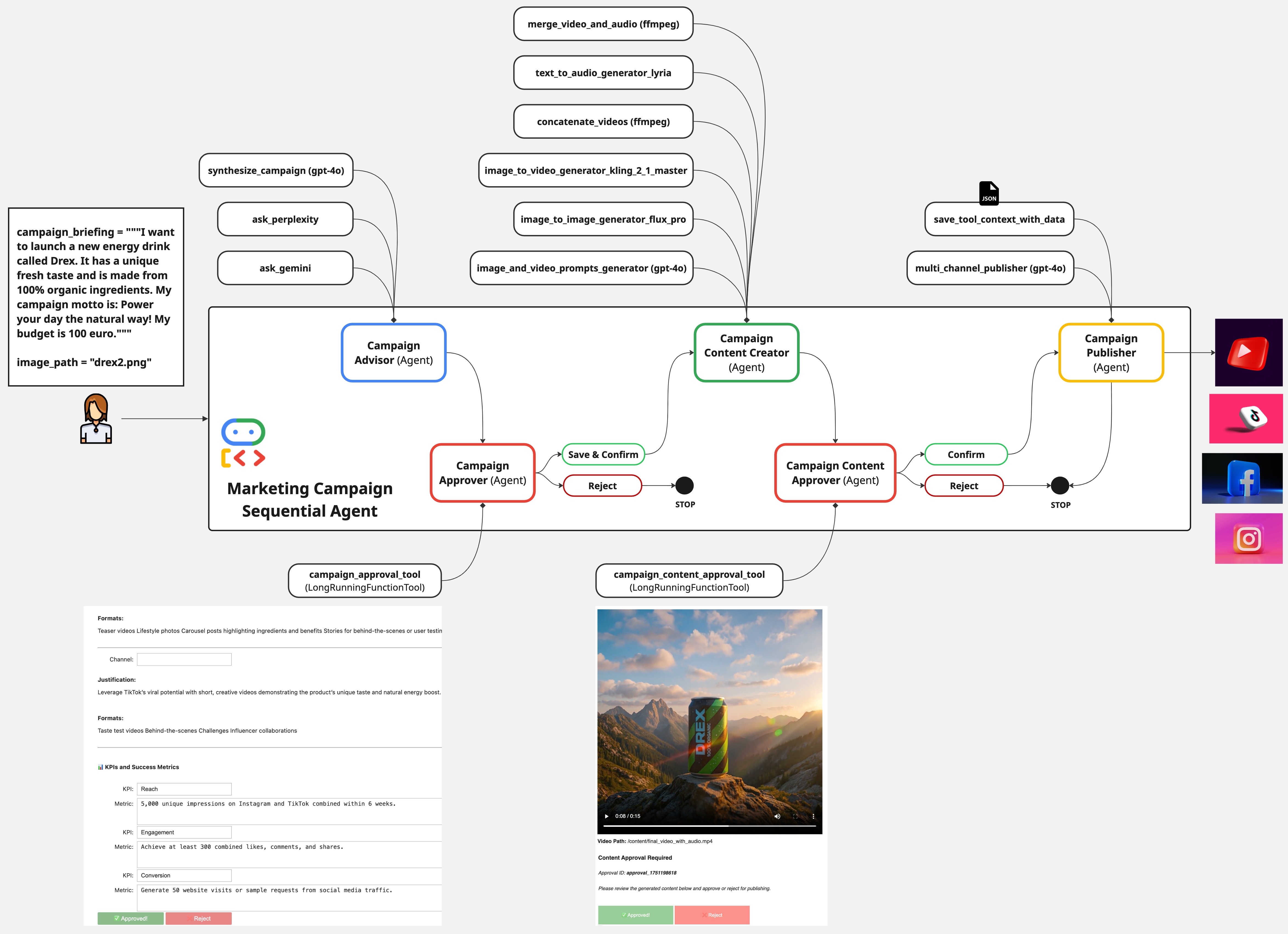
MarMesh implements an ADK Sequential Agent with human-in-the-loop checkpoints. It acts as the master orchestrator of five sub-agents, each purpose-built for a specific stage of the marketing pipeline.
Technical Stack
Core Framework: Google Agent Development Kit (ADK)
Marketing Strategy Research: Gemini, Perplexity
Prompt Generation: GPT-4o
AI Image Generation: Flux Pro AI
Video Animation: Kling 2.1 Master
Audio Production: Lyria (Google DeepMind)
Video Assembly: FFMPEG
Multi-Platform Publishing: YouTube Data API v3, (Instagram Graph API, TikTok API - not implemented)
1. Sequential Orchestrator Agent
The master conductor that coordinates the entire pipeline from brief to live campaign. It manages workflow state, handles inter-agent communication, and ensures proper execution order.
2. Campaign Advisor Agent
The AI marketing strategist that analyzes your product brief and generates comprehensive campaign strategies. Creates detailed target audience profiles, selects optimal marketing channels, develops key messaging themes, and sets performance KPIs based on market research and best practices.
3. Campaign Strategy Approver
Creates an interactive approval interface where users can review and edit generated campaign strategy. Features an editable form interface for target audience, messaging, channels, and budget, KPIs modifications.
4. Content Production Agent
The video production studio that combines multiple AI services:
- Script Generation: Converts campaign strategy into detailed visual scene prompts
- Visual Creation: Flux Pro AI generates high-quality product and lifestyle imagery
- Animation Pipeline: Kling 2.1 Master transforms static images into dynamic video scenes
- Audio Synthesis: Lyria produces background music out of the generated prompts
- Video Assembly: Concatenates scenes and merges audio for broadcast-ready content
5. Content Quality Controller
Implements a preview and approval system with an embedded video player, allowing final creative review before publication. Includes workflow pause/resume logic for quality assurance.
6. Multi-Channel Publisher
Distribution engine that automatically publishes approved content across selected social platforms. Features platform-specific optimization, metadata generation, and comprehensive campaign archival with JSON state persistence.
Challenges I ran into
I faced several challenges during implementation:
Human-in-the-loop with LongRunningFunctionTool was tricky
Implementing one human-in-the-loop workflows with LongRunningFunctionTool was already complicated but handling two of these was a real challenge. It took time to figure out how to make the SequentialAgent continue from where it left off instead of restarting from the beginning after resuming.
Video Generation
Video models require highly precise, model-specific prompting. This automation handles the generation of video prompts, but the GPT-4o prompt responsible for it still needs fine-tuning to achieve better results. I chose to work with Kling 2.1 Master because it supports Cfg Scale configuration and follows closely the prompt instructions. It delivered better results than Veo 3.
Gemini models hallucinated tool arguments All Gemini models I tested eventually started hallucinating tool argument names in oddly specific ways.
For example:
user_input became usera_input
theme_and_message became themea_anda_message
Gemini models invented non-existent tools When using Gemini models in Agents, they occasionally invented tool names that didn’t exist. This led to execution errors since those tools weren’t passed into the agent.
I resolved both issues above by switching all agents to use gpt-4o via LiteLlm and working almost exclusively with the tool_context.
Accomplishments that I am proud of
Above all, I'm proud of my perseverance in overcoming the challenges I encountered during this project and for not giving up despite the short timeline (I started building too late).
I orchestrated multiple cutting-edge AI models into a seamless production pipeline using Google ADK.
My agent solves an actual business problem - transforming weeks-long marketing campaign creation into minutes of automated work, while keeping humans in control of critical decisions.
What I learned
Building with Google ADK taught me that coordinating multiple AI agents isn’t just about chaining API calls - it’s about robust state management and learning how to handle the unpredictable nature of AI outputs. Each failure point required careful consideration.
What's next for MarMesh
MarMesh represents a hackathon-level proof of concept, but I didn't manage to realize the full scope of my original idea. The complete system would automatically publish videos as paid ads and monitor performance across channels, dynamically adjusting budgets based on real-time metrics compared to the initially set campaign KPIs.
I wanted to let the Agents "reason", not just chain them in a classical automation workflow, so that's exactly what will happen in the next steps of this automation.
Video creation is inherently creative and complex task, and outsourcing it entirely to a single video agent is far from ideal. Instead, specialized video agents tailored to specific campaign types, and designed to work closely with a human, should be added.
Also campaign strategy creation needs polishing and it alone could be a multi-step process.


Log in or sign up for Devpost to join the conversation.