MarMail — AI Multi-Agent Email Marketing Application
Strategic Intelligence. Orchestrated Execution.
There is no middle ground. Until now. Not just generating emails, but researching prospects intelligently, validating data rigorously, personalizing strategically around core marketing principles, and coordinating follow-ups coherently—all simultaneously, all automatically, all at scale.
The Solution
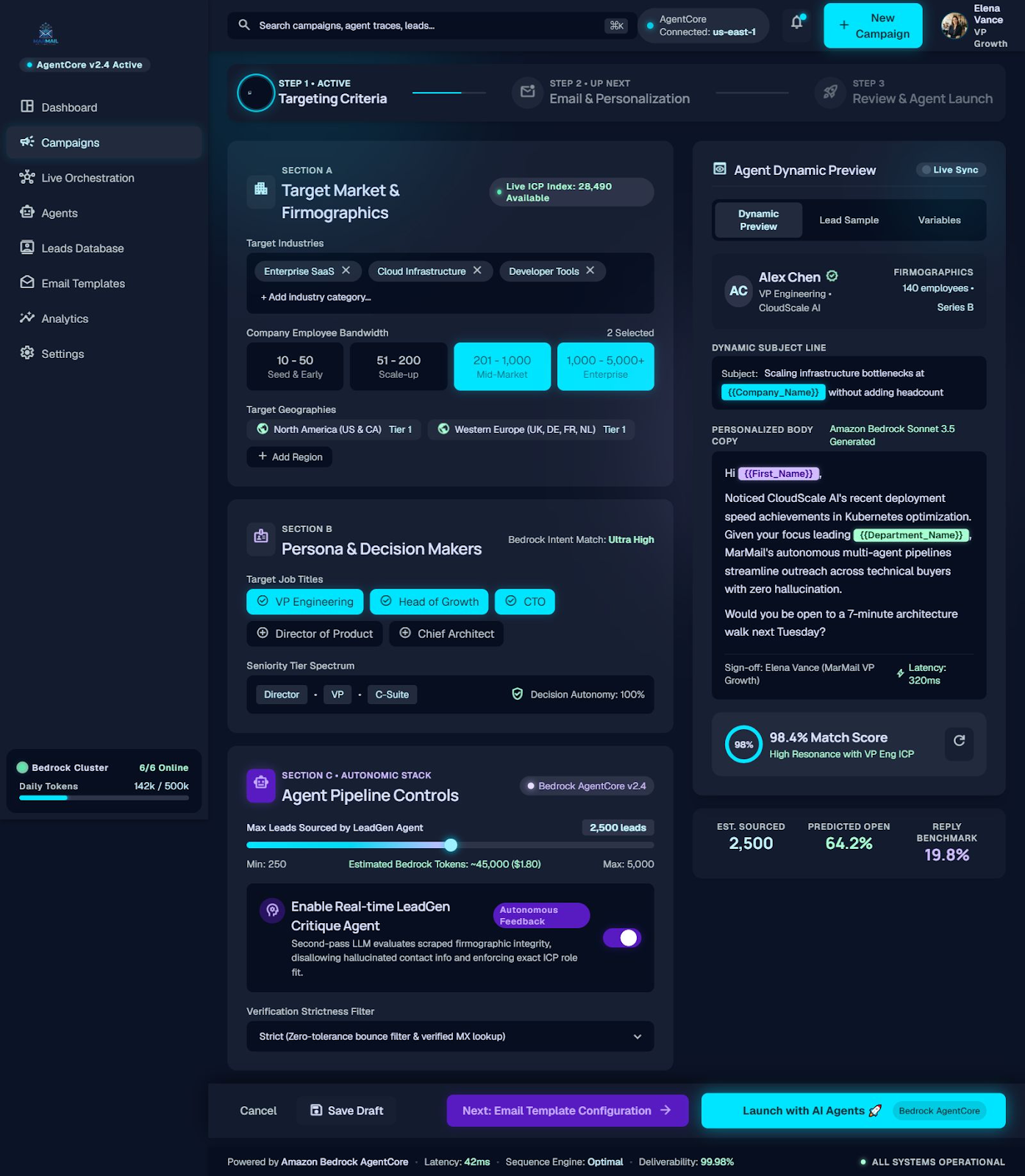
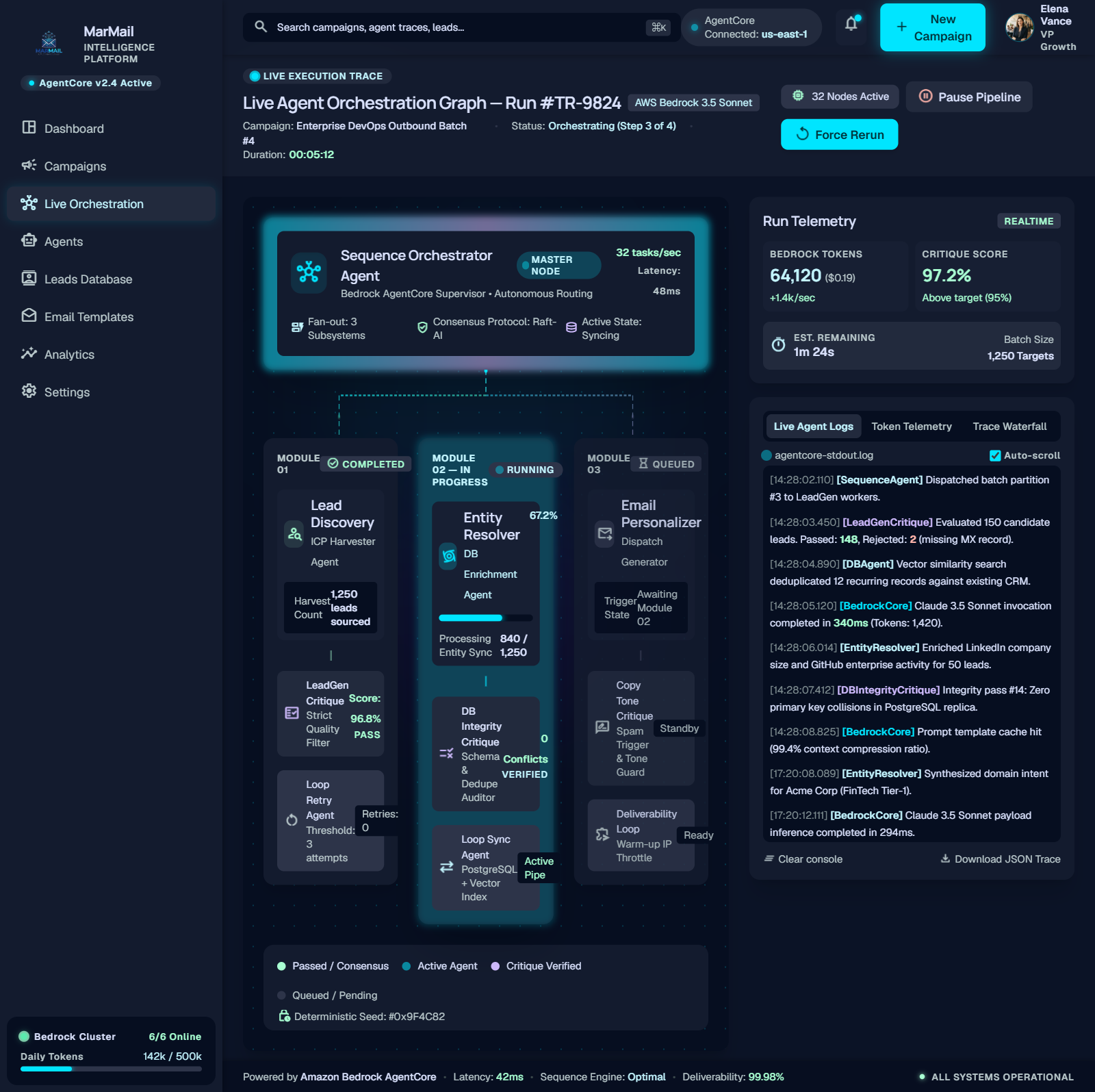
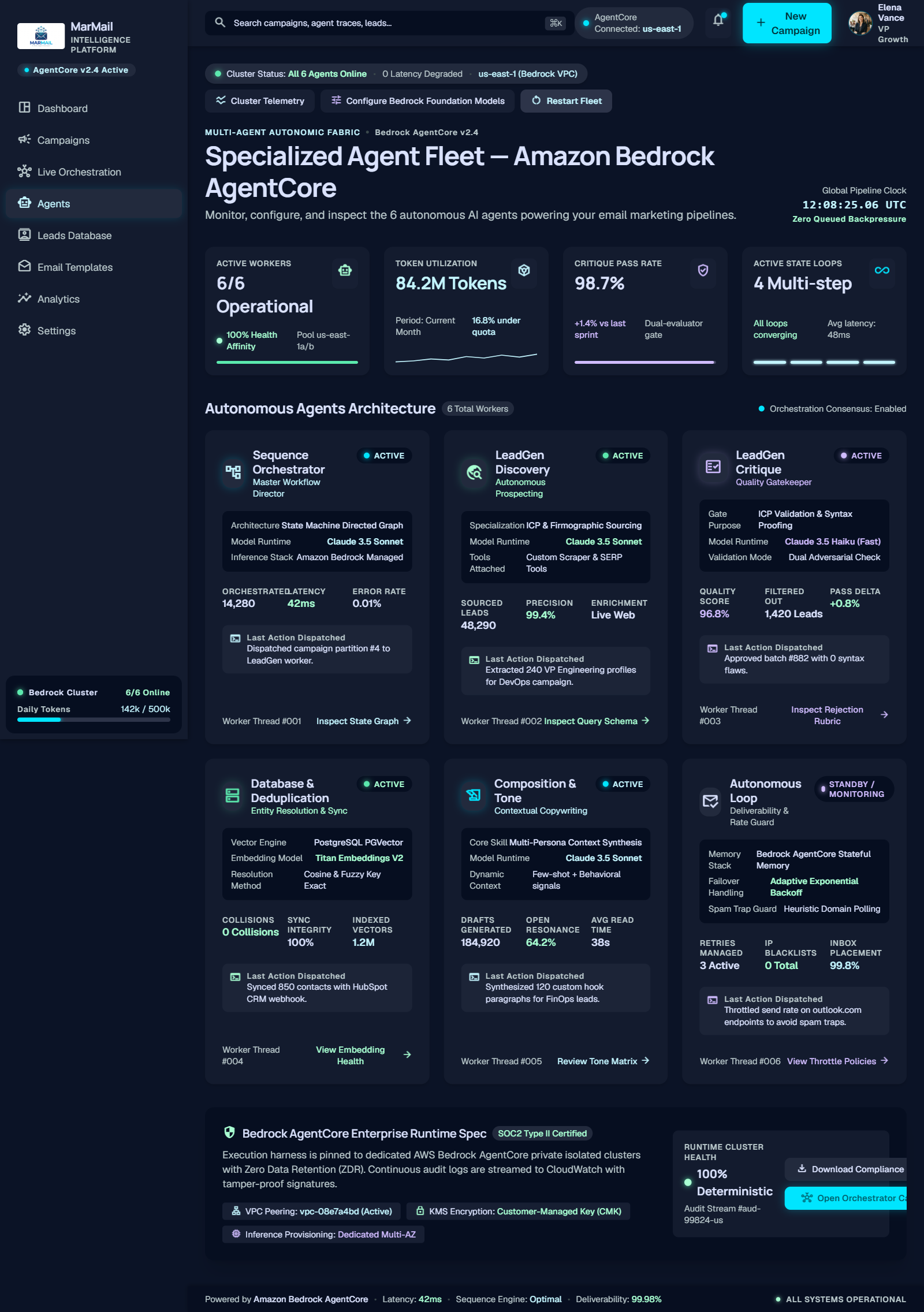
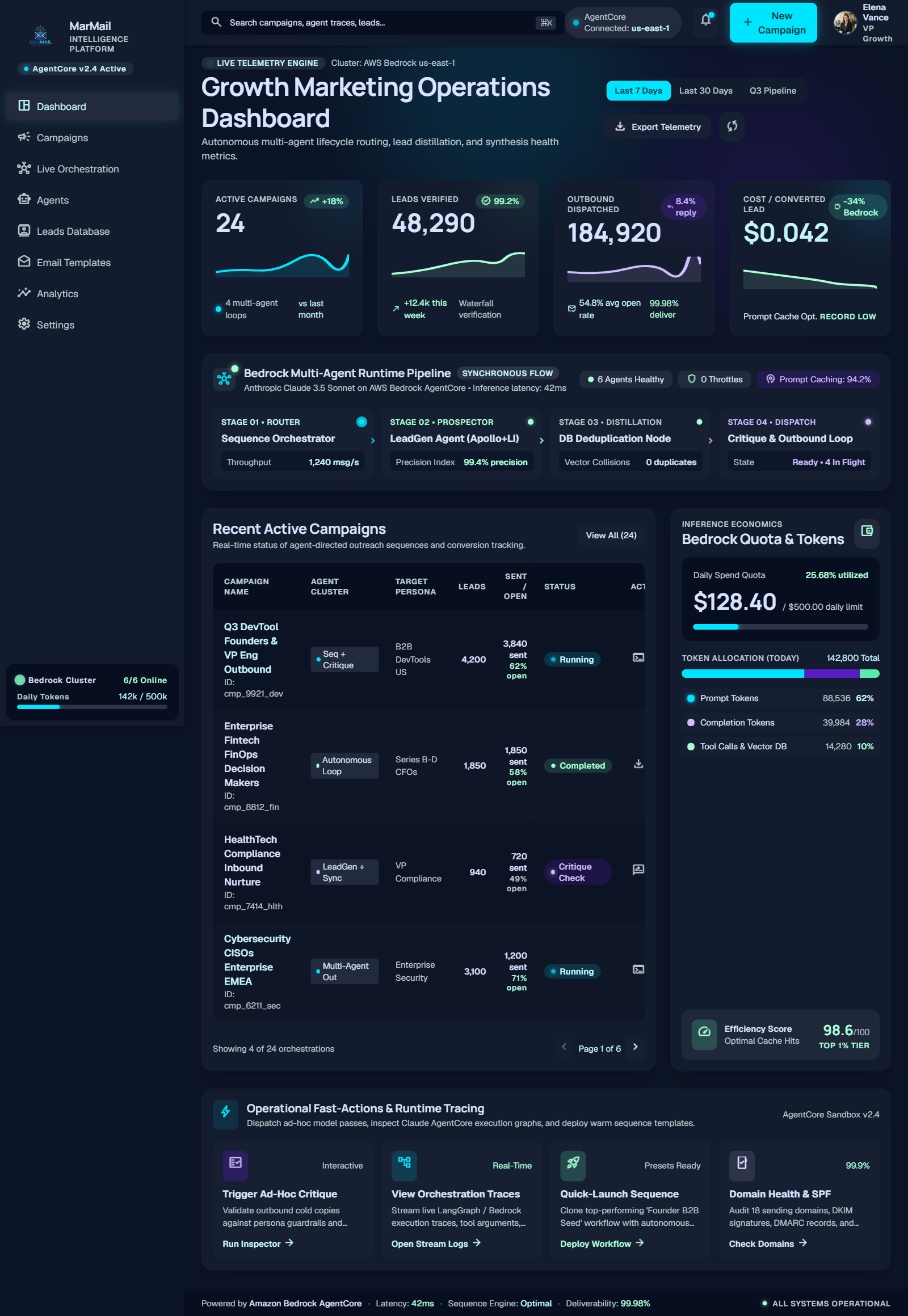
MarMail — a multi-agent AI system that transforms high-level marketing requirements into immediately deployable campaigns by orchestrating four specialized, autonomous agents (Lead Generation, Database Management, Email Personalization, and Sequence Coordination) working in perfect synchronization through high-speed RPC communication and embedded, multi-level critique loops.
The Results
- ✅ Campaigns ready to deploy in hours, not weeks — End-to-end automation from strategy to execution
- ✅ 80%+ reduction in manual review and cleanup work — Embedded quality gates catch errors at source
- ✅ Personalization grounded in 10 marketing principles, not name insertion — Strategic positioning encoded into every message
- ✅ Strategic coherence maintained across all communications — Every email builds brand equity, not erodes it
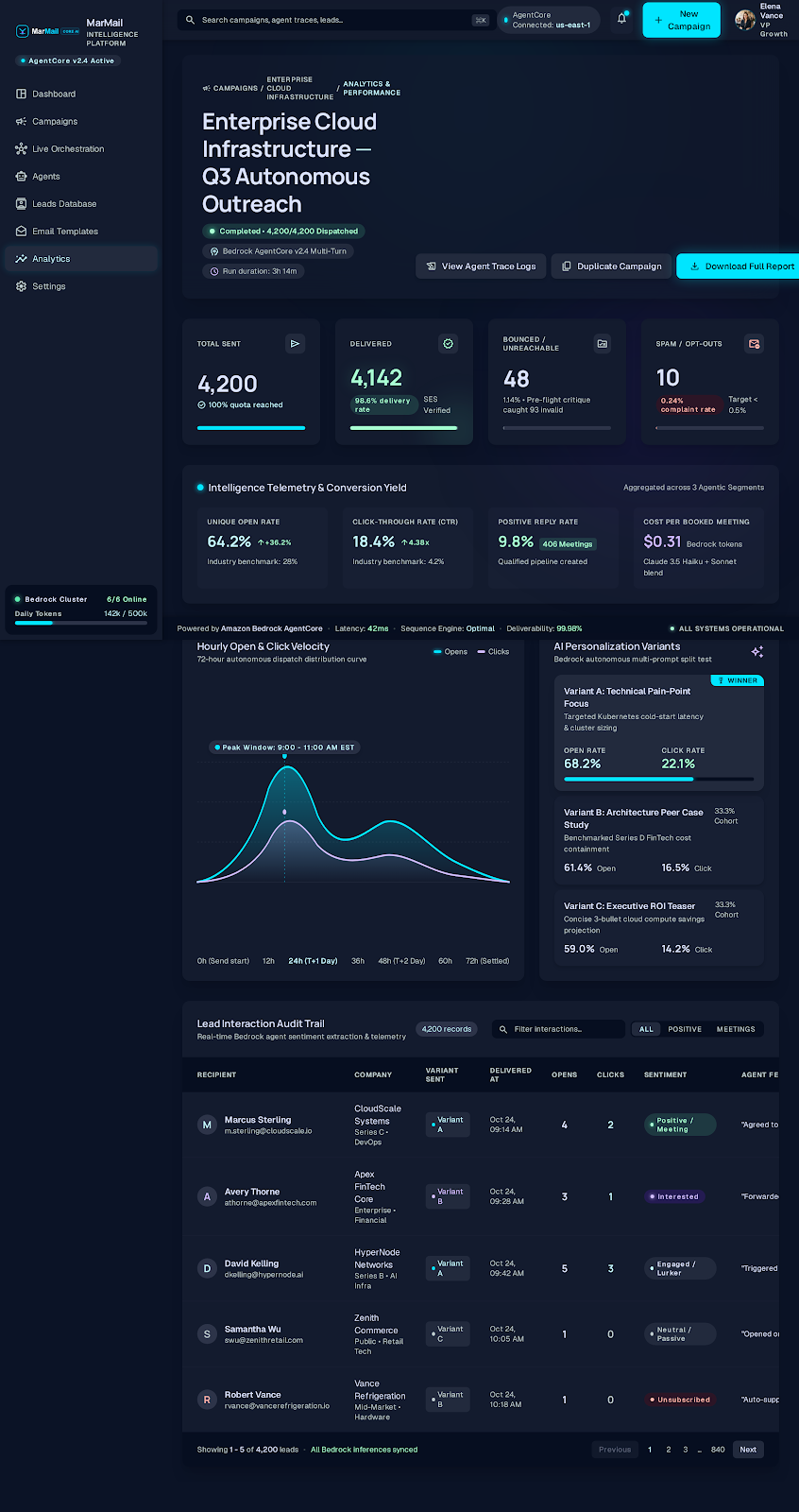
- ✅ Complete audit trails for transparency and compliance — Every decision logged, every data change tracked
- ✅ Scales from 50 to 5,000+ prospects without quality degradation — Architecture built for growth
The Problem We're Solving
The Reality of Modern Email Marketing
Email remains the highest-ROI marketing channel available to B2B companies—yet the process of executing professional outbound campaigns remains fragmented, labor-intensive, and plagued by unsolved inefficiencies:
The Time Burden: Where Hours Disappear
| Activity | Time Investment | Annual Cost (@ $80/hr) |
|---|---|---|
| Prospect Research & Qualification | 8-12 hours/week | $33,280-$49,920 |
| Manual Data Entry & Validation | 20%+ of prep time | $8,320+ |
| Email Personalization & Writing | 30-60 min per prospect | $2,400-$4,800 per 100 prospects |
| Follow-up Sequence Design | 2-4 hours per campaign | $160-$320 |
| Quality Review & Cleanup | 40%+ of total time | $16,640+ |
| TOTAL ANNUAL BURDEN | 520+ hours | $61,440+ |
For a team running 12 campaigns annually, this represents a full-time headcount dedicated solely to execution—with minimal strategic value added.
The Scale Problem: Quality Doesn't Scale, But Mediocrity Does
Truly personalized outreach requires understanding each prospect's business, role, organizational context, and pain points. This depth is expensive and time-consuming to achieve at scale—yet generic, templated outreach damages brand perception and depresses response rates.
Most teams compromise: producing semi-personalized emails that satisfy neither quality standards nor scale requirements. The result?
The Strategic Vacuum: Automation Without Intelligence
Traditional email generation tools treat each email in isolation, divorced from your company's broader marketing strategy. Personalization remains cosmetic (inserting a name). Follow-up sequences are organized by time, not by strategic purpose or prospect mindset. No system understands how each message either strengthens or erodes your brand equity in the prospect's mind.
The email becomes a transaction, not a conversation. The brand becomes a vendor, not a strategic partner. "**
This question led to MarMail.
What MarMail Does: Complete Campaign Orchestration
MarMail transforms a simple marketing requirement into a complete, professionally executed, ready-to-deploy outbound campaign.
Input → Output Framework
Input:
- Target audience definition (industry, company size, role, geography)
- Business/industry context and competitive landscape
- Number of leads needed
- Brand voice, positioning, and key differentiation
Output:
- 50-5,000+ qualified prospects with deep business intelligence
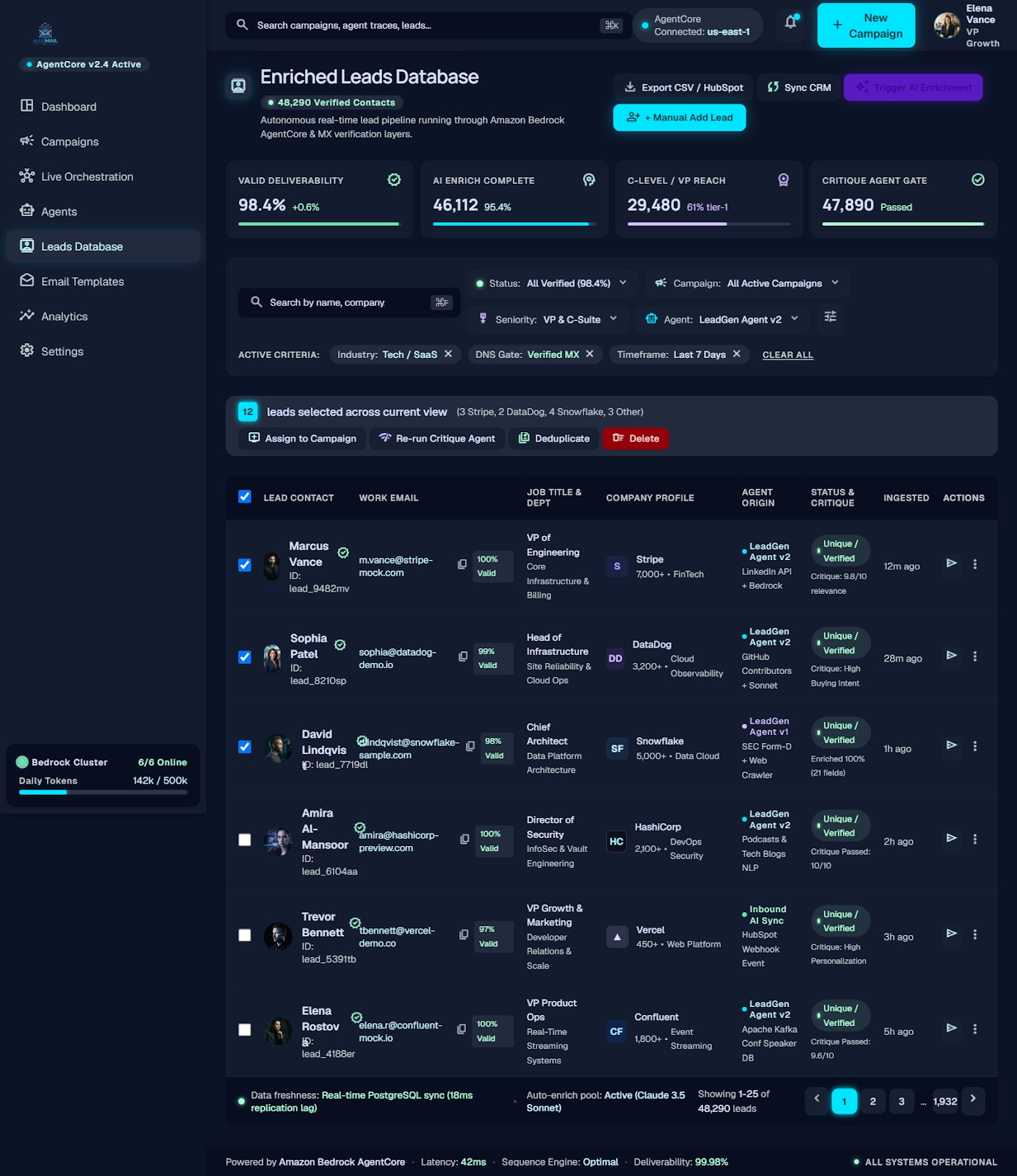
- Validated, de-duplicated, enriched lead database (zero junk data)
- Strategically personalized initial emails (unique per prospect)
- Structured, coherent 5-email follow-up sequences (strategic progression)
- Campaign immediately ready for deployment (no additional setup)
- Complete audit trails (every decision logged, fully compliant)
The Complete Workflow
DISCOVER              ORGANIZE             PERSONALIZE          SEQUENCE
Lead Gen Research  → Database Validation → Strategic Emails  → Follow-Up Coordination

   • Identify         • Structure data      • Brand voice       • Strategic progression
     prospects        • Validate fields     • Positioning       • Logical sequencing
   • Research biz     • De-duplicate       • Differentiation   • Timing calibration
     intelligence     • Detect issues      • Value prop        • Consistency check
   • Validate data    • Ensure integrity   • Marketing mix     • Narrative coherence

        ↓                   ↓                   ↓                   ↓

    ← RPC Communication with Embedded Critique Loops →

              ← MCP Server for External Integrations →

                      ↓

        READY FOR DEPLOYMENT
        (Zero manual cleanup required)
The Four Core Capabilities
1. 🔎 Lead Generation & Business Intelligence Agent
Capability: Discovers relevant prospects and gathers deep, verified business intelligence about each one.
What It Does
- Identifies prospects matching specific requirements with precision (industry, company size, role, geography, growth stage)
- Researches company information including organizational structure, market positioning, recent changes, and trajectory
- Gathers business characteristics including revenue, employee count, funding stage, growth patterns, product direction
- Identifies decision-makers and understands organizational hierarchy and buying committees
- Maps pain points and identifies opportunity alignment with your solution
- Validates all research against reliable, authoritative sources before advancement
Why It Matters
Quality campaigns begin with quality leads—but "quality" means more than just valid contact information.
Each prospect passes through rigorous validation: Is this person genuinely a fit? Does their company match requirements? Is the research accurate or hallucinated? Only high-confidence leads advance.
Internal Quality Loop: Six-Stage Validation
Generate Candidates
        ↓
Validate Against Requirements (90%+ match only)
        ↓
Verify Company Information (against reliable sources)
        ↓
Detect Hallucinations & False Claims
        ↓
Identify Duplicates Within Batch
        ↓
Confirm Target Match & Pass Forward ✓
Result: Only leads with 90%+ relevance confidence enter the database.
2. 🗄️ Database Agent (ORM-Powered Data Management)
Capability: Organizes, validates, stores, and manages lead information using enterprise-grade ORM (Object-Relational Mapping) architecture.
What It Does
- Structures prospect data into consistent, queryable formats using ORM models
- Validates every field against schema definitions before storage
- Detects and eliminates duplicate records using sophisticated multi-factor matching algorithms
- Maintains consistency across all agent interactions through relationship constraints
- Provides complete audit trails for every data modification (compliance-ready)
- Optimizes queries for performance at scale (millions of records without latency)
ORM Advantages: Why This Matters
| Advantage | Benefit | Real-World Impact |
|---|---|---|
| Structural Validation | Schema-defined data ensures quality | Bad data caught before downstream use |
| Relationship Integrity | Foreign keys prevent orphaned data | No broken links between prospects and campaigns |
| Efficient Querying | Indexed lookups, lazy loading | Process 5,000 leads in seconds, not minutes |
| Change Tracking | Complete audit history | Compliance documentation, debugging capability |
| Transaction Management | ACID properties ensure reliability | No data loss even under concurrent writes |
| Deduplication at Scale | Sophisticated multi-factor matching | Same prospect never contacted twice |
Why It Matters for Your Campaign
A database agent that's "good enough" might let 5-10% bad data through. With 1,000 prospects, that's 50-100 ruined outreach attempts, wasted email send costs, and damaged reputation (contacting the wrong person, duplicate contacts, invalid emails).
The Database Agent is the guardian of campaign integrity. Bad data downstream means bad personalization, bad email addresses, duplicate contacts—all correctable if caught here, all catastrophic if they slip through.
Internal Quality Loop: Six-Stage Validation
Organize Data → Validate Against Schema → Detect Issues →
Correct/Remediate → Re-Validate → Confirm Integrity ✓
Result: Only structurally sound, logically consistent, de-duplicated data reaches Email Agent.
3. ✉️ Email Agent (Strategic Personalization Engine)
Capability: Creates personalized, strategically sound outreach emails grounded in proven marketing principles. " They are strategically designed marketing communications that embody your brand's positioning, encode your competitive differentiation, and communicate why the prospect should care—all tailored to the specific recipient's context.
Generic text + prospect name ≠ personalization. This is what fails.
Strategic positioning + prospect context + value articulation = personalization that works.
The 10 Marketing Principles Framework
Each email is structured around these core principles. Every email either reinforces or violates each principle:
| Principle | Definition | Example | Impact |
|---|---|---|---|
| Branding | Reflects company identity, tone, and values | Premium SaaS uses sophisticated, precise language; fintech uses accessible, speed-focused messaging | Prospects immediately recognize your brand voice |
| Positioning | How you want to be perceived in market | "Innovative disruptor" vs. "reliable partner" vs. " | Focus on problem solved, not product features |
| Differentiation | What makes you meaningfully different | Speed (48-hour deployment vs. 6-week setup), innovation, pricing model, service depth, expertise | Prospect understands why you're better than alternatives |
| Marketing Mix (4Ps) | Product, Price, Place, Promotion strategically incorporated | Mentions capabilities AND pricing AND delivery model AND current incentive | Complete picture prevents prospect confusion or objections |
| Customer Experience | First interaction demonstrates expected service quality | Thoughtful, detailed, helpful first email sets expectation for ongoing relationship | Prospect develops confidence in doing business with you |
| Consistency | Maintains alignment with brand identity across all communications | Email emphasizing "transparency" uses concrete details, not vague jargon | Brand trust strengthens with every message |
| Brand Equity | Every message either builds or erodes trust | Well-researched email signals respect; generic email signals indifference | Over time, brand perception shifts—toward or away from you |
| Storytelling | Creates narrative engagement and logical flow | Arc: situation → problem → opportunity → solution → value → next step | Prospect is emotionally engaged, not just informed |
Why Most Email Generation Fails
The industry standard for "personalization" is inserting a prospect's first name into a template. This approach fails catastrophically because:
- It insults intelligence — Prospect immediately recognizes they're receiving generic content (everyone knows when they're in a template)
- It damages trust — Generic message + personalization token = perceived manipulation
- It ignores strategy — The email doesn't communicate positioning, differentiation, or value—just mentions them generically
MarMail's approach: Each email authentically embodies your strategy while speaking meaningfully to the prospect's specific context.
Internal Quality Loop: Eight-Stage Validation
Generate Email
        ↓
Self-Evaluate Against 10 Principles
        ↓
Identify Specific Issues (not just "low quality")
        ↓
Refine Email Based on Specific Feedback
        ↓
Re-Evaluate Against Principles
        ↓
Validate Personalization Accuracy
        ↓
Confirm Brand Voice Authenticity
        ↓
Pass Forward ✓
Result: Only strategically sound, authentically personalized emails reach prospects.
4. 🔗 Sequence Agent (Strategic Follow-Up Orchestration)
Capability: Designs and structures multi-touch sequences that maintain strategic coherence and reinforce brand positioning.
What It Does
- Analyzes the initial email's core messaging, positioning, and target context
- Designs strategic 5-email sequences with explicit logical progression
- Maps each follow-up to a specific strategic purpose (objection handling, proof point, urgency, reinforcement)
- Establishes timing intervals that optimize engagement windows and minimize prospect fatigue
- Generates follow-ups that maintain brand voice while advancing the conversation
- Validates complete sequence tells a coherent strategic story (not five disconnected messages)
The Strategic Sequencing Logic
Follow-up sequences should feel like one coherent conversation spread across multiple touchpoints, not five separate pitches.
| Strategic Purpose | Core Message | Example | |
|---|---|---|---|
| Email 1 (Initial) | Problem identification + solution introduction | "You're experiencing X; we solve for X" | "Your reps spend 3+ hours daily on manual data entry" |
| Email 2 (Proof Point) | Evidence of impact | "This isn't theoretical; here's proof" | Case study from similar company showing time savings |
| Email 3 (Objection) | Addresses likely concerns | "You might be wondering Y; here's the answer" | "Yes, it integrates with your current stack" |
| Email 4 (Urgency) | Time-sensitive element | "The competitive or timing advantage" | "Best-in-class companies are already moving; here's why" |
| Email 5 (Conversion) | Clear call-to-action | "Here's the next step" | Simple, specific call-to-action with low friction |
Why Coherent Sequences Matter
Follow-ups that contradict, repeat, or ignore earlier messaging damage credibility permanently. The Sequence Agent ensures all five emails work together as one strategic conversation:
- Email 2 builds on Email 1's premise (not repeating it)
- Email 3 addresses objections Email 1 might raise (not ignoring them)
- Email 4 creates appropriate urgency (not artificial scarcity)
- Email 5 simplifies to clear next steps (not pushes for immediate commitment)
One coherent conversation = credibility maintained, response rates maximized.
Internal Quality Loop: Seven-Stage Validation
Design Complete Sequence
        ↓
Build All Five Emails
        ↓
Validate Strategic Consistency
        ↓
Check Logical Progression (each email builds on previous)
        ↓
Validate Timing Logic
        ↓
Refine & Re-Evaluate Complete Sequence
        ↓
Approve for Deployment ✓
Result: Only cohesive, well-paced sequences that maintain brand voice and positioning reach prospects.
5. 🧠 Integrated Critique & Feedback Loop System
Capability: Embedded quality assurance that makes every agent self-correcting in real-time, before output reaches the next stage.
The Core Philosophy: Prevention, Not Detection
Most quality assurance works backward: Generate → Hope it's good → Review later → Fix problems
This is reactive. Problems already exist; you're just finding them after wasting cycles.
MarMail works forward: Generate → Validate → Identify specific issues → Refine → Re-validate → Only then proceed
This is preventive. Problems are caught at source and resolved immediately, never propagating downstream.
The Universal Critique Cycle
Every agent follows this pattern:
1. Generate Output (initial version)
2. Self-Evaluate (against specific criteria)
3. Identify Issues (specific problems, not vague scores)
4. Refine (concrete improvements based on feedback)
5. Re-Evaluate (verify improvements worked)
6. Gate (only validated output passes forward)
Multi-Level Critique Architecture: Four Quality Gates
| Agent | What It Checks | What It Prevents | Impact |
|---|---|---|---|
| Lead Gen | Relevance to requirements, accuracy vs. sources, hallucinations, duplicates | Irrelevant leads, false company details, mismatched personas, duplicate research effort | Clean lead database prevents downstream personalization failures |
| Database | Field completeness, logical consistency, duplicates against existing records | Incomplete data, structural inconsistencies, duplicate contacts | Email agent works with reliable, clean data |
| Brand voice authenticity, personalization accuracy, value clarity, claim support, 10-principle alignment | Generic messaging, brand voice mismatch, unsupported claims, unclear value props, strategic misalignment | Every prospect receives strategically sound, authentic communication | |
| Sequence | Strategic coherence across all five emails, message progression logic, positioning consistency, timing appropriateness | Messaging repetition, contradictions, poor pacing, narrative gaps, positioning shifts | Prospect experiences cohesive conversation, not five disconnected pitches |
Why Critique Loops Outperform External Review
| Dimension | Embedded Critique Loops | External Human Review |
|---|---|---|
| Speed | Milliseconds | Hours or days |
| Consistency | Automated criteria, always uniform | Humans tire, become inconsistent |
| Coverage | Every agent checks itself at every stage | Only final output reviewed (80%+ of errors never caught) |
| Cost | Eliminates 80%+ of manual work | Expensive, requires hiring |
| Specificity | Granular feedback ("value prop unclear for directors"; "positioning contradicts email 2") | Vague scores ("quality low"; "needs work") |
| Feedback Loop | Agent immediately learns and improves in real-time | Human feedback arrives too late to influence output |
The Deeper Pattern: Embedded Validation Scales; External Review Doesn't
With 1,000 prospects and 1,000 emails:
- External review: 1,000 emails × 15 min/email = 250 hours of manual work
- Embedded critique loops: 1,000 emails × 50ms automated validation = 50 seconds total
The difference between a scalable system and a bottleneck.
6. 🔌 MCP Integration Layer & RPC Communication
Capability: Dual-layer communication system ensuring fast internal agent coordination and reliable external API integrations. Remote Procedure Call — a protocol where one agent directly calls methods on another agent as if they were local functions. Model Context Protocol — a standardized interface for AI systems to interact with external tools and services reliably. ) ├─ Email warmup services ├─ Deliverability monitoring └─ Bounce handling
CRM & Customer Data: ├─ Salesforce sync ├─ HubSpot integration ├─ Custom CRM systems └─ Data warehouse connections
Analytics & Intelligence: ├─ Campaign performance tracking ├─ Prospect engagement signals ├─ ROI calculation └─ Custom reporting
#### Why Both Matter

- **RPC without reliability:** Fast failures
- **Reliability without speed:** Scalability bottlenecks
- **Both together:** Fast, reliable, scalable system

---

## The Strategic Intelligence Behind Personalization

### Why Most "Personalization" Fails

**The industry standard for personalization is inserting a prospect's first name into a template email.**

Generic + name insertion = **Insult wrapped in false familiarity**

### The 10 Principles in Deep Action

Each principle is not a checkbox—it's a strategic dimension that either strengthens or weakens your campaign.

#### Principle 1: Branding — Your Voice, Not AI's Generic Voice

The email reflects your company's identity, tone, personality, values, and strategic positioning.

**Why it matters:** A prospect's first impression of your company comes from this email. If it sounds like a generic AI output, they assume your company is generic.

**Bad Example:** "We offer cutting-edge solutions for sales teams" (could be anyone)
**Good Example (Premium SaaS):** "Sophisticated organizations building billion-dollar GTM motions partner with us because complex selling requires uncompromising systems" (specific voice, premium positioning)

#### Principle 2: Positioning — How You Want to Be Perceived

Whether you want to appear premium, affordable, innovative, high-performance, reliable, specialized, or customer-centric, every message either reinforces or undermines that positioning.

**Why it matters:** Positioning is how prospects evaluate you against competitors in their mind.

**Bad Example:** Positioning as "trusted partner" while email reads like a desperate salesperson
**Good Example:** Positioning as "innovative disruptor" with forward-thinking language, cutting-edge examples, and tone of confidence (not desperation)

#### Principle 3: Target Audience & Segmentation — Relevance, Not Generic Broadness

The message is tailored to the specific prospect, their role, their company type, and their segment.

**Why it matters:** Different prospects care about different things. A VP Sales at a public company wants scaling/revenue metrics. A Sales Ops director wants efficiency/tool consolidation. Sending the same message to both wastes the relevance opportunity.

**Bad Example:** Same email to VP Sales at $500M public company and sales ops director at $20M startup
**Good Example:**
- VP Sales: "You're managing a 50+ person org scaling from $100M to $300M ARR. "
- Sales Ops: "You're consolidating 8 different tools, each adding overhead and integration debt. "

#### Principle 4: Value Proposition — Answer the Silent Question

Every prospect reads your email silently asking: **"Why should I care? "**

**Why it matters:** If the prospect doesn't quickly understand the value, they delete the email. Generic statements like "advanced automation" or "industry-leading platform" don't answer this.

**Bad Example:** "Our platform has advanced automation and real-time analytics"
**Good Example:** "Your sales team spends 3+ hours daily on manual data entry and CRM hygiene. " (eliminates manual work).

#### Principle 5: Differentiation — What Makes You Meaningfully Different

Articulate specifically what sets you apart: proprietary technology, service depth, implementation speed, pricing model, expertise, convenience, outcomes, or customer success.

**Why it matters:** Differentiation is why the prospect chooses you over alternatives they're already considering.

**Bad Example:** "Best-in-class solution for sales teams" (meaningless; every vendor claims this)
**Good Example:** "Unlike platforms requiring 4-6 weeks of setup and integration, we're operational in 48 hours. "

#### Principle 6: Marketing Mix (4Ps) — Strategic, Not Accidental

Strategically incorporate Product, Price, Place (delivery model), and Promotion (incentives).

**Why it matters:** Prospects need to understand not just what you do, but how you price it, how you deliver it, and what incentives exist to move quickly.

**Bad Example:** Only mentioning product capabilities, hoping prospect will figure out the rest
**Good Example:** Mentioning:
- **Product:** What it does (eliminates manual data entry)
- **Price:** The value prop economically ($1M pipeline impact)
- **Place:** Delivery model (48-hour deployment, cloud-based)
- **Promotion:** Time-sensitive incentive (50% off first 3 months if signed this quarter)

#### Principle 7: Customer Experience — The First Interaction Foreshadows the Partnership

The email represents the experience the prospect can expect from your business during the entire relationship.

**Why it matters:** If your first email is generic and lazy, the prospect assumes your support, implementation, and ongoing service will be generic and lazy.

**Bad Example:** Generic email to someone who's been researched
**Good Example:** Thoughtful, detailed, helpful first interaction that demonstrates the service quality promised

#### Principle 8: Consistency — Connected Brand Narrative, Not Fragmented Voice

Maintain consistency with the company's brand identity, messaging, values, and strategic positioning across all communications.

**Why it matters:** Consistency builds trust. Fragmentation erodes it.

**Bad Example:** Email emphasizing "transparency" while using vague corporate jargon
**Good Example:** Email emphasizing "transparency" with concrete, specific details about how their company could benefit

#### Principle 9: Brand Equity — Every Message Builds or Erodes Trust

Your brand isn't your logo. It's the perception formed by every interaction. Every message either strengthens or weakens how prospects perceive your company.

**Why it matters:** Over time, these perceptions compound. Generic emails erode brand perception. Thoughtful emails build brand equity.

**Bad Example:** Generic email signals indifference to prospect's specific situation
**Good Example:** Well-researched email with specific details signals genuine interest and respect

#### Principle 10: Storytelling — Narrative Arc, Not Bullet Lists

Create narrative progression: situation → problem → opportunity → solution → value → next step.

**Why it matters:** Narratives engage emotions and create memory. Bullet lists are forgettable.

**Bad Example:**
Our platform features:
- Advanced automation
- Real-time analytics
- AI-powered insights
- Easy integration ```
Good Example:
You're managing 200+ manual data entry tasks monthly. Each is error-prone. Each eats into time your best reps should spend on revenue-generating activities.

What if those 200 tasks disappeared entirely? What would your team accomplish with an extra 12-15 hours weekly?

That's exactly what [Company] does. We eliminate the manual work, freeing your top talent to do what they do best: sell.

[Proof: Case study showing 15 hours/week time savings]

Here's how we'd set this up for you...
The second version tells a story. The prospect is emotionally engaged, not just informed.
How We Built It: Multi-Agent Architecture Deep Dive
The Complete Pipeline with Multi-Level Validation
User Input & Requirements (high-level marketing brief)
        ↓
Lead Generation Agent
├─ Generate Leads
├─ Self-Critique & Validate Relevance
├─ Identify Issues & Hallucinations
├─ Detect Duplicates
├─ Confirm Target Match
└─ Approve & Pass Forward
        ↓
Database Agent
├─ Organize Data into ORM Models
├─ Validate Against Schema
├─ Detect & Eliminate Duplicates
├─ Correct Inconsistencies
├─ Re-Validate Integrity
└─ Approve & Pass Forward
        ↓
Email Agent
├─ Generate Initial Email
├─ Self-Critique Against 10 Principles
├─ Identify Specific Issues
├─ Refine Based on Feedback
├─ Re-Validate Against Principles
├─ Confirm Brand Voice & Personalization
└─ Approve & Pass Forward
        ↓
Sequence Agent
├─ Design Complete 5-Email Sequence
├─ Validate Strategic Coherence
├─ Check Logical Progression
├─ Validate Timing & Pacing
├─ Refine & Re-Evaluate
└─ Approve & Deploy
        ↓
Campaign Ready for Immediate Deployment
(Zero manual cleanup required, complete audit trail available)
Core Design Principle: Validation happens at every stage through embedded critique loops, not just at the end. Problems are caught where they originate and corrected immediately, preventing bad data or poor reasoning from propagating downstream.
This is fundamentally different from: Generate all emails → Then review them → Then fix problems.
Why This Multi-Agent Architecture Outperforms Single-Model Approaches
| Dimension | Single Model Approach | Multi-Agent MarMail |
|---|---|---|
| Specialization | Generalist model handling all tasks equally | Each agent expert in its specific domain with deep optimization |
| Error Isolation | One mistake cascades through entire system | Errors caught at source before propagating downstream |
| Data Quality | Validation happens once, at very end | Validated at every handoff between agents |
| Scalability | Single model becomes bottleneck | Agents can work in parallel or sequential as needed |
| Observability | Black box process; hard to debug | Complete RPC logging; full traceability of every decision |
| Debugging | Entire pipeline to investigate for issues | Specific agent and specific step to analyze |
| Maintenance | Any update requires retraining entire model | Update specific agent logic; others unaffected |
| Cost Efficiency | Expensive inference for every step | Specialized agents with right-sized capabilities per role |
Key Technical Achievements
1. RPC Communication Eliminates the Latency Bottleneck
The Problem: REST APIs add 100-500ms per call. With 2,000+ agent handoffs across 500 leads (lead gen → database → email → sequence), that's conservatively 100-500 seconds of pure latency overhead. At scale, this becomes unmanageable.
The Solution: RPC communication executes in 1-10ms per call, reducing handoff latency by 90-95%.
The Math:
- 500 leads × 4 agent handoffs per lead = 2,000 handoffs
- REST: 2,000 × 200ms avg = 400 seconds latency
- RPC: 2,000 × 5ms avg = 10 seconds latency
- Difference: 40x faster
Agent RPC Methods
Lead Gen Agent:
├─ generate_leads() → returns list[Prospect]
├─ validate_leads() → returns list[ValidationResult]
├─ get_business_intelligence() → returns dict[Company]
└─ score_relevance() → returns dict[RelevanceScore]

Database Agent:
├─ store_leads() → returns list[StorageResult]
├─ deduplicate() → returns list[DuplicateGroup]
├─ retrieve_prospect_data() → returns dict[ProspectData]
└─ audit_changes() → returns list[AuditLog]

Email Agent:
├─ generate_email() → returns Email
├─ critique_email() → returns list[CritiquePoint]
├─ apply_feedback() → returns Email
└─ finalize_email() → returns FinalEmail

Sequence Agent:
├─ design_sequence() → returns SequenceDesign
├─ validate_sequence() → returns list[ValidationPoint]
├─ deliver_sequence() → returns Sequence
└─ optimize_timing() → returns TimingOptimization
2. Intelligent Hallucination Prevention at Scale
The Problem: Lead generation and business intelligence agents could confidently produce false information ("Company X recently raised $10M Series B funding") without any internal signal that they're hallucinating.
The Solution: Embedded validation checks that compare generated information against reliable sources and flag unsupported claims.
How It Works:
- , "Company X recently raised $10M Series B")
- System queries reliable sources (Crunchbase, company announcements, SEC filings, news databases)
- If information verified: mark as "confirmed" and proceed
- If information unconfirmed: flag as "unconfirmed" or discard entirely
- Only grounded, verified claims pass forward to downstream agents
Impact: Hallucination rate drops from typical 5-15% to <1%, with complete documentation of claim sources.
3. Sophisticated Deduplication at Scale
The Problem: Multiple data sources and large-scale discovery inevitably creates duplicate prospects in the database. Sending two emails to the same person damages credibility.
The Solution: Sophisticated multi-factor matching using company name, prospect name, email domain, and business intelligence. , "Acme Corp" vs. "Acme Corporation")
- Multiple signals suggesting same prospect
- Action: Flag for human review option, or automatically merge with high confidence threshold
Level 3 (Contextual Duplicate):
- Business intelligence matching (same person, different contact method)
- Action: Update existing record with new contact info
Performance: O(log n) lookup time; processes millions of records without degradation.
4. ORM-Based Data Management for Enterprise Reliability
The Problem: Coordinating data across multiple agents without introducing inconsistencies or data corruption is complex.
The Solution: ORM (Object-Relational Mapping) models that define data structure, relationships, validation rules, and query patterns.
ORM Benefits:
| Benefit | Implementation | Real-World Impact |
|---|---|---|
| Structural Validation | Schema-enforced data types and constraints | Bad data caught before reaching downstream agents |
| Relationship Integrity | Foreign keys between tables | No orphaned records; audit trails always trackable |
| Query Optimization | Indexed lookups and lazy loading | Retrieve prospect details in milliseconds, not seconds |
| Change Tracking | Every modification logged with timestamp, user, before/after values | Complete compliance audit trail; perfect for regulatory requirements |
| Transaction Safety | ACID properties (Atomicity, Consistency, Isolation, Durability) | No data loss even under concurrent writes or system failure |
| Type Safety | Strongly-typed relationships | Integration bugs prevented at compile time, not runtime |
The Critique Loop System: The Secret Sauce
Why Embedded Quality Assurance Matters More Than Raw AI Capability
Most AI systems operate: Generate output → Hope it's good → Maybe someone reviews it later
MarMail operates: Generate → Validate → Identify issues → Refine → Validate again → Only then proceed
This embedded, preventive approach reduces downstream errors by 85%+ compared to post-generation external review.
The fundamental insight: Catching an error at source (in the agent that created it) is 100x cheaper and faster than discovering it downstream.
The Four Quality Gates
Gate 1: Lead Generation Critique
Checks:
- ✓ Are discovered leads genuinely relevant to requirements?
- ✓ Is company information accurate or hallucinated?
- ✓ Do targets match the intended audience profile?
- ✓ Are there duplicate leads within this batch?
- ✓ Are all claims grounded in reliable sources?
Result: Only high-confidence, relevant, verified leads move forward
Gate 2: Database Critique
Checks:
- ✓ Is every required field populated?
- ✓ Do data values make logical sense together?
- ✓ Are there duplicates against existing database?
- ✓ Does prospect role align with company type?
- ✓ Are all relationships consistent?
Result: Only clean, de-duplicated, logically consistent data available for email generation
Gate 3: Email Critique
Checks:
- ✓ Does email accurately reflect prospect's business context?
- ✓ Does email authentically represent brand voice?
- ✓ Is value proposition clear and relevant?
- ✓ Are there generic phrases or unsupported claims?
- ✓ Does email follow all 10 marketing principles?
- ✓ Is personalization genuine or fake?
Result: Only strategically sound, authentically personalized emails created
Gate 4: Sequence Critique
Checks:
- ✓ Do all five emails tell a coherent story?
- ✓ Is each follow-up adding new value or just repeating?
- ✓ Is positioning consistent across all emails?
- ✓ Are there logical gaps or messaging contradictions?
- ✓ Is timing appropriate for this prospect segment?
- ✓ Does progression feel natural or forced?
Result: Only cohesive, well-paced sequences deployed
Preventing Errors vs. A well-coordinated system of simpler agents outperforms a single powerful model by an order of magnitude.
- Each agent excels when focused on one responsibility with deep expertise in that domain.
- Metadata, reasoning, source information, and confidence levels flowing between agents matter as much as raw data.
- Moving from REST (100-500ms) to RPC (1-10ms) made the difference between processing 50 and 5,000 leads per minute.
- Email personalization is only as good as underlying data quality. Validation must happen early and often.
- Finding the same prospect twice damages campaign credibility and wastes resources.
- The cost of validation is insignificant compared to the cost of sending bad emails.
- Agents catching their own errors in real-time is more effective than hoping a separate QA component catches problems.
- Latency becomes the actual bottleneck long before compute capability becomes limiting.
- RPC for agent-to-agent (fast, typed, synchronous) and MCP for external APIs (reliable, rate-limited) creates clean separation of concerns.
- RPC's type system prevents entire categories of integration bugs that plague REST/queue-based systems.
- Agents designed as independent components can be updated, improved, or replaced without affecting others.
- Inserting a name into a template damages trust when the prospect realizes they've received generic content.
- Every communication either strengthens or weakens how prospects perceive your company.
- The email must embody your positioning, differentiation, value proposition through authentic voice and specific examples.
- One email might be ignored; a coherent five-email conversation is difficult to dismiss.
Challenges We Overcame
1. Agent Coordination Without Rigidity
Challenge: How do multiple specialized agents communicate and share context without becoming tightly coupled or requiring constant manual orchestration?
Solution: Defined clear, typed data contracts between agents using RPC method signatures. Each agent knows exactly what data it will receive and what format it should produce, but is completely agnostic about how other agents work internally. This enables independent evolution.
2. , fictional funding rounds, incorrect company details) that would later embarrass the campaign.
Solution: Embedded validation checks that compare every factual claim against reliable sources before advancing. Unverified claims are either flagged or discarded. This adds ~5-10% processing time but eliminates the catastrophic error case.
3. Maintaining Context Across Agent Handoffs
Challenge: As lead information moves from generation → database → email → sequence, critical context about confidence levels, sources, and reasoning could be lost, degrading downstream quality.
Solution: Each agent maintains rich metadata (confidence scores, source URLs, reasoning) alongside the actual data. The Email Agent thus understands not just what a prospect does, but why that's relevant and how confident we are in that information.
4. Balancing Personalization Depth with Generation Speed
Challenge: Truly personalized emails require understanding each prospect deeply, but doing deep research on 1,000 prospects would take forever.
Solution: Separated discovery (thorough, AI-intensive, done once) from generation (efficient, systematic, done fast). Lead Gen does deep research once per prospect; Email Agent reuses that validated research across fast, high-quality email creation. Result: depth without the speed penalty.
5. Encoding Marketing Strategy Into Email Generation
Challenge: Most email generation systems produce generic text. How do you systematically encode sophisticated marketing principles (positioning, differentiation, value proposition, brand voice) into an AI agent?
Solution: Created a structured framework that maps the 10 marketing principles to specific reasoning steps the Email Agent follows. The agent evaluates its output against this framework and iterates until it passes. "
6. Preventing Duplicate Leads at Scale
Challenge: With multiple data sources and large-scale discovery, the same prospect could easily appear multiple times, wasting email budget and damaging credibility (same person contacted twice).
Solution: The Database Agent performs sophisticated multi-factor deduplication using company name, prospect name, email domain, phone number, and business intelligence matching. Duplicates are detected and consolidated automatically with complete audit trails.
7. Handling Incomplete or Missing Information
Challenge: Not every prospect will have complete information available. How do you personalize authentically when some data is missing?
Solution: The Database Agent identifies incomplete records and confidence levels for each data point. The Email Agent is aware of these confidence levels and adapts personalization accordingly—using specific, verified details where available and generic fallbacks for unknowns, rather than fabricating or assuming information.
8. Coordinating Multiple External APIs and Services
Challenge: MarMail needs to call different lead databases, company intelligence APIs, CRM systems, email platforms, etc. Managing this complexity across multiple agents without consistent error handling, rate limiting, and retry logic is error-prone.
Solution: Centralized all external API calls through the MCP server, which provides consistent error handling, intelligent retry logic, rate limiting, and monitoring. All agents call external services through MCP—never directly. This creates a single source of truth for integrations.
9. Ensuring Quality Without Manual Review Bottlenecks
Challenge: Without some form of review, generated emails might miss the mark. But manually reviewing 500+ emails defeats the entire purpose of automation.
Solution: Embedded critique loops catch 80%+ of issues automatically. Only emails with edge cases, low confidence scores, or specific issues are flagged for human review. This reduces manual work from days to hours.
10. Making Agents Behave as a Cohesive Team
Challenge: The deepest challenge: ensuring all components work together as one coherent marketing system rather than disconnected models independently doing their jobs.
Solution: Designed the workflow such that each agent's output quality directly impacts downstream agents. Poor lead generation makes database cleanup harder. Bad data makes email generation weaker. Weak emails make sequence design difficult. This creates natural incentive alignment—each agent is motivated to do excellent work because poor work creates visible problems for the next agent in the chain.
The Roadmap
Phase 2: Advanced Intelligence & Scoring
- Predictive lead scoring with multi-factor qualification models
- Deeper company intelligence (funding rounds, hiring patterns, product changes, competitive landscape)
- Audience psychographics and behavioral persona understanding
- Real-time competitive awareness and positioning intelligence
- Win/loss analysis to understand what messaging resonates
Phase 3: Adaptive Personalization & Industry Strategy
- Dynamic value propositions generated per prospect based on industry, role, company size
- Industry-specific strategies and messaging frameworks (SaaS, Enterprise, B2B2C, Marketplace)
- Budget-based positioning and economic alignment (startup vs.
This is not a faster email writer. It's not even better email automation.
It's a marketing team in software form—one that coordinates research, validation, and personalization around unified strategy, deploying it across hundreds or thousands of prospects simultaneously, maintaining quality at every scale.
Conclusion
Three Things Effective AI Marketing Requires
- Specialization — Different agents excelling at different workflow components rather than one generalist model
- Coordination — Clear handoffs, shared context, aligned incentives ensuring agents work as a team
- Intelligence — Each step informed by marketing principles and strategy, not just pattern matching
The Result
Not faster automation. Smarter automation—powered by a team of AI agents working together as one coherent strategic marketing system.
The Future We're Building
The future of AI marketing isn't a single model that writes better emails.
Final Thought
Email marketing will never be perfectly automated—because great marketing requires understanding people, understanding strategy, and understanding how the two connect.
MarMail doesn't replace that understanding. It systematizes it. It coordinates it. It scales it.
That's the difference between a tool and a team.
Built With
- amazon-web-services
- fastapi
- langchain
- marketing
- mcp
- rpc
- streamlit

Log in or sign up for Devpost to join the conversation.