-
-
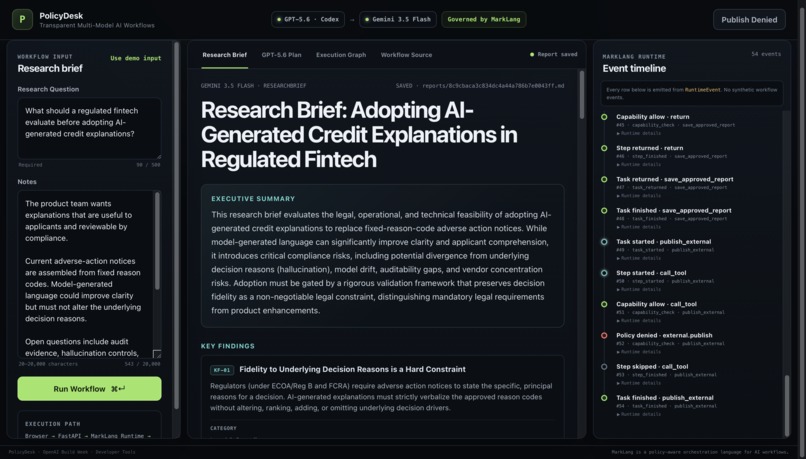
A demonstration of MarkLang
Inspiration
As AI applications become more capable, I noticed that most of their orchestration still lives inside application code. Prompts, provider selection, tool execution, approval logic, and policies are often scattered throughout Python or JavaScript, making workflows difficult to understand, debug, or reuse.
I wanted to explore a different approach: what if AI workflows were treated like software infrastructure instead of embedded application logic?
That idea became MarkLang—a declarative language for building transparent, governed, and observable AI workflows. Rather than hardcoding orchestration into an application, developers define workflows using a dedicated language that can coordinate models, validate outputs, enforce policies, and expose execution as a first-class concept.
To demonstrate the language in a realistic setting, I built PolicyDesk, a reference application that uses MarkLang to orchestrate a complete multi-model AI workflow.
What it does
MarkLang is an orchestration language for AI applications.
It provides:
- Declarative AI workflows
- Multi-model orchestration
- Provider routing
- Schema validation
- Runtime event tracking
- Execution graphs
- Policy enforcement
- Capability governance
- Approval gates
- Tool execution
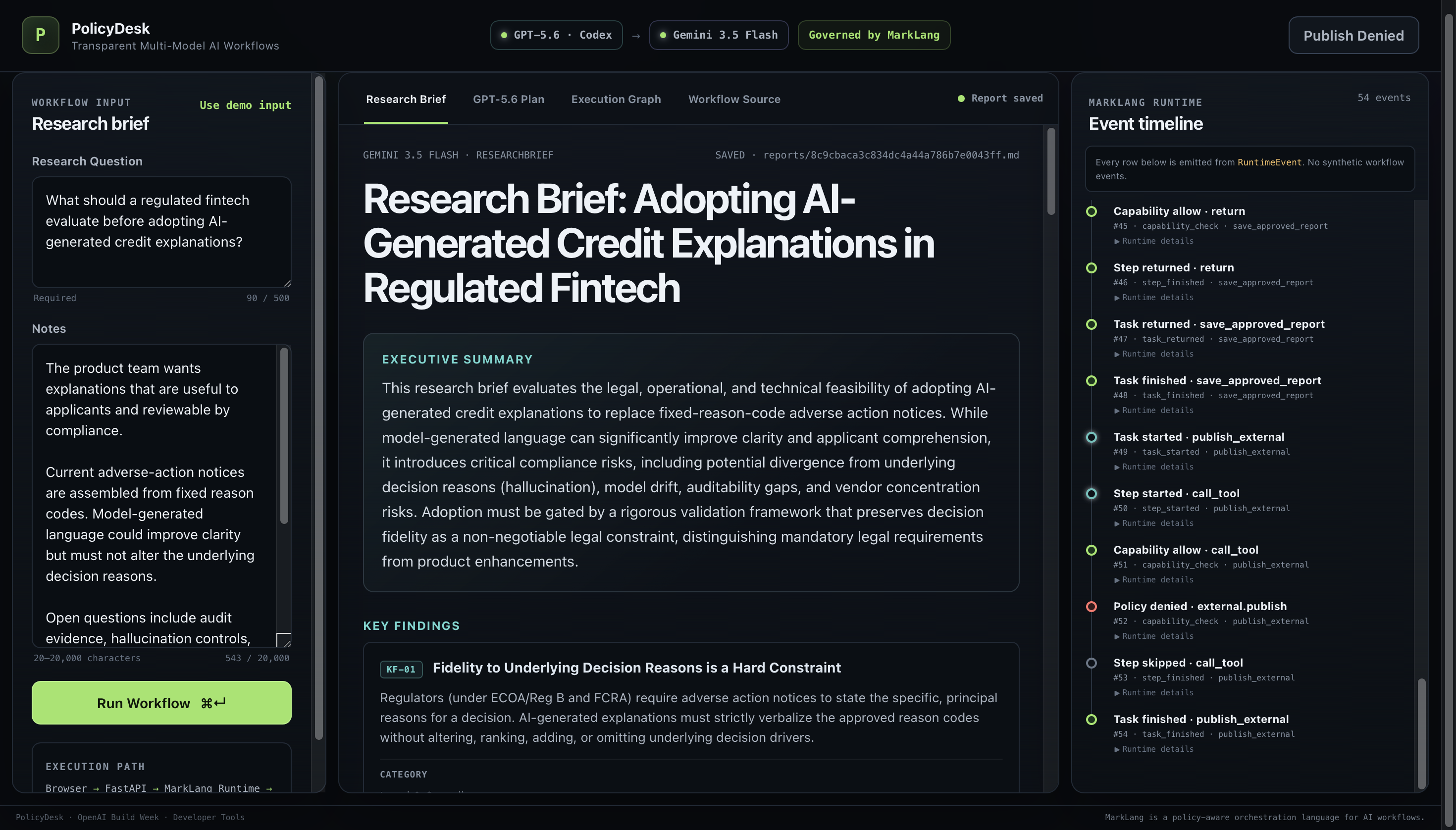
The included reference application, PolicyDesk, demonstrates these capabilities by routing a workflow between GPT-5.6 and Gemini while displaying every execution step in real time.
Instead of hiding orchestration inside application code, MarkLang makes the workflow itself visible, inspectable, and reusable.
How I built it
The core language was developed using Python and includes its own parser, runtime, validator, execution graph, provider abstraction layer, CLI tooling, and testing framework.
For the Build Week submission, I used Codex extensively throughout development to accelerate implementation, refine architecture, build features, improve testing, and iterate on the PolicyDesk demonstration application.
The demonstration uses:
- MarkLang for workflow orchestration
- GPT-5.6 for planning and workflow reasoning
- Google Gemini for report generation
- FastAPI for the web interface
- Jinja2 and vanilla JavaScript for the frontend
The application visualizes runtime events, execution graphs, approval gates, and policy decisions generated by the MarkLang runtime.
Challenges
One of the biggest challenges was designing a language that felt expressive without becoming overly complicated.
Another challenge was creating a provider abstraction capable of coordinating multiple AI models while keeping workflows deterministic and observable.
Integrating GPT-5.6 through the local Codex environment alongside Gemini required building a provider layer that could reliably invoke different model backends while preserving a consistent workflow interface.
Finally, making orchestration visible through runtime events and execution graphs required treating observability as a core language feature rather than something added afterward.
What I learned
Building MarkLang reinforced how important orchestration becomes as AI systems grow more complex.
Large language models are only one part of an AI application. Equally important are validation, policies, governance, tooling, and observability.
By separating workflow logic from application code, AI systems become easier to understand, debug, test, and extend.
This project also demonstrated how modern AI-assisted development can accelerate the implementation of ambitious developer tools while still requiring thoughtful language design, architecture, and engineering decisions.
Looking Forward
PolicyDesk is intentionally a reference application.
The long-term vision is for MarkLang to serve as a general-purpose orchestration language for AI systems, enabling developers to build transparent, governed, and multi-model workflows across research, automation, enterprise software, developer tools, and future AI applications.
Built With
- ai
- marklang
- python

Log in or sign up for Devpost to join the conversation.