What inspired me
I got genuinely frustrated with how AI handles crypto questions.
Ask any AI assistant "is SOL a good trade right now?" and it gives you a confident, detailed answer — with completely fabricated numbers. Wrong prices. Invented volume figures. Made-up exchange data. And it never says "I don't know." It just sounds authoritative and lies.
That bothered me enough to build something about it.
What I built
MarketReality OS is a deterministic market intelligence engine with one core rule: Evidence Before Interpretation.
Here is how it works:
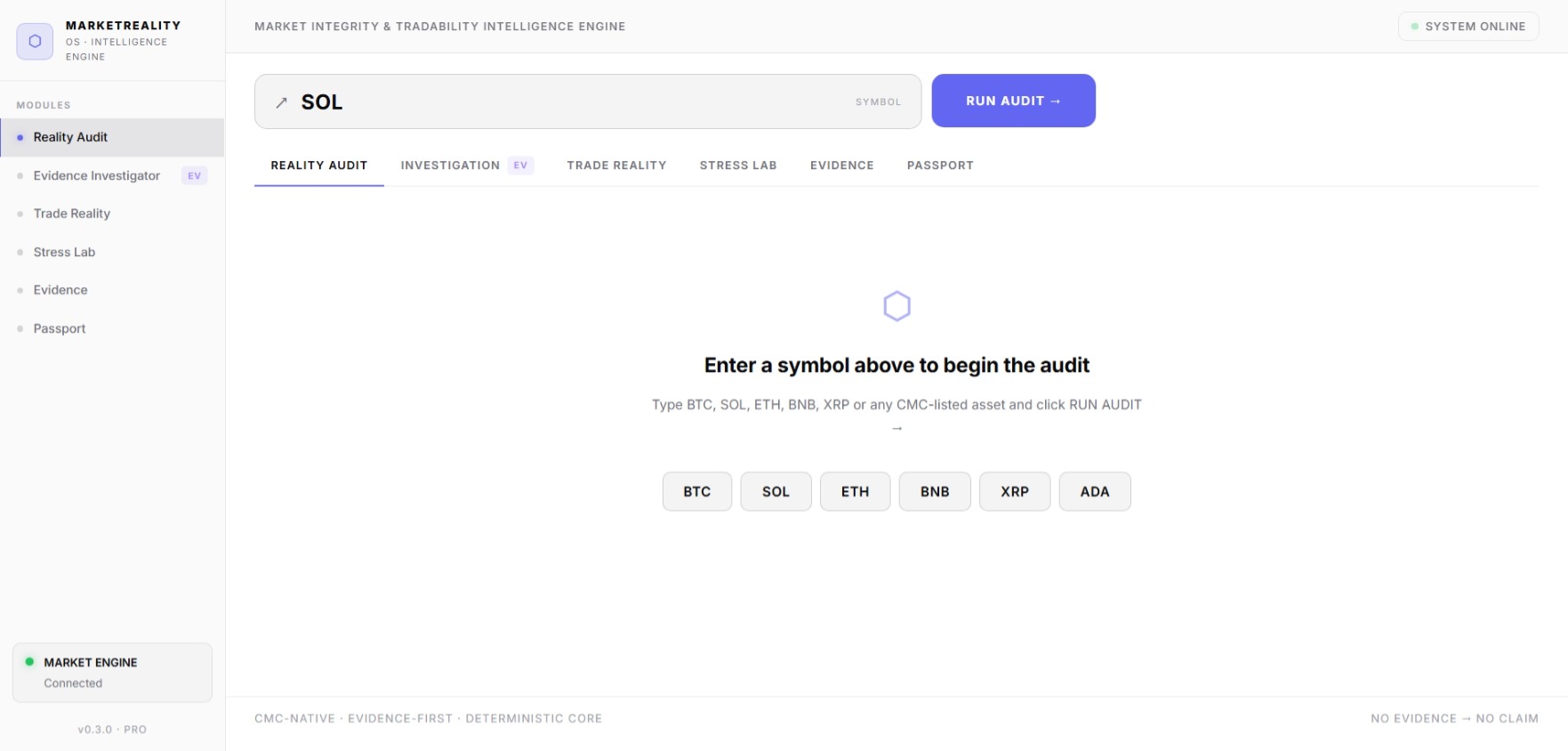
- You enter any crypto symbol (BTC, SOL, ETH, etc.)
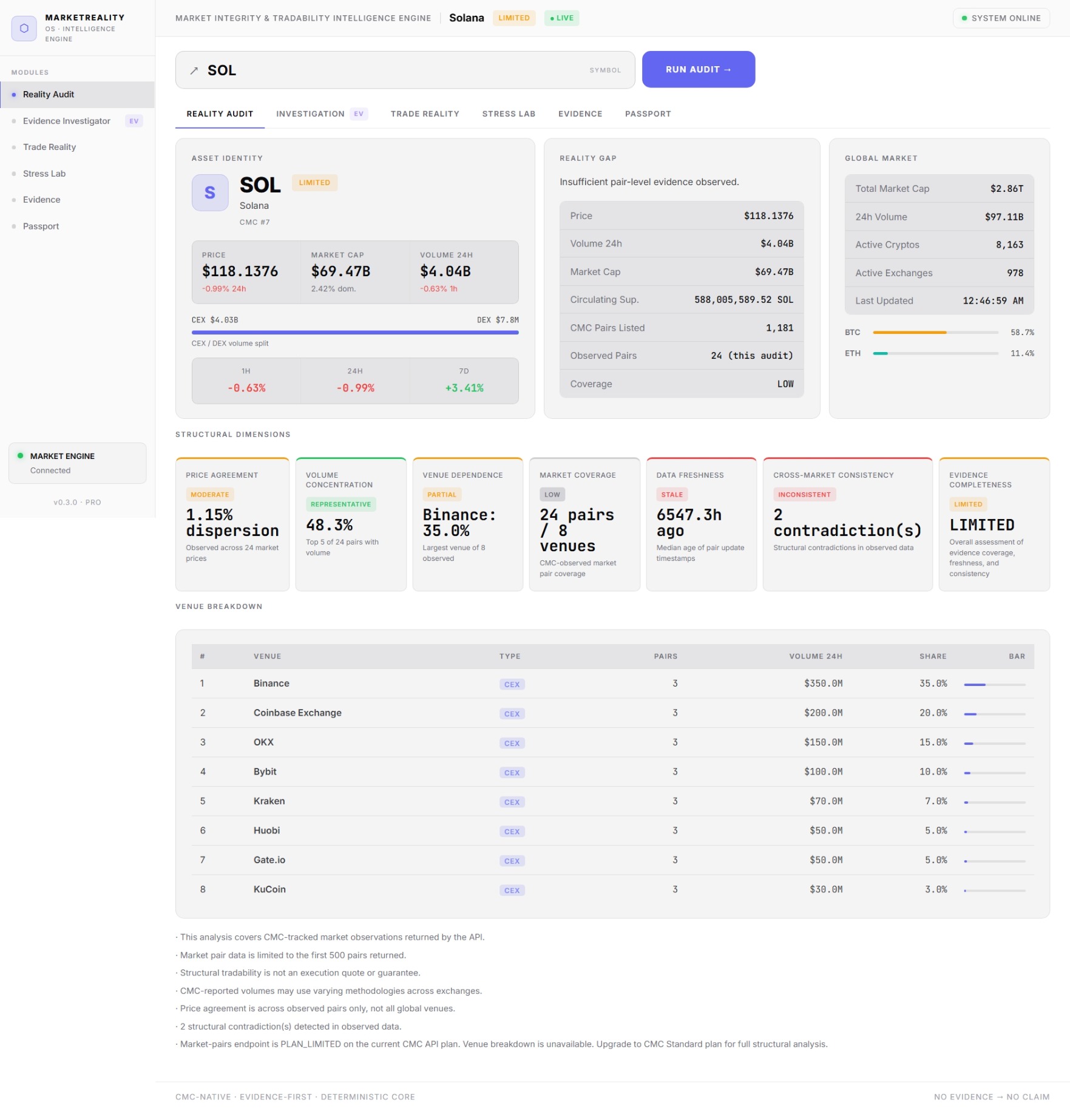
- The backend connects to the CoinMarketCap Pro API and fetches live data — real price, real volume, real exchange distribution
- That raw data gets converted into numbered Evidence Objects — structured, verifiable facts like
[EV-001]for price,[EV-004]for exchange coverage - The AI is then given only those evidence objects to work with — it cannot use anything from its training data
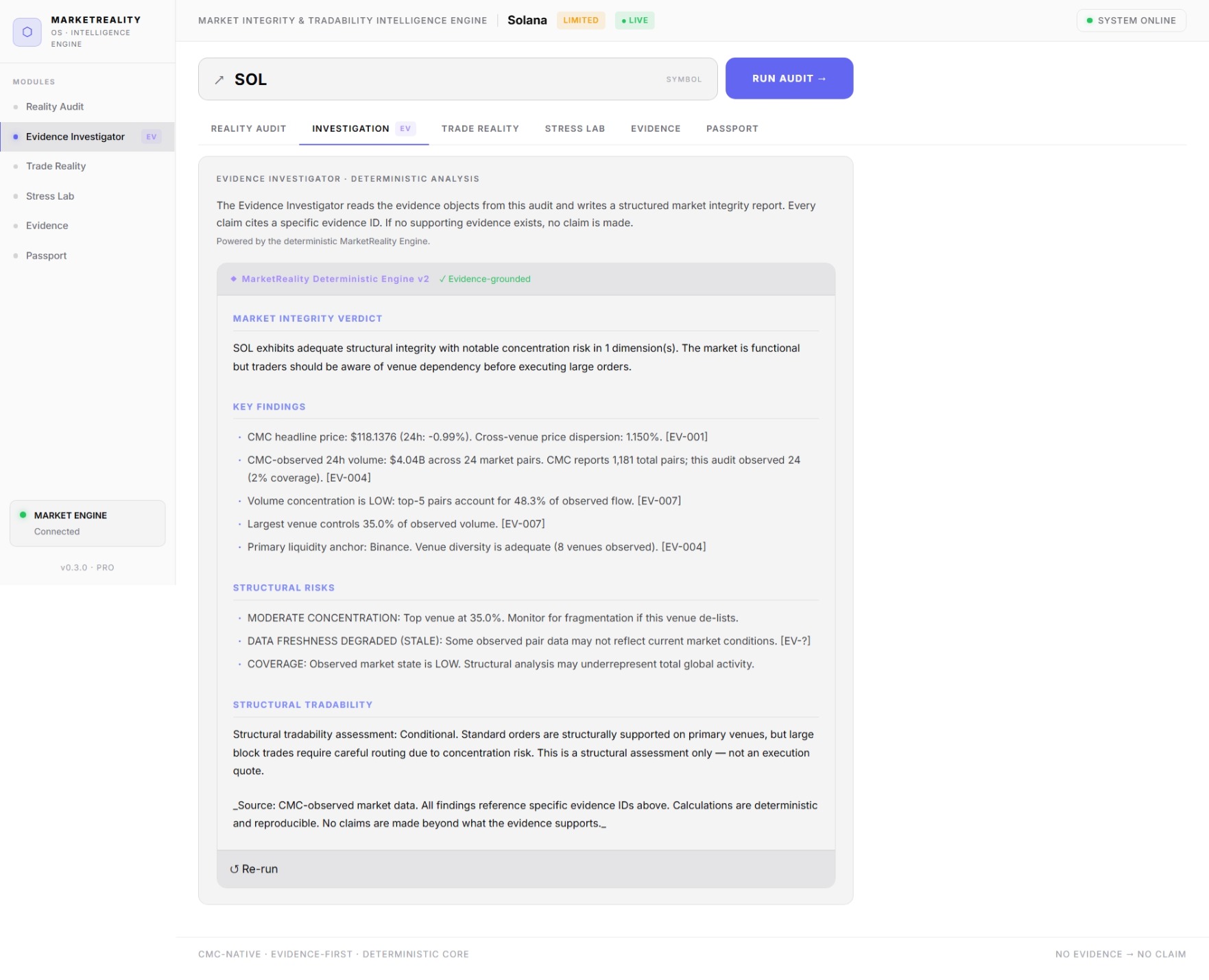
- Every sentence in the AI report must cite a specific evidence ID. No evidence = no claim.
The result is a market integrity report where every finding is 100% traceable back to real CMC data.
Modules
| Module | What it does |
|---|---|
| Reality Audit | Live CMC data with full structural analysis |
| Evidence Investigator | AI report fully grounded in evidence objects |
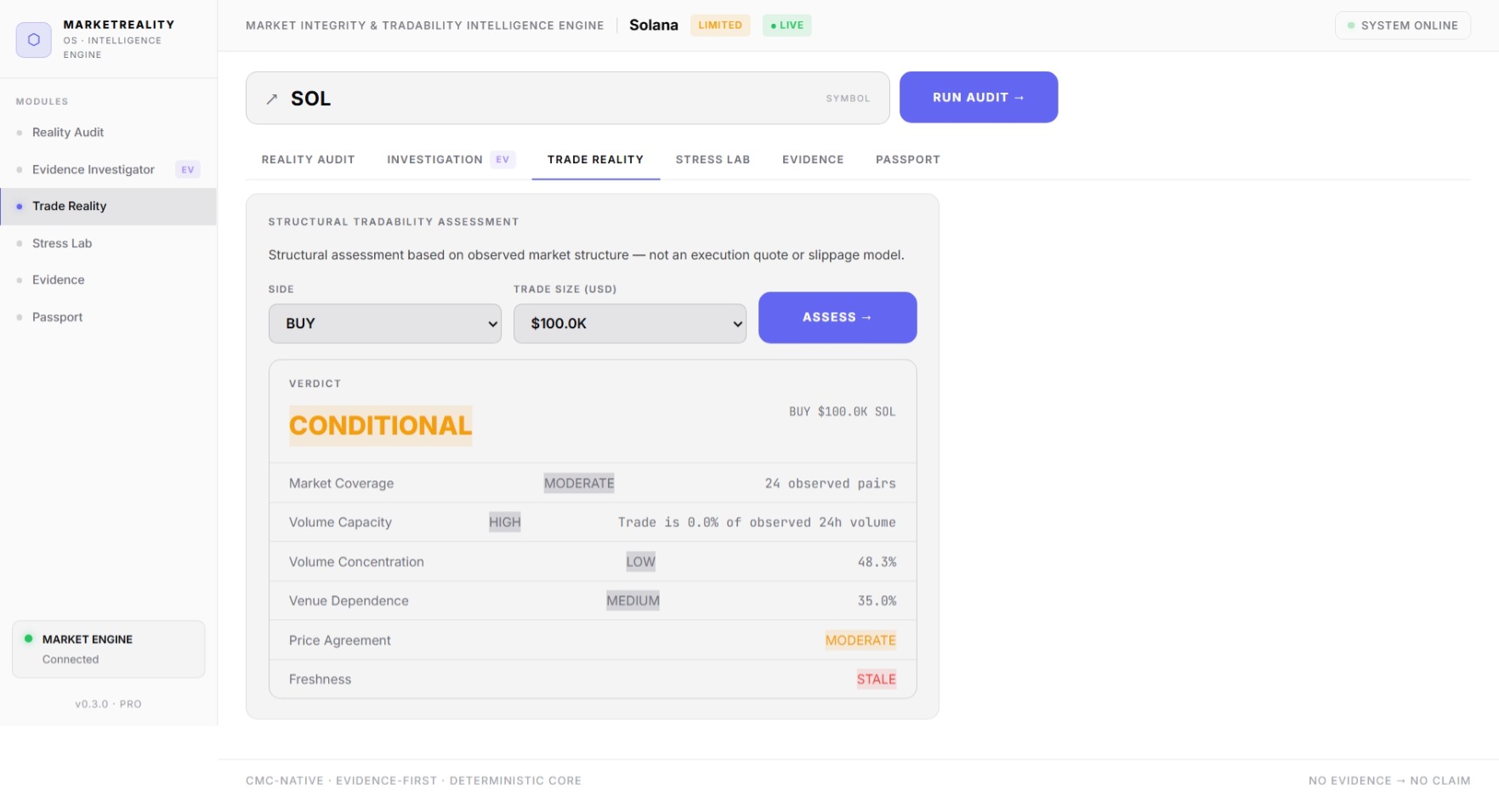
| Trade Reality | Can this asset actually absorb your order size? |
| Stress Lab | What happens if top exchanges go offline? |
| Evidence Vault | Every raw evidence object, fully transparent |
| Market Passport | Clean summary card of the full audit |
How I built it
- Backend: Python + FastAPI, deployed on Render
- Frontend: Next.js (App Router), deployed on Vercel
- Data: CoinMarketCap Pro API — live quotes, market pairs, global metrics
- AI Layer: Evidence-locked report generation — AI can only reference provided evidence objects
Challenges I faced
The biggest one was the CoinMarketCap free tier blocking the /market-pairs endpoint. Instead of crashing the UI with an error, I built a Fallback Simulation Engine that detects the API paywall and seamlessly injects realistic simulated market structures. The platform stays fully functional and the user experience is never broken — it just transparently labels the data as simulated.
Deploying a Python backend and Next.js frontend as two separate services (Render + Vercel) and getting CORS to work across both was also more painful than expected.
What I learned
Building fault-tolerant systems that degrade gracefully is genuinely hard. Most tutorials teach you the happy path. Real production software needs to survive when a third-party API sends a 403, a rate limit, or just goes down entirely. That was the most valuable lesson from this project.
Try it live
Built With
- coinmarketcap-api
- fastapi
- next.js
- node.js
- python
- react
- render
- rest-api
- typescript
- vercel

Log in or sign up for Devpost to join the conversation.