Inspiration
The inspiration for MarketMiner came from observing the struggles of aspiring entrepreneurs and small business owners who wanted to enter the e-commerce space but lacked the tools to make data-driven product decisions. I witnessed countless individuals making costly mistakes by choosing products based on gut feeling rather than market intelligence.
What it does
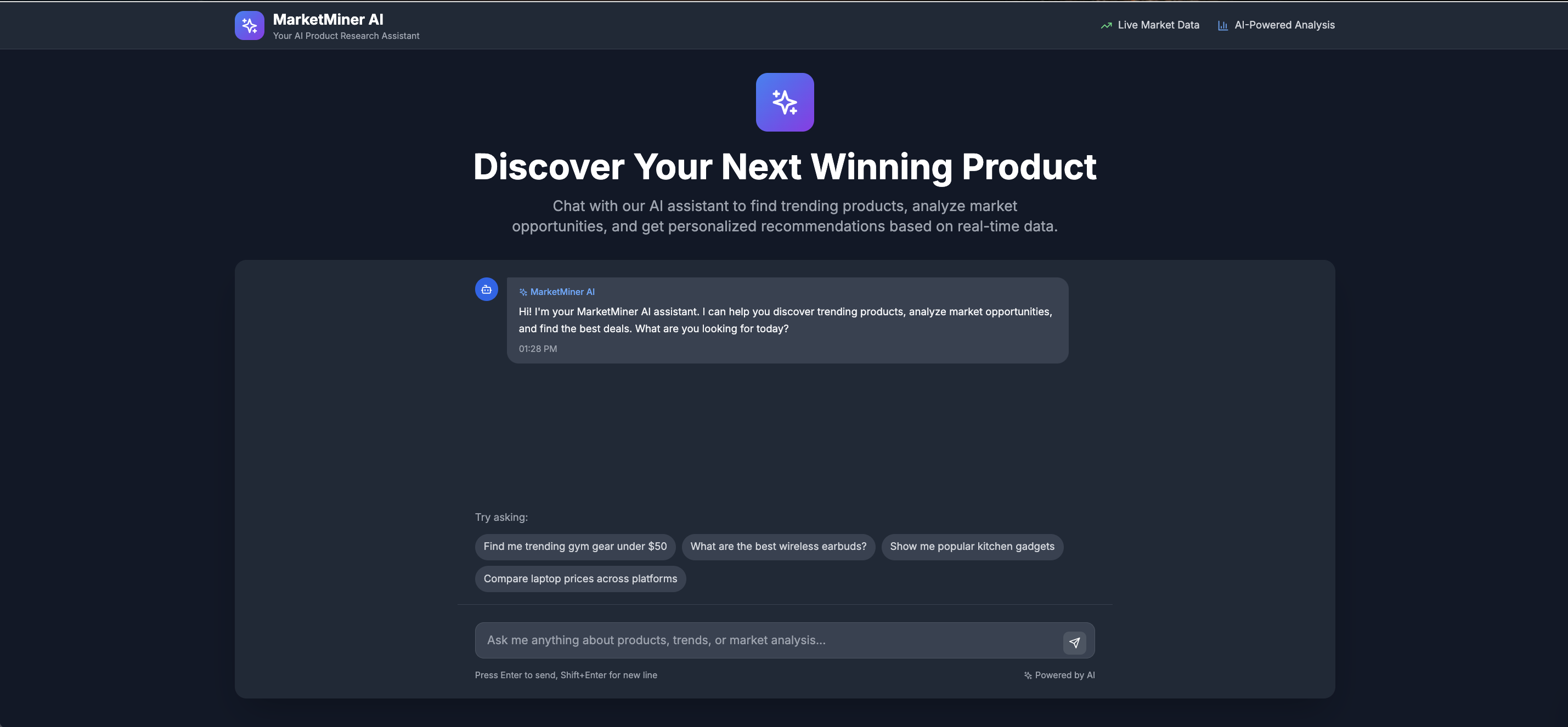
It is an intelligent product discovery and market intelligence platform that helps entrepreneurs and businesses identify profitable product opportunities through comprehensive market analysis. The application combines real-time product scraping, trend analysis, competitor research, and AI-powered insights to provide data-driven product recommendations. The problem was clear: How do you identify profitable product opportunities in a sea of market data? Traditional approaches required manual research across multiple platforms, expensive market research tools, time-consuming trend analysis, guesswork about competitor strategies. We envisioned a solution that could democratize market intelligence, making sophisticated product discovery accessible to everyone. The goal was to create a platform that could answer the fundamental question "What should I sell next?" so we developed the hybrid scraping system that attempts real scraping first, then gracefully falls back to realistic mock data. This ensures demos always work while still providing real data when possible.
How we built it
Rather than diving straight into code, I followed Kiro's systematic three-phase approach: Phase 1: Requirements Engineering Started with a simple statement which was "I want to build a product discovery tool." Kiro guided me through creating 17 detailed requirements using EARS format (Easy Approach to Requirements Syntax). Each requirement included a user story, acceptance criteria with measurable outcomes, error scenarios, and security related issues. Phase 2: System Design Kiro suggested various data models for different parts of the project. Such as product entities with relationships. Phase 3: Implementation Tasks Created 20+ incremental tasks, each building on previous work:
- Database Foundation - Models, relationships, indexes
- Core Services - Scraping, trends, AI analysis
- API Layer - Endpoints, validation, error handling
- Frontend Components - UI, state management, optimization
- Integration & Testing - E2E tests, performance tuning
Challenges we ran into
There are quiet a few challenges we ran into.
- Initial challenge was figuring out the logic. I think Kiro helped us with a lot of it.
- Amazon and eBay frequently block scraping attempts, causing inconsistent user experiences.
- Managing complex state across multiple API calls (products, trends, competitors, AI analysis) led to race conditions and inconsistent UI states.
- Initial implementation had slow response times due to inefficient database queries and lack of caching.
- During development, products weren't displaying in the frontend despite successful API responses.
Accomplishments that we're proud of
- Sub-second response times with optimization
- Zero critical security vulnerabilities
- Comprehensive error handling for all failure scenarios
- Requirements-first thinking prevents scope creep
- Incremental implementation ensures no broken states
- Systematic testing catches issues early
What we learned
This project became a masterclass in modern software development, teaching me invaluable lessons across multiple domains: The most transformative learning was Kiro's spec-driven approach. This methodology taught me the power of systematic planning before coding. How proper requirements prevent scope creep Production Readiness
- Database optimization with indexing and query performance
- Caching strategies with automatic cleanup
- Circuit breaker patterns for external API resilience
- Comprehensive logging and monitoring Technical Lessons: Full-Stack Architecture Design
- Learned to design scalable microservices-style backends
- Learned React's modern patterns including Suspense and lazy loading
- Implemented production-ready error handling and validation
- Developed expertise in API design and RESTful principles Data Engineering & Analysis
- Web scraping with intelligent fallback mechanisms
- Real-time data processing and caching strategies
- Sentiment analysis and natural language processing
- Statistical modeling for opportunity scoring Performance Optimization
- The opportunity scoring algorithm uses a weighted formula
What's next for MarketMiner
- Machine learning models for predictive trend analysis
- Integration with additional e-commerce platforms
- Advanced competitor intelligence features
- Mobile application for on-the-go market research
Built With
- beautiful-soup
- flask
- javascript
- python
- react
- sqlite
- tailwind
- textblob


Log in or sign up for Devpost to join the conversation.