-
-
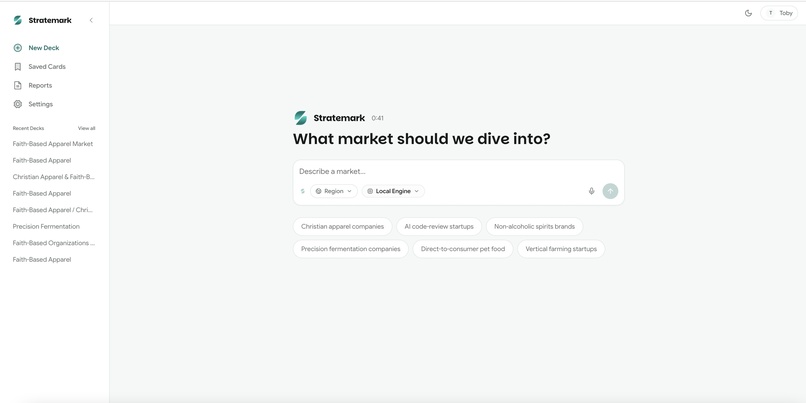
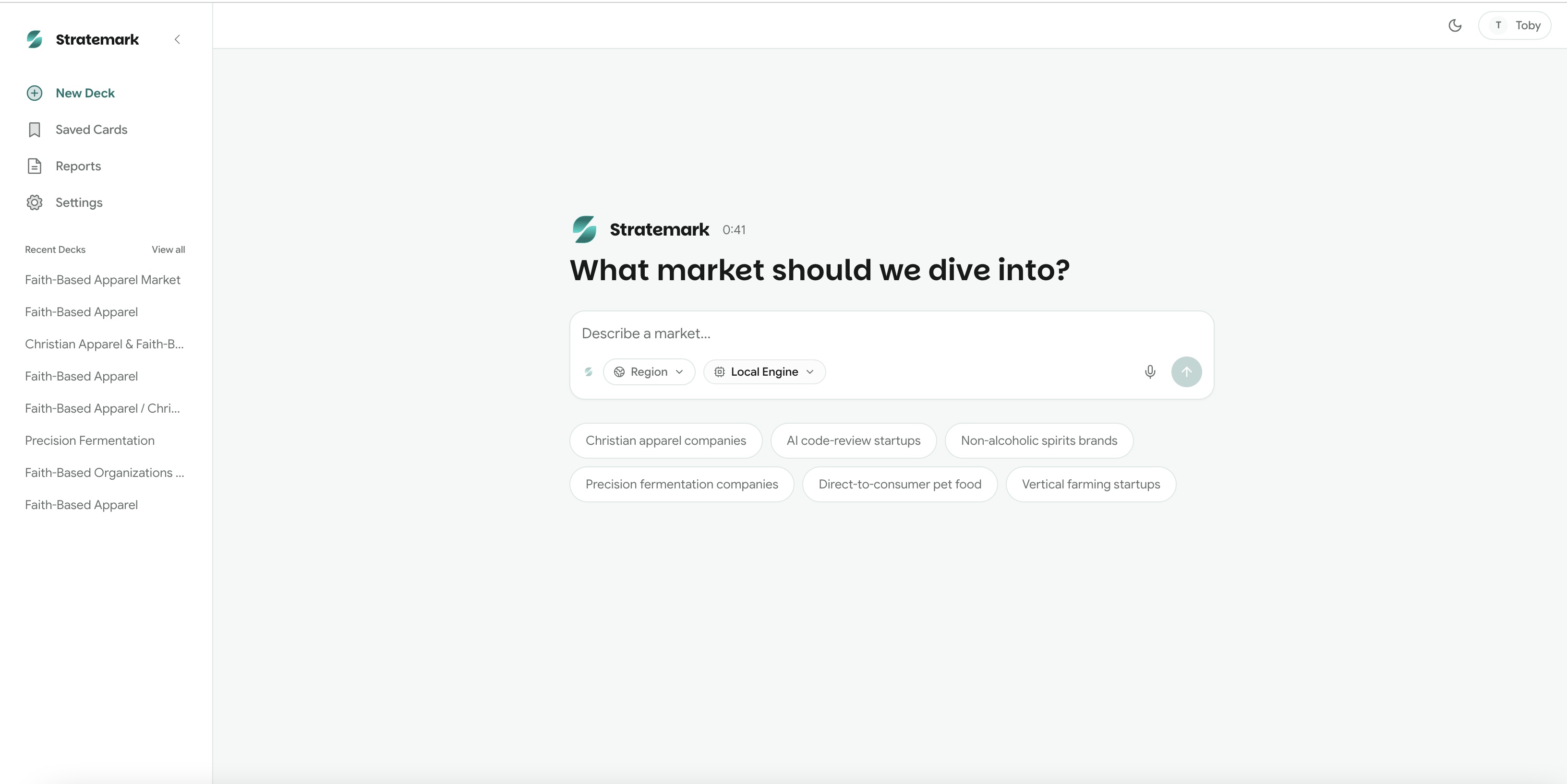
Home Search Interface
-
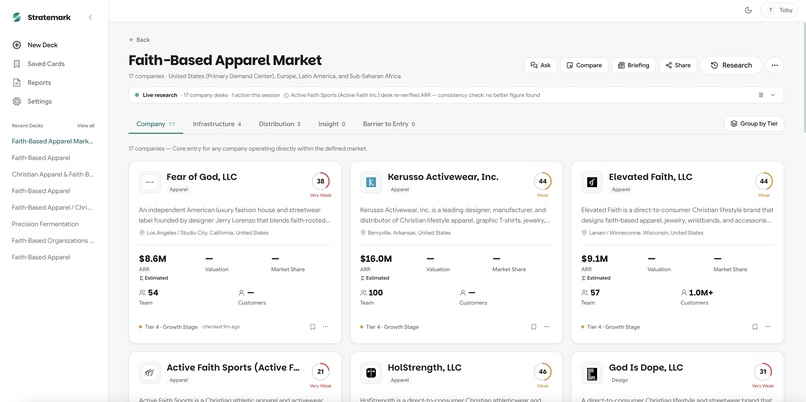
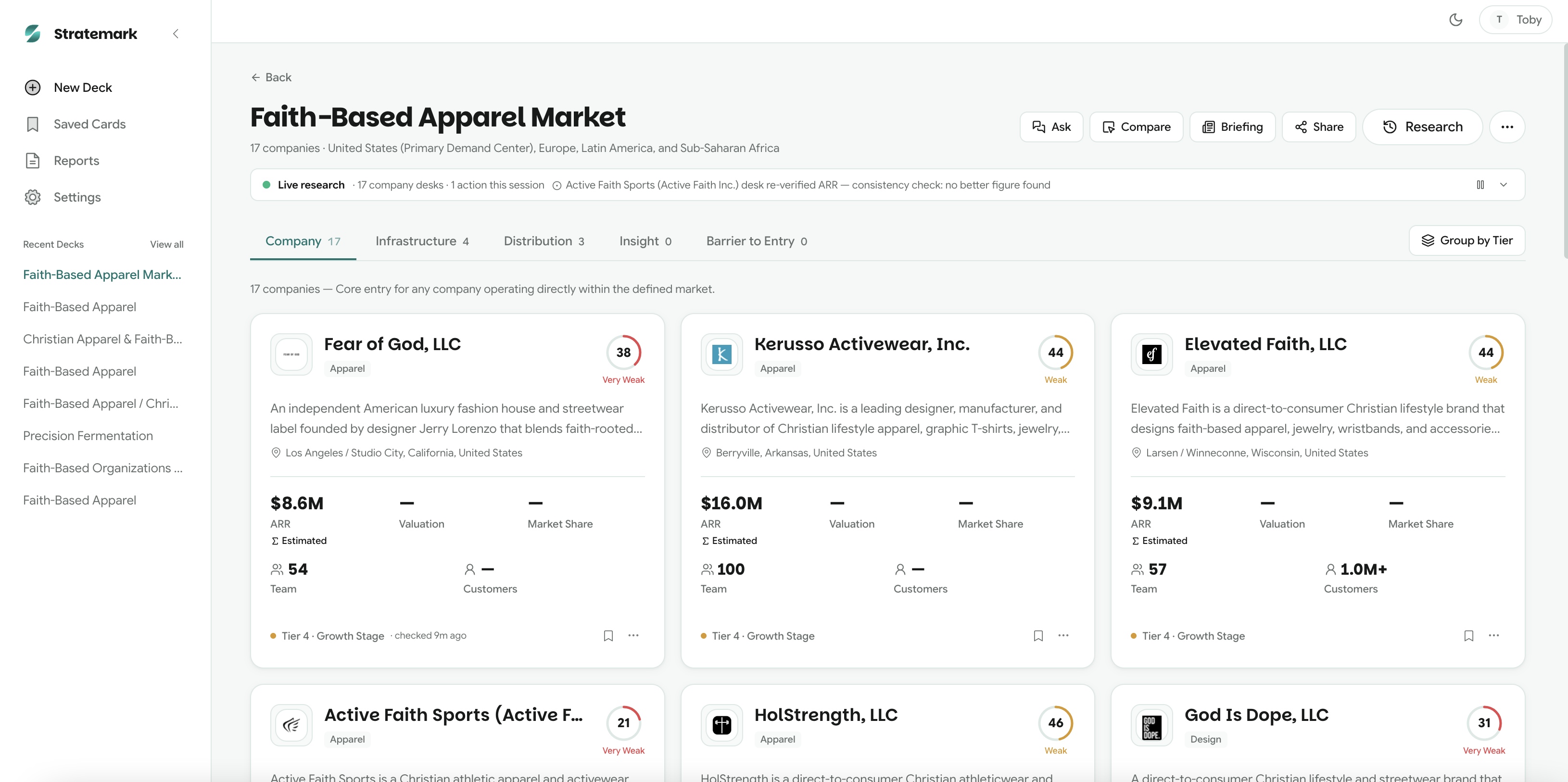
Market Intelligence Deck
-
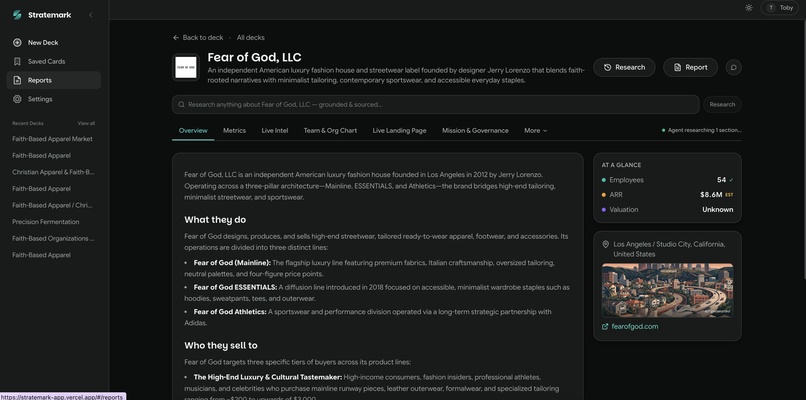
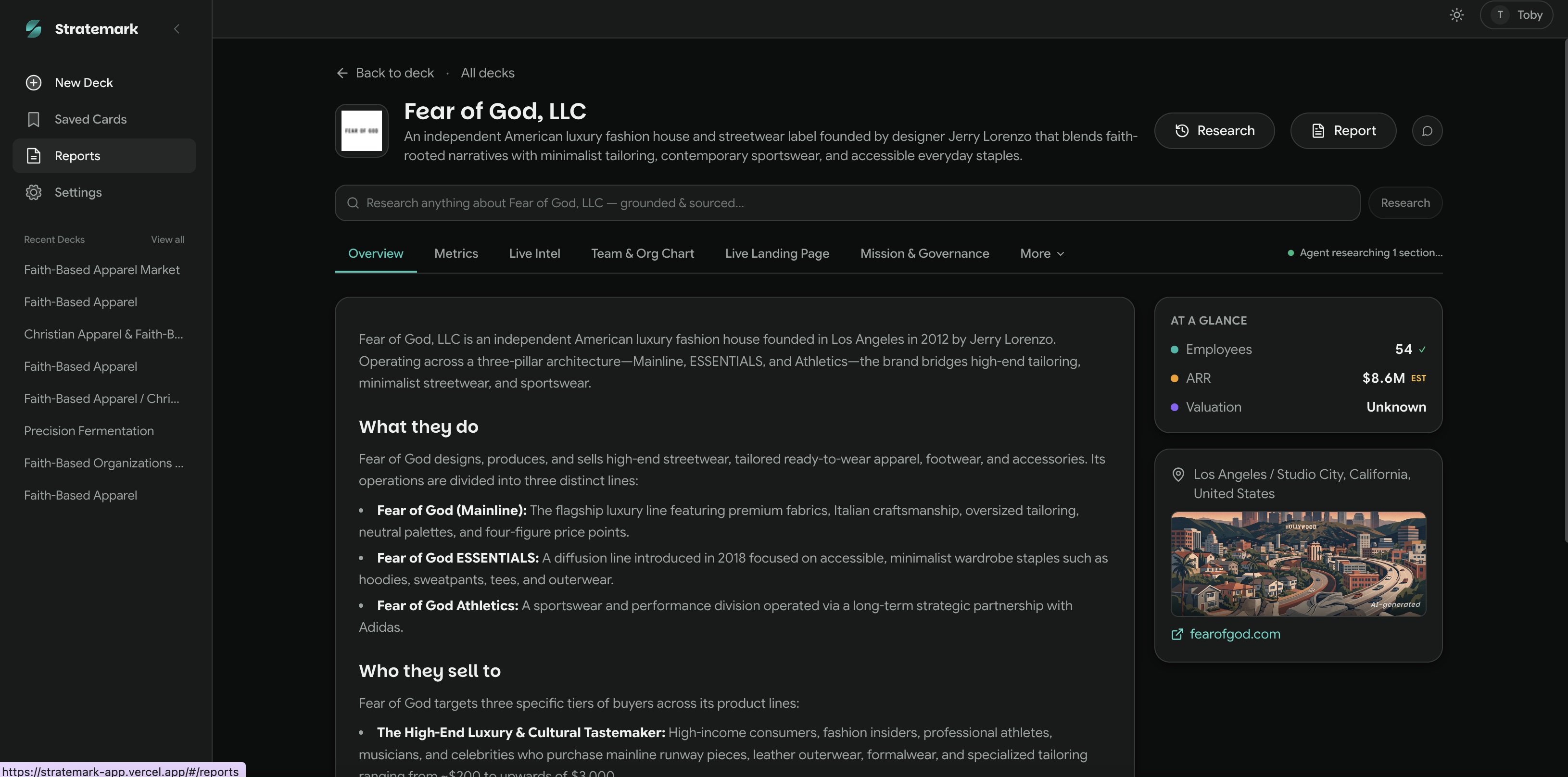
Company Deep Dive
-
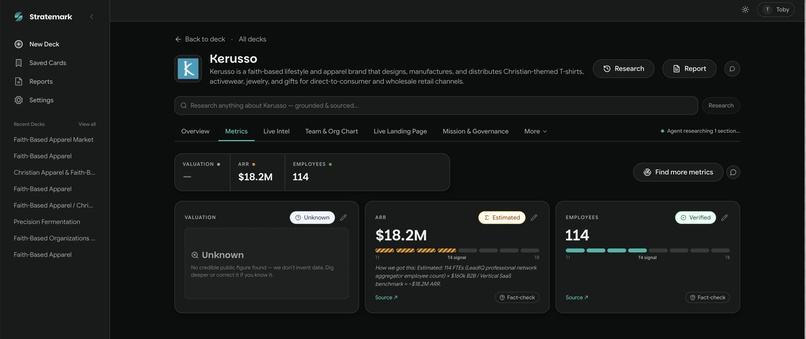
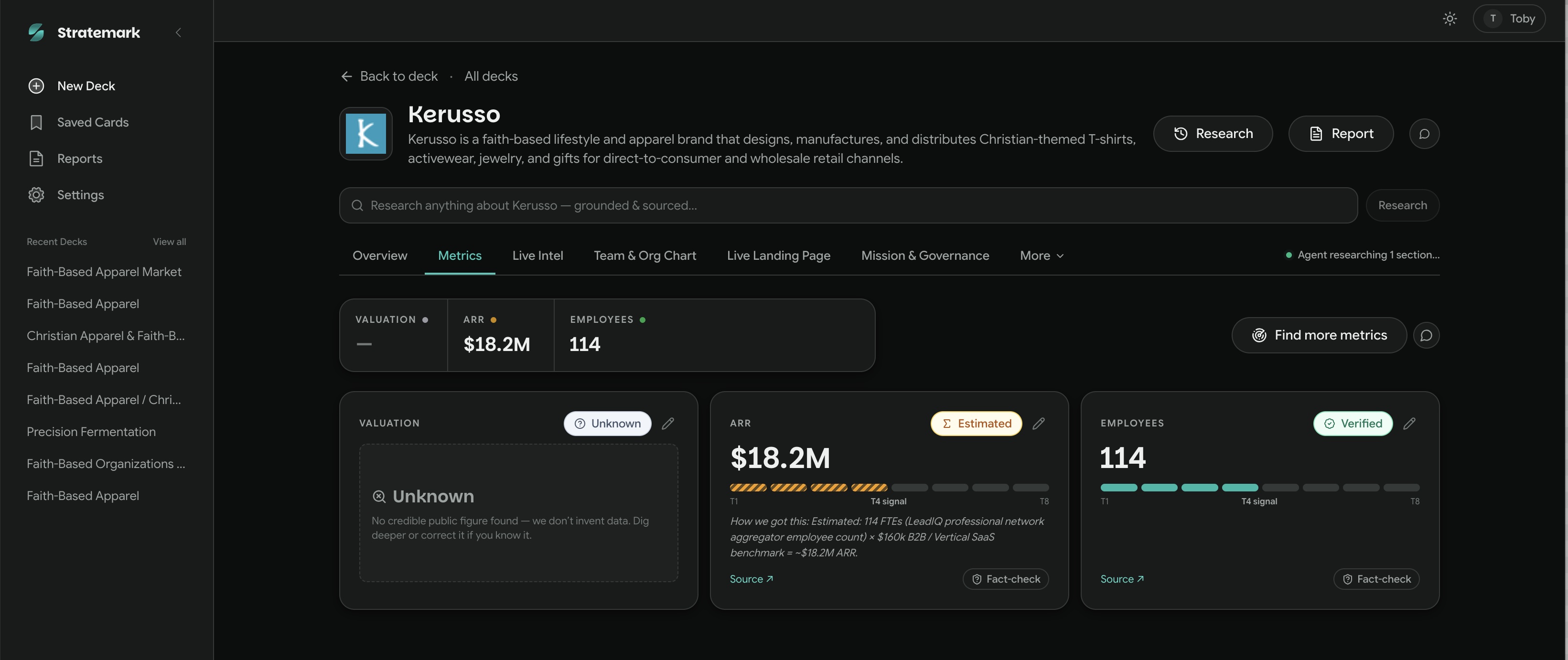
Financial & Metrics Dashboard
STRATEMARK — Devpost Project Story
Inspiration
Understanding a new market should not require days of searching, copying numbers into spreadsheets, and wondering which claims can be trusted. Founders, analysts, investors, and strategy teams repeatedly perform the same exhausting workflow: identify the companies, verify their size and momentum, compare them consistently, and turn the findings into something decision-makers can use.
We began building STRATEMARK around August 12, 2026, during the All Things Agentic Hackathon submission period, to take that work off their plate. Instead of beginning with dozens of browser tabs, the user begins with one plain-language question: “Help me understand this market.”
What it does
STRATEMARK turns a market question into a living competitive-intelligence deck.
It searches the live web, identifies the companies that matter, researches each one, and organizes the results into consistent company and market-context cards. Users can compare competitors, investigate individual dossiers, ask follow-up questions grounded in the same research, fact-check claims, and turn the finished deck into a structured report.
Its defining rule is simple: STRATEMARK does not invent missing business data. Every metric is labeled verified, estimated, or unknown, with its evidence attached. If credible support does not exist, the gap remains visible instead of becoming a confident guess.
Unlike a chatbot response that disappears into conversation history, a STRATEMARK deck becomes a market workspace the user can continue exploring and refining.
How we built it
STRATEMARK is a TypeScript monorepo with clear boundaries between the product interface, research engine, data contracts, and cloud service.
The React and Vite web application communicates through a MarketIntelRepository interface. The research package contains the staged agent workflow and a shared LlmClient contract. The browser and Electron paths can run locally with the user’s own Gemini key, while the server path uses the official Google GenAI SDK through a Cloud Run service.
The research process follows a two-call ground-and-structure pattern. Gemini 3.7 Flash first uses Google Search grounding to gather current information and citations. Gemini 3.5 Flash-Lite then converts that grounded material into structured JSON validated against Zod schemas. A provenance layer checks evidence before data reaches the product.
The Cloud Run service handles capabilities that do not belong safely in the browser, including server-side research through the official SDK, verified webpage capture, and document rendering. Vertex AI application-default credentials avoid placing a Gemini key inside the container. Secret Manager protects service tokens, while authorization, usage limits, and rate controls guard spending routes.
Challenges we ran into
The hardest problem was not generating more text. It was deciding what the system was allowed to claim.
Business information is incomplete and often contradictory. Revenue, valuation, headcount, and funding figures may be estimates repeated across secondary sources. Prompting a model to “be accurate” was not enough, so we made trust an architectural concern: every metric carries confidence, provenance, and source information; unsupported values become unknown; and fact-checking can contradict an earlier estimate rather than silently defend it.
Webpage capture created another trust problem. A screenshot might show a CAPTCHA or error page instead of the intended company site. Our capture service records a receipt containing the final URL, HTTP status, title, and content hash, then verifies the page before presenting it. Failed verification produces an honest receipt instead of a misleading screenshot.
We also had to control the cost of autonomous research. Search grounding can trigger multiple queries inside one model request, so the server meters usage, rate-limits callers, requires authorization for spending routes, and checks its allowance before starting an operation.
Accomplishments that we’re proud of
We are proud that STRATEMARK can say “Unknown.” That restraint changes the relationship between a user and AI-generated research.
We also built one research workflow that can operate through two delivery paths without changing its orchestration: local-first research using the user’s key, and a Google Cloud path using the official GenAI SDK. The boundaries between UI, research, and infrastructure let the product remain useful locally while adding cloud capabilities where they genuinely help.
Most importantly, the result is not another report generator. The deck stays interactive: users can inspect sources, compare companies, ask new grounded questions, fact-check claims, and generate reports from the assembled intelligence.
What we learned
Trustworthy agentic software requires more than a capable model. It needs explicit contracts for uncertainty, provenance, credentials, state, failure, and cost.
We learned that Google Search grounding works best when separated from structured extraction: one pass gathers current evidence and citations; another produces dependable typed data.
We also learned that cloud infrastructure should solve real product constraints. STRATEMARK remains local-first where privacy and ownership matter, while Cloud Run handles server-side operations a browser cannot perform reliably.
What’s next for STRATEMARK
Next, we plan to connect persistent cloud worklists so scheduled refreshes can monitor selected markets and surface meaningful competitor changes. We also plan to add collaborative team decks, richer change histories, and alerts for events such as funding rounds, leadership changes, product launches, and strategic pivots.
Our goal is to make market intelligence continuous rather than episodic: research that stays organized, shows where every claim came from, and becomes more useful each time the user returns.
Project timing
All STRATEMARK work submitted here was created during the official August 3–31, 2026 submission period. Development began around August 12, 2026.
We used standard open-source frameworks, libraries, starter tooling, and permitted AI coding assistants. No pre-existing STRATEMARK code or work was incorporated into this submission.
Built With
- gcloud
- genkit
- google-adk
- google-genai
- react
- ts
- vite

Log in or sign up for Devpost to join the conversation.