-
-
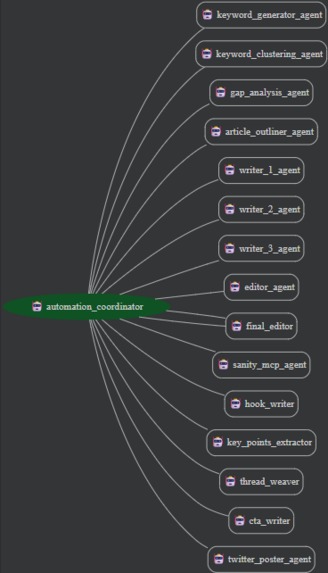
architecture
Inspiration
The content creation landscape is fragmented and time-consuming. Content creators struggle with keyword research, gap analysis, SEO optimization, and social media distribution - tasks that require different expertise but are often done manually. This project was inspired by the need to streamline the entire content creation pipeline using AI agents that can work together intelligently.
What it does
AI-Powered SEO Content Creation: An AI assistant that automates the creation of SEO-optimized content.
Multi-Agent System: A coordinator agent manages specialized sub-agents for a streamlined workflow.
Content Strategy & Generation: It handles keyword generation, clustering, content gap analysis, and automatically writes blog posts and Twitter threads.
Sanity MCP Integration: It uses a dedicated agent (sanity_mcp_agent) to upload the final content to Sanity.
End-to-End Automation: The project streamlines the entire content creation process, from initial research to final deployment.
How I built it
The system follows a coordinator pattern with a main automation_coordinator that orchestrates 16+ specialized sub-agents:
automation_coordinator
├── keyword_generator              # Semrush: Generate relevant keywords for topics
├── keyword_clustering             # Gemini 2.5 Pro: Group keywords semantically (requires deeper semantic understanding and reasoning)
├── gap_analysis                   # Gemini 2.5 Pro: Identify content gaps using Perplexity API (demands advanced analysis and complex problem-solving)
├── article_outliner               # Gemini 2.5 Pro: Create structured article outlines (requires logical coherence and comprehensive structuring)
├── writer (3 instances)
    ├── instance_1                 # Gemini 2.5 Flash: Generate content variations (focus on rapid draft creation and diverse outputs)
    ├── instance_2                 # Gemini 2.5 Flash: Generate content variations (focus on rapid draft creation and diverse outputs)
    └── instance_3                 # Gemini 2.5 Flash: Generate content variations (focus on rapid draft creation and diverse outputs)
├── editor                         # Gemini 2.5 Pro: Refine and improve content (needs strong language understanding, style adherence, and quality enhancement)
├── final_editor                   # Gemini 2.5 Pro: Final polish and SEO optimization (requires meticulous attention to detail, strong SEO knowledge, and high accuracy)
├── hook_writer                    # Gemini 2.5 Flash: Create engaging social media hooks (prioritizes conciseness, catchiness, and quick generation of options)
├── key_points_extractor           # Gemini 2.5 Flash: Extract key insights for threads (efficient for summarization and pulling out essential information)
├── thread_weaver                  # Gemini 2.5 Pro: Weave content into Twitter threads (requires maintaining context, narrative flow, and social media optimization across multiple posts)
├── cta_writer                     # Gemini 2.5 Flash: Generate call-to-action content (needs to be concise, impactful, and direct for quick generation)
├── twitter_poster                 # (API/Tool - Not an LLM function): Handle social media publishing (this is an integration task, not directly an LLM generation task)
└── sanity_mcp_agent               # Gemini 2.5 Pro: Quality assurance and validation (critical task requiring high accuracy, robust error checking, and deep content understanding)
Each agent is built using Google ADK with Gemini 2.0 Flash and 2.5 pro according to their need(inspired from alpha evolve) as the underlying models, allowing for consistent, high-quality outputs across the entire pipeline.
Challenges I ran into
- Agent Coordination: Ensuring smooth data flow between 16+ specialized agents without losing context or quality
- API Rate Limiting: Managing multiple external API calls (Perplexity, Google AI) efficiently
- Output Consistency: Maintaining consistent quality and style across different content formats (articles vs. Twitter threads)
- Deployment Complexity: Orchestrating a complex multi-agent system on Vertex AI with proper dependency management
- Error Handling: Implementing robust fallback mechanisms when individual agents fail 6*Lot More*
Accomplishments that I'm proud of
- Technical Innovation: Built a production-ready multi-agent system with 16+ AI agents, deployed on Google Vertex AI with auto-scaling and Perplexity API for real-time content gap analysis.
- Content Excellence: Automated end-to-end SEO content and Twitter thread creation from a URL, with intelligent keyword clustering and multi-format adaptation.
- Architecture: Modular agent design, robust error handling and faster content generation via parallel processing.
- Production Readiness: Enterprise-grade deployment on Google Cloud with comprehensive testing and API integrations (Perplexity, Twitter, Sanity CMS).
- Developer Experience: One-command deployment, interactive testing tools, and detailed documentation.
What I learned
- Multi-Agent AI Design: I learned to build a complex system by coordinating multiple specialized AI agents, each focused on a specific task.
- Strategic API Integration: I gained experience combining different AI services (like Gemini , Semrush, Perplexity) to leverage the unique strengths of each.
- Real-World AI Application: I learned how to apply AI to automate a practical, end-to-end business workflow—in this case, SEO content creation.
- Production-Ready Development: I learned how to structure a project for scalability and prepare it for deployment in a cloud environment like Vertex AI.
What's next for AI Marketing Agency
To make it a all in one marketing automation tool
- Scalable SaaS Platform
- Build a "plug and play" SaaS with high performance and security. -Schedulable content
Social Media Integration
- Support LinkedIn, YouTube, Instagram with unified management.
AI Content Creation
- Use Imagen, Veo, HeyGen for images, videos, and personalized content.
CMS Integrations
- Connect with WordPress, Shopify, HubSpot, etc., via APIs/plugins.


Log in or sign up for Devpost to join the conversation.