-
-
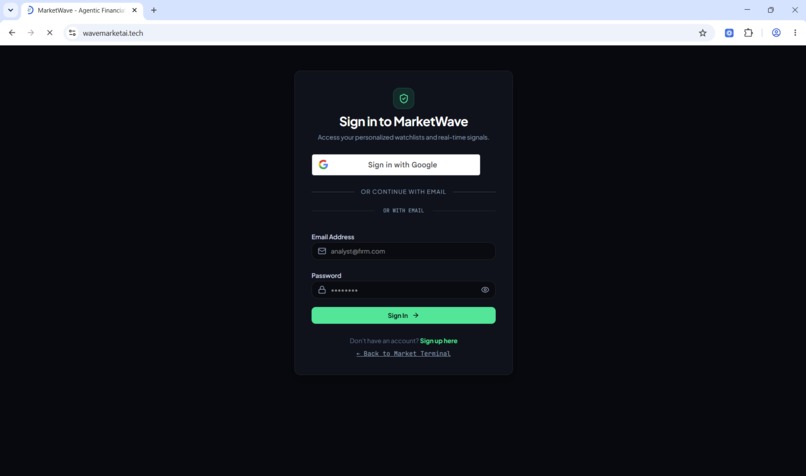
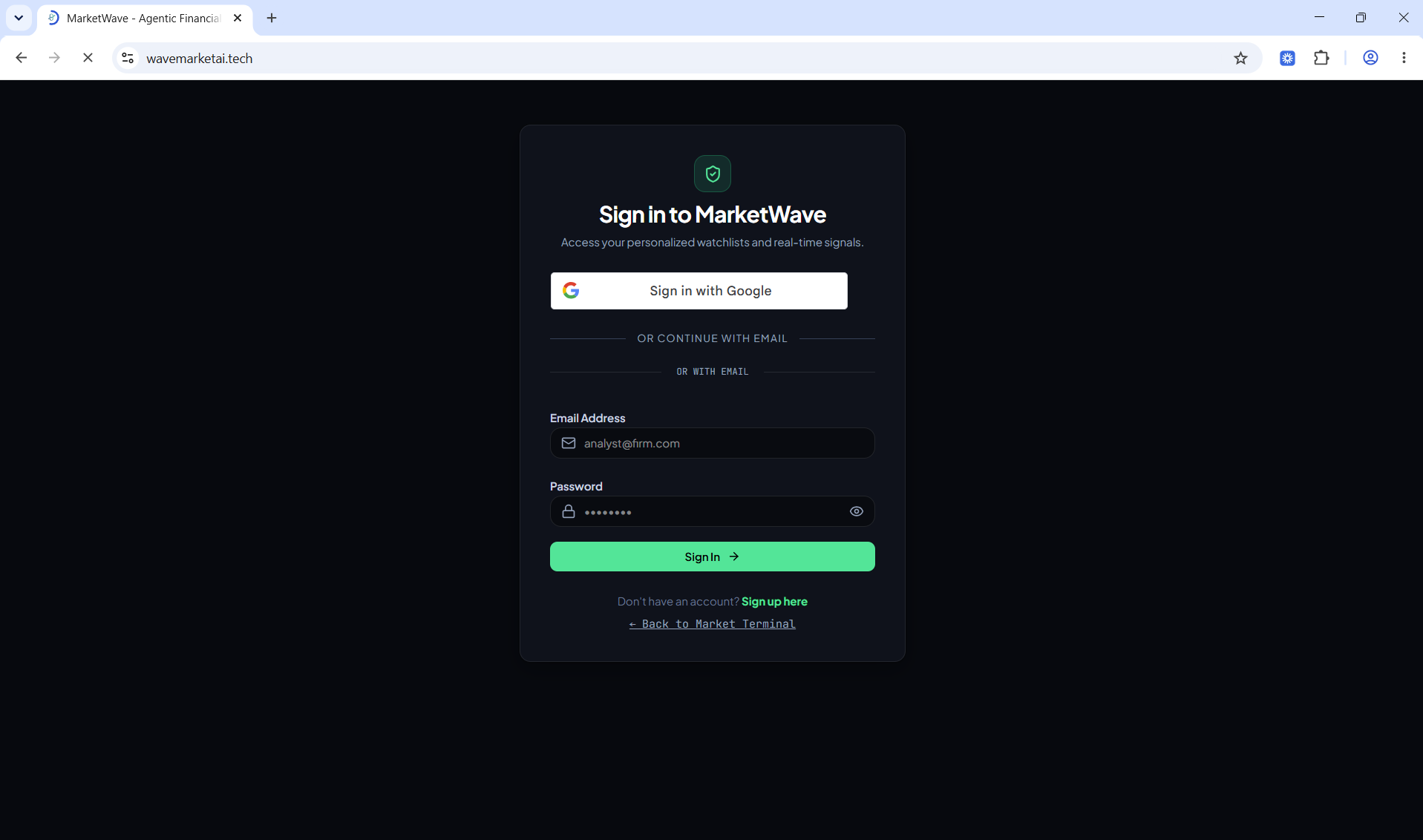
Login Screen
-
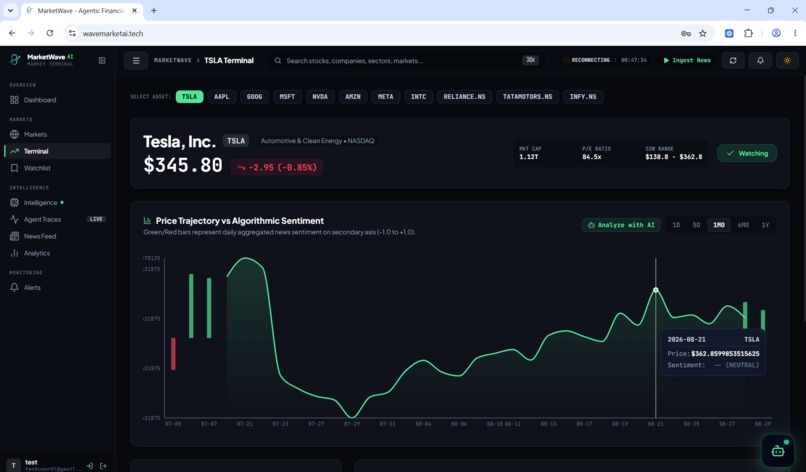
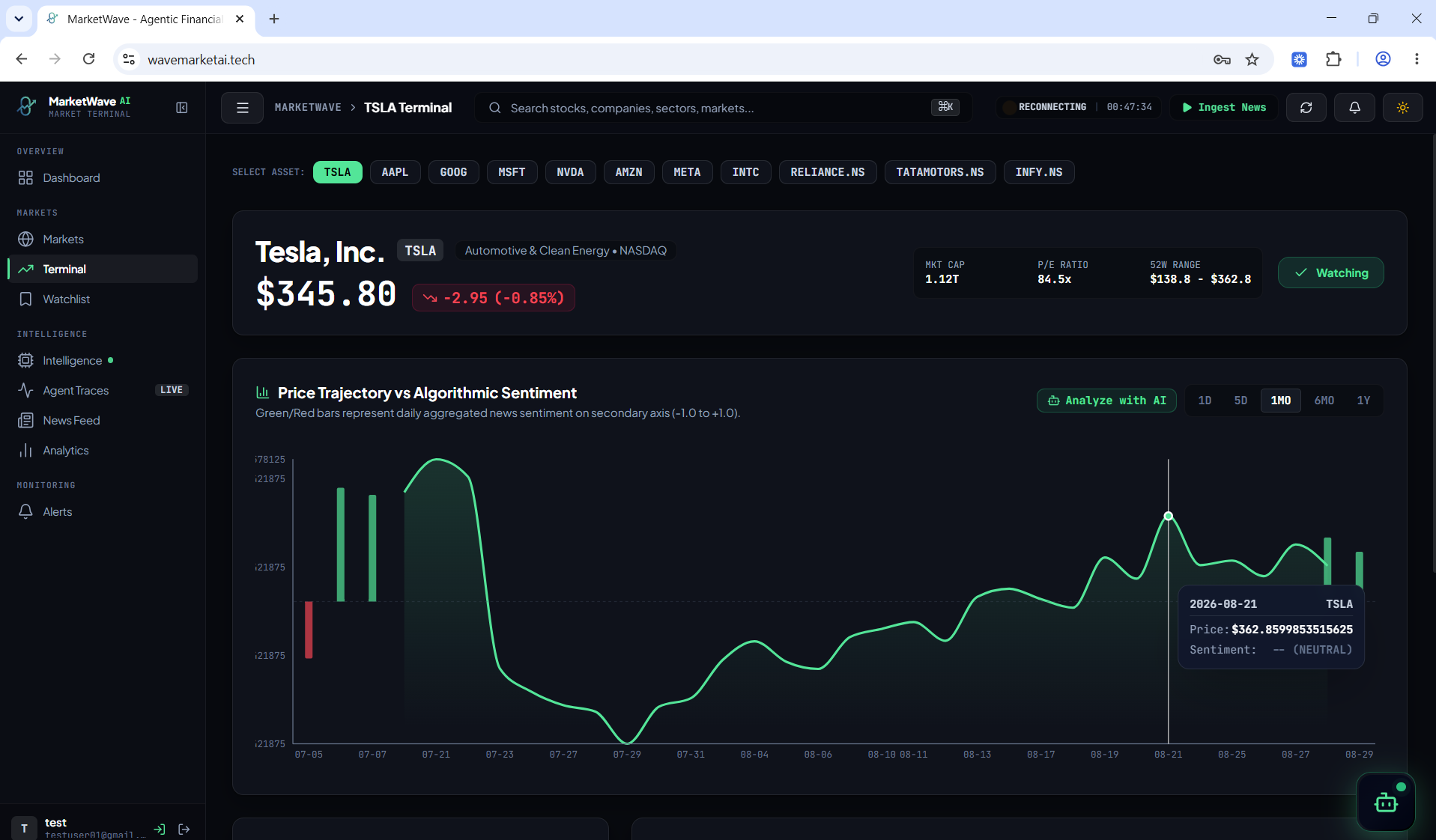
Terminal
-
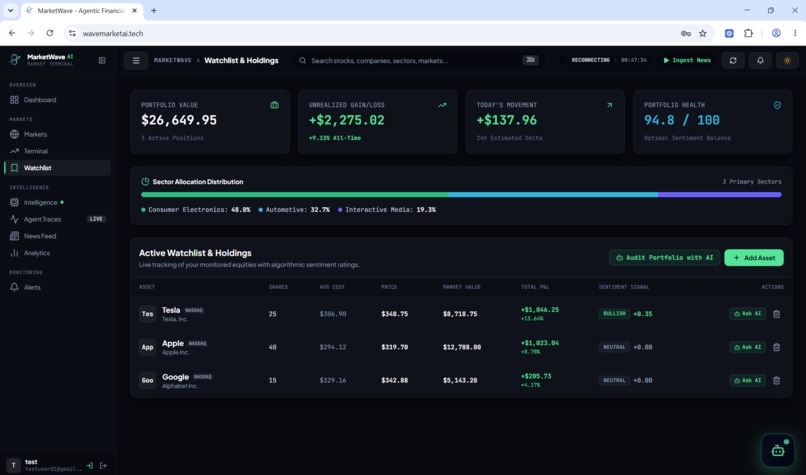
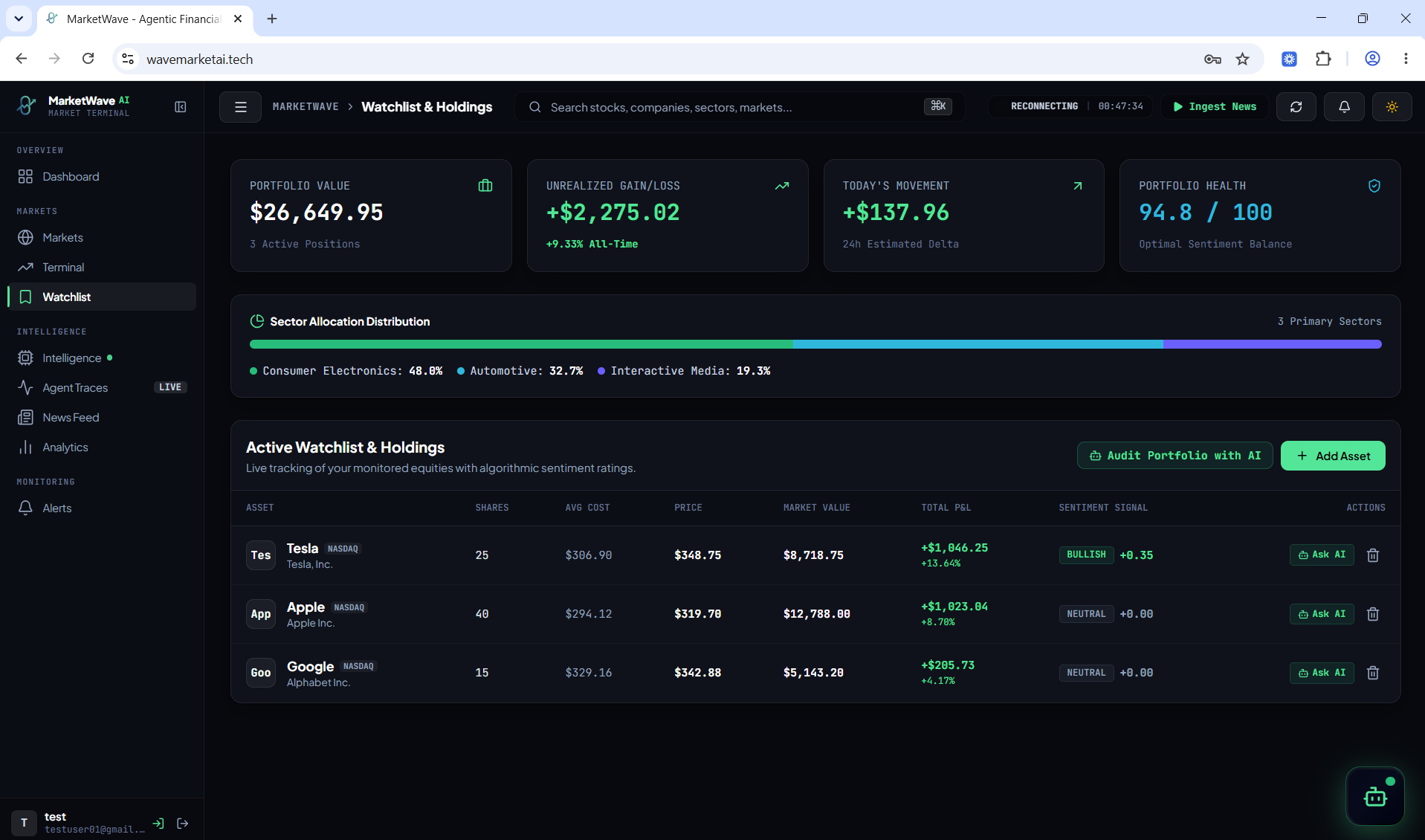
Watchlist
-
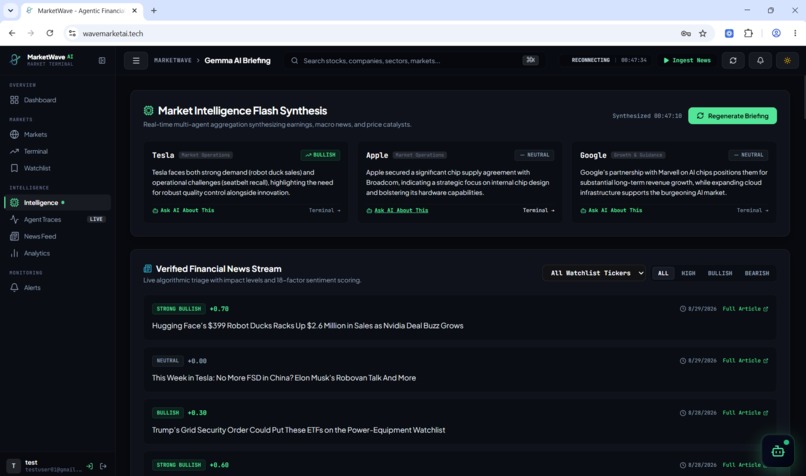
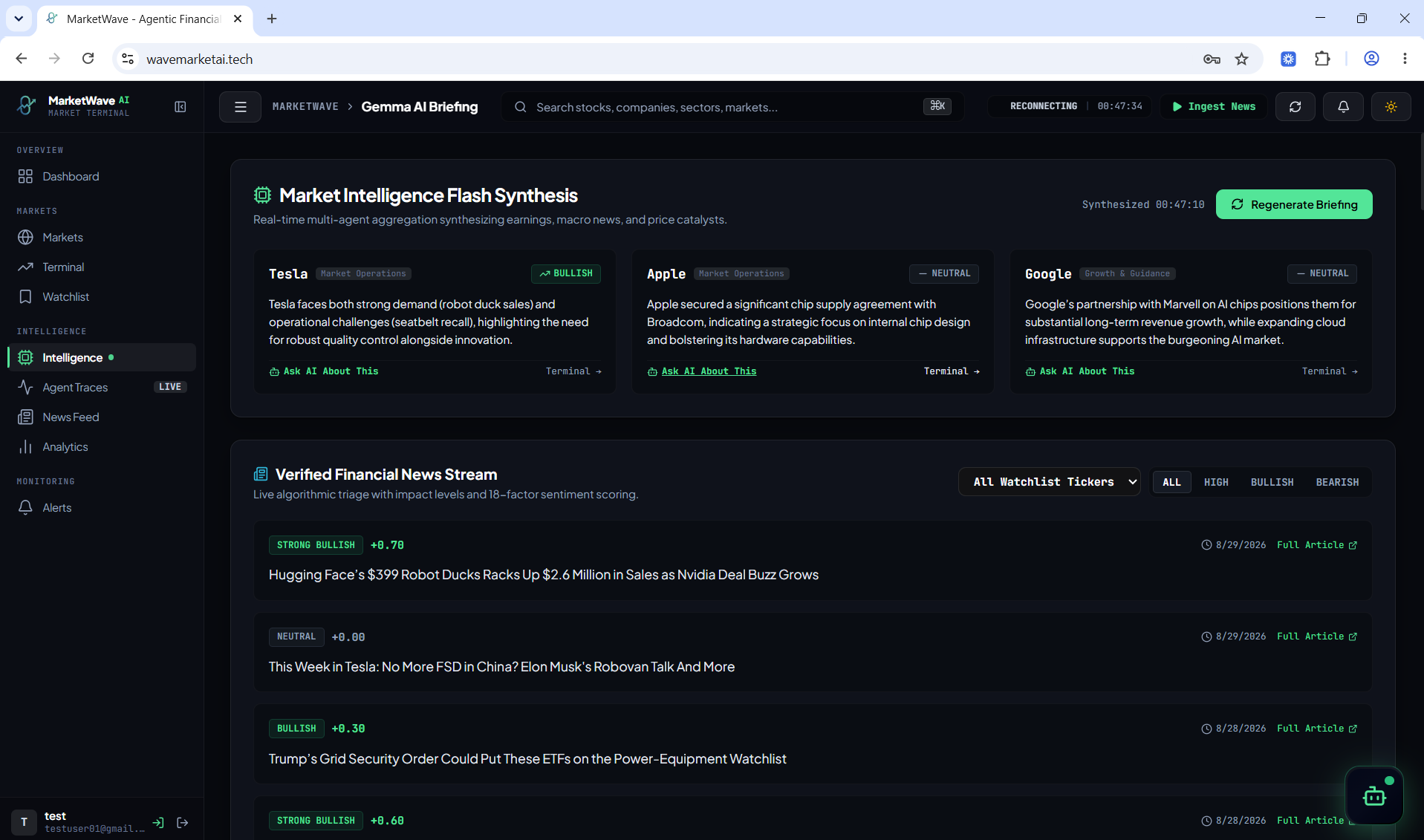
Intelligence
-
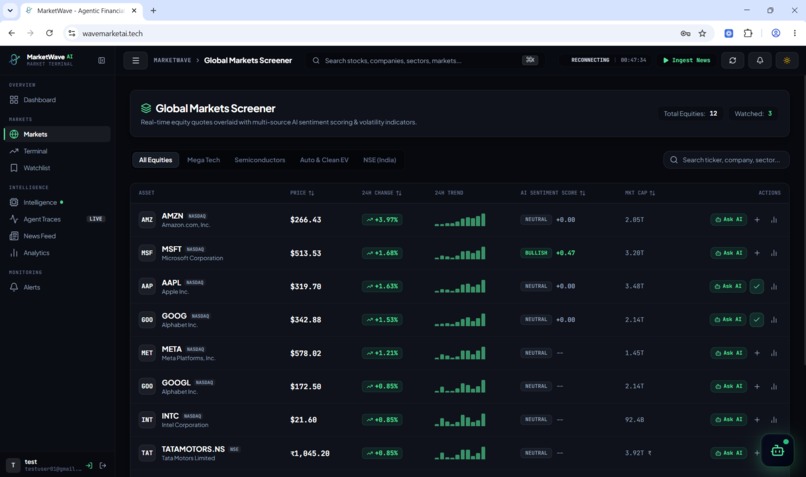
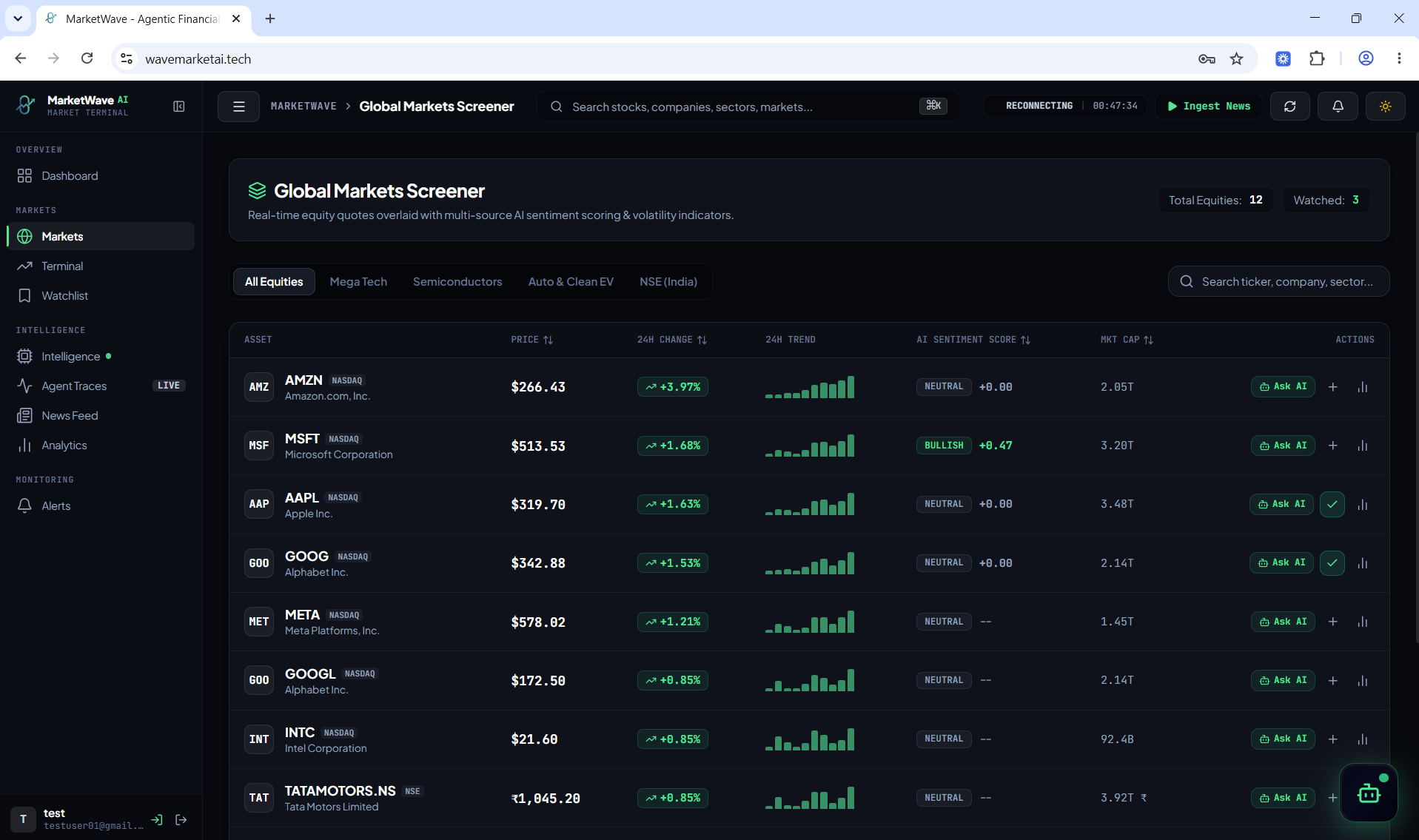
Markets
-
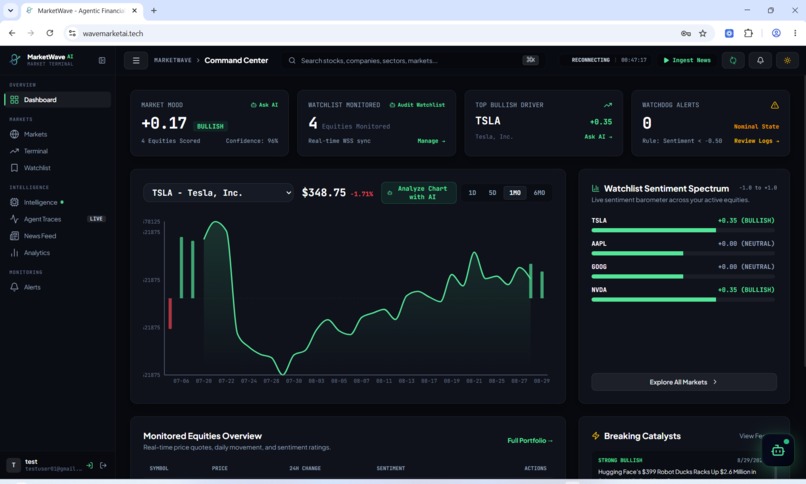
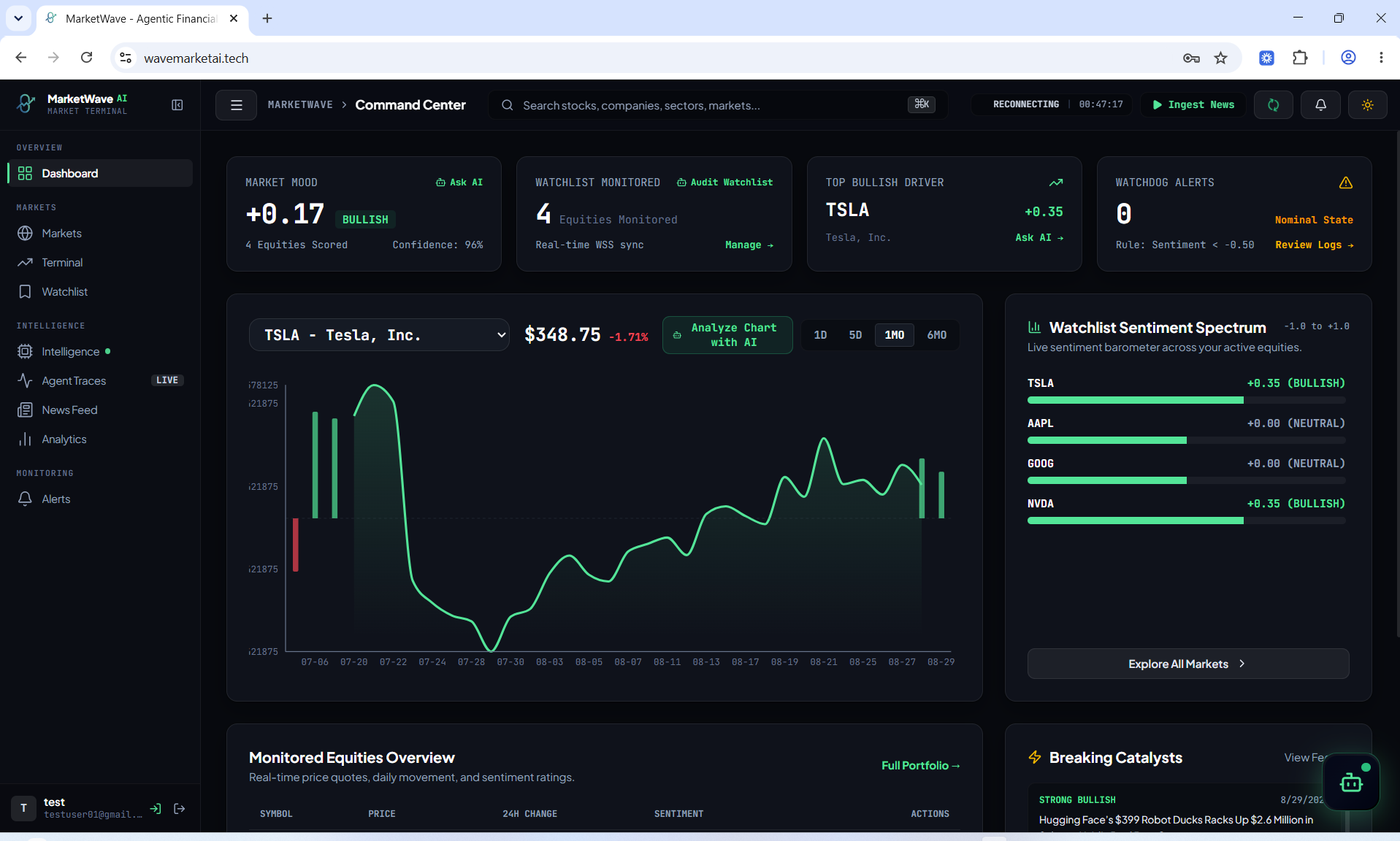
Dashboard
-
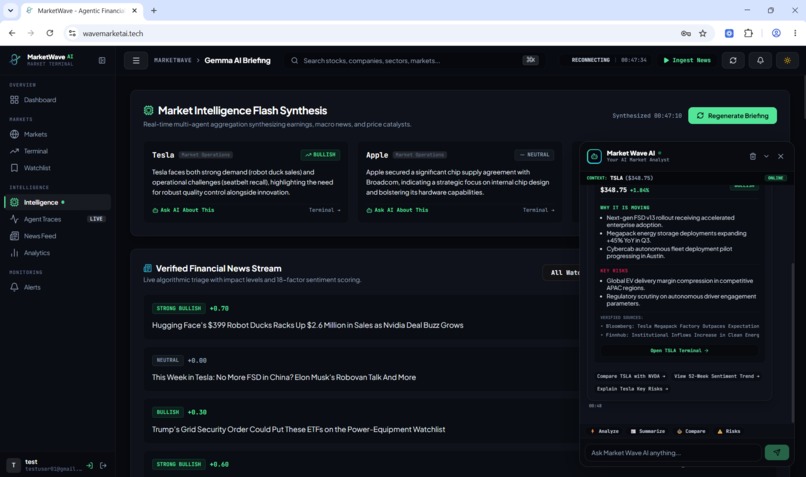
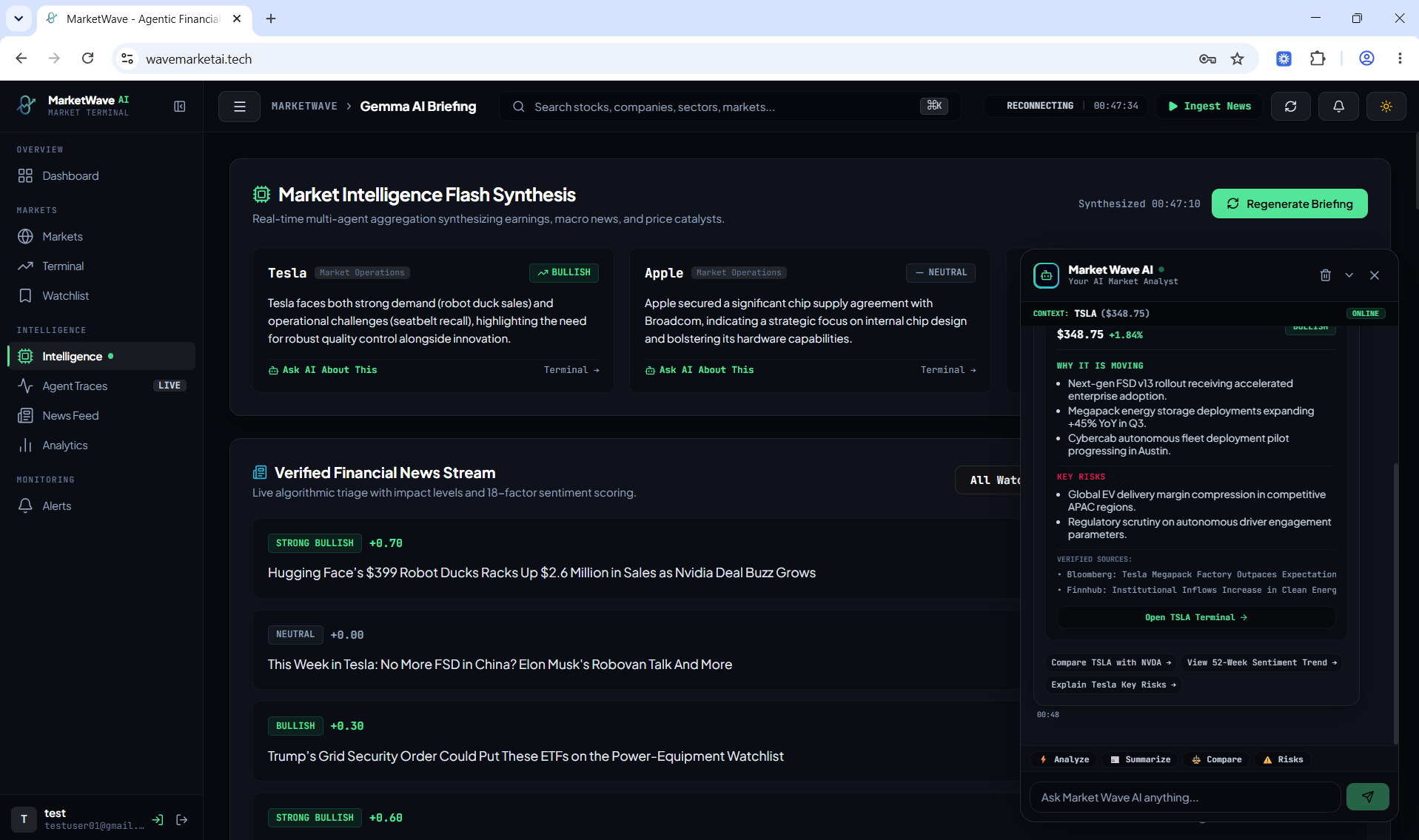
Bot Interaction
-
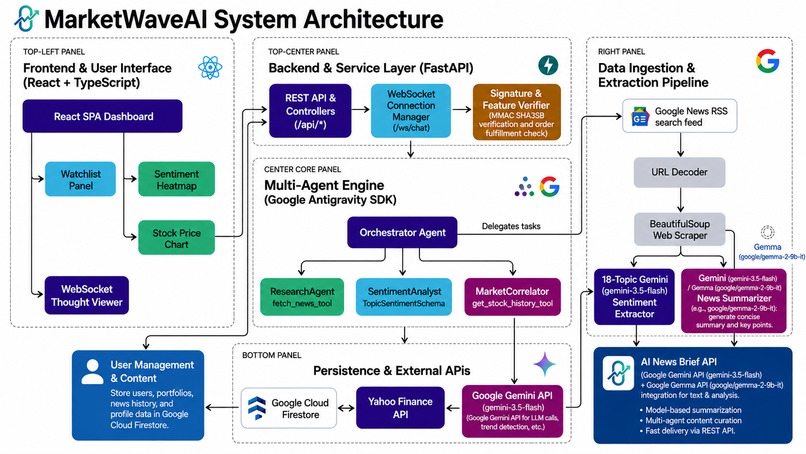
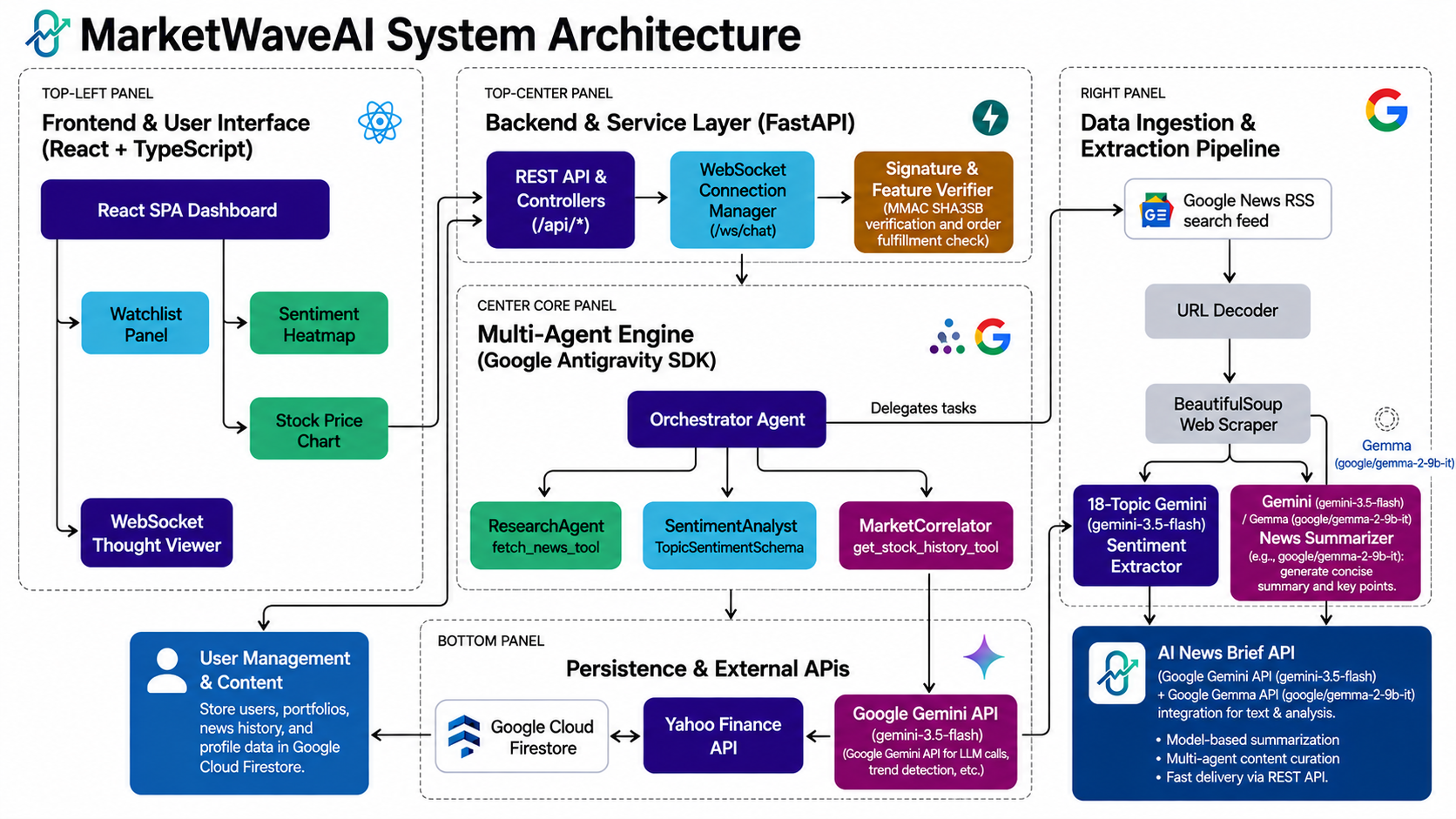
Architecture Diagram
-
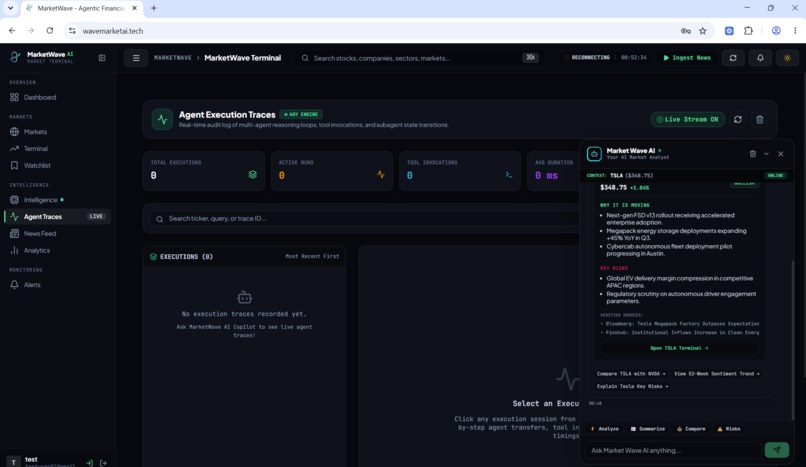
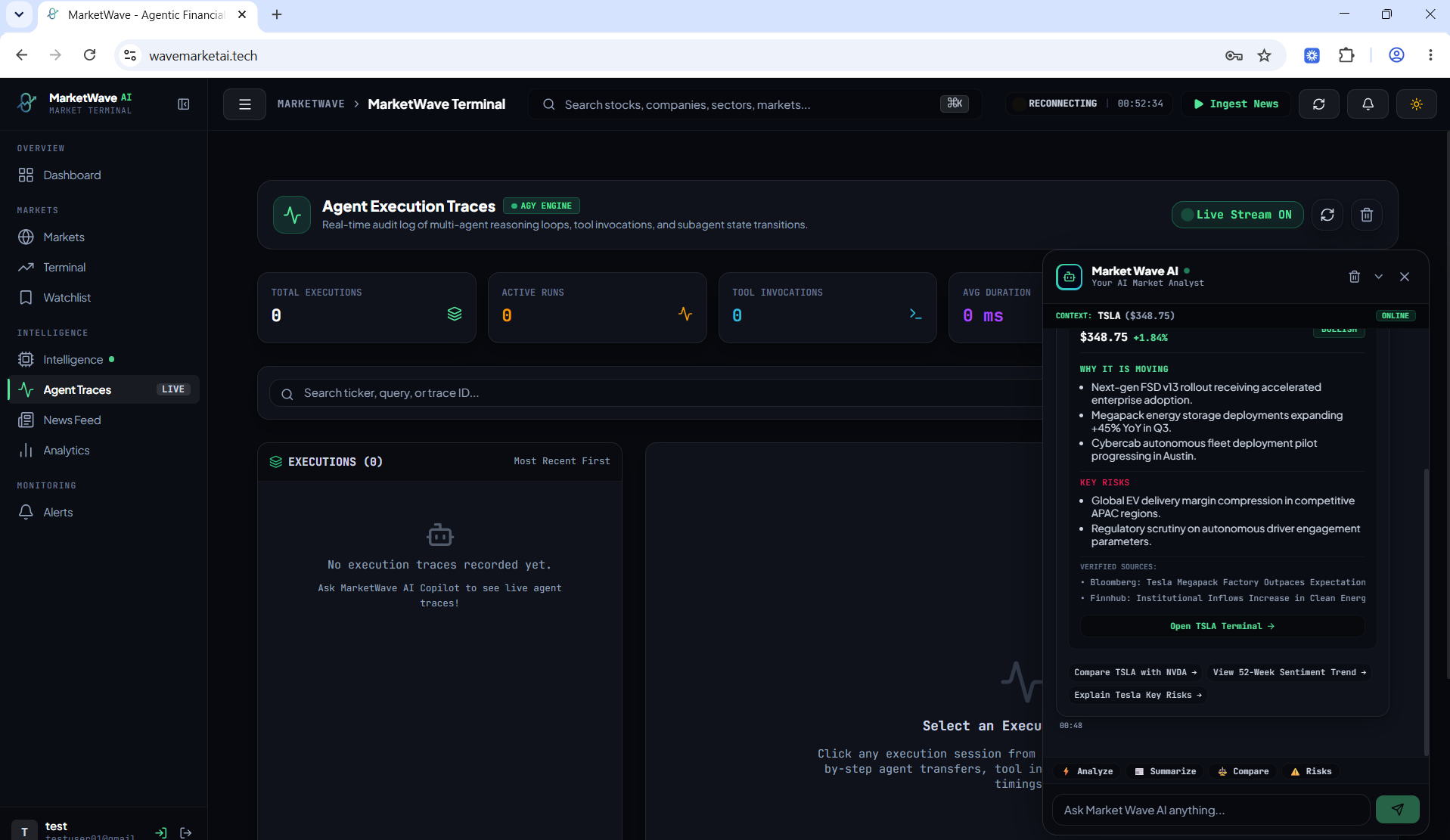
Agent Activity
Inspiration
Financial markets move faster than humans can read. Every day, thousands of financial news articles, company announcements, analyst reports, macroeconomic updates, and market events compete for an investor's attention. The challenge is not simply finding news—it is understanding which news matters, why it matters, how different aspects of the story affect a company, and whether that sentiment is reflected in the market price.
Traditional financial sentiment systems often reduce an article to a single label such as positive, negative, or neutral. That loses the nuance that matters to investors. A company can have positive revenue growth while simultaneously facing regulatory risk, management concerns, or deteriorating competitive positioning.
We wanted to build something more useful: an autonomous financial intelligence system that doesn't just classify news, but understands it across multiple dimensions, tracks how those signals evolve over time, and connects them to real market behavior. That became MarketWave AI.
MarketWave AI continuously monitors financial news, analyzes every relevant story across 18 financial sentiment dimensions, correlates those signals with historical OHLCV market data, and coordinates a hierarchy of specialized AI agents to transform raw news into actionable market intelligence.
What it does
You give MarketWave AI a company, stock symbol, or market entity. The system continuously monitors relevant financial information and performs five major tasks.
It discovers and collects market-moving news. A News Monitoring Agent searches financial sources for company-specific and market-relevant events, filtering out irrelevant or duplicate information.
News Research Agent It performs multi-dimensional sentiment analysis. Instead of producing one generic sentiment score, specialized analysis evaluates the article across 18 dimensions such as revenue, earnings, growth, management, competition, regulation, risk, innovation, market outlook, and investor confidence.
Sentiment Analyzer Agent It builds a sentiment trajectory. Sentiment is aggregated chronologically to show how the market narrative around a company is changing rather than treating every article as an isolated event.
Aggregate Correlator Agent It correlates sentiment with real market behavior. Sentiment signals are aligned with historical stock candles and OHLCV data, allowing the system to investigate whether major sentiment changes coincide with price, volume, volatility, or trend movements.
It coordinates multiple specialized agents. A hierarchical agent architecture delegates research, sentiment analysis, market-data analysis, correlation, and final synthesis to specialized agents. The reasoning process is streamed to the UI so users can observe what the system is doing in real time.
The result is not simply a sentiment dashboard. It is an autonomous market research workflow.
This is where MarketWave differs from traditional financial sentiment systems. While most systems reduce an article to a single label—positive, negative, or neutral—our 18-dimensional sentiment engine analyzes every relevant article across independent financial dimensions, including revenue, earnings, growth, management, competition, regulation, risk, innovation, market outlook, investor confidence, and more. This means a single article can be positive for growth, negative for regulation, and neutral for management at the same time. Each dimension is assigned a structured sentiment score along with a confidence value, and these signals are then aggregated chronologically to create a sentiment trajectory that captures how the financial narrative around a company evolves over time.
Market Correlation
But sentiment alone doesn't tell the complete story. MarketWave aligns the sentiment trajectory with historical OHLCV data — Open, High, Low, Close, and Volume — to provide a deeper view of how financial narratives relate to actual market behavior. This allows us to analyze relationships between sentiment and price returns, trading volume, volatility, and changes in market trends. The goal is not to claim causation, but to provide the market context needed to understand what happened following significant shifts in financial sentiment.
Google Anti-gravity
Behind the interface is our hierarchical multi-agent architecture. We use the Google Antigravity SDK as our agent runtime and orchestration layer, with the MarketWave Orchestrator at the top. Rather than relying on a single monolithic AI prompt, the Orchestrator delegates tasks to specialized agents. The Research Agent identifies the company, market context, and relevant financial information. The News Monitoring Agent discovers, filters, and deduplicates potentially market-moving news. The Sentiment Analysis Agent, powered by Gemini 3.5, understands the context of each article and evaluates it across all 18 financial dimensions. The Correlation Agent retrieves historical market data and aligns sentiment signals with actual market behavior. The Orchestrator then combines these structured outputs to generate our final Market Intelligence.
Market Intelligence
Market Intelligence is the final layer that brings everything together. It transforms raw financial news, multi-dimensional sentiment, historical market behavior, and multi-agent analysis into a concise and contextual view of what is happening, what is driving it, and how the market is responding. We also use Gemma for news briefing and aggregation workflows. Through Agent Traces, users can observe the agents executing this entire process in real time. Finally, the application is deployed on Google Cloud Platform, with Google Cloud Firestore providing persistent storage for users, watchlists, articles, sentiment data, and alerts.
How we built it
| Layer | Technology | Role |
|---|---|---|
| Reasoning & LLM | Google Gemini (gemini-3.5-flash) via google-generativeai & google-adk |
Powers multi-topic sentiment extraction, article synthesis, sub-agent reasoning, and market QA |
| Agentic Framework | Google Antigravity SDK (google-antigravity) |
Code-owned agent runtime managing sub-agent delegation (ResearchAgent, SentimentAnalyst, MarketAnalyst), policies, and tools |
| Backend Framework | FastAPI on Uvicorn | Async REST API, streaming WebSocket server, background ingestion tasks |
| Frontend Framework | React 18 + Vite + TypeScript + Tailwind CSS | Interactive dashboard with dark/light themes, TradingView-style price/sentiment charts, sentiment heatmap, and expandable agent thought viewer |
| Database & DB | Google Cloud Firestore (emulator) & users.json / alerts.json |
Persists user accounts, watchlists, scraped articles with 18-topic sentiment maps, and watchdog alerts with zero-config local fallbacks |
| Market Data & Ingestion | yahooquery, Finnhub, Google News RSS, BeautifulSoup4 |
Pulls historical stock price series, discovers per-ticker news, and scrapes live web articles |
| Alerting Watchdog | Async Background Watchdog (agents/triggers.py) |
Hourly autonomous watchdog evaluating watchlist overall sentiment against critical thresholds |
| Gemma | google/gemma-2-9b-it |
Used for News Briefing and historical data show |
Challenges we ran into
The hardest part was not generating sentiment scores. It was making those scores meaningful, comparable, and temporally useful.
- Financial sentiment is contextual Words such as "loss", "debt", "investment", or "decline" cannot be interpreted in isolation. A company reporting a larger-than-expected investment may initially look negative from a financial perspective, while the same event could represent a positive long-term growth strategy. We therefore rely on Gemini's contextual reasoning rather than simple keyword-based sentiment.
- One article can contain contradictory signals Financial articles frequently contain both positive and negative information. Instead of forcing the entire article into one sentiment class, MarketWave AI analyzes each financial dimension independently.
- News timestamps and market timestamps differ Articles may be published before market open, during trading hours, after market close, or over weekends. Connecting news events to OHLCV candles therefore requires careful temporal alignment rather than a simplistic one-article-to-one-candle mapping.
- Correlation is not causation A stock can move because of earnings, macroeconomic news, sector movements, institutional trading, or unrelated events. MarketWave AI therefore presents sentiment/market relationships as analytical signals rather than claiming that a particular news article caused a specific price movement.
- Multi-agent coordination Multiple agents can produce overlapping or contradictory observations. The orchestrator therefore needs to maintain context, validate outputs, and synthesize the individual perspectives into a coherent final result.
Accomplishments that we're proud of
18-dimensional financial sentiment analysis. We moved beyond a single positive/negative classification and created a structured representation of financial sentiment. Autonomous multi-agent market research. Specialized agents collaborate instead of relying on a single monolithic AI prompt. News-to-market correlation. Sentiment trajectories are aligned with real historical OHLCV data to investigate how market narratives relate to price and volume behavior. Real-time agent visibility. Users can watch the analysis progress as agents discover news, analyze sentiment, retrieve market data, and synthesize conclusions. Continuous market monitoring. The architecture is designed around an ongoing monitoring workflow rather than a one-time question-answering interaction. Structured AI outputs. Sentiment and market signals are represented as structured data, making the system suitable for downstream analytics and visualization. Extensible agent architecture. New capabilities—such as earnings analysis, analyst-rating analysis, macroeconomic analysis, or sector comparison—can be introduced as additional specialized agents.
What we learned
We learned that financial intelligence is less about generating a clever summary and more about connecting multiple streams of evidence. News provides the narrative. Sentiment provides the interpretation. Historical market data provides the behavioral context. Multi-agent reasoning provides the coordination layer. The most useful insights emerge when these pieces are analyzed together. We also learned that transparency matters. When an AI system influences a financial research workflow, users need to understand where an insight came from and which agents contributed to it. Streaming the agent activity makes the system feel less like a black box and more like an observable research assistant.
What's next for MarketWave AI
Real-time market alerts triggered by significant sentiment changes. Earnings-call intelligence with automatic transcript analysis. Analyst-rating and price-target monitoring. Sector-level sentiment maps showing how narratives move across industries. Company-to-company sentiment comparison for competitive intelligence. Event-driven market analysis for earnings, M&A, product launches, regulatory actions, and geopolitical events. Personalized investor agents that monitor only the companies, sectors, and dimensions relevant to a user.
Backtesting sentiment signals against historical market behavior. Long-term narrative memory so the system can compare today's market story with previous cycles. Proactive autonomous monitoring, where MarketWave AI detects unusual sentiment changes and initiates an investigation without waiting for a user query.


Log in or sign up for Devpost to join the conversation.