-
-
Valid Test
Inspiration
90% of startups fail because founders build products nobody wants. Not because they lack talent — because they skip validation. Market research tools either cost thousands of dollars, take weeks, or require a data analyst to interpret.
We asked: what if a non-technical founder could type a raw idea and get real, actionable market intelligence in under 60 seconds?
That question became Market Scout AI.
What It Does
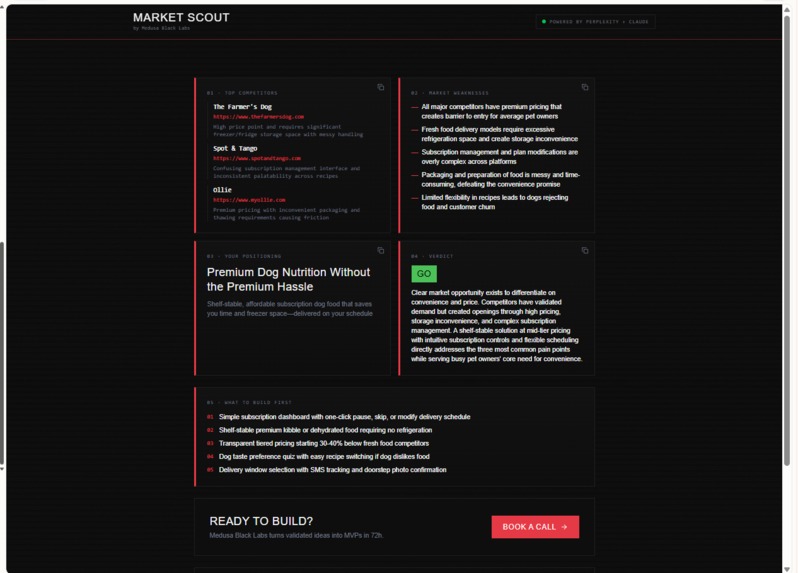
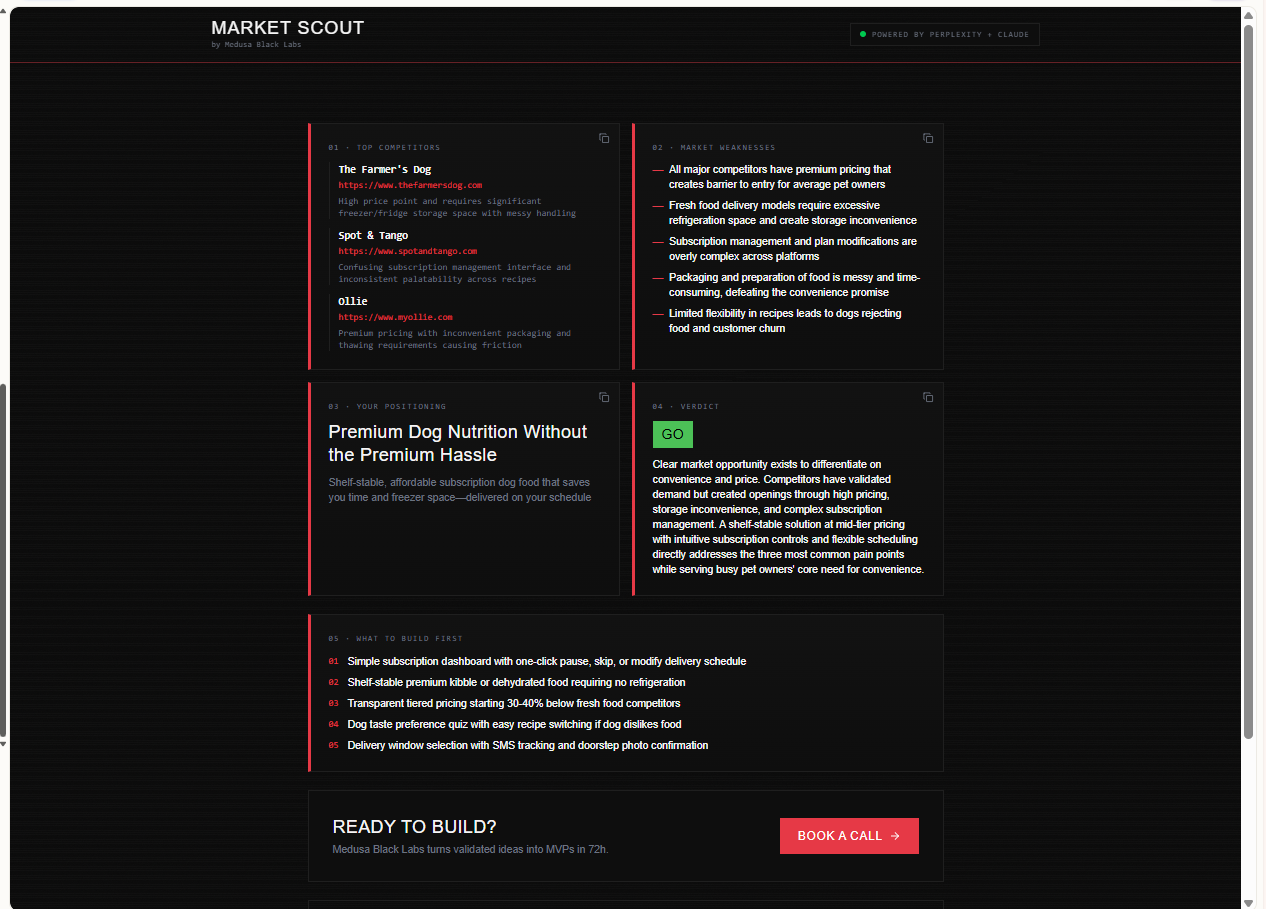
Market Scout AI is a real-time market validation engine. A founder types any startup idea — raw, messy, unpolished — and the platform immediately returns:
| Output | Description |
|---|---|
| Top Competitors | 3 real companies with live URLs, sourced from the web in real time |
| Market Weaknesses | The 5 most common pain points customers have with existing solutions |
| Your Positioning | An AI-generated H1 headline + subheadline ready to use |
| Verdict | GO / CAUTION / NO-GO with a clear strategic rationale |
| What to Build First | 5 prioritized MVP feature recommendations |
No jargon. No 40-page reports. Just a clean, structured output a founder can act on immediately.
How We Built It
Market Scout uses a two-stage AI pipeline running entirely in real time on the frontend:
Stage 1 — Live Web Intelligence (Perplexity API)
The user's idea triggers a live web search via the Perplexity sonar model. This returns grounded, real-time competitor data — not hallucinated company names, but actual URLs with actual customer complaints sourced from the live web.
Stage 2 — Strategic Analysis (Anthropic Claude)
The raw Perplexity output is passed directly to Claude (claude-sonnet-4-5) with a structured prompt. Claude transforms the competitive intelligence into actionable positioning: headline copy, market weaknesses, MVP priorities, and a GO/CAUTION/NO-GO verdict with rationale.
Stage 3 — Silent Automation (Make.com Webhook)
After results display, a background webhook fires to Make.com — logging the lead (name, email, idea, verdict) for CRM follow-up. Zero friction for the user.
User Input → Perplexity API (live search) → Claude API (analysis) → Structured Output ↓
Make.com Webhook (background)
Tech Stack:
| Layer | Technology |
|---|---|
| Frontend | Lovable (React + TypeScript) |
| Live Search | Perplexity API (sonar model) |
| AI Analysis | Anthropic Claude (claude-sonnet-4-5) |
| Automation | Make.com Custom Webhook |
| Hosting | Lovable (production) |
| Secrets | Lovable server-side environment variables (never exposed client-side) |
Challenges We Ran Into
1. Model String Errors
The initial Claude API call returned a 404 because Lovable generated an incorrect model string (claude-sonnet-4-20250514). Diagnosed and corrected to claude-sonnet-4-5 — verified against the Anthropic API directly.
2. API Key Exposure Risk
Early builds risked exposing API keys client-side. Solved by routing all API calls through Lovable server-side environment variables — neither the Perplexity nor Anthropic key is ever visible in the browser.
3. Latency UX
The two-stage API pipeline takes 10–15 seconds. Without feedback, users abandoned. Solved with a terminal-style animated loader showing which stage is running in real time ("Perplexity scanning..." → "Claude analyzing...").
4. JSON Parsing Reliability
Claude occasionally returned markdown-wrapped JSON, breaking the parser. Solved by explicitly instructing Claude to return strict JSON with no preamble, and adding a JSON.parse fallback with replace(/json|/g, '').
Accomplishments We're Proud Of
- ✅ Full end-to-end pipeline live — Perplexity → Claude → structured output → Make.com webhook, all working in production
- ✅ Real competitor URLs — not hallucinated names, but actual verified companies sourced from live web data
- ✅ Sub-15 second total latency — both API calls complete and render before a user loses patience
- ✅ Zero technical knowledge required — tested with a 60-year-old non-technical founder who completed a full analysis in 90 seconds
- ✅ Built and shipped in under 72 hours — from blank Lovable canvas to live production URL
What We Learned
Perplexity and Claude are genuinely complementary, not redundant. Perplexity is a retrieval engine — fast, grounded, factual. Claude is a reasoning engine — structured, strategic, copywriting-ready. Using each for what it does best produces output neither could achieve alone.
We also learned that the biggest UX challenge in AI tools isn't the AI — it's managing the latency gap. The animated terminal loader reduced perceived wait time more than any performance optimization we made.
What's Next for Market Scout AI
Q3 2026 — Integration Layer
- Connect validated ideas directly to Medusa Black Labs' 72h MVP build service
- Add PDF export of the full market analysis report
- Integrate Notion output (one-click save to founder's workspace)
Q4 2026 — Depth Mode
- Add TAM/SAM/SOM estimation layer
- Competitive pricing analysis (scrape pricing pages of identified competitors)
- Historical trend data overlay (is this market growing or shrinking?)
2027 — Platform
- API access for accelerators and startup studios
- Bulk analysis mode for investors evaluating deal flow
- White-label version for startup incubators
Market Scout AI is the entry point. The validated idea becomes the brief. The brief becomes the MVP. That's the Medusa Black Labs flywheel.
Built With
- anthropic-claude
- lovable
- make
- perplexity-api
- react
- typescript

Log in or sign up for Devpost to join the conversation.