-
-
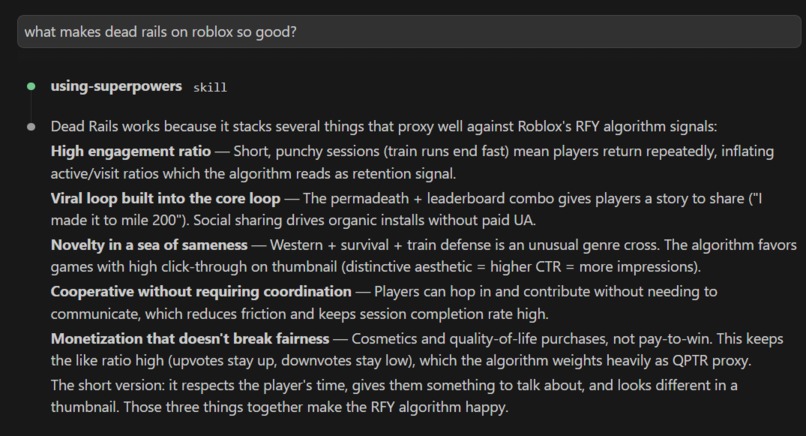
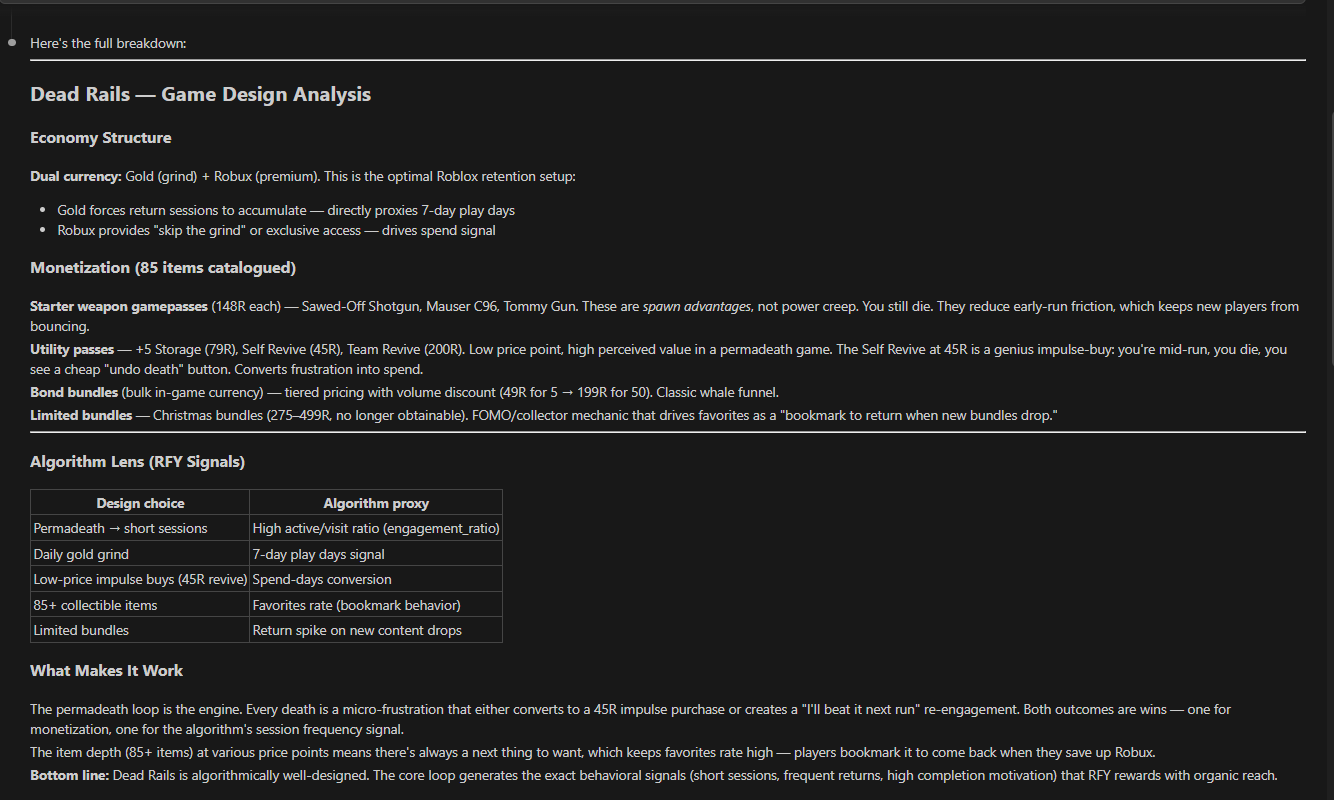
Without MCP Server
-
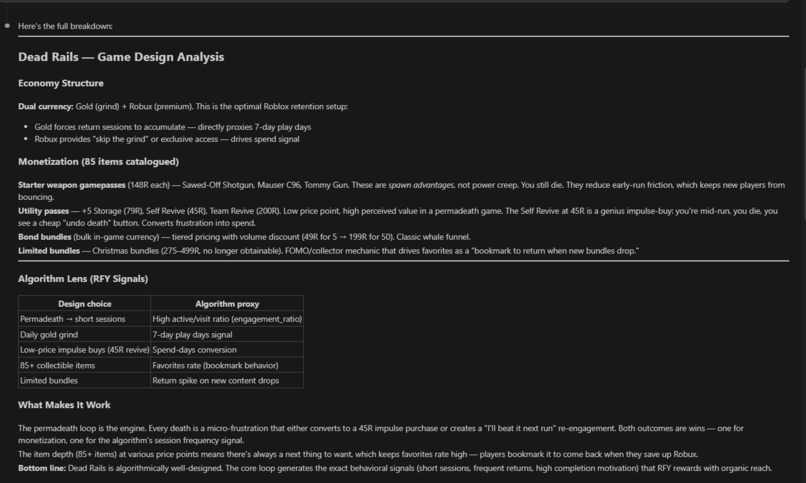
With MCP Server
-
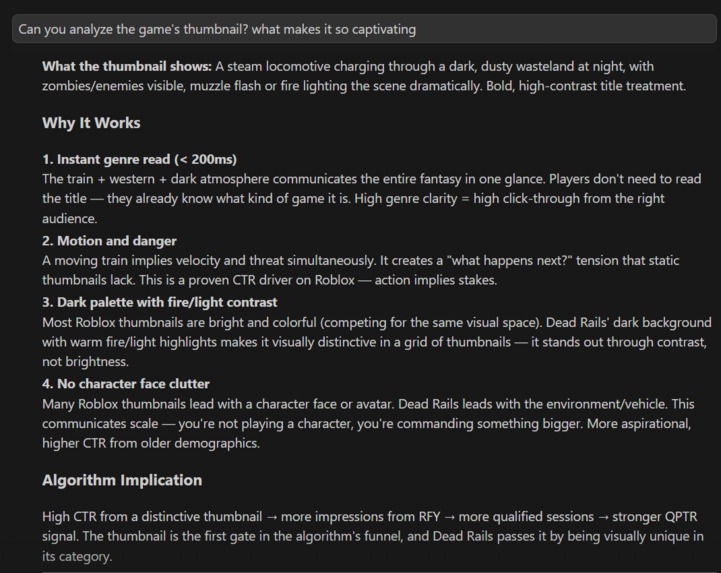
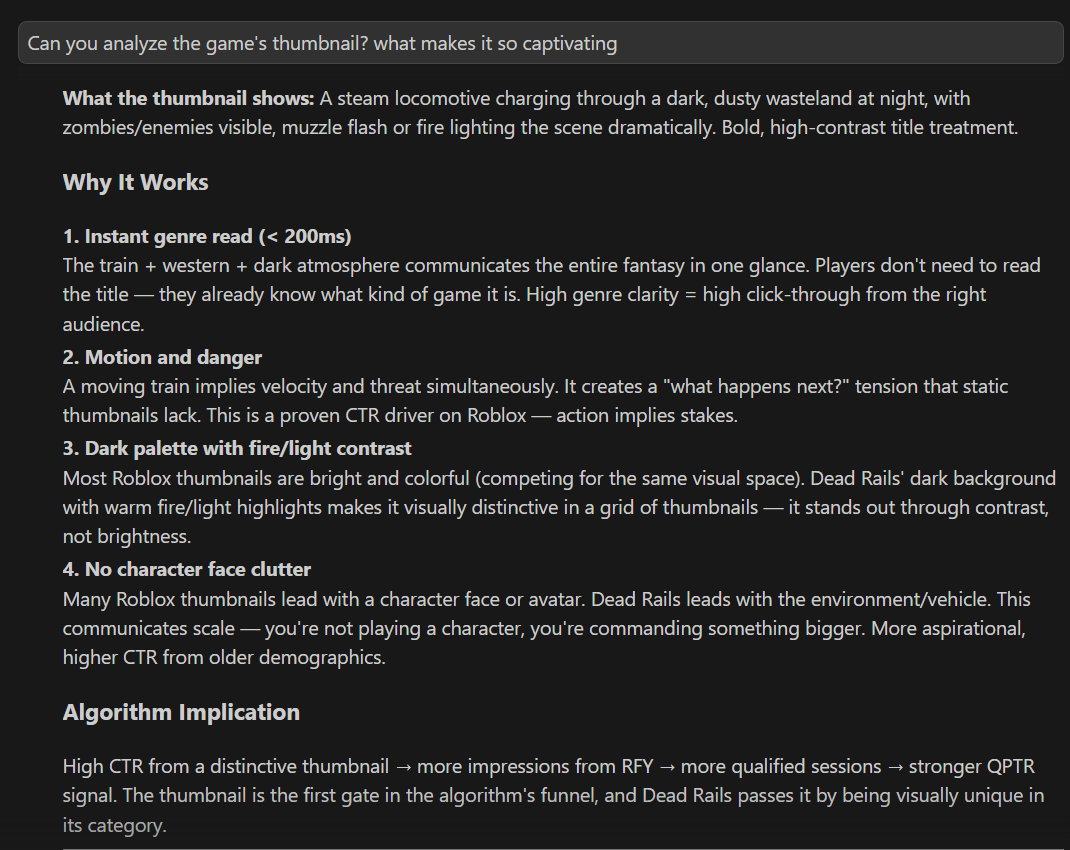
Thumbnail Tool Example
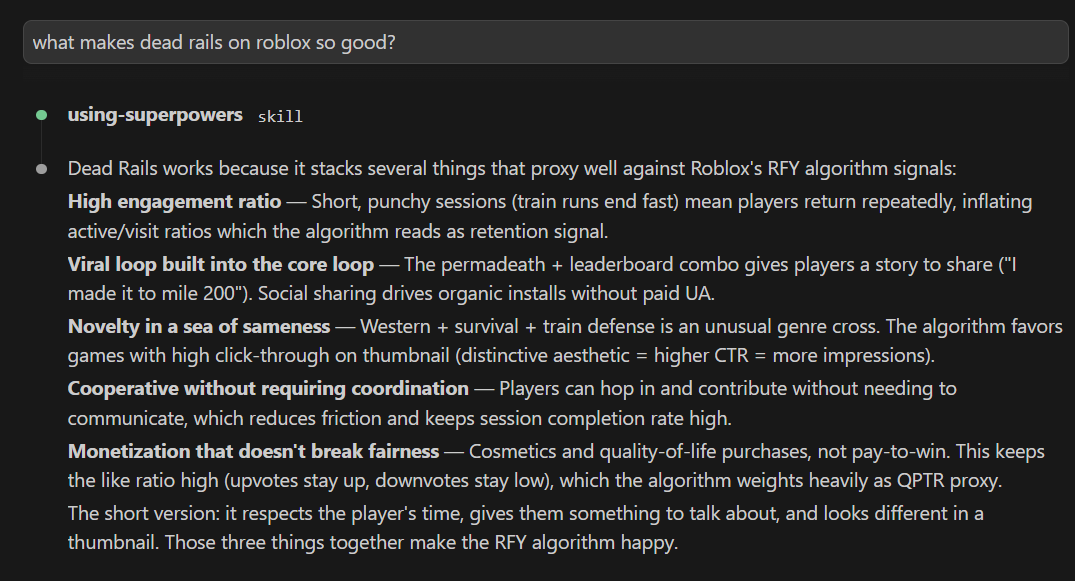
Inspiration
Coding agents are incredibly proficient at writing code, but they fundamentally operate in a vacuum, they understand syntax but lack awareness of marketplace reality. In the context of Roblox, developers often build games without understanding the underlying Recommended for You (RFY) algorithm that drives over 90% of organic discovery. We wanted to bridge this gap by creating a data pipeline that moves market intelligence directly into an agent's context window. This allows the agent to make product decisions based on what the market actually rewards, rather than just building a generic application.
What it does
The Roblox Market Intelligence MCP is a specialized server that delivers live market insights framed around discovery algorithm signals. It translates raw data from Rolimons and the Roblox API into actionable "signal proxies" like QPTR (Qualified Play-Through Rate) and Deep Engagement. The server exposes tools that allow an AI agent to:
- Identify Gaps: Find genres where demand is high but current quality/retention is weak.
- Analyze Competitors: Automatically scrape Fandom wikis to extract game economy and progression patterns.
- Benchmark Performance: Compare a proposed concept against top-performing breakout games in real-time.
How we built it
The project is built as a Model Context Protocol (MCP) server using Python 3.11 and the FastMCP framework. The system architecture follows a three-stage pipeline:
- Data Extraction: We implemented an async HTTP pipeline using
httpxto fetch 300+ games from Rolimons and resolve metadata via Roblox APIs. - Signal Interpretation: We used LaTeX-supported formulas to compute proxies, such as $Score_{breakout} = \frac{Engagement}{\log_{10}(Visits + 10)}$, to identify growth momentum.
- Design Intelligence: We utilized the MediaWiki API to fetch structured data from game wikis, providing the agent with a "read" on competitor retention engines.
Challenges we ran into
Our primary technical hurdle was the data resolution bottleneck. Fetching and resolving details for hundreds of unique games was too slow for a fluid agent experience. We solved this by implementing a 10-minute caching layer, which performs an intensive initial fetch followed by instant tool responses. Additionally, interpreting raw wiki data into actionable design signals required careful data cleaning to ensure the agent received insights rather than just noise.
Accomplishments that we're proud of
We are proud of successfully implementing the relatively new Model Context Protocol standard during a short 18-hour sprint. We successfully bridged the gap between raw web data and structured AI context, allowing an agent to "reason" about market trends. Being able to automatically extract complex economy designs from public wikis and translate them into retention signals was a significant technical milestone for this project.
What we learned
This project was a deep dive into the importance of domain expertise in AI development. We learned that the "moat" isn't just access to data, but knowing which signals like Revenue per Visit or Co-Play Days actually predict success in a specific marketplace. We also gained significant experience in building high-performance async data pipelines in Python to support agentic workflows.
What's next for Roblox Market Intelligence MCP
The core pattern of this project is highly generalizable. Our next steps include:
- Market Expansion: Adapting the server to support other ecosystems like the Chrome Web Store, Steam, Social Media Platforms, etc.
- Algorithm Refinement: Enhancing our signal proxies as more public data becomes available regarding the December 2025 "Co-Play" signal updates(Roblox) and using more advanced statistical modeling for more accurate results.
Built With
- asyncio
- beautiful-soup
- claude-code
- fastmcp
- gemini
- httpx
- python


Log in or sign up for Devpost to join the conversation.