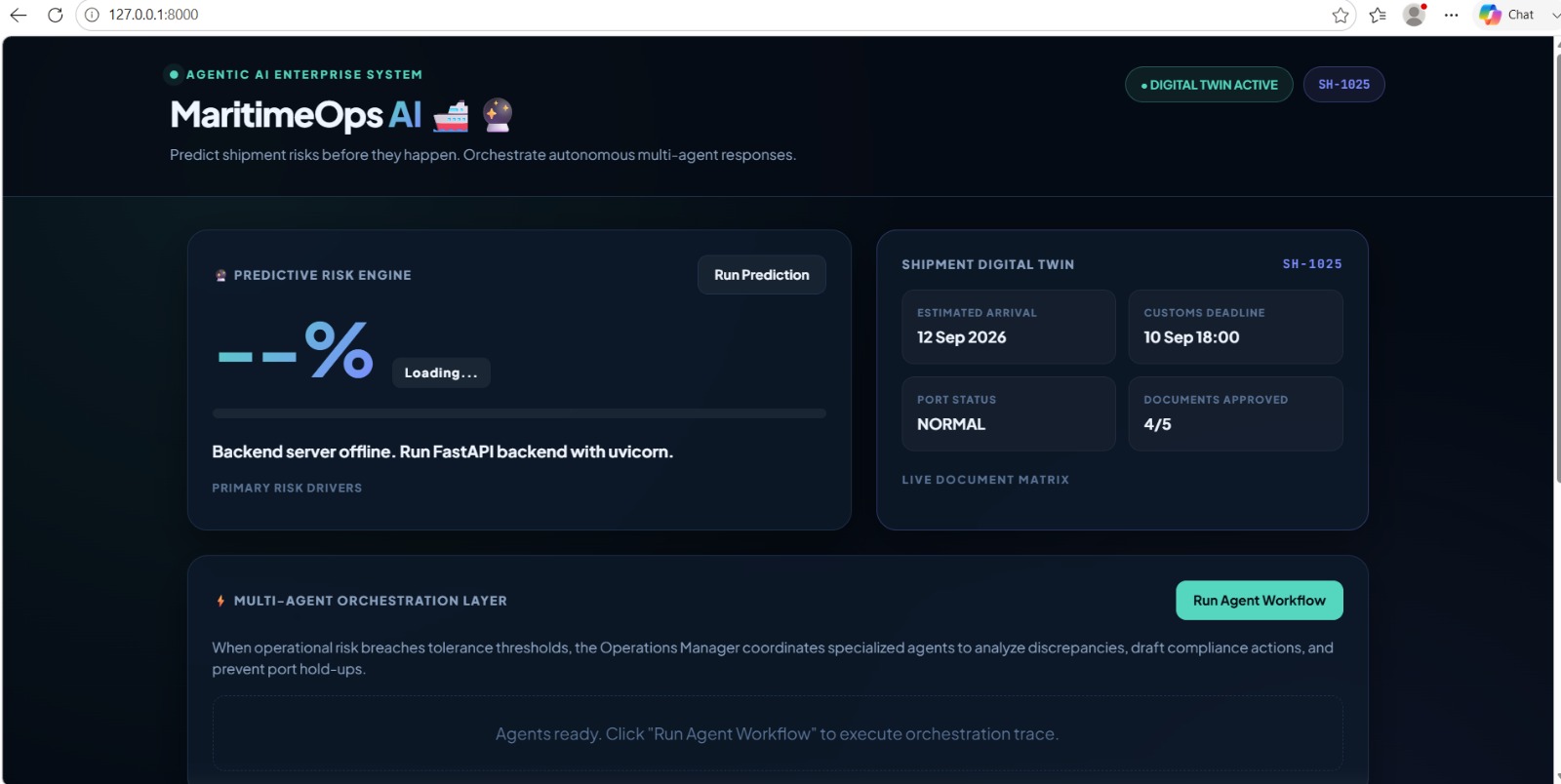
MaritimeOps AI — Predict. Prevent. Protect.
Inspiration
Maritime shipping depends on many organizations, documents, deadlines, and operational events. A small delay or missing document can cascade into customs issues, approval delays, cargo holds, and delivery disruptions.
We asked a simple question:
What if an AI system could predict a shipment problem before it actually happens—and take preventive action?
That led us to build MaritimeOps AI, an agentic AI Operations Manager designed to continuously monitor shipment conditions, predict future risks, explain why they may occur, and coordinate preventive actions.
What We Built
MaritimeOps AI treats every shipment as a live digital state, combining:
- 📄 Document status and versions
- ⏱️ Deadlines and processing times
- 🚢 Port and operational events
- 📦 Shipment information
- ⚠️ Document inconsistencies
- 👥 Approval and stakeholder delays
Instead of waiting for a failure, our system continuously evaluates these signals and produces an early-warning risk prediction.
For example:
82% probability of documentation delay**
The system can explain the prediction:
- Required certificate is missing
- Customs deadline is approaching
- Approval historically takes time
- A port disruption has occurred
It then moves beyond prediction by coordinating agents to initiate preventive action.
Agentic AI Architecture
The system uses a multi-agent architecture coordinated by an AI Operations Manager.
🔮 Prediction Agent
Analyzes shipment signals and predicts potential delays or operational risks.
📄 Document Agent
Monitors document completeness, versions, and status.
✅ Validation Agent
Cross-checks information across related documents and identifies inconsistencies.
🧠 Investigation Agent
Explains the causes and evidence behind a detected risk.
🤝 Coordination Agent
Identifies the appropriate stakeholder and recommends or initiates preventive action.
⚙️ Operations Manager
Orchestrates the agents, evaluates the overall situation, and decides the next operational step.
This creates an event-driven loop:
Event → Understand → Predict → Investigate → Decide → Act → Re-validate
What Makes It Different
Traditional systems often focus on tracking what has already happened.
MaritimeOps AI focuses on:
Predicting what is likely to happen next.
A missing document alone is not necessarily a failure. But when combined with an approaching deadline, delayed approval, and a port disruption, the combined signals can indicate a high probability of future delay.
Our system brings these signals together and converts them into an actionable prediction.
Trust & Auditability
Because shipping documents pass between multiple stakeholders, maintaining trustworthy history is important.
Our prototype maintains a tamper-evident audit trail using SHA-256 hash chaining. Each important event is linked to the previous event, creating a verifiable history of the shipment lifecycle.
Sensitive documents are not placed directly on the blockchain. In a production architecture, documents can remain in secure encrypted storage while integrity proofs, versions, approvals, and audit events can be anchored to a permissioned blockchain.
What We Learned
During development, we learned that building an effective agentic system is not simply about adding an LLM.
The important part is giving each agent:
- A clear responsibility
- Access to appropriate tools and data
- Context about the current shipment state
- Rules for when to escalate
- The ability to coordinate with other agents
- Human approval for high-impact decisions
We also learned that explainability is essential for operational AI. Instead of presenting a risk score such as “82%” without context, our system provides the factors contributing to that prediction and the recommended preventive actions.
How We Built It
The prototype combines:
Agentic AI + LLM/RAG-ready architecture + predictive risk analysis + document intelligence + event-driven workflows + digital twin concepts + secure auditability.**
The system is designed so that the predictive engine can later be replaced with a trained machine-learning model using historical shipment data, while the agent orchestration layer remains unchanged.
A production version could additionally integrate real port APIs, customs systems, enterprise document repositories, RAG over maritime regulations and SOPs, MCP tools, and permissioned blockchain infrastructure.
Challenges
The biggest challenge was designing a system that could work across different stakeholders and heterogeneous shipping systems without creating another isolated data silo.
We addressed this by designing around a unified shipment state and an event-driven agent architecture.
Another challenge was balancing automation with trust. We therefore designed the system so that agents can recommend and coordinate actions while sensitive or high-risk decisions can still require human approval.
Our Vision
We don't want MaritimeOps AI to be another dashboard that tells an operator that something went wrong.
We want it to become an AI Operations Manager that sees the risk coming, explains it, coordinates the right people, and helps prevent the problem before it becomes a disruption.
Predict. Prevent. Protect
Built With
- agentic
- anomaly
- autonomous
- context-aware
- database
- detection
- digital
- forecasting
- human-in-the-loop
- intelligence
- llm
- multi-agent
- orchestration
- planning
- prediction
- predictive
- rag
- reasoning
- risk
- semantic
- simulation
- tool-calling
- twin
- vector
- workflow

Log in or sign up for Devpost to join the conversation.