-
-
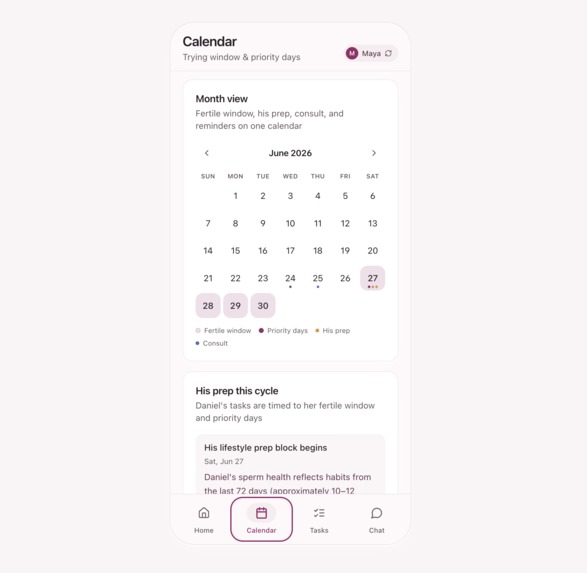
Calendar UI
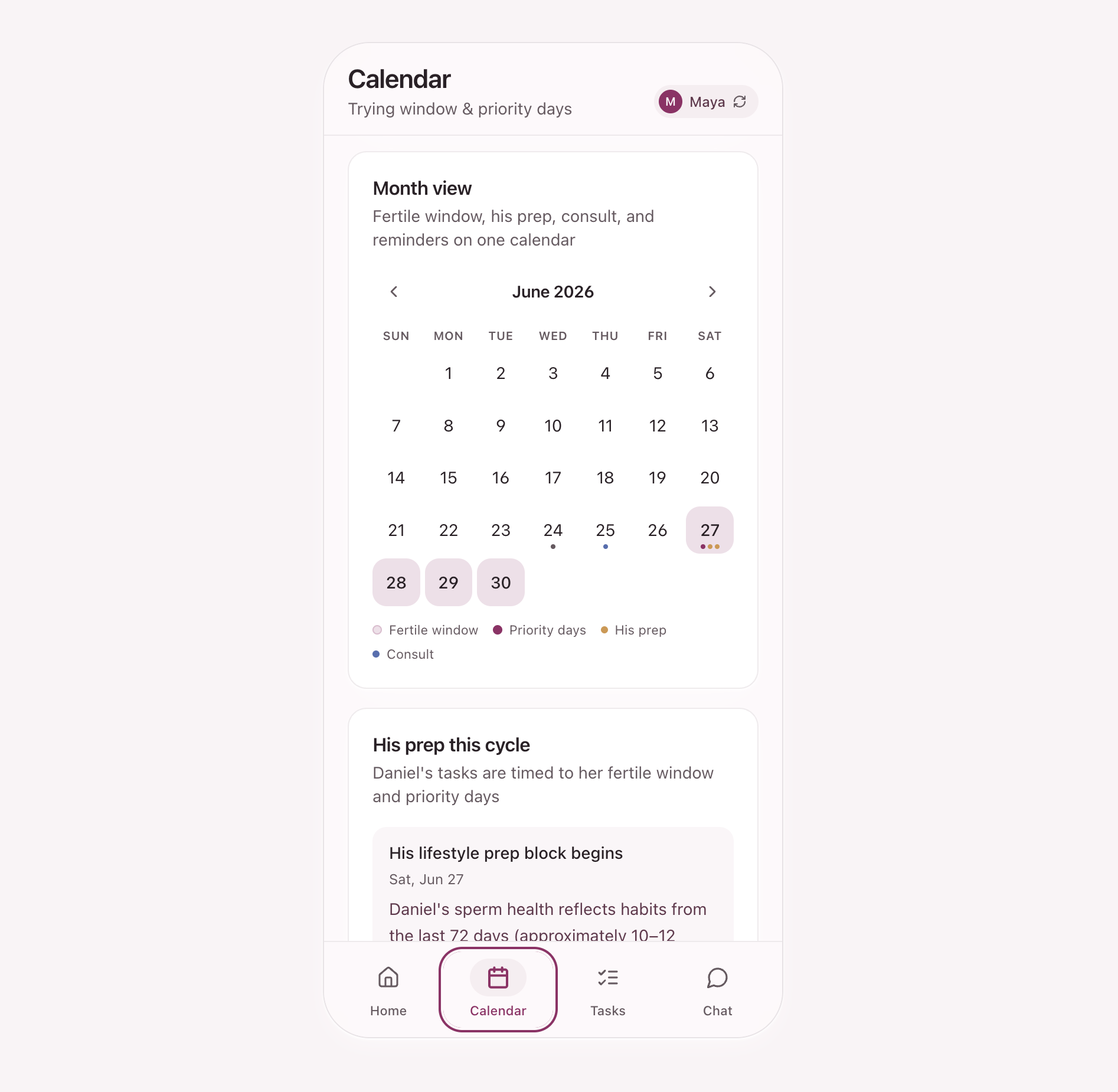
Inspiration
Infertility is common, expensive, and emotionally exhausting. WHO estimates that about 1 in 6 adults globally experience infertility, and CDC reports that in the U.S., 1 in 5 married women ages 15-49 with no prior births are unable to get pregnant after one year of trying.
But infertility is not only a medical problem. It often becomes a relationship problem and an inequality problem.
Even though conception is a shared journey, fertility care usually puts more visible burden on women. Women are often the ones tracking cycles, scheduling appointments, managing lab results, calling insurance, preparing clinic questions, and carrying the emotional weight of whether each step worked. Even when male-factor infertility is involved, women often go through most of the testing, procedures, hormones, and physical treatment. That imbalance can quietly create resentment, guilt, misunderstanding, and conflict between partners.
I built Mariposa because fertility care should not leave one person carrying the medical, administrative, financial, and emotional load alone. Pregnancy and infertility care should be treated as a cooperative process, where both partners understand what is happening, what is missing, and what each person can do next.
What it does
Mariposa is an AI fertility admin companion for couples preparing for infertility care.
It helps couples:
- Complete intake by speaking naturally with Deepgram voice input.
- Auto-populate intake fields from voice while keeping the couple in control to review before submitting.
- Turn intake into structured, validated fertility context.
- Detect missing next-step data like labs, semen analysis, and insurance gaps.
- Verify fertility insurance benefits through a Browserbase-powered web workflow.
- Use Claude to extract clear coverage facts and next actions.
- Store agent memory and retrieval context in Redis.
- Run the insurance admin workflow through Agentspan/local orchestration.
- Generate a shared Summary tab, task list, and follow-up plan the couple can actually use before a clinic visit.
- Let couples add new lab, semen analysis, insurance, or clinic updates after intake, then update the summary, tasks, and Redis memory.
The demo focuses on one realistic workflow: helping a sample couple understand what is covered, what is missing, and what they should do next together.
The normal user experience is Intake, Summary, Tasks, Calendar, and Chat. The insurance-flow demo screen is an internal proof view that shows the agent workflow running behind the scenes.
How I built it
I built Mariposa as a Next.js application with a structured fertility workspace and sponsor-integrated agent workflow.
Core pieces:
- Deepgram powers direct microphone intake. Users speak naturally, Mariposa transcribes the turn, extracts structured draft fields, auto-populates the validated intake form for review, and uses Deepgram text-to-speech to respond.
- Anthropic Claude extracts insurance coverage facts from transcript and portal context, returning structured fields like deductible, coinsurance, covered services, prior authorization needs, and follow-up tasks.
- Redis powers vector retrieval for insurance context and stores couple-scoped agent memory, including workflow results and later result updates.
- Browserbase is the web verification layer: it fetches the synthetic member benefits portal when reachable, and the app clearly marks when it uses a fallback snapshot.
- Agentspan / Orkes-shaped workflow runs the insurance admin flow and exposes orchestration metadata, including execution status when available.
- Sentry captures server-side workflow errors for reliability.
- The app includes deterministic fallbacks so the demo remains explainable even when a sponsor credential or external service is unavailable.
I intentionally built small, inspectable workflows instead of a generic chatbot. The system produces structured outputs: coverage facts, missing data, tasks, summaries, and memory events.
Challenges I ran into
The hardest challenge was making the demo both real and reliable. Live AI, browser automation, Redis, voice APIs, and orchestration tools can all fail independently, so I had to design clear fallback paths without pretending a fallback was live.
I also had to be careful with the sensitivity of fertility care. Mariposa does not diagnose, recommend treatment, or replace clinicians. It helps organize information, identify missing administrative steps, and prepare couples to talk to doctors.
Another challenge was designing the product around both partners, not just the person who is pregnant or trying to become pregnant. A lot of fertility tools focus on the woman’s body and cycle, which makes sense medically, but can accidentally reinforce the idea that fertility is mostly her responsibility. I wanted Mariposa to make the shared work visible: insurance calls, semen analysis, lab prep, clinic questions, document uploads, and next steps.
Accomplishments that we're proud of
I am proud that Mariposa is not just an AI wrapper. It is a working, end-to-end fertility admin workflow with structured intake, voice input, retrieval, memory, web verification, AI extraction, task generation, and observability.
The most important accomplishment is clarity for the couple. Instead of giving a vague answer, Mariposa can say: diagnostic evaluation is covered, semen analysis is covered, prior authorization is needed for IUI/IVF, use the in-network lab, verify pharmacy benefits, and bring specific items to the clinic.
I am also proud that the product directly addresses an overlooked emotional problem: couples often fight not only because infertility is painful, but because the work around it is uneven and unclear. Mariposa turns that invisible burden into a shared plan.
From an engineering side, the demo has fallback flags, visible provider status, tests, progress documentation, and honest separation between live paths and deterministic demo paths.
What I learned
I learned that fertility care has a huge “coordination gap.” Couples are not only asking “what treatment do we need?” They are asking “what labs are missing?”, “will insurance cover this?”, “who do we call?”, “what do we bring?”, and “what should we do next?”
I also learned that the burden is not distributed equally by default. Women often become the project manager of infertility care, even though male-factor infertility contributes to a large share of cases and both partners are affected. That mismatch can make an already painful process feel lonely and unfair.
AI is most useful here when it becomes infrastructure for action: extracting facts, remembering context, checking external sources, and turning ambiguity into a checklist.
Finally, I learned that reliability and transparency matter as much as model quality. In health-adjacent workflows, the system must show what it knows, where it came from, and what still needs human or clinical confirmation.
What's next for Mariposa
Next, I would make Mariposa persistent and production-ready:
- Store intake updates, result uploads, tasks, and memory in a real database.
- Expand voice intake to support multi-turn conversations across both partners.
- Add result ingestion for PDFs/images of labs and semen analysis.
- Run full workflow recomputation whenever new results arrive.
- Add clinic-specific prep packets and insurance appeal templates.
- Improve Browserbase coverage for real payer portals.
- Add Arize evaluations to measure extraction quality and reduce hallucination risk.
- Build clinician-shareable summaries with clear source attribution.
- Add partner-specific task ownership so the burden is shared more clearly.
The long-term vision is a trusted admin layer for fertility care: not replacing doctors, but helping couples reach appointments prepared, informed, and less alone.
Sources referenced: WHO infertility prevalence report; CDC infertility FAQ; reproductive medicine literature on male-factor infertility and infertility-related psychological distress.


Log in or sign up for Devpost to join the conversation.