Inspiration
Offshore marine operations depend on engineering evidence.
For a Marine Warranty Surveyor (MWS), determining whether a complex operation is ready to proceed can require reviewing lifting calculations, installation procedures, vessel information, metocean criteria, subsea documentation, risk assessments, drawings, certificates, and other project records.
The challenge is not simply finding information. The real challenge is connecting the information:
What evidence supports which requirement?
Where did the evidence come from?
Has it been verified?
What is still missing?
Are there conflicts or gaps?
MarineGuard was inspired by this practical problem. We wanted to build an AI-powered assurance system that could reduce the manual effort involved in engineering evidence review while preserving traceability and keeping the final professional decision with the Marine Warranty Surveyor.
What it does
MarineGuard is an AI-powered Marine Warranty Survey assurance engine designed to go beyond a simple document chatbot.
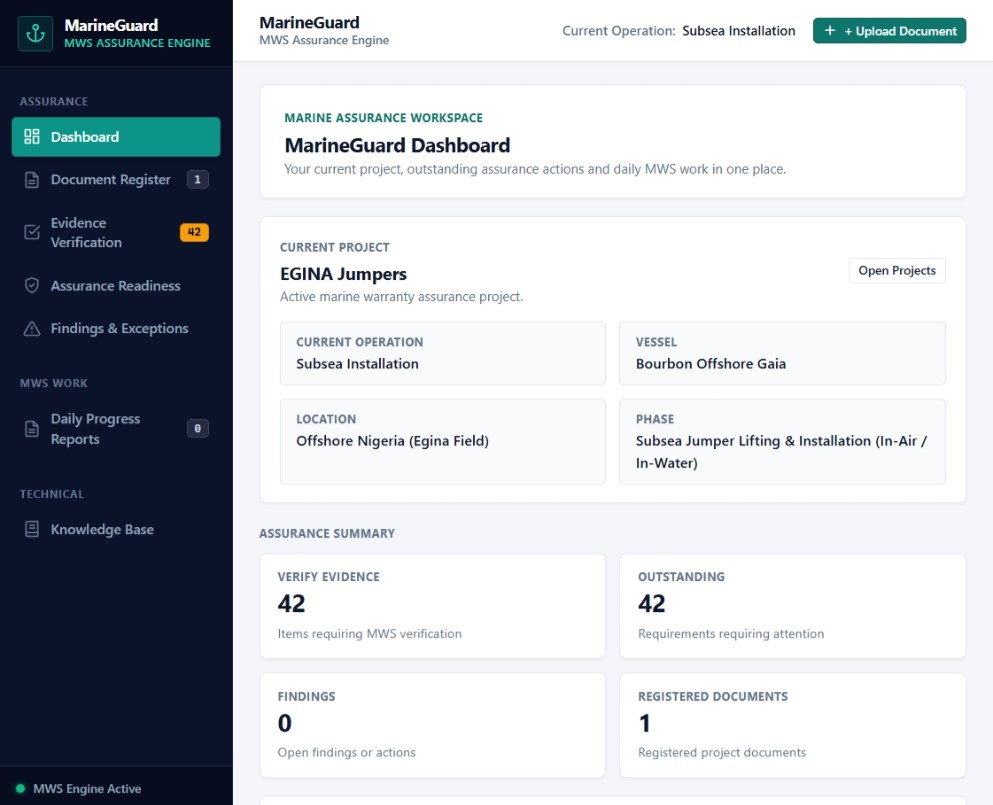
When an engineering document is uploaded, MarineGuard resolves the project and operation context, extracts engineering evidence, links that evidence to its source, maps it against assurance requirements, and presents the resulting readiness state for MWS review.
From a 37-page calculation to structured engineering evidence
For our demonstration, MarineGuard processes a 37-page Check of Lifting Arrangement - Calculation Note for an EGINA subsea jumper installation workflow.
MarineGuard in Action
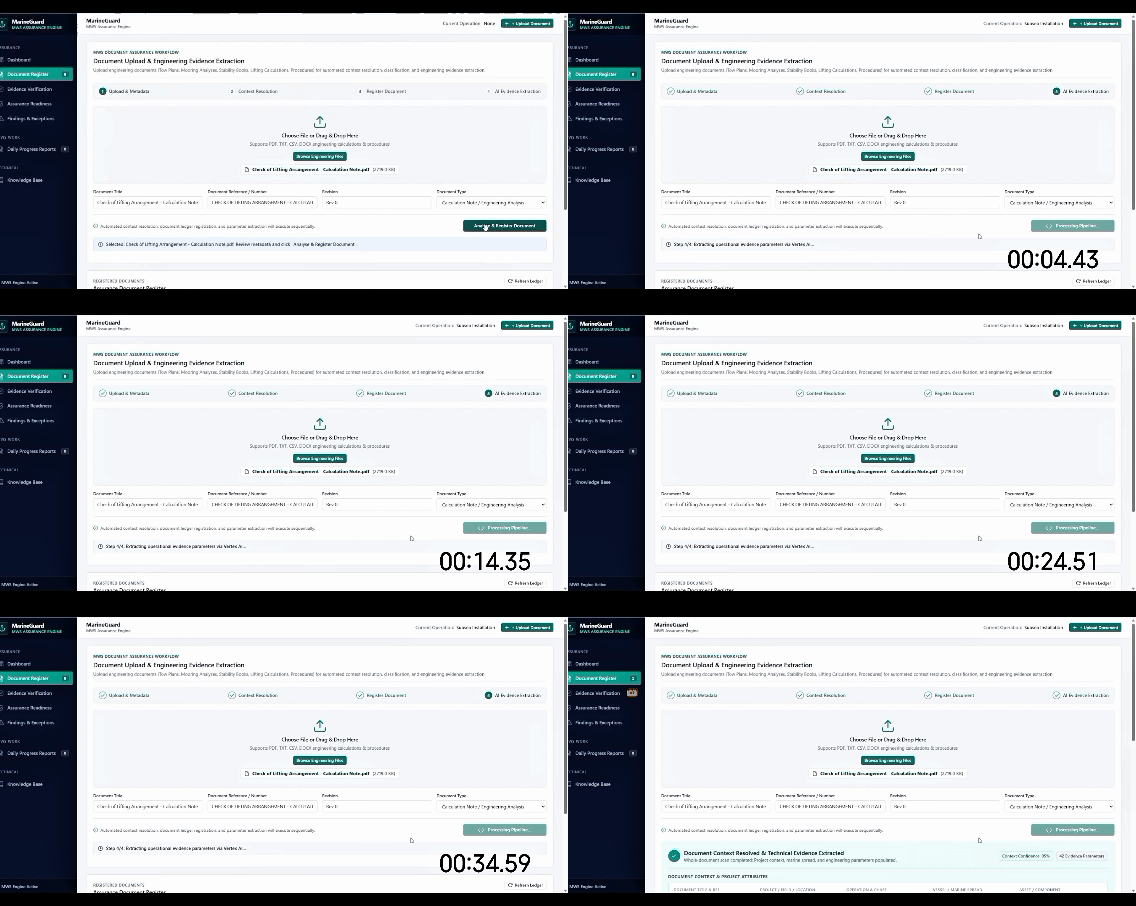
Within 45 seconds, MarineGuard extracted 42 engineering evidence parameters.
Examples include:
| Engineering Evidence | Extracted Value | Source / Traceability |
|---|---|---|
| Jumper weight in air | 22,860 kg | Check of Lifting Arrangement - Calculation Note, Section 4.3, Page 11 |
| Jumper weight in water | 15,935 kg | Check of Lifting Arrangement - Calculation Note, Section 4.3, Page 11 |
| Developed jumper length | 47.45 m | Check of Lifting Arrangement - Calculation Note, Section 4.1, Page 7 |
| Pipe dimensions | OD 168.3 mm / WT 18.3 mm | Check of Lifting Arrangement - Calculation Note, Section 4.1, Page 7 |
| Design pressure | 517 bar | REF 1: DU600105288 Rev A, PJPN1C EGINA jumper drawing |
For example:
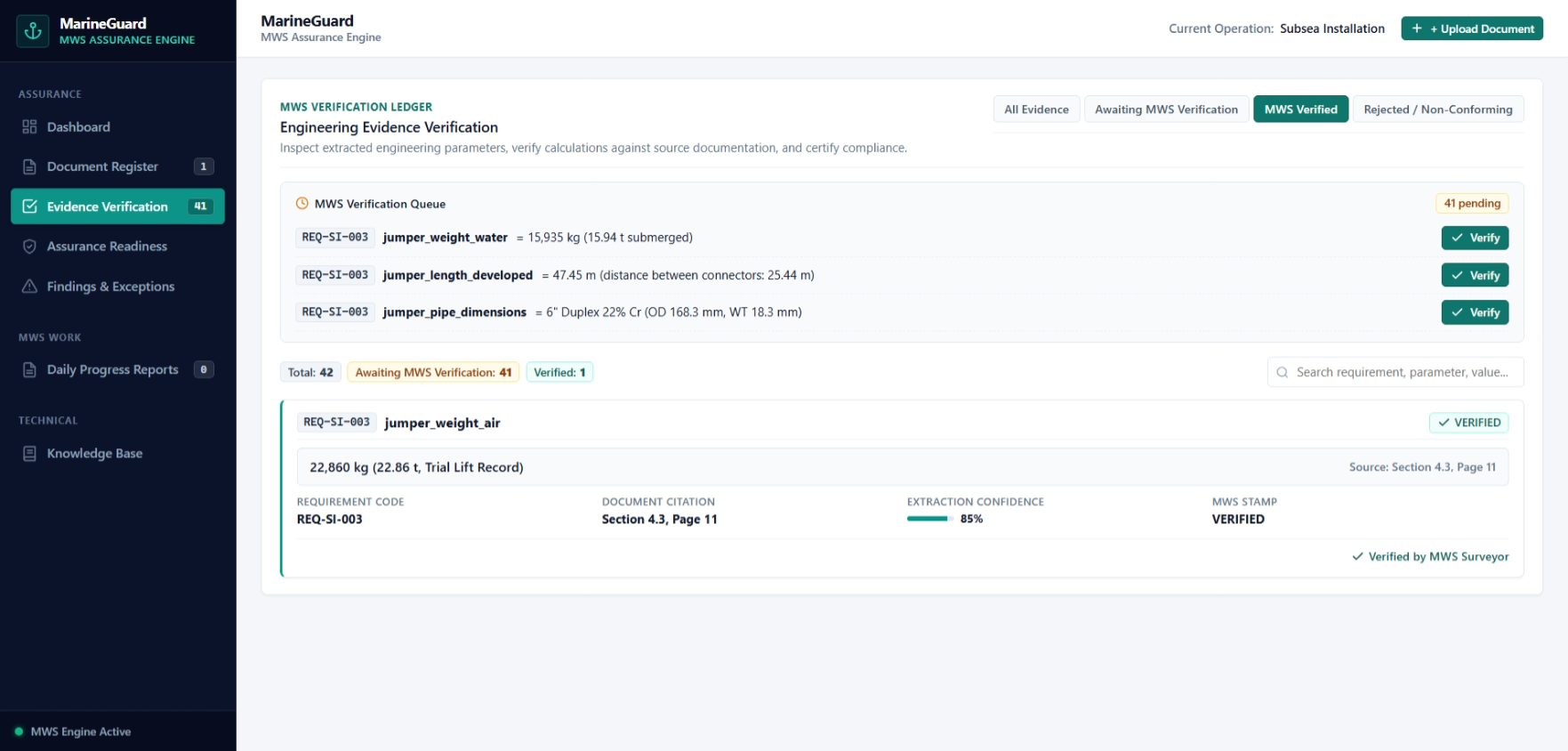
jumper_weight_air
22,860 kg
Source: Section 4.3, Page 11
Extraction confidence: 85%
MarineGuard does not simply return a number. It preserves the relationship between the extracted engineering parameter and its source.
From extraction to assurance action
MarineGuard does not stop at answering questions about an engineering document.
Once a document is uploaded, it:
- Resolves the operation context.
- Extracts structured engineering evidence.
- Preserves source-level traceability.
- Determines the applicable assurance requirements.
- Places evidence into the MWS verification workflow.
- Maps evidence to requirements.
- Surfaces outstanding evidence and assurance actions.
The result is a workflow that moves from document ingestion to structured assurance action, rather than simply generating a conversational response.
Human-in-the-loop verification
MarineGuard deliberately separates AI extraction from engineering verification.
The evidence workflow distinguishes between:
| Evidence Status | Count |
|---|---|
| Extracted | 42 |
| Awaiting MWS Verification | 40 |
| Verified | 2 |
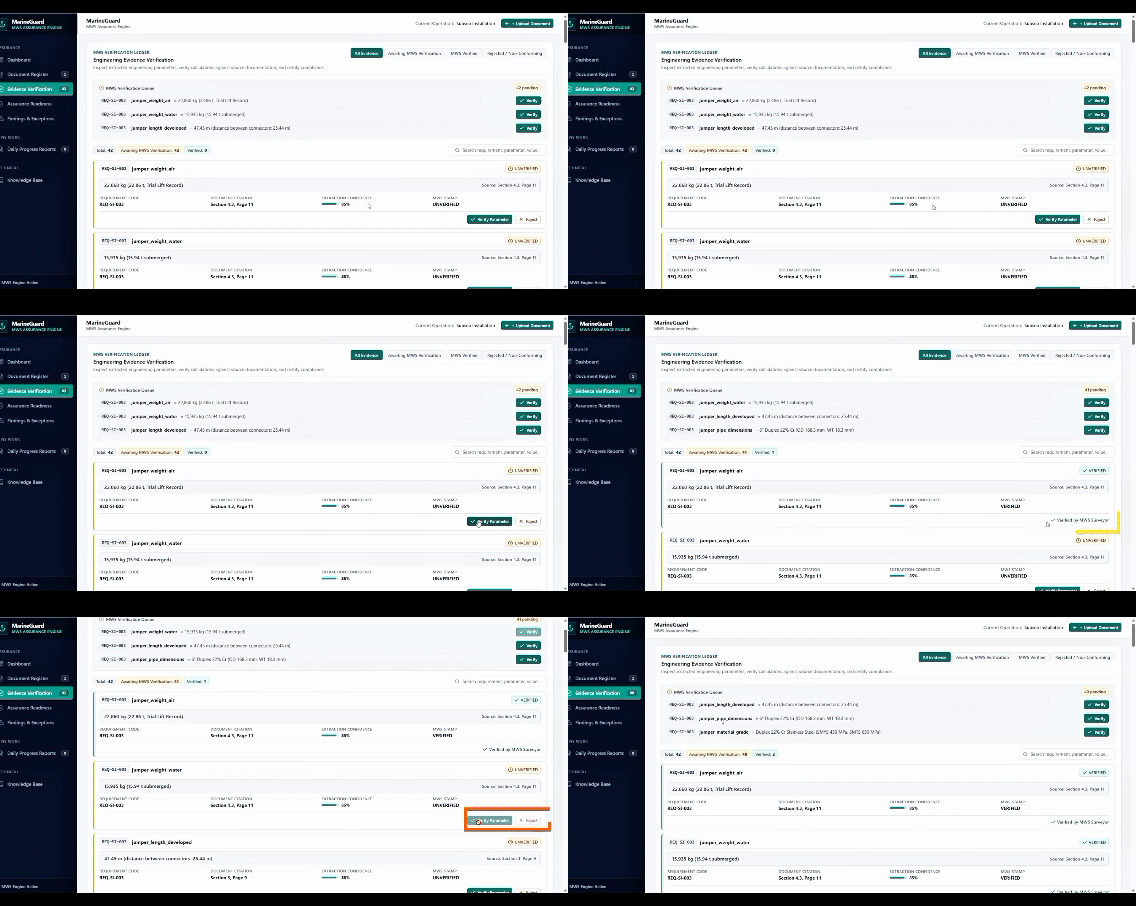
The MWS can inspect the extracted value and source before explicitly verifying the evidence.
AI assists the assurance workflow. The qualified MWS retains the professional assurance decision.
Requirement intelligence
MarineGuard maps extracted evidence against the requirements applicable to the selected operation.
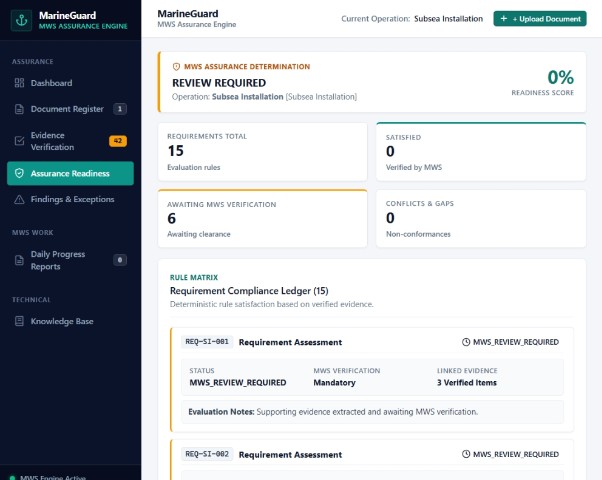
For the demonstrated Subsea Installation workflow, the system evaluates 15 assurance requirements.
The result is an assurance ledger rather than a simple document summary.
The MWS can see which requirements have supporting evidence, which require verification, and which still have no evidence.
Assurance readiness
MarineGuard turns the evidence and requirement status into a transparent readiness picture.
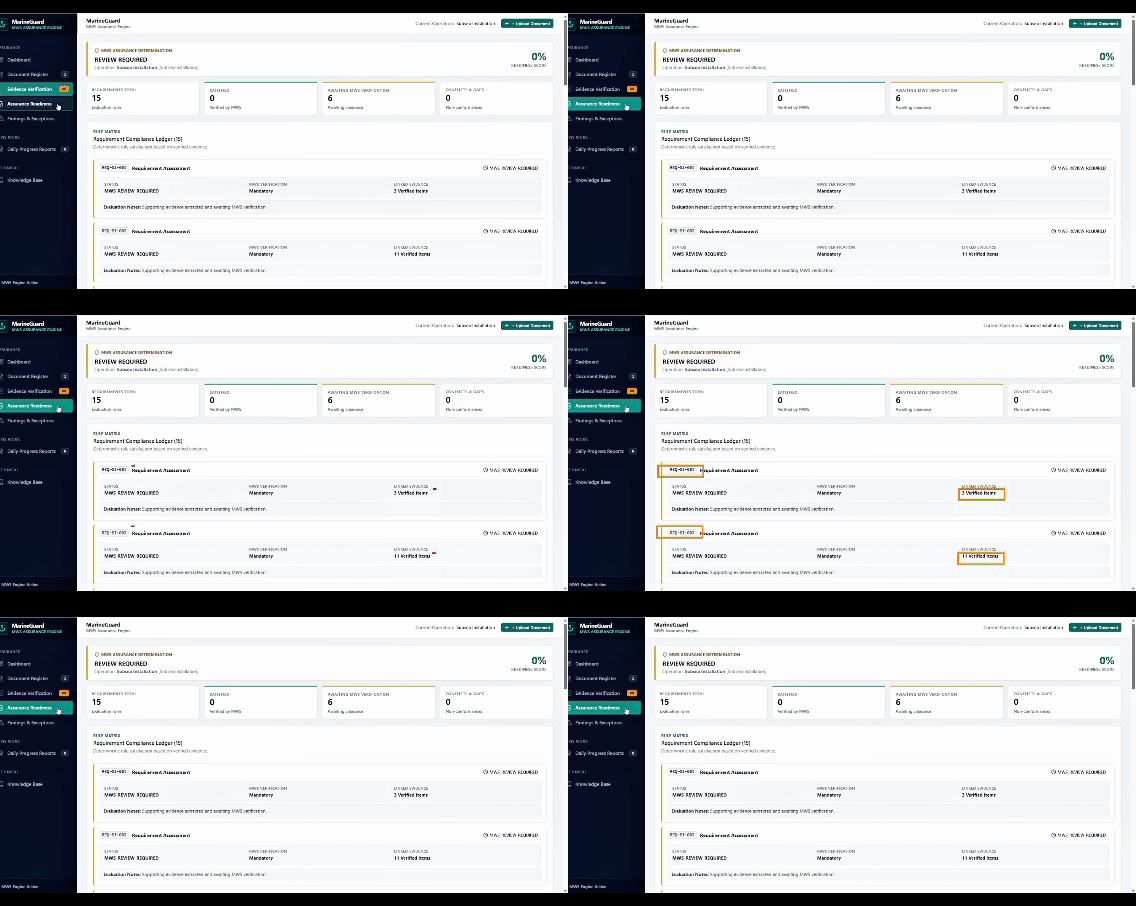
Instead of hiding uncertainty, the system surfaces:
- Evidence requiring MWS verification
- Requirements awaiting evidence
- Verified evidence
- Requirement compliance status
- Conflicts and gaps
- Outstanding assurance actions
The final assurance decision remains with the qualified MWS.
How we built it
MarineGuard was built as a modular application that separates the AI workflow from the underlying assurance logic.
The workflow connects document ingestion, project and operation context, AI evidence extraction, evidence traceability, MWS verification, requirement mapping, and assurance readiness.
MarineGuard Assurance Workflow
| Step | Assurance Stage | What MarineGuard Does |
|---|---|---|
| 01 | Engineering Document | Ingests engineering calculations, procedures, certificates, and operational documents. |
| 02 | Project / Operation Context | Identifies the relevant project, operation, vessel, location, phase, and document context. |
| 03 | Applicable Requirements | Determines the assurance requirements relevant to the selected operation. |
| 04 | AI Evidence Extraction | Extracts structured engineering parameters and technical evidence from the source documents. |
| 05 | Source Traceability | Links extracted evidence back to its document, section, page, and source citation. |
| 06 | MWS Verification | Places extracted evidence in the MWS verification queue for human review and certification. |
| 07 | Requirement Mapping | Maps verified and pending evidence against the applicable assurance requirements. |
| 08 | Assurance Readiness | Presents the overall readiness state, outstanding evidence, conflicts, gaps, and MWS actions. |
Technology Stack
| Layer | Technology |
|---|---|
| AI Model | Gemini 3.5 Flash |
| AI Platform | Vertex AI |
| Agent Framework | Google Agent Development Kit (ADK) |
| Backend | Python / FastAPI |
| Frontend | JavaScript / HTML / CSS |
| Persistent Storage | Firestore / Application Evidence Store |
| Deployment | Google Cloud Run |
MarineGuard maintains project and operation context so evidence can be scoped to the correct operational workflow.
The application uses environment-based configuration for Google Cloud and Vertex AI settings rather than embedding credentials directly in the application.
Google Cloud deployment
MarineGuard is deployed on Google Cloud Run.
| Deployment | Value |
|---|---|
| Service | marineguard |
| Revision | marineguard-00018-p9r |
| Region | us-central1 |
| Traffic | 100% |
The AI workflow uses Gemini through Vertex AI, with the Google Agent Development Kit supporting the agentic workflow.
Challenges we ran into
One of our biggest challenges was maintaining context throughout the entire assurance workflow.
An engineering value by itself is not enough.
MarineGuard needs to maintain the relationship between every stage of the assurance process.
An engineering value is only useful when MarineGuard can connect it to:
- the source document
- the relevant project and operation
- the applicable requirement
- its verification status
- the resulting assurance state
This relationship is critical because the same engineering value can have very different implications depending on the operation, requirement, source document, and verification status.
Another challenge was ensuring that AI-generated extraction was never treated as automatic engineering approval.
We addressed this through explicit evidence states and a human-in-the-loop verification workflow.
We also needed to ensure that evidence was associated with the correct operation and evaluated against the appropriate operation-specific requirements.
AI output vs engineering assurance
A conventional AI system might return:
"The jumper weighs 22,860 kg."
MarineGuard needs to answer a much larger question:
What is the value, where did it come from, what requirement does it support, has it been verified, and what does it mean for the assurance state?
That distinction shaped much of the system architecture.
Another challenge was balancing automation with transparency. In engineering assurance, the system must be useful without hiding uncertainty or presenting AI output as professional engineering approval.
Accomplishments that we're proud of
We are proud that MarineGuard evolved from the idea of document analysis into an operation-aware assurance workflow.
Key results
| Result | Demonstration |
|---|---|
| Engineering document | 37-page lifting calculation |
| Evidence extracted | 42 parameters |
| Extraction time | 45 seconds |
| Assurance requirements | 15 |
| Automated tests | 143 passed |
| Cloud deployment | Google Cloud Run |
| AI platform | Vertex AI |
| AI model | Gemini 3.5 Flash |
| Agent framework | Google ADK |
We are particularly proud of the evidence traceability.
For example, the extracted value:
22,860 kg
can be traced directly to:
Check of Lifting Arrangement - Calculation Note → Section 4.3 → Page 11
The evidence is therefore not presented as an unexplained AI-generated value. MarineGuard preserves its connection to the original engineering document and its location within the source.
We are also proud that MarineGuard makes uncertainty visible rather than hiding it.
The system maintains an explicit evidence lifecycle:
Extracted → Awaiting MWS Verification → MWS Verified → Requirement Status → Assurance Readiness
In our demonstration, MarineGuard extracted 42 engineering evidence parameters, with 40 awaiting MWS verification and 2 already verified.
This creates a transparent assurance workflow where AI-generated evidence can be reviewed against its source before contributing to the overall assurance assessment.
AI assists the workflow. The MWS remains the professional decision authority.
Our latest full test run completed with:
143 tests passed
The deployed application was also validated through the live Google Cloud Run environment with a successful health check returning HTTP 200.
What we learned
The biggest lesson was that applying AI to engineering is not simply about extracting information.
The real challenge is maintaining:
- Context
- Traceability
- Verification status
- Requirement relationships
- Decision boundaries
A value such as 22,860 kg has limited meaning by itself.
Its value within an assurance workflow comes from knowing:
Which document?
Which operation?
Which requirement?
Where in the source?
Has it been verified?
What remains outstanding?
This led to one of the central principles behind MarineGuard:
AI should accelerate engineering assurance without hiding uncertainty or replacing professional judgement.
We also learned that agentic systems are most useful when they take meaningful actions across a workflow rather than simply generating a conversational response.
The most important distinction for MarineGuard is:
AI assists the assurance workflow.
The qualified MWS retains the professional assurance decision.
What's next for MarineGuard
The current system demonstrates the core assurance workflow using engineering documents.
The next stage is to expand MarineGuard into a broader continuous assurance platform.
Multi-document assurance
Process complete engineering and operational document packages rather than individual documents.
Cross-document evidence comparison
Compare evidence across calculations, procedures, drawings, certificates, and other project records.
Revision intelligence
Identify how document revisions affect previously extracted evidence and assurance requirements.
Evidence conflict detection
Automatically surface conflicting values or statements across documents.
Automated MWS reporting
Generate structured evidence registers and draft assurance reports from verified evidence.
Continuous assurance
Maintain the assurance state as new documents and revisions are uploaded throughout an offshore campaign.
Our long-term goal is to give Marine Warranty Surveyors an intelligent assurance assistant that reduces repetitive document work while preserving the traceability, transparency, and professional judgement required for offshore engineering assurance.
The principle behind MarineGuard
MarineGuard is not designed to replace the MWS.
It is designed to make the MWS's work more efficient, structured, and traceable.
MarineGuard turns engineering documents into traceable assurance evidence, while keeping the final engineering decision where it belongs: with the MWS.
Built With
- agents
- fastapi
- firestore
- gemini
- javascript
- python
- vertex


Log in or sign up for Devpost to join the conversation.